






Question 9→ 2025 IAS Prelims GS I : Genius Classroom Explanation
📘 IAS Prelims 2025 — GS-I Q.9 | Classroom Explanation
📌 Question
Q.9) Consider the following statements:
Statement I: Circular economy reduces the emissions of greenhouse gases.
Statement II: Circular economy reduces the use of raw materials as inputs.
Statement III: Circular economy reduces wastage in the production process.
Which one of the following is correct in respect of the above statements?
(a) Both Statement II and Statement III are correct and both of them explain Statement I
(b) Both Statement II and Statement III are correct but only one of them explains Statement I
(c) Only one of the Statements II and III is correct and that explains Statement I
(d) Neither Statement II nor Statement III is correct
✅ Correct Answer: (a)
🧑🏫 Classroom Explanation
This question tests systems thinking in environmental policy and links process efficiency with climate outcomes.
🔍 Understanding the Circular Economy
• A circular economy emphasizes:
- Reduce
- Reuse
- Repair
- Recycle
instead of the traditional linear “take–make–dispose” model.
• Its central goal is to retain materials and value within the economy for as long as possible.
🔍 Statement-wise Analysis
✅ Statement II: Correct
• Circular economy reduces dependence on virgin/raw materials by:
- Recycling materials
- Reusing components
- Extending product life cycles
• Reduced extraction and processing of raw materials means:
- Lower energy consumption
- Fewer emissions from mining, refining, and transport
➡️ Hence, Statement II is correct.
✅ Statement III: Correct
• Circular models are designed to eliminate waste at the design stage itself.
• This leads to:
- Higher production efficiency
- Reduced industrial waste
- Lower emissions from waste treatment (landfills, incineration)
➡️ Hence, Statement III is correct.
✅ Statement I: Correct (Explained by II & III)
• Greenhouse gas emissions are reduced because:
- Raw material extraction is energy-intensive
- Waste processing emits methane and CO₂
- Circular processes cut both these emission sources
• Therefore:
- Reduced raw material use (Statement II)
- Reduced wastage (Statement III)
together explain why circular economy lowers GHG emissions.
➡️ Hence, Statement I is correctly explained.
🧮 Logical Flow (UPSC Lens)
• Statement I is the outcome
• Statements II & III are the mechanisms
• When mechanisms fully explain the outcome → choose option (a)
🎯 Final Evaluation
✔️ Statement II: Correct
✔️ Statement III: Correct
✔️ Both explain Statement I
➡️ Correct answer: (a)
🔗 Bridge Points (Future Questions)
• Circular economy is frequently linked with:
- Net Zero strategies
- Climate mitigation policies
- Sustainable Development Goals (SDG 12, SDG 13)
• Expect questions on:
- Life-cycle assessment
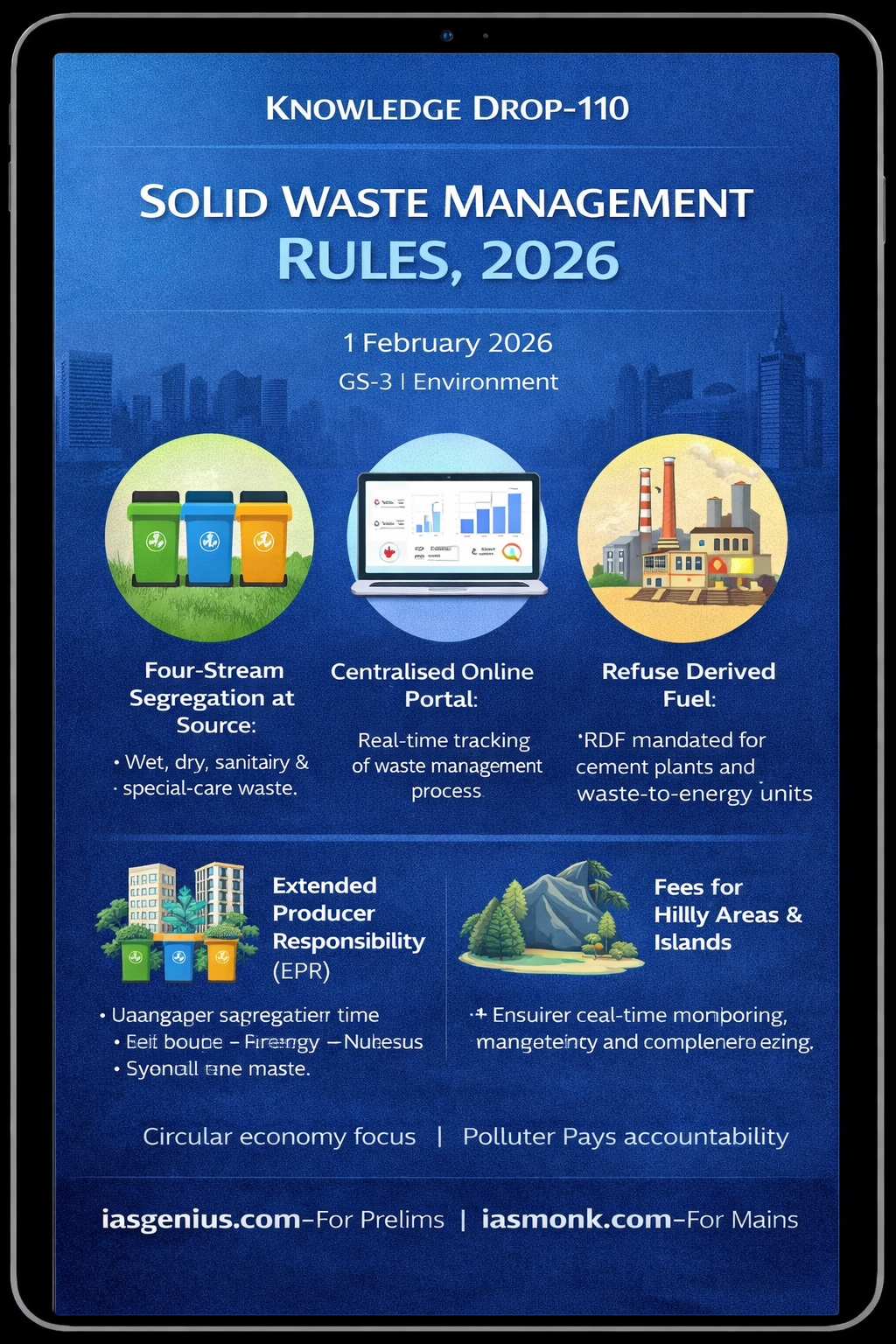
- Extended Producer Responsibility (EPR)
- Circular economy vs green economy
📍 GS Mapping
- GS Paper III
- Subject: Environment & Ecology
- Theme: Climate mitigation, sustainable production
- Nature: Conceptual + policy-oriented