
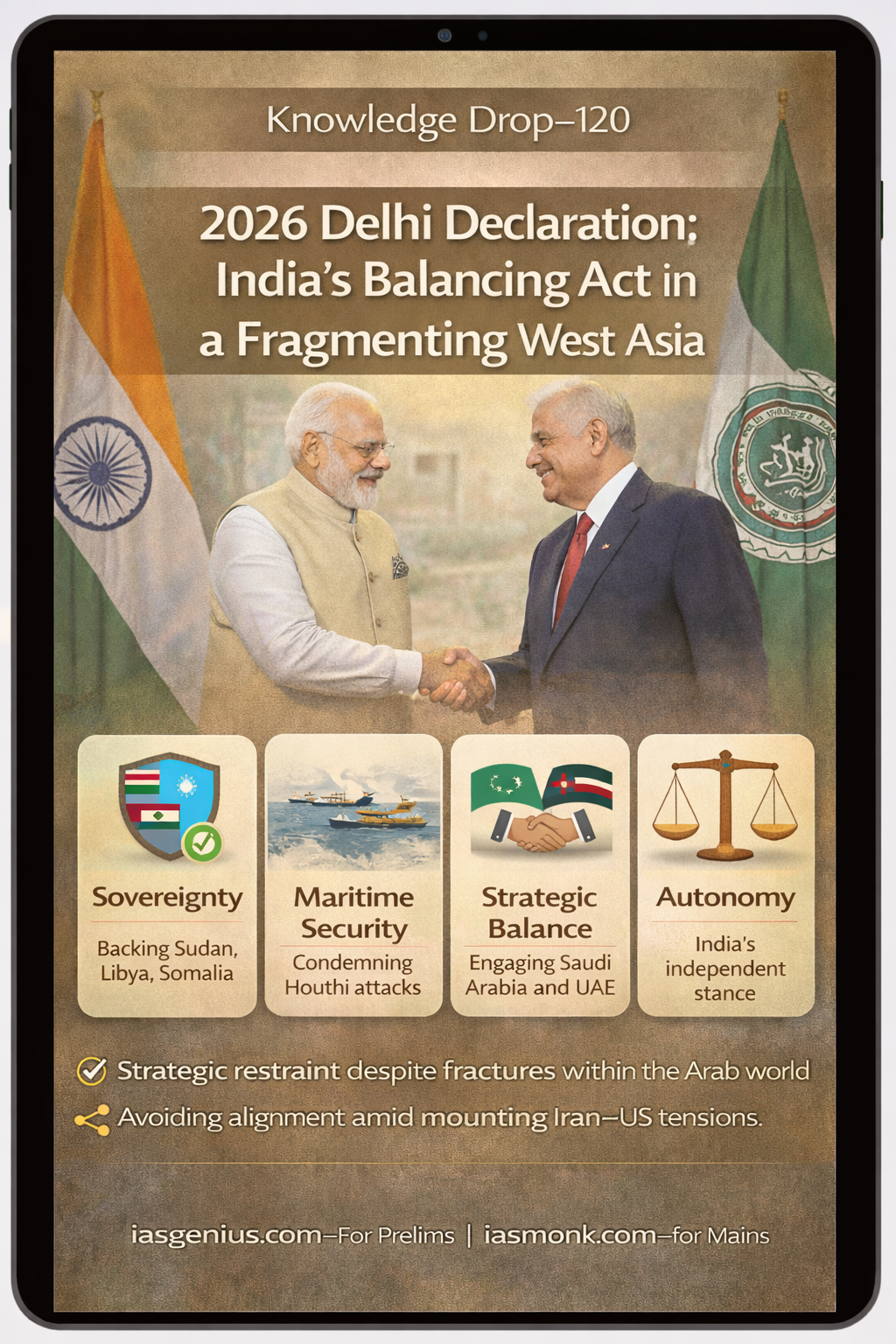
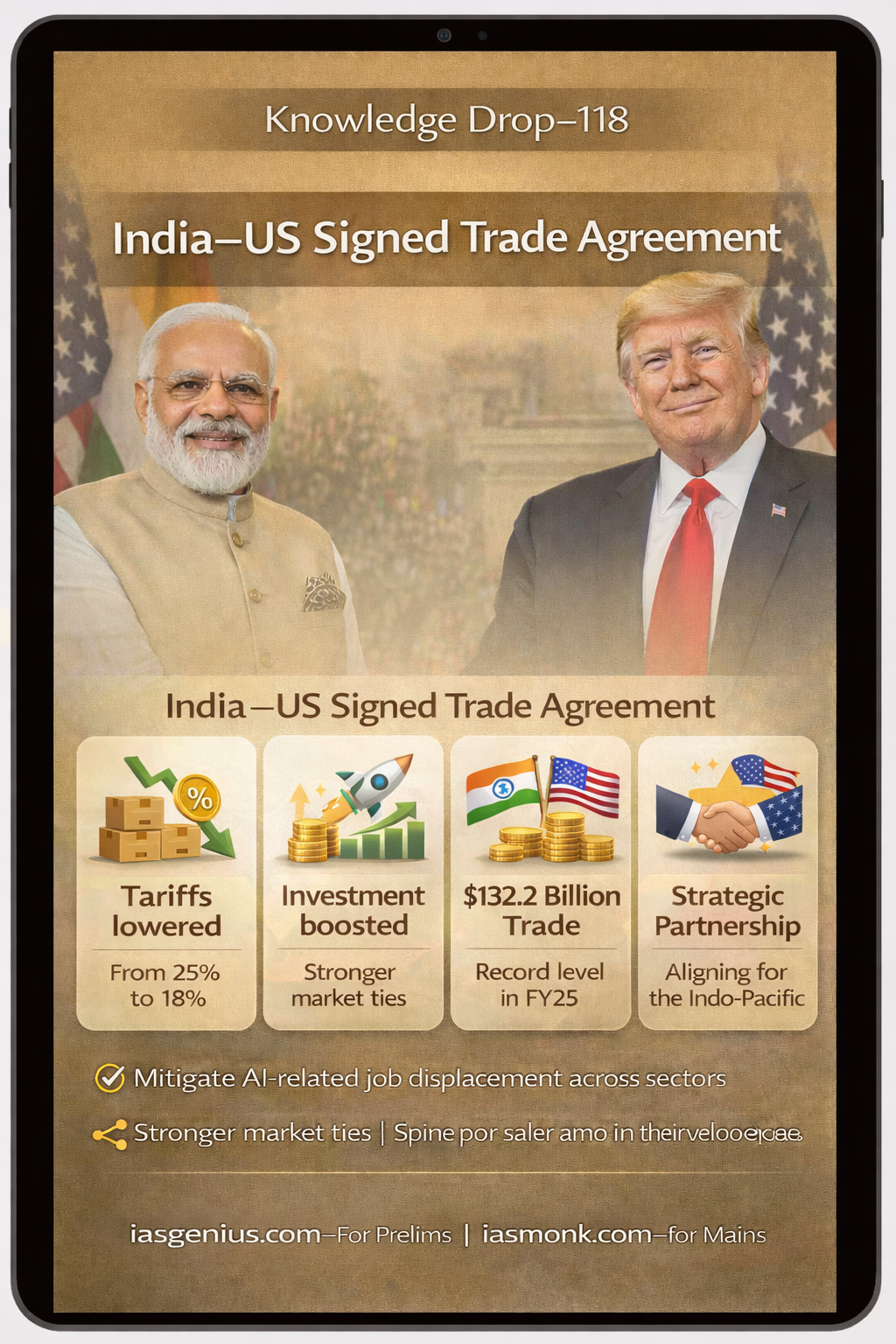
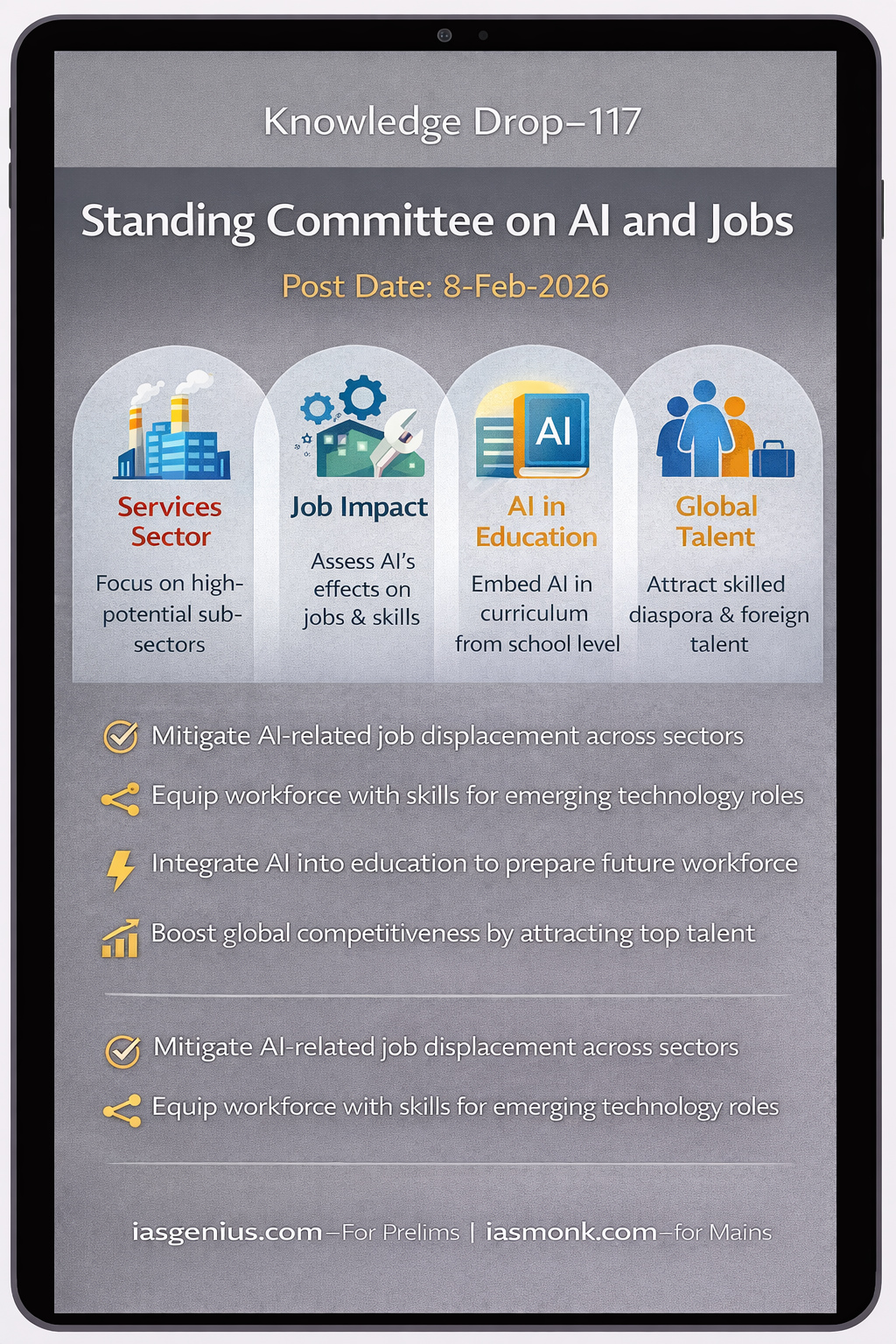

🧠 Knowledge Drop-121 | BRICS 2026: New Delhi Summit Takeaways | Wisdom Drop-121: Mains Essay
Post Date: September 15, 2026
Why in News?
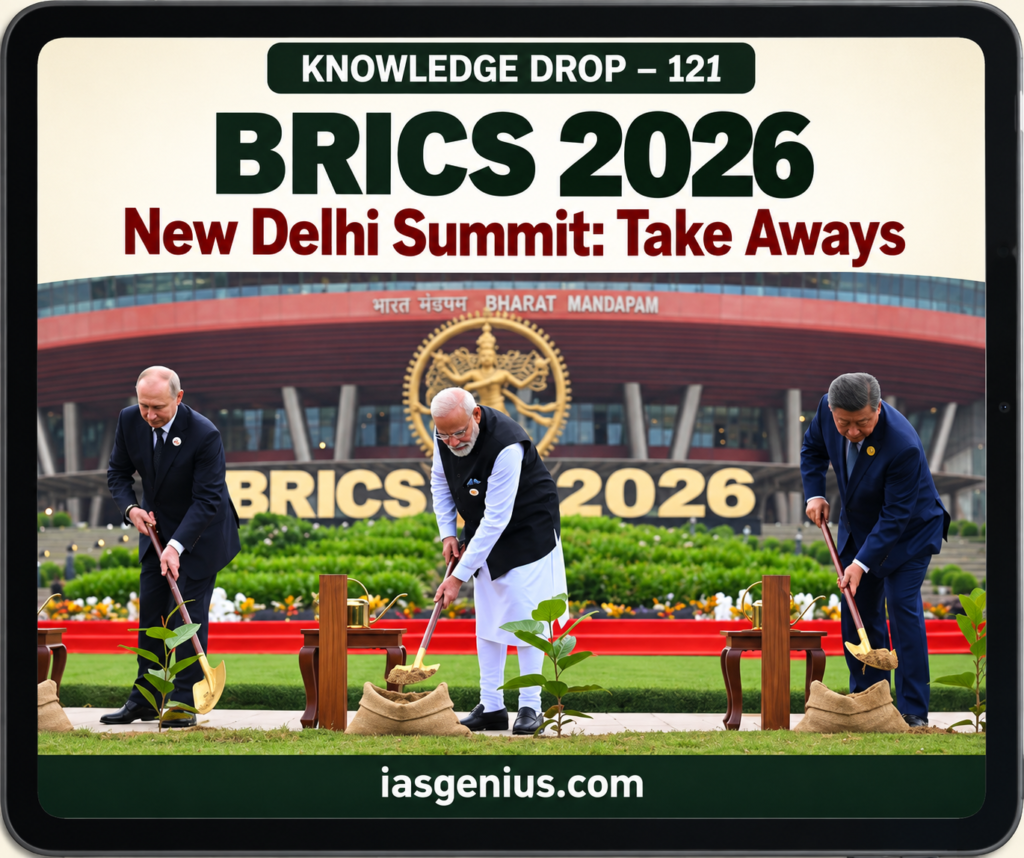
The 18th BRICS Summit, hosted by India in New Delhi on September 12–13, 2026, adopted the 140-point New Delhi Declaration. With 11 members, BRICS today has greater geopolitical and economic weight, but also a much harder consensus problem.
The 6 UPSC Takeaways
1. Terrorism: Pahalgam explicitly condemned
The Declaration condemned in the strongest terms the April 22, 2025 Pahalgam terrorist attack, in which 26 people were killed. It also stressed zero tolerance for terrorism, including terrorist financing, safe havens and cross-border movement of terrorists.
UPSC Lens → BRICS decisions are consensus-based. Therefore, explicit language acceptable to all members carries diplomatic significance.
2. Trade: Against unilateral protectionism
BRICS opposed unilateral coercive and protectionist trade measures inconsistent with international law/WTO principles. It also criticised discriminatory or protectionist carbon-border measures.
But note the trap:
Opposition to unilateral tariffs ≠ creation of a BRICS retaliatory tariff mechanism.
3. West Asia: Consensus through calibrated language
With Iran and the UAE now inside BRICS, reaching common language on West Asia was difficult. The Declaration called for restraint, diplomacy, protection of civilians and humanitarian access, while avoiding direct attribution of blame in contentious areas.
This reveals the operating logic of an enlarged BRICS:
More members → greater global weight → greater diversity → harder consensus → carefully negotiated language.
4. Payments: Local currencies, NOT a BRICS currency ⭐
This is the most examination-worthy distinction.
BRICS is exploring:
local-currency settlement + payment-system interoperability + faster/cheaper cross-border payments + greater local-currency financing by the New Development Bank.
It does NOT yet have:
a common BRICS currency, a single settlement architecture, or an operational bloc-wide BRICS Pay system.
That gives us a beautiful elimination trap:
De-dollarisation efforts ≠ common currency.
5. AI & Digital Public Infrastructure
BRICS backed wider, inclusive and trustworthy access to Artificial Intelligence, particularly from a Global South perspective. India also pushed cooperation through a proposed BRICS Digital Public Infrastructure repository, pilot DPI projects and other technology initiatives.
6. India’s institutional innovation: Continuity Mechanism
India proposed a BRICS Continuity and Implementation Mechanism, using the troika of outgoing, current and incoming chairs to follow up summit commitments.
Why? BRICS has a recurring institutional weakness:
Presidency changes → priorities change → initiatives lose momentum.
China assumes the chair in 2027, so that handover becomes the first real test of continuity.
2021 → 2026: BRICS Changed
In 2021, India chaired a five-member BRICS amid Covid and the India-China border crisis. In 2026, India chaired an expanded grouping of 11 members plus partner countries, with greater emphasis on trade, technology, fintech, AI, development finance and institutional reform.
India’s trade with BRICS members also rose from roughly $203 billion in 2020–21 to $417 billion in 2025–26.
🧠 IAS Genius ETP (Prelims Elimination Tricks Principles) Hook
Watch for statements such as:
“BRICS has launched a common currency.” → FALSE
“BRICS has established a fully operational common cross-border payment platform.” → FALSE
“BRICS is exploring greater use of national currencies and payment interoperability.” → TRUE
The conceptual chain is:
National currencies → interoperability → settlement efficiency → deeper financial cooperation
not
National currencies → BRICS common currency.
♟️ KD–121 Bottom Line
BRICS 2026 showed that expansion has strengthened BRICS’ weight, but complicated its unity.
Its achievement was therefore not revolutionary integration. It was something subtler:
11 diverse states finding enough common ground to keep cooperation moving.
🪶Wisdom Drop-121 |High-Quality Mains Essay for Practice:
Word Limit 1000-1200
BRICS and the Emerging Multipolar World: Can Diversity Become Strength?
“The test of a new world order is not whether nations cease to differ, but whether they learn to cooperate without first becoming alike.”
The 18th BRICS Summit in New Delhi in September 2026 offered an intriguing portrait of the changing international order. Eleven countries, representing different continents, political systems, economic structures and strategic interests, sat around the same table. Some are major powers; others are emerging economies. Some are energy exporters; others are enormous energy consumers. Some enjoy close relations with the West; others face Western sanctions. Some cooperate closely with one another even while simultaneously carrying unresolved bilateral tensions.
Yet they produced a common declaration.
That fact captures both the promise and the paradox of BRICS. Its diversity is the source of its growing global relevance, but the same diversity can become the greatest obstacle to collective action. The larger question raised by BRICS, therefore, extends far beyond the organisation itself: Can an emerging multipolar world convert plurality into cooperation without demanding uniformity?
From a Unipolar Moment to a Multipolar Search
The international system after the Cold War was characterised for a time by overwhelming Western, particularly American, predominance. Institutions created largely in the aftermath of the Second World War continued to shape global finance, security and rule-making even as the distribution of economic power gradually changed.
The twenty-first century has disturbed this architecture.
China emerged as an economic giant. India became one of the world’s major economies and a significant political voice of the Global South. Countries such as Brazil, Indonesia, South Africa and the Gulf states acquired greater economic and diplomatic influence. Meanwhile, repeated financial crises, wars, pandemics, climate emergencies and disruptions of global supply chains exposed weaknesses in existing institutions.
BRICS emerged within this transition. What began with Brazil, Russia, India, China and South Africa has expanded into a much broader grouping. Expansion gives BRICS greater demographic, economic and geopolitical weight. But arithmetic alone does not create influence. A large orchestra can still produce noise unless its instruments discover some harmony.
That is the central challenge before BRICS.
Diversity: Weakness or New Diplomatic Technology?
Traditional alliances are often built around similarity: common security threats, ideological affinity or closely aligned strategic interests. BRICS is different. It is neither a military alliance nor an ideological bloc.
Its members disagree on several important questions. Their relations with the United States and Europe vary enormously. Their approaches to regional conflicts differ. Their economic interests sometimes compete. India and China themselves combine extensive economic engagement with a difficult boundary relationship and strategic rivalry.
Seen through the conventional lens of alliance politics, such diversity appears to be a weakness.
But BRICS may be experimenting with another form of multilateralism: cooperation without complete convergence.
The New Delhi Summit illustrated this. Despite disagreements over ongoing conflicts, members found language sufficiently broad to preserve consensus. The declaration condemned terrorism, addressed instability in West Asia, supported reforms in global institutions and advanced cooperation in trade, finance, technology and development.
Consensus here does not mean identical perceptions. It means discovering the minimum sufficient agreement necessary for collective movement.
In an increasingly fragmented world, that itself may be a valuable diplomatic skill.
The Global South and the Question of Representation
The deeper legitimacy of BRICS comes from a genuine imbalance in global governance.
Institutions such as the United Nations Security Council, International Monetary Fund and World Bank emerged from an earlier distribution of global power. Developing countries have repeatedly argued that their representation and voting influence have not kept pace with their growing economic and demographic importance.
BRICS consequently derives much of its political energy not from opposition to a particular civilisation but from dissatisfaction with unequal representation.
Its strongest case is therefore reform, not replacement.
A constructive BRICS should not seek to substitute one hierarchy for another. Replacing Western dominance with domination by another major power would hardly democratise global governance. Its credibility will depend on whether it can advocate institutions in which smaller and developing states obtain greater voice, rules become more representative, and development receives adequate attention.
Multipolarity acquires moral meaning only when it produces plurality of voice rather than plurality of domination.
Currency Debate: Pragmatism Before Grandiosity
Nowhere is the difference between rhetoric and reality clearer than in discussions about a supposed “BRICS currency”.
The dramatic idea attracts headlines. The practical agenda is considerably more modest and arguably more useful.
BRICS members are exploring greater settlement of trade in national currencies, interoperability among payment systems, cheaper cross-border transactions and greater local-currency financing. These initiatives respond to genuine concerns: transaction costs, exposure to external financial shocks, sanctions risks and excessive dependence on a limited number of international payment channels.
But diversification is not equivalent to creating a common currency.
A common currency requires extraordinary levels of macroeconomic coordination, institutional trust and monetary integration. BRICS countries possess different exchange-rate systems, capital controls, financial regulations, inflation dynamics and geopolitical priorities.
The wiser approach is therefore incremental:
interoperability before monetary union; practical cooperation before symbolic grandeur.
This principle applies to BRICS more generally. Its future will be determined less by spectacular announcements than by whether businesses can trade more easily, development projects obtain financing, digital systems communicate securely, and ordinary economic actors experience lower transaction costs.
India and the Politics of Bridges
India occupies an especially interesting position within this evolving architecture.
It participates in BRICS while maintaining deep partnerships with Western economies. It is a member of the Quad while championing the concerns of the Global South. It seeks closer economic engagement with several powers without surrendering strategic autonomy to any one camp.
Such apparently intersecting relationships are not necessarily contradictions. They reflect India’s preference for multi-alignment in a multipolar world.
India therefore has an interest in ensuring that BRICS does not evolve into an explicitly anti-Western bloc. Such a transformation would narrow India’s diplomatic space and diminish BRICS’ wider legitimacy.
India’s more productive role is that of a bridge: between developed and developing countries, between established and emerging institutions, and between geopolitical competition and developmental cooperation.
The proposed BRICS Continuity and Implementation Mechanism reflects another important Indian contribution. Multilateral diplomacy frequently suffers from an “announcement disease”: ambitious declarations flourish at summits but wither between presidencies. Using the outgoing, current and incoming chairs to track commitments attempts to convert diplomatic promises into institutional memory.
The future of BRICS will depend precisely on this transition from declaration to delivery.
The China Question and Internal Asymmetry
Yet the greatest structural challenge cannot be wished away.
BRICS members are unequal in economic weight, and China occupies a particularly dominant position in intra-group trade. Several members have substantial trade deficits with it. Political disagreements and strategic mistrust also persist among members.
If BRICS is perceived merely as a vehicle for the geopolitical preferences of its strongest member, smaller participants will eventually hedge against it.
A genuinely multipolar organisation must therefore practise internally what it demands externally.
That means consultation, institutional restraint, respect for sovereignty and meaningful space for smaller members. A movement demanding democratisation of world order cannot sustainably operate through hierarchy within itself.
From Multipolarity to Multilateralism
Multipolarity by itself is neither peaceful nor just. Europe before the First World War was multipolar. Competing centres of power can generate balance, but they can also generate insecurity, arms races and conflict.
The real objective should therefore not merely be a multipolar world, but a multipolar and multilateral world.
The distinction is crucial.
Multipolarity describes the distribution of power. Multilateralism describes the method by which that power is exercised.
BRICS will matter historically only if it helps connect the two.
Its agenda on development finance, artificial intelligence, digital public infrastructure, health, trade facilitation and payment connectivity offers precisely such an opportunity. These are areas where cooperation can generate tangible public goods without requiring members to agree on every geopolitical question.
Conclusion: The Strength to Disagree and Still Cooperate
The New Delhi Summit did not create a common currency, erase geopolitical rivalries or transform BRICS into a unified bloc. Judged against such extravagant expectations, it may appear limited.
But perhaps those are the wrong expectations.
The significance of BRICS lies precisely in attempting something more difficult: constructing cooperation among countries that do not share identical worldviews.
The emerging international order will contain many centres of power, multiple civilisations, competing interests and overlapping partnerships. No durable institution can demand complete agreement before cooperation begins.
BRICS therefore faces a profound test. It can become merely another arena where great powers compete for influence, or it can demonstrate that diversity itself can be institutionally managed.
Its future will depend not on how loudly it challenges the old order, but on how effectively it helps build a better one.
The maturity of multipolarity will ultimately be measured not by the number of poles the world possesses, but by the bridges it can build between them.
≈ 1,250 words | Wisdom Drop–121 | IASGenius.com
🪶 IAS Monk Whisper
“Power creates poles. Wisdom builds bridges.
The future belongs not to the nation that stands tallest alone,
but to those that learn to stand together without becoming alike.”
— IAS Monk