

🧠 KD-91 | National Youth Day 2026: Swami Vivekananda’s Vision and India’s Youth Empowerment Framework| IAS Prelims 2026-27 Highly Expected MCQs
Post Date: 13 January 2026
Syllabus: Miscellaneous / Social Issues / Governance
🧠 KD-91 | National Youth Day 2026: Swami Vivekananda’s Vision and India’s Youth Empowerment Framework| IAS Prelims 2026-27 Highly Expected MCQs
📌 In News
Recently, National Youth Day was observed to mark the birth anniversary of Swami Vivekananda.
📘 National Youth Day (Rashtriya Yuva Divas)
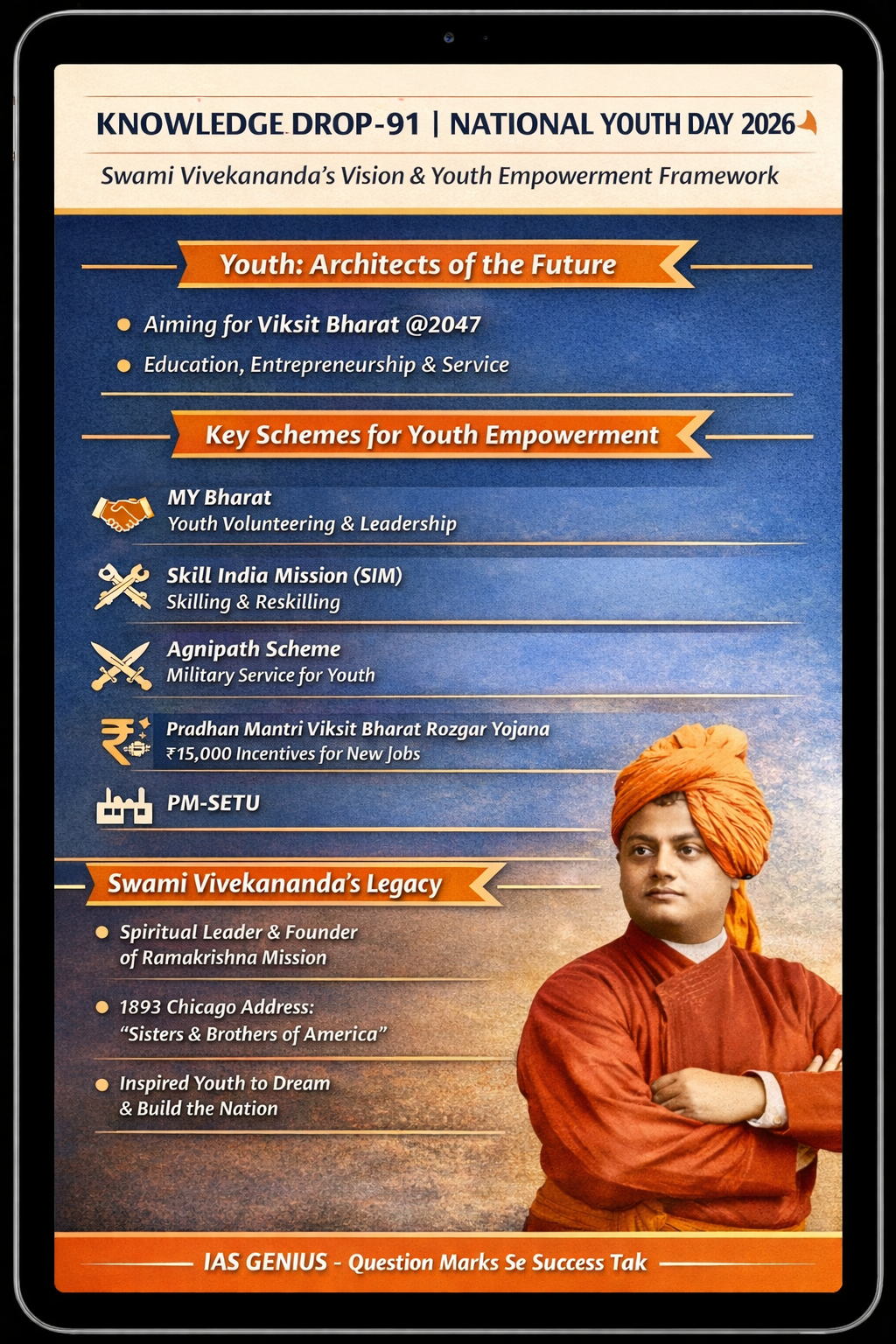
National Youth Day is celebrated on 12 January every year in commemoration of the great spiritual leader, philosopher, and thinker Swami Vivekananda, whose unwavering belief in the potential of youth continues to inspire generations.
His life and message urge the youth to nurture their dreams, unleash their energies, and shape a future worthy of his ideals.
In India, youth, defined as those in the 15–29 years age group, constitute nearly 40% of the population, making them a decisive force in nation-building.
🌱 Importance
National Youth Day highlights the aspirations and responsibilities of India’s youth, who form over 65% of the population under 35 years and are central to achieving the vision of Viksit Bharat @2047.
The government has developed a comprehensive youth empowerment framework covering:
- Civic engagement
- Skill development
- Entrepreneurship
- Health and fitness
- National service
This framework is led by the Ministry of Youth Affairs and Sports, in collaboration with other ministries, with the aim of involving youth as active partners in nation-building.
🏗️ Related Government Initiatives
- Mera Yuva Bharat (MY Bharat):
An autonomous, technology-driven platform under the Ministry of Youth Affairs and Sports connecting youth with volunteering, skill development, leadership, and experiential learning opportunities. - National Service Scheme (NSS):
Aims to instil social consciousness among students and promote personality development through community service. - Agnipath Scheme:
Launched in 2022 to recruit youth aged 17.5–21 years as Agniveers for a four-year tenure in the armed forces. - PM-SETU (Pradhan Mantri Skilling and Employability Transformation through Upgraded ITIs):
Launched in October 2025 to modernise ITIs and align vocational training with global industry standards. - Skill India Mission (SIM):
Launched in 2015 to provide training for skilling, re-skilling, and up-skilling through a nationwide network of institutions. - Pradhan Mantri Kaushal Vikas Yojana (PMKVY):
Provides short-term skill training, including Recognition of Prior Learning (RPL), to youth across India. - Jan Shikshan Sansthan (JSS) Scheme:
Originally launched as Shramik Vidyapeeth (1967) to provide non-formal skill training. - National Apprenticeship Promotion Scheme (NAPS):
Launched in 2016 to promote apprenticeship through financial support for apprentice stipends. - Deen Dayal Upadhyaya Grameen Kaushalya Yojana (DDU-GKY):
Part of NRLM, focuses on enhancing rural youth employability and diversifying rural incomes. - Rural Self Employment and Training Institutes (RSETIs):
Launched in 2009 to provide free residential training and post-training support for rural youth entrepreneurship. - Pradhan Mantri Viksit Bharat Rozgar Yojana (2025):
Announced with an outlay of ₹1 lakh crore, offering:- Up to ₹15,000 incentive to newly employed youth
- Up to ₹3,000 per month support to employers for each new employee
- Startup India:
Launched in 2016 to promote innovation and entrepreneurship. - Pradhan Mantri MUDRA Yojana (PMMY):
Aims at funding the unfunded micro and small enterprises. - Rashtriya Kishor Swasthya Karyakram (RKSK):
Launched in 2014 to address the holistic health needs of adolescents aged 10–19 years.
🧾 About Swami Vivekananda
- Born as Narendra Nath Datta in Kolkata on 12 January 1863
- Disciple of Ramakrishna Paramhansa
- Introduced Yoga and Vedanta to the West
- Gained global recognition through his 1893 Chicago address at the Parliament of the World’s Religions
- Founded the Ramakrishna Mission (1897) and Belur Math (1899)
- Authored works such as Raja Yoga, Jnana Yoga, and Karma Yoga
- Advocated spiritual upliftment alongside material progress
- Netaji Subhas Chandra Bose described him as the “maker of modern India”
🏁 Conclusion
National Youth Day 2026 underscores the vital role of India’s youth in shaping the nation’s future through education, entrepreneurship, service, and leadership.
Inspired by Swami Vivekananda, the day reminds us that the youth are not merely inheritors of the nation’s destiny, but its architects on the path toward Viksit Bharat @2047.
🪔 IAS Monk Whisper
A nation does not rise on the shoulders of history alone. It rises on the courage of its youth to imagine, to build, and to serve.
Target IAS-2026-27: Highly Expected Prelims MCQs :
📌 Prelims Practice MCQs
Topic: National Youth Day 2026: Swami Vivekananda’s Vision and India’s Youth Empowerment Framework
MCQ 1 | TYPE 1 — How Many Statements Are Correct?
Consider the following statements regarding National Youth Day and youth in India:
1)National Youth Day is observed on 12January to commemorate Swami Vivekananda’s birth anniversary.
2)In India, youth in the age group of 15–29years constitute nearly 40% of the population.
3)The vision of Viksit Bharat @2047 places youth at the center of nation-building.
4)Swami Vivekananda founded the Ramakrishna Mission in 1899.
How many of the above statements are correct?
A)Only one
B)Only two
C)Only three
D)All four
🌀 Didn’t get it? Click here (▸) for the Correct Answer & Explanation.
🟩 Correct Answer: C)Only three
🧠 Explanation:
1)✅ True – National Youth Day is observed on 12January as Swami Vivekananda’s birth anniversary.
2)✅ True – Youth (15–29 years) are nearly 40% of India’s population (as given).
3)✅ True – Youth are central to the Viksit Bharat @2047 vision and nation-building.
4)❌ False – Ramakrishna Mission was founded in 1897; 1899 relates to Belur Math (as given).
MCQ 2 | TYPE 2 — Two-Statement Type
Consider the following statements:
Statement 1: The Ministry of Youth Affairs and Sports leads India’s youth empowerment framework in collaboration with other ministries.
Statement 2: The National Service Scheme (NSS) focuses exclusively on military training of youth.
Which of the following is correct?
A)Only Statement 1 is correct
B)Only Statement 2 is correct
C)Both statements are correct
D)Neither statement is correct
🌀 Didn’t get it? Click here (▸) for the Correct Answer & Explanation.
🟩 Correct Answer: A) Only 1 is correct
🧠 Explanation:
Statement 1)✅ True – The youth empowerment framework is led by the Ministry of Youth Affairs and Sports with other ministries (as given).
Statement 2)❌ False – NSS is for community service and social consciousness, not exclusive military training.
MCQ 3 | TYPE 3 — Code-Based Statement Selection
Consider the following statements regarding government initiatives for youth:
1)MYBharat is a technology-driven platform connecting youth with volunteering and skill development opportunities.
2)Under the Agnipath Scheme, Agniveers are recruited for a four-year period.
3)PM-SETU was launched to modernise ITIs and align vocational training with global industry standards.
4)NAPS promotes apprenticeship by providing financial support for apprentice stipends.
Which of the above statements are correct?
A)1,2 and3 only
B)1,2 and4 only
C)1,3 and4 only
D)1,2,3 and 4
🌀 Didn’t get it? Click here (▸) for the Correct Answer & Explanation.
🟩 Correct Answer: D)1,2,3 and 4
🧠 Explanation:
1)✅ True – MYBharat connects youth with volunteering, leadership, skill and experiential learning (as given).
2)✅ True – Agnipath recruits Agniveers for four years (as given).
3)✅ True – PM-SETU modernises ITIs and aligns training with global standards (as given).
4)✅ True – NAPS supports apprenticeship via stipend support (as given).
MCQ 4 | TYPE 4 — Direct Factual Question
Who presided over the Parliament of the World’s Religions, Chicago (1893), where Swami Vivekananda delivered his famous “Sisters and Brothers of America” speech?
A)John Henry Barrows
B)Charles Carroll Bonney
C)Swami Vivekananda
D)William Jennings Bryan
🌀 Didn’t get it? Click here (▸) for the Correct Answer & Explanation.
🟩 Correct Answer: B)Charles Carroll Bonney
🧠 Explanation:
Charles Carroll Bonney was the President of the World’s Congress Auxiliary, under which the Parliament of the World’s Religions (1893) was organised, and he presided over the sessions.
John Henry Barrows was the Chairman of the Parliament, but not the presiding president.
Swami Vivekananda was a delegate/speaker, not the presiding authority.
William Jennings Bryan was a contemporary American political figure, not associated with presiding over the Parliament.
MCQ 5 | TYPE 5 — UPSC 2025 Linkage Reasoning Format (I, II, III)
Consider the following statements:
Statement I:
National Youth Day is observed to highlight the role of youth in India’s nation-building and the vision of Viksit Bharat @2047.
Statement II:
India’s youth form a significant proportion of the population and are central to demographic and economic transformation.
Statement III:
The Government of India has launched multiple initiatives such as MY Bharat, Skill India, PMKVY, and PM-SETU to empower youth through skills, service, and employment.
Which one of the following is correct?
A) Both Statements II and III are correct and both explain Statement I
B) Both Statements II and III are correct but only one explains Statement I
C) Only one of the Statements II and III is correct and that explains Statement I
D) Neither Statement II nor Statement III is correct
🌀 Didn’t get it? Click here (▸) for the Correct Answer & Explanation.
🟩 Correct Answer: A) Both Statements II and III are correct and both explain Statement I
🧠 Explanation:
Statement II) ✅ True – Youth constitute a large share of India’s population and are central to demographic and economic change, which explains why youth are crucial for nation-building.
Statement III) ✅ True – The launch of multiple youth-focused schemes shows the policy focus on empowering youth, which also explains why National Youth Day emphasizes their role in nation-building.
Therefore, both Statements II and III are correct and both explain Statement I.