










🧠 KD-92 | Warming of Earth’s Oceans: Record Ocean Heat Content in 2025 and Its Climate Impacts | IAS Prelims 2026-27 Highly Expected MCQs
Post Date: 14 January 2026
Syllabus: GS3 | Environment & Climate Change
🌍 KD-92 | Warming of Earth’s Oceans: Record Ocean Heat Content in 2025 and Its Climate Impacts
📌 Context
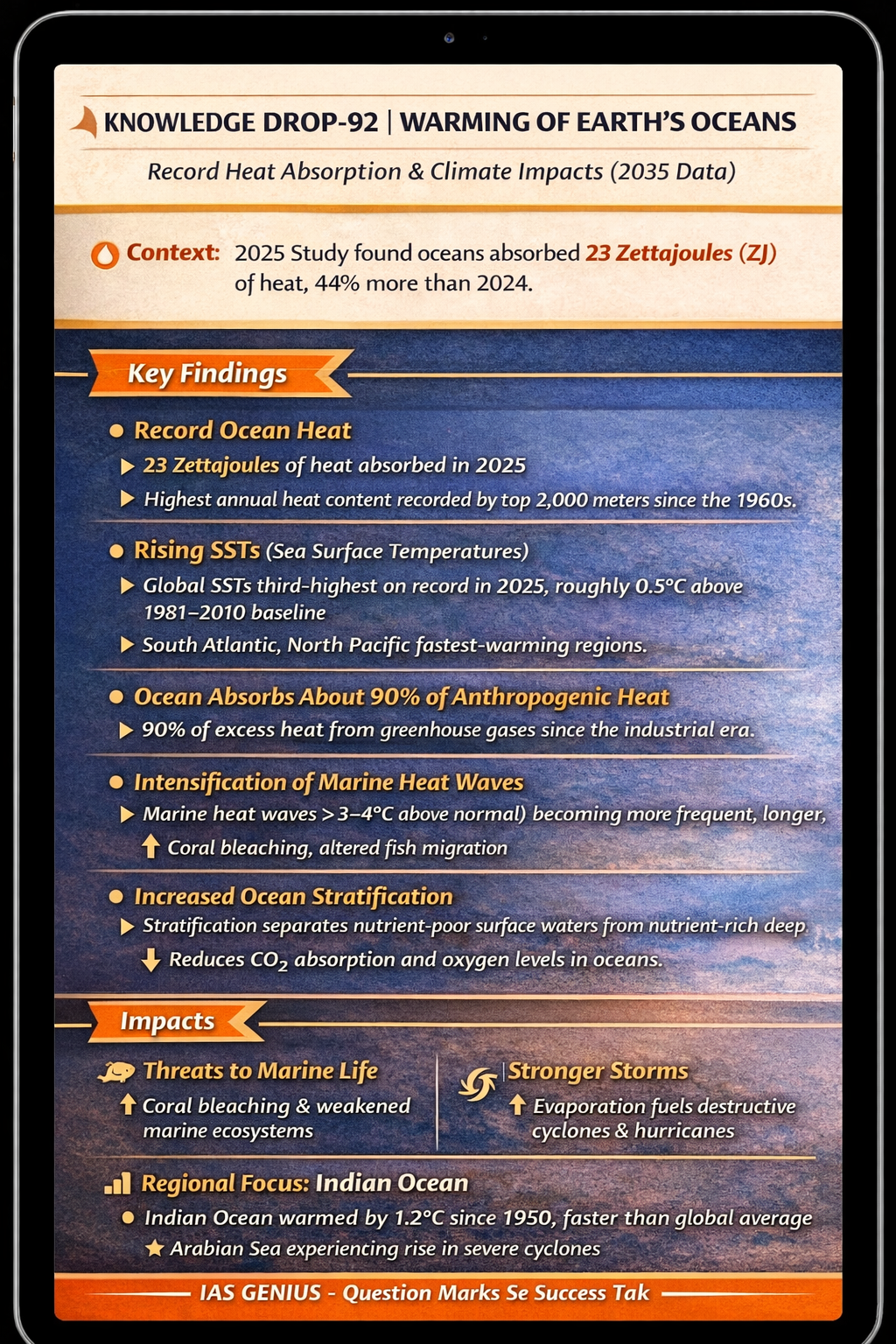
According to a study titled “Ocean Heat Content Sets Another Record in 2025”, the world’s oceans absorbed more heat in 2025 than in any year since modern measurements began in the 1960s.
The study focused on the top 2,000 metres of the ocean, where most of the excess heat is stored.
📊 Key Findings of the Study
🔹 Record-Breaking Ocean Heat Content (OHC)
- Earth’s oceans absorbed 23 Zettajoules (ZJ) of additional heat in 2025.
- This surpasses all previous records since the 1960s.
- It marks a 44% increase compared to 2024, when oceans absorbed 16 ZJ.
🔹 Rising Global Sea Surface Temperatures (SSTs)
- Global average SSTs in 2025 were the third highest on record, about 0.5°C above the 1981–2010 baseline.
- The South Atlantic, North Pacific, and Southern Ocean were the fastest-warming regions.
🔹 Oceans Absorb About 90% of Anthropogenic Heat
- Nearly 90% of the excess heat trapped by greenhouse gases since the industrial era has been absorbed by oceans.
- This causes steady long-term warming, even when atmospheric temperature rise slows temporarily.
🔹 Increased Ocean Stratification
- Rising heat content is strengthening ocean stratification, separating:
- Warm, light, nutrient-poor surface waters
- Cooler, denser, nutrient-rich deep waters
- Consequences:
- Reduced vertical mixing
- Less CO₂ absorption by oceans
- Oxygen depletion in deeper waters
- Nutrient scarcity for surface marine life
🔹 Threats to Marine Ecosystems
- Warming and stratification threaten phytoplankton, the base of marine food webs.
- Decline in phytoplankton affects zooplankton, fish, crustaceans, and corals, increasing the risk of ecosystem collapse.
🔹 Intensification of Marine Heat Waves (MHWs)
- Marine heat waves (regions 3–4°C above average for ≥5 days) are becoming:
- More frequent
- Longer
- More intense
- As per IPCC (2021), MHW frequency doubled between 1982 and 2016.
- Impacts:
- Coral bleaching
- Reduced coral reproduction
- Altered fish migration patterns
🔹 Stronger and More Destructive Storms
- Warmer oceans fuel more powerful tropical storms, cyclones, and hurricanes.
- Increased evaporation and heat transfer lead to:
- Stronger winds
- Heavier rainfall
- More severe flooding at landfall
🌊 Oceans Warming: The Bigger Picture
- Ocean warming is primarily driven by human-induced climate change, through:
- Greenhouse gas emissions
- Thermal expansion
- Altered ocean–atmosphere interactions
- According to WMO and IPCC, over 90% of excess heat trapped by greenhouse gases since the 1970s has been absorbed by oceans.
- This affects:
- Global weather patterns
- Marine ecosystems
- Coastal communities
🔥 Causes of Ocean Warming
- Increased concentrations of CO₂, CH₄, and N₂O, trapping heat in the atmosphere
- Deforestation and industrial emissions reducing natural carbon sinks
- Changes in ocean circulation driven by atmospheric warming
🐠 Impact on Marine Life and Ecosystems
- Coral bleaching is increasing; up to 70–90% of coral reefs may be lost if warming exceeds 1.5°C.
- Fish migration is shifting toward cooler waters, impacting global fisheries.
- Deoxygenation and acidification further stress marine ecosystems.
🔁 Ocean Warming and Climate Feedback Loops
- Warming water expands (thermal expansion), contributing to sea-level rise and altering ocean circulation.
- Feedback mechanisms include:
- Reduced CO₂ absorption capacity of warmer waters
- Melting polar ice, increasing heat absorption (albedo effect)
- Altered weather systems, including stronger El Niño events
- The UN Environment Programme (UNEP) warns these feedbacks could accelerate warming beyond current projections.
🌏 Regional Focus: Indian Ocean
- Data from MoES and INCOIS show:
- The Indian Ocean has warmed by about 1.2°C since 1950, faster than the global average.
- Implications:
- More intense monsoons
- Greater cyclone variability
- Increased coastal flooding
- The Arabian Sea is witnessing a rise in severe cyclonic storms.
- The IMD warns that rising ocean heat content is linked to sea-level rise along India’s coastline, threatening coastal ecosystems and communities.
🛠️ Mitigation and Global Action
- The UN Decade of Ocean Science for Sustainable Development (2021–2030) emphasizes:
- Enhanced marine observation networks
- Emission reductions through renewable energy transition
- Blue carbon initiatives such as mangrove and seagrass restoration
- In India:
- NCCR and MoES are implementing long-term ocean observation programmes under the Deep Ocean Mission to understand and mitigate ocean warming impacts.
🪔 IAS Monk Whisper
The oceans have silently carried the burden of our warming world. But silence is not safety. When the seas change, civilisation feels the tremor.
Target IAS-2026+: Highly Expected Prelims MCQs :
📌 Prelims Practice MCQs
Topic: 🌍 KD-92 | Warming of Earth’s Oceans: Record Ocean Heat Content in 2025 and Its Climate Impacts
MCQ 1 | TYPE 1 — How Many Statements Are Correct?
Consider the following statements regarding ocean heat content and sea surface temperatures:
1)In 2025, Earth’s oceans absorbed 23 Zettajoules of additional heat, the highest on record since the 1960s.
2)This represented about a 44% increase compared to the heat absorbed by oceans in 2024.
3)Global average sea surface temperatures in 2025 were the highest ever recorded.
4)The South Atlantic, North Pacific, and Southern Ocean were among the fastest-warming regions.
How many of the above statements are correct?
A)Only one
B)Only two
C)Only three
D)All four
🌀 Didn’t get it? Click here (▸) for the Correct Answer & Explanation.
🟩 Correct Answer: C)Only three
🧠 Explanation:
1)✅ True – Oceans absorbed 23 ZJ in 2025, the highest since records began in the 1960s.
2)✅ True – This is about a 44% increase over 2024 (16 ZJ).
3)❌ False – 2025 SSTs were the third highest, not the highest, on record.
4)✅ True – These regions were identified as among the fastest-warming.
MCQ 2 | TYPE 2 — Two-Statement Type
Consider the following statements:
Statement 1: Nearly 90% of the excess heat trapped by greenhouse gases since the industrial era has been absorbed by the oceans.
Statement 2: Because of this, ocean warming shows no long-term trend when atmospheric temperature rise slows temporarily.
Which of the following is correct?
A)Only Statement 1 is correct
B)Only Statement 2 is correct
C)Both statements are correct
D)Neither statement is correct
🌀 Didn’t get it? Click here (▸) for the Correct Answer & Explanation.
🟩 Correct Answer: A) Only 1 is correct
🧠 Explanation:
Statement 1)✅ True – About 90% of anthropogenic excess heat has been taken up by oceans.
Statement 2)❌ False – Oceans show steady long-term warming even when atmospheric warming slows temporarily.
MCQ 3 | TYPE 3 — Code-Based Statement Selection
Consider the following statements regarding impacts of ocean warming and stratification:
1)Increased ocean stratification reduces vertical mixing between surface and deep waters.
2)Stratification can lead to oxygen depletion in deeper waters and nutrient scarcity near the surface.
3)Marine heat waves have become less frequent but more intense in recent decades.
4)Marine heat waves contribute to coral bleaching and altered fish migration patterns.
Which of the above statements are correct?
A)1, 2 and 4 only
B)1 and 3 only
C)2, 3 and 4 only
D)1, 2, 3 and 4
🌀 Didn’t get it? Click here (▸) for the Correct Answer & Explanation.
🟩 Correct Answer: A)1, 2 and 4 only
🧠 Explanation:
1)✅ True – Stratification reduces vertical mixing.
2)✅ True – It leads to oxygen depletion at depth and nutrient scarcity near the surface.
3)❌ False – Marine heat waves are becoming more frequent, longer, and more intense, not less frequent.
4)✅ True – They drive coral bleaching and alter fish migration patterns.
MCQ 4 | TYPE 4 — Direct Factual Question
According to the IPCC, the frequency of marine heat waves has:
A)Remained stable between 1982 and 2016
B)Decreased due to improved ocean circulation
C)Doubled between 1982 and 2016
D)Tripled after 2010 due to El Niño events
🌀 Didn’t get it? Click here (▸) for the Correct Answer & Explanation.
🟩 Correct Answer: C)Doubled between 1982 and 2016
🧠 Explanation:
The IPCC (2021) notes that the frequency of marine heat waves doubled between 1982 and 2016.
The other options are not supported by the reported findings.
MCQ 5 | TYPE 5 — UPSC 2025 Linkage Reasoning Format (I, II, III)
Consider the following statements:
Statement I:
Ocean warming is contributing to stronger tropical storms, cyclones, and hurricanes.
Statement II:
Warmer ocean surfaces increase evaporation and heat transfer to the atmosphere.
Statement III:
Warmer oceans store more heat energy, which can intensify atmospheric convection and storm systems.
Which one of the following is correct?
A)Both Statements II and III are correct and both explain Statement I
B)Both Statements II and III are correct but only one explains Statement I
C)Only one of the Statements II and III is correct and that explains Statement I
D)Neither Statement II nor Statement III is correct
🌀 Didn’t get it? Click here (▸) for the Correct Answer & Explanation.
🟩 Correct Answer: A)
🧠 Explanation:
Statement II)✅ True – Warmer oceans increase evaporation and heat transfer, strengthening storms.
Statement III)✅ True – Higher ocean heat content provides more energy for convection and storm intensification.
Both statements together explain why ocean warming leads to stronger and more destructive storms, as stated in Statement I.