




🌱 KD-93 | Article 6 of the Paris Agreement and India: Carbon Markets, JCM and Climate Finance | IAS Prelims 2026-27 Highly Expected MCQs
🌱 KD-93 | Article 6 of the Paris Agreement and India: Carbon Markets, JCM and Climate Finance
Post Date: 15 January 2026
Syllabus: GS3 | Environment
📌 In Context
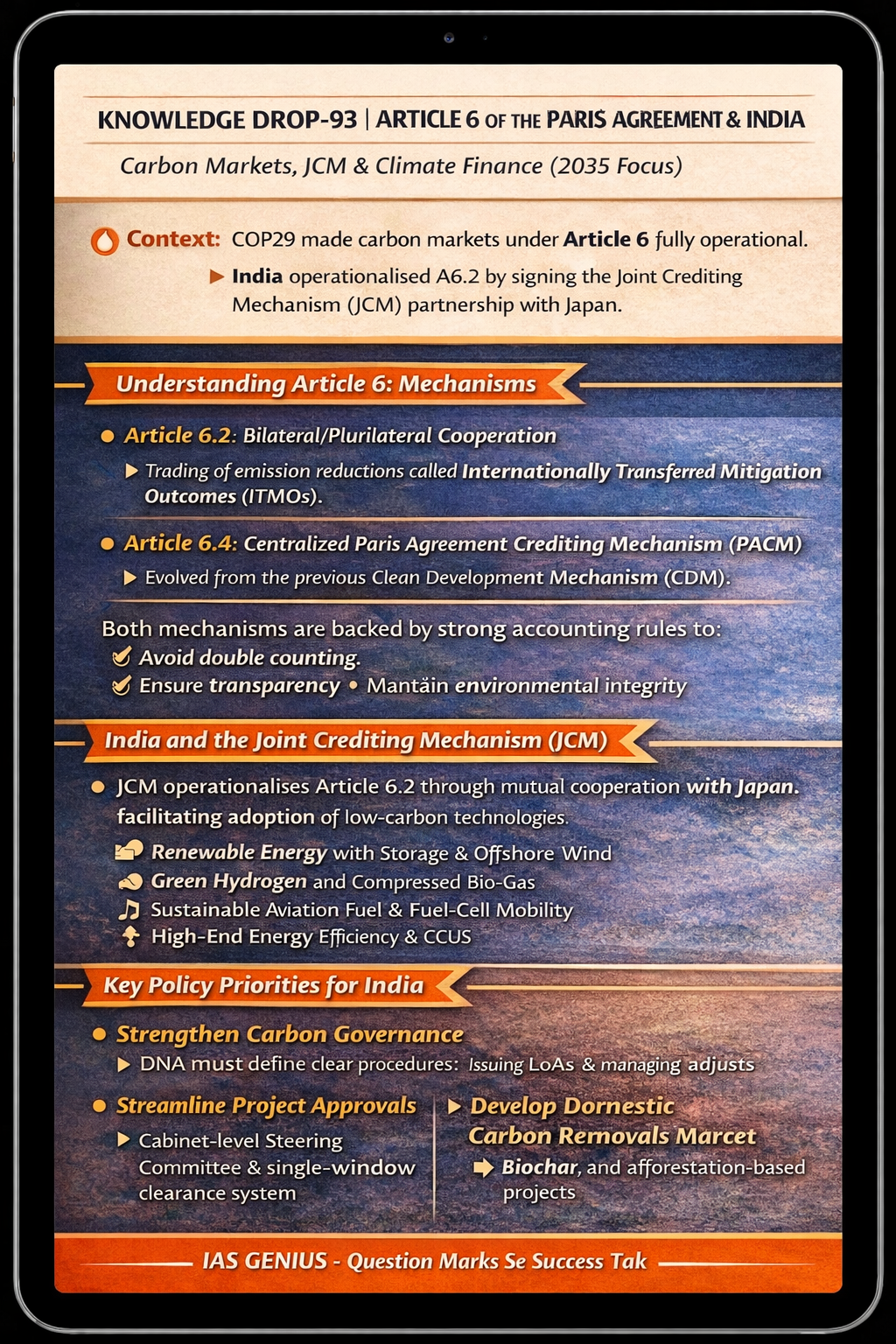
At COP29, carbon markets under Article 6 (A6) of the Paris Agreement were made fully operational to improve the delivery and efficiency of climate finance.
Earlier, India took a major step by signing the Joint Crediting Mechanism (JCM), effectively operationalising Article 6.2 and marking India’s formal entry into international carbon market cooperation.
📘 What is Article 6 of the Paris Agreement?
Article 6 creates a framework that allows countries to cooperate voluntarily to achieve their Nationally Determined Contributions (NDCs) through two main routes:
🔹 Article 6.2
- Enables bilateral or plurilateral cooperation through the trading of emission reductions called
Internationally Transferred Mitigation Outcomes (ITMOs).
🔹 Article 6.4
- Establishes a centralised Paris Agreement Crediting Mechanism (PACM), evolved from the earlier Clean Development Mechanism (CDM).
- It validates and verifies projects that generate carbon credits.
Both mechanisms are supported by strong accounting rules to:
- Avoid double counting
- Ensure transparency
- Maintain environmental integrity
🤝 India and the Joint Crediting Mechanism (JCM)
India’s entry into Article 6 through its JCM partnership with Japan represents the operationalisation of Article 6.2.
The JCM framework will:
- Facilitate adoption of low-carbon and advanced industrial technologies
- Provide mutual benefits:
- Emissions reduction for Japan
- Technology transfer and climate finance for India
The Government of India has identified 13 eligible activities under Article 6, focusing on high-impact and emerging technologies such as:
- Renewable energy with storage and offshore wind
- Green hydrogen and compressed bio-gas
- Sustainable aviation fuel and fuel-cell mobility
- High-end energy efficiency applications
- Carbon capture, utilisation, and storage (CCUS)
These priorities reflect a strategic alignment between India’s development needs and its long-term decarbonisation goals, especially in sectors like steel, cement, and power generation.
🧭 Key Policy Priorities for India
🔹 Strengthen the Domestic Carbon Governance Framework
India’s Designated National Authority (DNA) must define clear procedures for:
- Issuing Letters of Authorisation (LoAs) for Article 6 projects
- Managing corresponding adjustments to prevent double counting
- Establishing a robust legal and regulatory architecture for carbon trading
🔹 Streamline Project Approvals
- A Cabinet-level steering committee and single-window clearance system can significantly reduce delays.
- Currently, voluntary carbon projects take over 1,600 days to register, nearly four times slower than regional peers.
🔹 Develop a Domestic Carbon Removals Market
- With rising global demand, India can position itself as a key supplier of high-quality removal credits through:
- Biochar
- Enhanced rock weathering
- Afforestation-based projects
🔹 Promote South–South Collaboration
- India’s leadership in platforms like ISA, CEM, and BASIC can help:
- Build shared platforms for knowledge exchange
- Encourage co-investment among developing economies
🏁 Conclusion
The operationalisation of Article 6 of the Paris Agreement and India’s entry through the JCM mark a significant step toward integrating climate finance, technology transfer, and market-based mitigation.
With the right governance framework and policy reforms, India can emerge as a credible, high-integrity player in global carbon markets while advancing its own development and decarbonisation goals.
🪔 IAS Monk Whisper
Carbon markets are not merely about trading emissions. They are about trading pathways to a future where growth and responsibility learn to walk together.
Target IAS-2026+: Highly Expected Prelims MCQs :
📌 Prelims Practice MCQs
Topic: 🌱 KD-93 | Article 6 of the Paris Agreement and India: Carbon Markets, JCM and Climate Finance
MCQ 1 | TYPE 1 — How Many Statements Are Correct?
Consider the following statements regarding Article 6 of the Paris Agreement:
1)Article 6 allows countries to cooperate voluntarily to achieve their Nationally Determined Contributions.
2)Article 6.2 deals with bilateral or plurilateral trading of emission reductions called ITMOs.
3)Article 6.4 establishes a centralized crediting mechanism evolved from the Clean Development Mechanism.
4)Both Article 6.2 and 6.4 operate without any specific accounting rules to ensure flexibility.
How many of the above statements are correct?
A)Only one
B)Only two
C)Only three
D)All four
🌀 Didn’t get it? Click here (▸) for the Correct Answer & Explanation.
🟩 Correct Answer: C)Only three
🧠 Explanation:
1)✅ True – Article 6 enables voluntary cooperation to achieve NDCs.
2)✅ True – Article 6.2 covers trading of ITMOs through bilateral or plurilateral cooperation.
3)✅ True – Article 6.4 establishes the Paris Agreement Crediting Mechanism, evolved from CDM.
4)❌ False – Both mechanisms are backed by strong accounting rules to avoid double counting and ensure integrity.
MCQ 2 | TYPE 2 — Two-Statement Type
Consider the following statements:
Statement 1: India’s Joint Crediting Mechanism (JCM) partnership with Japan operationalises Article 6.2 of the Paris Agreement.
Statement 2: The Joint Crediting Mechanism is primarily designed to replace India’s domestic carbon market framework.
Which of the following is correct?
A)Only Statement 1 is correct
B)Only Statement 2 is correct
C)Both statements are correct
D)Neither statement is correct
🌀 Didn’t get it? Click here (▸) for the Correct Answer & Explanation.
🟩 Correct Answer: A) Only 1 is correct
🧠 Explanation:
Statement 1)✅ True – India’s JCM with Japan operationalises Article 6.2 through bilateral cooperation.
Statement 2)❌ False – JCM complements international cooperation; it does not replace India’s domestic carbon governance framework.
MCQ 3 | TYPE 3 — Code-Based Statement Selection
Consider the following statements regarding India’s priorities under Article 6:
1)India has identified renewable energy with storage, green hydrogen, and CCUS among eligible activities.
2)The focus sectors include hard-to-abate industries such as steel, cement, and power generation.
3)Corresponding adjustments are required to prevent double counting of emission reductions.
4)Under Article 6.4, projects are validated and verified through a centralized Paris Agreement Crediting Mechanism.
Which of the above statements are correct?
A)1, 2 and 3 only
B)1, 2 and 4 only
C)1, 2, 3 and 4
D)2 and 3 only
🌀 Didn’t get it? Click here (▸) for the Correct Answer & Explanation.
🟩 Correct Answer: C)1, 2, 3 and 4
🧠 Explanation:
1)✅ True – These are among the identified high-impact activities.
2)✅ True – Steel, cement, and power are key focus sectors.
3)✅ True – Corresponding adjustments are essential to avoid double counting.
4)✅ True – Article 6.4 establishes a centralized crediting mechanism for project validation and verification.
MCQ 4 | TYPE 4 — Direct Factual Question
Which of the following best describes ITMOs in the context of the Paris Agreement?
A)They are domestic carbon taxes imposed to meet NDC targets.
B)They are internationally transferred mitigation outcomes used in cooperative approaches under Article 6.2.
C)They are voluntary corporate carbon offsets outside the Paris Agreement framework.
D)They are financial instruments issued only under Article 6.4’s centralized mechanism.
🌀 Didn’t get it? Click here (▸) for the Correct Answer & Explanation.
🟩 Correct Answer: B)They are internationally transferred mitigation outcomes used in cooperative approaches under Article 6.2.
🧠 Explanation:
ITMOs are emission reductions transferred between countries under Article 6.2 to help achieve NDCs.
They are not domestic taxes, not purely voluntary corporate offsets, and not limited only to Article 6.4.
MCQ 5 | TYPE 5 — UPSC 2025 Linkage Reasoning Format (I, II, III)
Consider the following statements:
Statement I:
India’s participation in Article 6 mechanisms can enhance both climate finance inflows and access to low-carbon technologies.
Statement II:
Under the Joint Crediting Mechanism, Japan benefits from emission reductions while India gains technology transfer and finance.
Statement III:
Article 6 provides a framework for voluntary international cooperation using market-based mechanisms with strong accounting rules.
Which one of the following is correct?
A)Both Statements II and III are correct and both explain Statement I
B)Both Statements II and III are correct but only one explains Statement I
C)Only one of the Statements II and III is correct and that explains Statement I
D)Neither Statement II nor Statement III is correct
🌀 Didn’t get it? Click here (▸) for the Correct Answer & Explanation.
🟩 Correct Answer: A)
🧠 Explanation:
Statement II)✅ True – JCM provides mutual benefits: emission reductions for Japan and technology/finance for India.
Statement III)✅ True – Article 6 enables voluntary, market-based cooperation with strong accounting rules.
Together, these explain why India’s participation can boost climate finance inflows and access to low-carbon technologies, as stated in Statement I.