








🚀 KD-95 | ISRO’s PSLV-C62/EOS-N1 Mission Anomaly: What Happened and Why PSLV Still Matters | IAS Prelims 2026-27 Highly Expected MCQs
🚀 KD-95 | ISRO’s PSLV-C62/EOS-N1 Mission Anomaly: What Happened and Why PSLV Still Matters
Post Date: 17 January 2026
Syllabus: GS3 | Space
📌 In News
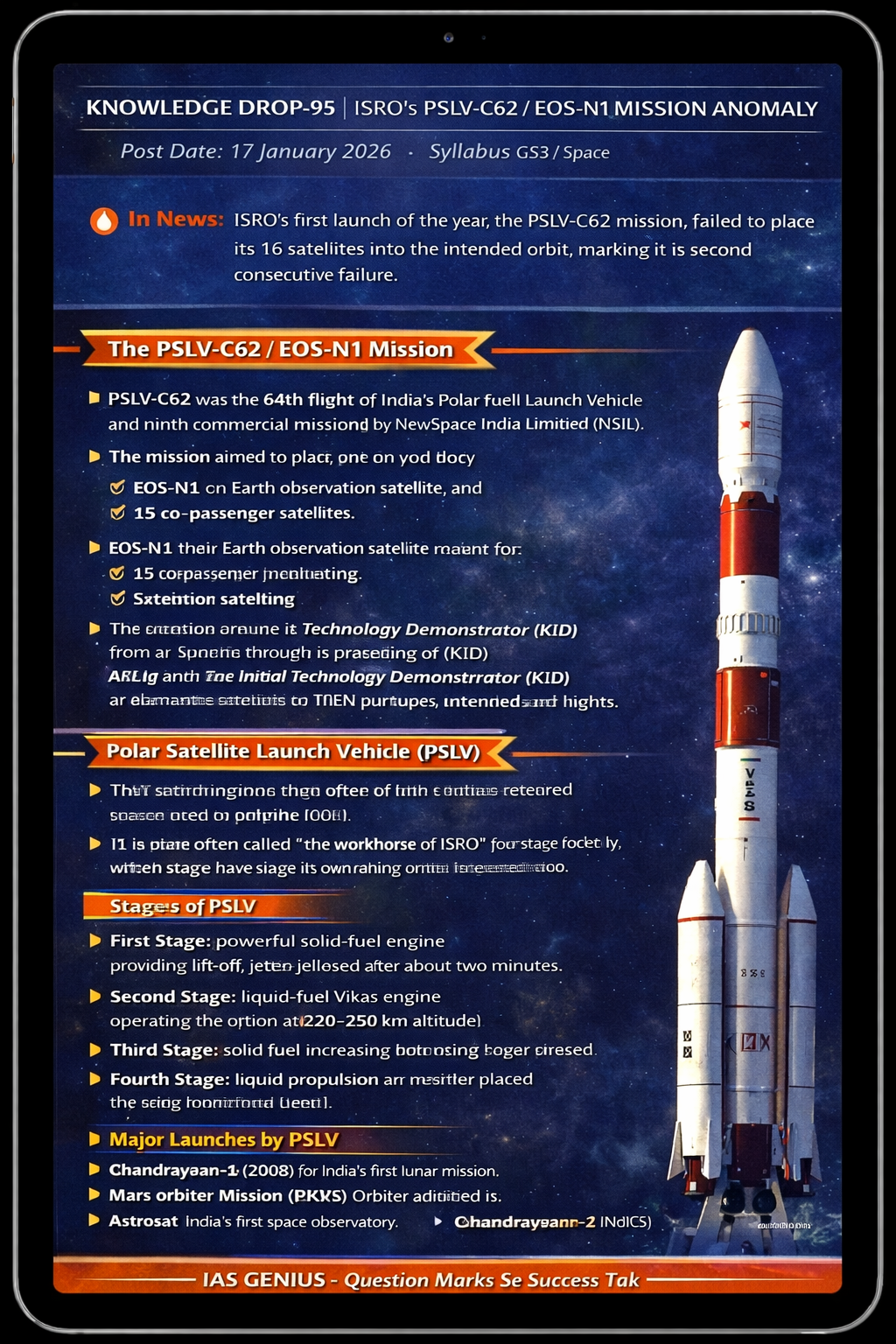
ISRO’s first launch of the year, the PSLV-C62 mission, failed to place its 16 satellites into the intended orbit, marking the second consecutive failure of the otherwise long-reliable PSLV rocket.
🛰️ The PSLV-C62 / EOS-N1 Mission
- PSLV-C62 was the 64th flight of India’s Polar Satellite Launch Vehicle and the ninth commercial mission by NewSpace India Limited (NSIL).
- The mission aimed to launch:
- EOS-N1, an Earth observation satellite, and
- 15 co-passenger satellites.
- EOS-N1 is intended for:
- Environmental monitoring
- Resource mapping
- Disaster management
- The mission also carried a technology demonstration payload:
- Kestrel Initial Technology Demonstrator (KID) from a Spanish startup
- A small re-entry vehicle prototype designed to return to Earth and provide data for future re-entry system development
🛠️ Polar Satellite Launch Vehicle (PSLV)
- The Polar Satellite Launch Vehicle (PSLV) is India’s third-generation launch vehicle.
- It is often called “the workhorse of ISRO” due to its long record of reliably delivering satellites into Low Earth Orbit (LEO).
- It was the first Indian launch vehicle to be equipped with liquid stages.
- PSLV is a four-stage rocket, where:
- Each stage has its own engine and fuel
- The stages operate sequentially during flight
- After completing their role, each stage separates from the vehicle
🧩 Stages of PSLV
- First Stage:
- Uses a powerful solid-fuel engine
- Provides lift-off, overcoming gravity and air resistance
- Jettisoned after about two minutes
- Second Stage:
- Powered by the liquid-fuel Vikas engine
- Continues the climb and accelerates the rocket
- Operates at around 220–250 km altitude
- Third Stage:
- Uses solid fuel
- Rapidly increases horizontal speed
- Places the vehicle on a sub-orbital path
- Fourth Stage:
- Uses liquid propulsion
- Precisely manoeuvres and places the satellite into its designated Low Earth Orbit
🌍 Major Launches by PSLV
- After its first successful launch in October 1994, PSLV emerged as a reliable and versatile launch vehicle.
- Besides LEO missions, PSLV has launched satellites for:
- Communication
- Meteorology
- Navigation
- Scientific experiments
- Space exploration missions
- Notable missions:
- Chandrayaan-1 (2008) – India’s first lunar mission
- Mars Orbiter Mission (2013) – Mangalyaan, India’s interplanetary mission to Mars
- Astrosat – India’s first space observatory
🤔 Do You Know?
- The Geosynchronous Satellite Launch Vehicle (GSLV) is India’s largest fourth-generation launch vehicle, designed to overcome PSLV’s payload limitations and carry heavier payloads to higher orbits.
- GSLV is a three-stage vehicle with:
- Four liquid strap-ons
- A solid rocket motor
- A cryogenic upper stage
- It can deliver:
- Up to 1,750 kg to Low Earth Orbit (up to 600 km)
- Smaller payloads to Geostationary Transfer Orbit (GTO)
- GSLVs use cryogenic engines (liquid hydrogen and liquid oxygen), providing greater thrust than earlier launch vehicles.
- Its advanced variant, LVM-3 (formerly GSLV Mk III):
- Uses solid, liquid, and cryogenic engines
- Can carry:
- Up to 8,000 kg to Low Earth Orbit (up to 2,000 km)
- About 4,000 kg to geosynchronous orbit (36,000 km)
- Is nicknamed ‘Bahubali’ for its payload capacity
- LVM-3 milestones:
- First successful mission in 2017 with GSAT-19
- Followed by Chandrayaan-2 (2019) and Chandrayaan-3 (2023)
- ISRO is developing its heaviest rocket, the Lunar Module Launch Vehicle (LMLV), expected by 2035, to support future lunar missions, including India’s first human Moon mission planned for 2040.
🏁 Conclusion
The anomaly in the PSLV-C62/EOS-N1 mission is a reminder that even proven systems face setbacks in high-technology domains like spaceflight. However, PSLV’s long legacy as ISRO’s workhorse and India’s growing launch vehicle ecosystem—from GSLV to LVM-3 and the future LMLV—reflect a space programme that learns, adapts, and steadily expands its ambitions.
🪔 IAS Monk Whisper
In space, failure is not a fall from grace. It is a footnote in the long manuscript of learning that eventually writes history among the stars.
Target IAS-2026+: Highly Expected Prelims MCQs :
📌 Prelims Practice MCQs
Topic: 🚀 KD-95 | ISRO’s PSLV-C62/EOS-N1 Mission Anomaly: What Happened and Why PSLV Still Matters
MCQ 1 | TYPE 1 — How Many Statements Are Correct?
Consider the following statements regarding the PSLV-C62 / EOS-N1 mission:
1)PSLV-C62 was the 64th flight of India’s PSLV and the ninth commercial mission by NSIL.
2)The mission aimed to place EOS-N1 and 15 co-passenger satellites into the intended orbit.
3)EOS-N1 is an Earth observation satellite meant for communication and navigation services only.
4)The mission carried a technology demonstrator named Kestrel Initial Technology Demonstrator (KID).
How many of the above statements are correct?
A)Only one
B)Only two
C)Only three
D)All four
🌀 Didn’t get it? Click here (▸) for the Correct Answer & Explanation.
🟩 Correct Answer: C)Only three
🧠 Explanation:
1)✅ True – PSLV-C62 was the 64th PSLV flight and the ninth commercial mission by NSIL.
2)✅ True – The mission targeted EOS-N1 plus 15 co-passenger satellites.
3)❌ False – EOS-N1 is for Earth observation, not only communication and navigation.
4)✅ True – The mission carried the Kestrel Initial Technology Demonstrator (KID).
MCQ 2 | TYPE 2 — Two-Statement Type
Consider the following statements:
Statement 1: The Polar Satellite Launch Vehicle (PSLV) is India’s third-generation launch vehicle and is often called the “workhorse of ISRO”.
Statement 2: PSLV was the first Indian launch vehicle to be equipped with a cryogenic upper stage.
Which of the following is correct?
A)Only Statement 1 is correct
B)Only Statement 2 is correct
C)Both statements are correct
D)Neither statement is correct
🌀 Didn’t get it? Click here (▸) for the Correct Answer & Explanation.
🟩 Correct Answer: A) Only 1 is correct
🧠 Explanation:
Statement 1)✅ True – PSLV is a third-generation launch vehicle and widely called ISRO’s workhorse.
Statement 2)❌ False – PSLV was the first Indian launch vehicle to be equipped with liquid stages, not a cryogenic upper stage.
MCQ 3 | TYPE 3 — Code-Based Statement Selection
Consider the following statements regarding the stages of PSLV:
1)The first stage uses a solid-fuel engine and provides lift-off.
2)The second stage is powered by the liquid-fuel Vikas engine and operates at high altitude.
3)The third stage uses liquid fuel to precisely place the satellite into orbit.
4)The fourth stage uses liquid propulsion for precise orbital manoeuvring and satellite injection.
Which of the above statements are correct?
A)1, 2 and 3 only
B)1, 2 and 4 only
C)2, 3 and 4 only
D)1, 2, 3 and 4
🌀 Didn’t get it? Click here (▸) for the Correct Answer & Explanation.
🟩 Correct Answer: B)1, 2 and 4 only
🧠 Explanation:
1)✅ True – The first stage uses solid fuel and provides lift-off.
2)✅ True – The second stage uses the liquid-fuel Vikas engine.
3)❌ False – The third stage uses solid fuel; it is the fourth stage that places the satellite precisely into orbit.
4)✅ True – The fourth stage uses liquid propulsion for precise orbital insertion.
MCQ 4 | TYPE 4 — Direct Factual Question
Which of the following missions were launched by PSLV and later travelled to the Moon and Mars respectively?
A)Chandrayaan-2 and Mangalyaan
B)Chandrayaan-1 and Mars Orbiter Mission
C)Astrosat and Chandrayaan-3
D)GSAT-19 and Chandrayaan-1
🌀 Didn’t get it? Click here (▸) for the Correct Answer & Explanation.
🟩 Correct Answer: B)Chandrayaan-1 and Mars Orbiter Mission
🧠 Explanation:
PSLV launched Chandrayaan-1 (2008) to the Moon and the Mars Orbiter Mission (2013) to Mars.
The other options involve missions not matching both destinations launched by PSLV.
MCQ 5 | TYPE 5 — UPSC 2025 Linkage Reasoning Format (I, II, III)
Consider the following statements:
Statement I:
PSLV has been described as the “workhorse of ISRO” despite recent mission anomalies.
Statement II:
Since its first successful launch in 1994, PSLV has delivered a wide variety of satellites for Earth observation, navigation, scientific experiments, and space exploration.
Statement III:
PSLV has demonstrated high mission reliability over decades and has been used for landmark missions such as Chandrayaan-1, Mars Orbiter Mission, and Astrosat.
Which one of the following is correct?
A)Both Statements II and III are correct and both explain Statement I
B)Both Statements II and III are correct but only one explains Statement I
C)Only one of the Statements II and III is correct and that explains Statement I
D)Neither Statement II nor Statement III is correct
🌀 Didn’t get it? Click here (▸) for the Correct Answer & Explanation.
🟩 Correct Answer: A)
🧠 Explanation:
Statement II)✅ True – PSLV’s long service across multiple mission types explains its reputation as ISRO’s workhorse.
Statement III)✅ True – Its high reliability and role in landmark missions like Chandrayaan-1, MOM, and Astrosat further explain this reputation.
Together, both statements explain why PSLV continues to be called the “workhorse of ISRO” despite occasional anomalies.