





☀️ KD-96 | China’s EAST Fusion Reactor Breaks Density Limit: What It Means for ITER and Clean Energy | IAS Prelims 2026-27 Highly Expected MCQs
☀️ KD-96 | China’s EAST Fusion Reactor Breaks Density Limit: What It Means for ITER and Clean Energy
Post Date: 18 January 2026
Syllabus: GS3 | Science and Technology
📌 Context
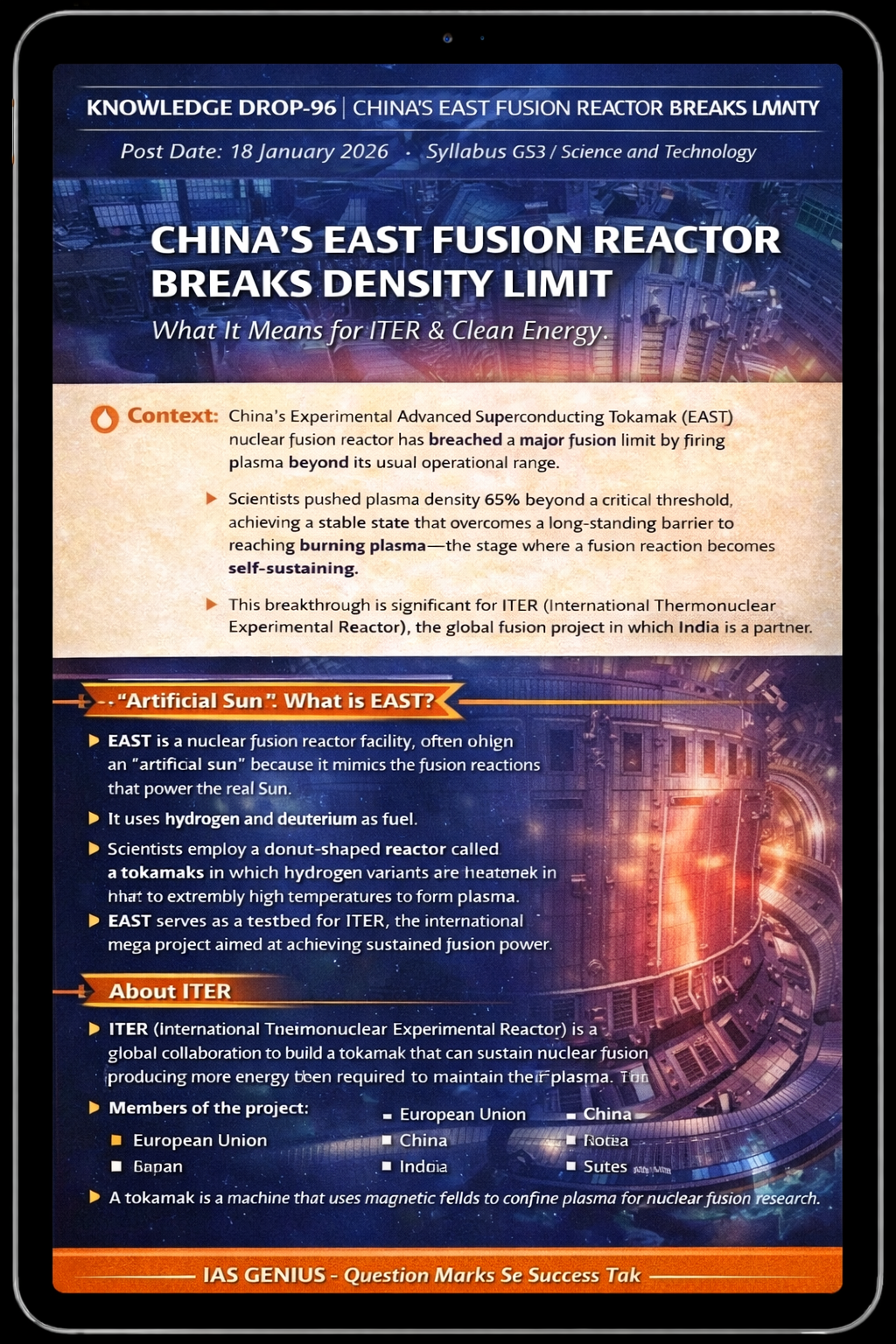
China’s Experimental Advanced Superconducting Tokamak (EAST) nuclear fusion reactor has breached a major fusion limit by firing plasma beyond its usual operational range.
Scientists pushed plasma density 65% beyond a critical threshold, achieving a stable state that overcomes a long-standing barrier to reaching burning plasma—the stage where a fusion reaction becomes self-sustaining.
This breakthrough is significant for ITER (International Thermonuclear Experimental Reactor), the global fusion project in which India is a partner.
☀️ “Artificial Sun”: What is EAST?
- EAST is a nuclear fusion reactor facility, often called an “artificial sun” because it mimics the fusion reactions that power the real Sun.
- It uses hydrogen and deuterium as fuel.
- Scientists employ a donut-shaped reactor called a tokamak, in which hydrogen variants are heated to extremely high temperatures to form plasma.
- EAST serves as a testbed for ITER, the international megaproject aimed at achieving sustained fusion power.
🌍 About ITER
- ITER (International Thermonuclear Experimental Reactor) is a global collaboration to build a tokamak that can sustain nuclear fusion producing more energy than required to maintain the plasma.
- Members of the project:
- European Union
- China
- India
- Japan
- Korea
- Russia
- United States
- A tokamak is a machine that uses magnetic fields to confine plasma for nuclear fusion research.
🕰️ Background: From Fission to Fusion
- 1939: Lise Meitner and Otto Frisch explained nuclear fission as a process of energy release.
- 1942: Enrico Fermi and his team built the first sustainable nuclear fission reactor.
- Nuclear fission produces harmful radioactive waste, whereas nuclear fusion does not produce long-lived high-activity waste.
- Fusion has become a major technological goal for a world seeking clean and abundant energy.
- Current status: Projects like ITER are progressing, but net-positive energy from fusion is still a work in progress.
🔬 What is Nuclear Fusion?
- Nuclear fusion is the process by which two light atomic nuclei combine to form a heavier nucleus, releasing enormous amounts of energy.
- Fusion occurs in a state of matter called plasma—a hot, charged gas of ions and free electrons, distinct from solids, liquids, or gases.
- The Sun and all stars are powered by fusion.
🔹 Fusion Reaction Process
- Deuterium (H-2) + Tritium (H-3) → Helium (He-4) + Neutron
- The released neutron carries energy derived from the mass defect, converted into kinetic energy according to Einstein’s mass–energy equivalence.
⚡ Significance of Fusion Energy
- Clean Energy: Fusion does not emit carbon dioxide or greenhouse gases, making it a potential long-term low-carbon electricity source.
- Highly Efficient: Fusion can generate:
- About four times more energy per kilogram of fuel than fission
- Nearly four million times more energy than burning coal or oil
- Abundant Fuel:
- Deuterium can be extracted cheaply from seawater
- Tritium can be bred from lithium using fusion neutrons
- Fuel supplies could last millions of years
- Safer to Use:
- No risk of runaway reactions or meltdowns
- Not expected to produce high-activity or long-lived nuclear waste
- Fusion is difficult to start and maintain, making it intrinsically safer
🚀 Why EAST’s Breakthrough Matters
- EAST’s success demonstrates a practical and scalable pathway to extend density limits in tokamaks.
- This is crucial for next-generation burning plasma fusion devices, including ITER.
- ITER has faced criticism due to delays and cost overruns, and high costs have discouraged some governments.
- The new findings strengthen confidence that engineering barriers to sustained fusion can be overcome.
🏁 Way Ahead
- Continued progress in reactors like EAST will be critical for ITER’s future.
- If these density and stability gains can be replicated at scale, fusion could move closer to becoming a viable commercial energy source in the coming decades.
🪔 IAS Monk Whisper
Humanity learned to split the atom in a century. To teach atoms to unite may take longer—but in that union lies the quiet promise of a sun on Earth.
Target IAS-2026+: Highly Expected Prelims MCQs :
📌 Prelims Practice MCQs
Topic:
MCQ 1 | TYPE 1 — How Many Statements Are Correct?
Consider the following statements regarding China’s EAST reactor and the recent breakthrough:
1)EAST pushed plasma density about 65% beyond a critical threshold and achieved a stable state.
2)This breakthrough helps move closer to “burning plasma”, where fusion becomes self-sustaining.
3)EAST is primarily a commercial power reactor already supplying electricity to the grid.
4)The development is relevant for ITER, in which India is a participating member.
How many of the above statements are correct?
A)Only one
B)Only two
C)Only three
D)All four
🌀 Didn’t get it? Click here (▸) for the Correct Answer & Explanation.
🟩 Correct Answer: C)Only three
🧠 Explanation:
1)✅ True – The plasma density was pushed ~65% beyond a key threshold in a stable state.
2)✅ True – The goal is to reach burning plasma, a self-sustaining fusion stage.
3)❌ False – EAST is a testbed research reactor, not a commercial power plant.
4)✅ True – The result is significant for ITER, where India is a partner.
MCQ 2 | TYPE 2 — Two-Statement Type
Consider the following statements:
Statement 1: EAST is called an “artificial sun” because it mimics the fusion reactions that power the Sun using hydrogen variants in a tokamak.
Statement 2: EAST confines plasma using magnetic fields, which is a defining feature of tokamak devices.
Which of the following is correct?
A)Only Statement 1 is correct
B)Only Statement 2 is correct
C)Both statements are correct
D)Neither statement is correct
🌀 Didn’t get it? Click here (▸) for the Correct Answer & Explanation.
🟩 Correct Answer: C)Both statements are correct
🧠 Explanation:
Statement 1)✅ True – EAST mimics solar fusion using hydrogen variants and is often called an “artificial sun”.
Statement 2)✅ True – Tokamaks use magnetic fields to confine plasma for fusion research.
MCQ 3 | TYPE 3 — Code-Based Statement Selection
Consider the following statements regarding ITER and tokamak-based fusion:
1)ITER is a multinational project involving the EU, China, India, Japan, Korea, Russia, and the United States.
2)A tokamak uses magnetic fields to confine plasma for nuclear fusion research.
3)ITER’s objective is to demonstrate sustained fusion producing more energy than required to maintain the plasma.
4)EAST serves as a testbed for fission reactor technologies used in current nuclear power plants.
Which of the above statements are correct?
A)1, 2 and 3 only
B)1 and 3 only
C)2 and 4 only
D)1, 2, 3 and 4
🌀 Didn’t get it? Click here (▸) for the Correct Answer & Explanation.
🟩 Correct Answer: A)1, 2 and 3 only
🧠 Explanation:
1)✅ True – These are the ITER members.
2)✅ True – Magnetic confinement defines a tokamak.
3)✅ True – ITER aims for sustained fusion with net energy gain for the plasma system.
4)❌ False – EAST is a fusion testbed, not for fission technologies.
MCQ 4 | TYPE 4 — Direct Factual Question
In nuclear fusion research, which pair of nuclei is most commonly combined in present-day experimental reactors to produce Helium and a high-energy neutron?
A)Protium and Protium
B)Deuterium and Tritium
C)Uranium-235 and Neutron
D)Lithium-6 and Neutron
🌀 Didn’t get it? Click here (▸) for the Correct Answer & Explanation.
🟩 Correct Answer: B)Deuterium and Tritium
🧠 Explanation:
The standard fusion reaction in experiments is Deuterium (H-2) + Tritium (H-3) → Helium (He-4) + Neutron, releasing large energy from mass–energy conversion.
The other options relate to fission or breeding processes, not the primary fusion pair.
MCQ 5 | TYPE 5 — UPSC 2025 Linkage Reasoning Format (I, II, III)
Consider the following statements:
Statement I:
Breaching plasma density limits in tokamaks is crucial for progressing toward practical, self-sustaining fusion energy.
Statement II:
Higher plasma density, when kept stable, helps move the system closer to the “burning plasma” regime.
Statement III:
EAST demonstrated a stable state even after pushing plasma density far beyond its usual operational range.
Which one of the following is correct?
A)Both Statements II and III are correct and both explain Statement I
B)Both Statements II and III are correct but only one explains Statement I
C)Only one of the Statements II and III is correct and that explains Statement I
D)Neither Statement II nor Statement III is correct
🌀 Didn’t get it? Click here (▸) for the Correct Answer & Explanation.
🟩 Correct Answer: A)Both Statements II and III are correct and both explain Statement I
🧠 Explanation:
Statement II)✅ True – Stable higher density pushes the system toward the burning plasma regime, explaining why density limits matter.
Statement III)✅ True – EAST’s stable operation beyond the usual range shows the practical pathway to overcome this barrier.
Together, both statements explain why breaking density limits is crucial for practical fusion, as stated in Statement I.