




📅 May 5, 2025, Post 6: Glaciers in Retreat: Reassessing the Indus Water Treaty Amid Himalayan Meltdown | Mains Essay Attached | Target IAS-26 MCQs Attached: A complete Package, Dear Aspirants!
Glaciers in Retreat: Reassessing the Indus Water Treaty Amid Himalayan Meltdown
NATIONAL HERO — PETAL 006
🗓️ May 5, 2025
Thematic Focus: Climate Change 🌍 | Glaciology 🧊 | Geopolitics & Water Diplomacy 🌐
🌡️ Opening Whisper
When the mountains begin to weep, rivers forget their path, and treaties written in ink tremble under the weight of melting ice.
Key Highlights
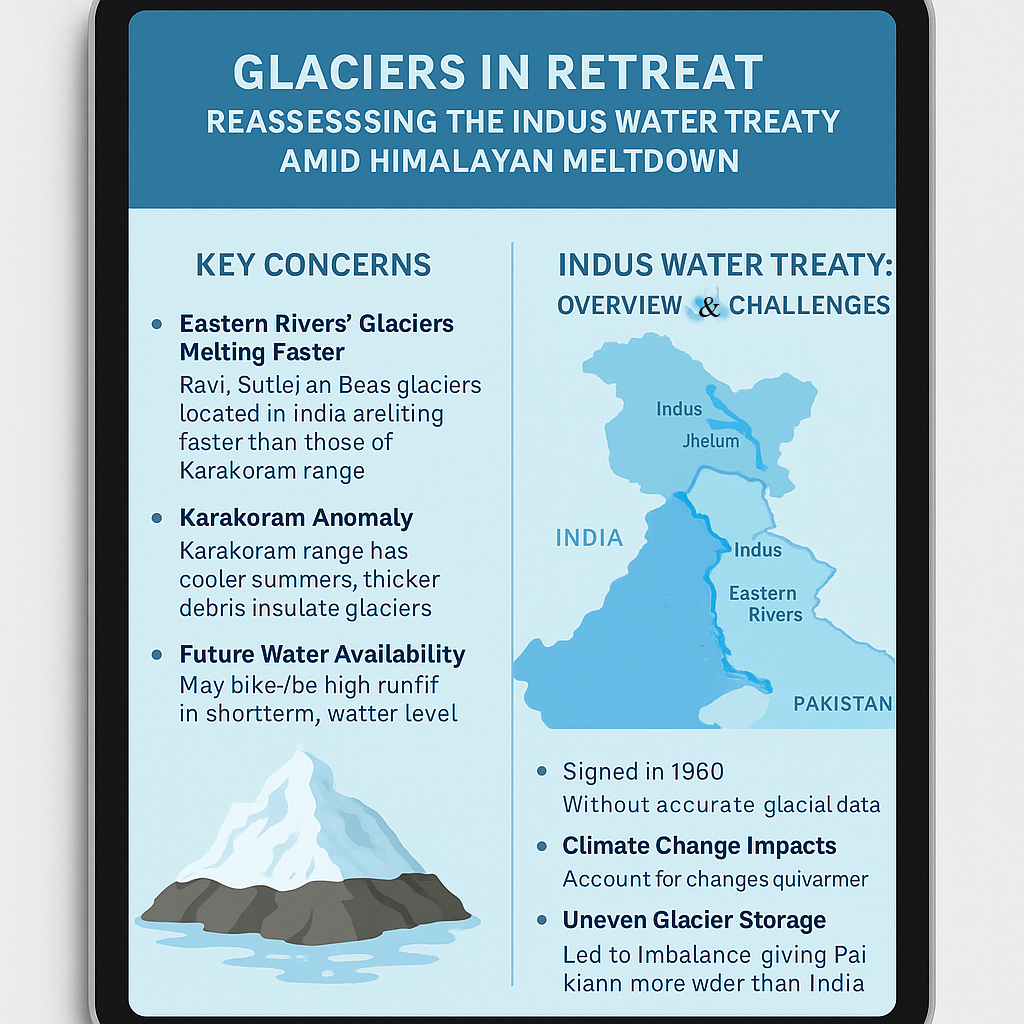
• Leading glaciologist Dr. Anil V. Kulkarni, from the Divecha Centre for Climate Change, IISc Bengaluru, has raised concern over accelerated glacier retreat in the eastern rivers of the Indus basin — Ravi, Sutlej, and Beas — compared to the more stable glaciers in Pakistan’s Karakoram range.
• He attributes this imbalance to the Karakoram Anomaly, where high-altitude glaciers are relatively stable due to:
🔹 Cooler summers,
🔹 More winter snowfall, and
🔹 Insulating rock/debris mass on glacier surfaces.
• In contrast, Indian glaciers at lower altitudes are experiencing faster melting and mass loss, leading to temporary high runoff till mid-century, followed by significant decline in water availability.
• Climate change, not considered during the drafting of the Indus Water Treaty (IWT) in 1960, has exposed critical gaps in hydrological and glacial understanding.
🌐 Indus Water Treaty: Overview and Emerging Challenges
• Signed in 1960 between India and Pakistan, with World Bank mediation, the IWT divides Indus basin rivers:
🔹 India gets full rights over eastern rivers – Ravi, Beas, Sutlej
🔹 Pakistan has rights over western rivers – Indus, Jhelum, Chenab (India can use these only for non-consumptive purposes)
• The treaty was hailed as a model of water-sharing diplomacy, but was drafted without accurate glacial data, and before the era of remote sensing and satellite mapping.
• Recent terror attacks in Kashmir and the growing cross-border tensions have prompted India to put the treaty “in abeyance”, citing national security concerns.
🔍 Why the Treaty Needs a Reassessment
• Uneven Glacier Water Storage: Pakistan’s glaciers hold more stored water, whereas India’s are melting faster, leading to potential disproportional water loss.
• Outdated Hydrological Assumptions: Satellite-based glacier mass balance and run-off projections were unavailable in 1960.
• Streamflow Changes: Melting may cause short-term floods and long-term scarcity in India’s eastern rivers.
• Climate Uncertainty: Though precipitation trends are unclear, temperature rise and glacier melt patterns are now well-documented.
• Geostrategic Pressures: The treaty’s unilateral structure offers limited flexibility to renegotiate allocations in light of ecological realities.
🧭 GS Paper Mapping
• GS Paper 1 – Geography
🔹 Himalayan glaciers and river systems
🔹 Climate-induced hydrological shifts
• GS Paper 2 – International Relations
🔹 Indus Water Treaty and bilateral treaties
🔹 India’s water diplomacy and strategic interests
• GS Paper 3 – Environment & Disaster Management
🔹 Climate change impacts on cryosphere
🔹 Adaptation strategies and basin governance
💭 A Thought Spark — by IAS Monk
Treaties are built on the confidence of climate constancy — but when the glaciers shift, rivers rebel. As science reveals what was once invisible, diplomacy must awaken to realities carved by melting ice.
High Quality Mains Essay For Practice :
Word Limit 1000-1200
India’s Glaciers: The Himalayan Gifts of Climate, Water, and Warning
Introduction: Where the Sky Meets the Source
High above the crowded plains of India, where silence is carved in ice and time flows like frozen breath, lie the Himalayas — guardians of the subcontinent and cradles of rivers. Draped in eternal snow, they are more than a mountain range — they are India’s climate buffers, spiritual metaphors, and hydrological engines. Within their folds lie over 9,000 glaciers, slow-moving giants that gift India life-giving rivers, seasonal balance, and monsoon memory.
But today, these climate gifts are unraveling. Global warming, erratic snowfall, pollution, and unsustainable development are accelerating glacial retreat. What were once timeless flows are now time-bound warnings. As India rises, its glaciers melt — creating an urgent paradox of growth versus guardianship.
This essay explores the geographic, ecological, cultural, and strategic importance of India’s glaciers — and why preserving these icy gifts is not just about saving water, but about saving time, life, and the climate future itself.
I. The Himalayan Glaciers: Givers of Rivers, Season, and Soil
India’s glaciers are mainly located in the Himalayan arc, which stretches over 2,500 km across Jammu & Kashmir, Ladakh, Himachal Pradesh, Uttarakhand, Sikkim, and Arunachal Pradesh. The region hosts:
- Greater Himalayas with long glaciers like Siachen, Gangotri, Zemu, and Satopanth
- Trans-Himalayan Karakoram, home to stable yet vast glaciers (the “Karakoram Anomaly”)
- Sources of India’s great rivers: Indus, Ganga, and Brahmaputra
🌊 Hydrological Gifts:
• Glaciers feed 12 major river basins and provide perennial flow even in dry seasons
• They support 400 million+ people in the Indo-Gangetic plains and 70% of India’s agriculture
🌧️ Climatic Modulators:
• Glaciers store snow and ice, releasing it seasonally to regulate runoff
• They interact with the Southwest Monsoon, absorbing thermal energy and controlling circulation
🧘 Cultural Icons:
• From Gomukh to Amarnath, glaciers have been seen as sacred sources in Indian traditions
• They symbolize purity, endurance, and transience — appearing in Vedic hymns, folk tales, and Buddhist chants
II. The Crisis of Melting: Warnings in the Wind
The Himalayas are now the fastest-warming mountain system in the world. According to studies:
- Glaciers are retreating at 10–20 meters per year
- Over 1,000 Himalayan glaciers have lost mass consistently since 2000
- The Gangotri Glacier has receded by over 2.5 km in the last century
🔥 Drivers of Melting:
- Climate Change
– Rising temperatures increase ablation (melting)
– Altered snowfall patterns reduce snow cover insulation - Black Carbon & Pollution
– Soot from diesel, biomass burning, and industrial emissions settles on glaciers, accelerating melt - Land Use and Infrastructure
– Deforestation, hydropower tunnels, and road blasting destabilize slopes
– Tourism and military activity stress fragile zones - Global Phenomena
– Arctic warming, El Niño patterns, and western disturbances disrupt glacial mass balance
III. Emerging Risks: From Drought to Deluge
⚠️ 1. Glacial Lake Outburst Floods (GLOFs):
As glaciers melt, moraine-dammed lakes form and may burst — like the 2021 Chamoli disaster, which killed over 200 and swept away hydropower projects.
⚠️ 2. Water Insecurity:
While early melting may increase river flow, the long-term consequence is dry rivers — especially during the lean summer months.
⚠️ 3. Agricultural Disruption:
Reduced snowmelt affects canal-fed agriculture, especially in Punjab, Himachal, and Uttarakhand. Cropping patterns may shift drastically.
⚠️ 4. Geostrategic Vulnerability:
Glacier-fed rivers are shared across India, China, Pakistan, Nepal, and Bhutan. Melting increases tensions over water-sharing, like those in the Indus basin.
IV. The Role of Science and Surveillance
India’s response has strengthened over time with institutional research and monitoring:
- Wadia Institute of Himalayan Geology and National Centre for Polar and Ocean Research lead glacier monitoring
- ISRO’s remote sensing tracks glacial movement and snow cover
- The Divecha Centre at IISc, led by experts like Dr. Anil V. Kulkarni, has pioneered glacier-climate linkage research
- Early warning systems for GLOFs are being piloted in Sikkim and Ladakh
Yet, field-level instrumentation is still sparse, and data-sharing between defense, environment, and water ministries is often siloed.
V. What Must Be Done: Guardianship of the Glacial Future
- Strengthen Himalayan Research Missions
– Expand the National Mission on Sustaining the Himalayan Ecosystem under NAPCC
– Improve automated weather stations, LIDAR mapping, and AI-based snowmelt models - Preserve Ecological Buffers
– Protect alpine meadows, forests, and permafrost zones
– Enforce eco-sensitive zone regulations near glaciers - Control Black Carbon Emissions
– Promote clean cookstoves, electric transport, and waste management in hill states
– Collaborate regionally on transboundary air pollution - Climate-Resilient Infrastructure
– Avoid overbuilding in vulnerable catchments
– Prioritize nature-based solutions like glacier lakes drainage and slope stabilization - Community-Led Glacier Stewardship
– Involve local youth, monks, and farmers in glacier watch campaigns
– Build awareness through education and media
Conclusion: Ice that Remembers, and Ice that Warns
India’s glaciers are not just melting ice — they are melting time. With each retreat, they whisper of changing climates, shifting seasons, and lost stability. If the First Green Revolution was fed by Himalayan waters, the next revolution must protect the Himalayan source.
Glaciers are slow-moving storytellers. But today, they are speeding up — not in joy, but in alarm. Their story is ours to heed, to rewrite, and to preserve.
Quote to End With
“In the cry of the melting glacier, we hear the language of a future not yet spoken. But it speaks to us now — to act, to preserve, to honor the cold cradle of our civilization.” — IAS Monk
Target IAS-26: Daily MCQs :
📌 Prelims Practice MCQs
Topic:
MCQ 1 – Type 1: How many of the below statements are correct?
Q. Consider the following statements about Himalayan glaciers and their relevance to India:
• 1) India’s Gangotri glacier, a major source of the Ganga River, has retreated over 2.5 km in the last century.
• 2) The Karakoram glaciers in Pakistan are melting faster than those in the Indian Himalayas.
• 3) Glacier-fed rivers in India are vital for agricultural irrigation and year-round river flow.
• 4) Glacial lake outburst floods (GLOFs) occur when debris-dammed lakes breach, causing sudden downstream flooding.
Options:
A) Only two
B) Only three
C) All four
D) Only one
🌀 Didn’t get it? Click here (▸) for the Correct Answer & Explanation
✅ Correct Answer: B) Only three
🧠 Explanation:
• • 1) ✅ Correct – The Gangotri glacier has indeed retreated over 2.5 km since early 20th century.
• 2) ❌ Incorrect – The Karakoram glaciers are relatively stable, a phenomenon known as the Karakoram Anomaly.
• 3) ✅ Correct – Glaciers feed perennial rivers, crucial for India’s irrigation and drinking water.
• 4) ✅ Correct – GLOFs are caused by sudden breaches in glacial lakes formed from meltwater dammed by moraines.
✅ Therefore, statements 1, 3, and 4 are correct.
MCQ 2 – Type 2: Two Statement Based
Q. Consider the following statements:
• 1) Black carbon from burning fossil fuels and biomass accelerates glacier melting by reducing surface reflectivity.
• 2) Glaciers in India are mainly located in the Western Ghats and Indo-Gangetic plains.
Which of the above statements is/are correct?
A) Only 1 is correct
B) Only 2 is correct
C) Both are correct
D) Neither is correct
🌀 Didn’t get it? Click here (▸) for the Correct Answer & Explanation
✅ Correct Answer: A) Only 1 is correct
🧠 Explanation:
• • 1) ✅ Correct – Black carbon reduces the albedo (reflectivity) of snow and accelerates melting.
• 2) ❌ Incorrect – India’s glaciers are found in the Himalayas, not in the Western Ghats or Indo-Gangetic plains.
✅ So, only Statement 1 is correct.
MCQ 3 – Type 3: Which of the statements is/are correct?
Q. Which of the following are impacts of Himalayan glacier retreat on India?
• 1) Increased risk of Glacial Lake Outburst Floods (GLOFs) in the upper Himalayas.
• 2) Long-term decline in water availability for rivers like Ganga, Yamuna, and Brahmaputra.
• 3) Improvement in India’s net agricultural output in the long run due to glacier melt.
• 4) Strategic tensions with neighboring countries over transboundary water management.
Options:
A) 1, 2, and 4 only
B) 1 and 3 only
C) 2, 3, and 4 only
D) All four
🌀 Didn’t get it? Click here (▸) for the Correct Answer & Explanation
✅ Correct Answer:A) 1, 2, and 4 only
🧠 Explanation:
• 1) ✅ Correct – Melting glaciers have led to the formation of unstable lakes prone to GLOFs.
• 2) ✅ Correct – Initial runoff may increase, but long-term water availability will decline.
• 3) ❌ Incorrect – While short-term melt may aid irrigation, long-term impact is negative for agriculture.
• 4) ✅ Correct – Water-sharing tensions, e.g., in Indus basin or Teesta, may intensify with reduced glacial input.
✅ Hence, 1, 2, and 4 are correct.
MCQ 4 – Type 4: Direct Fact
Q. Which of the following is the largest glacier in India by length?
A) Gangotri Glacier
B) Satopanth Glacier
C) Siachen Glacier
D) Zemu Glacier
🌀 Didn’t get it? Click here (▸) for the Correct Answer & Explanation.
✅ Correct Answer: C) Siachen Glacier
🧠 Explanation:
• Siachen Glacier, located in Ladakh’s Karakoram range, is the largest glacier in India, stretching over 75 km, and is the second-longest glacier in the world outside the polar regions.
• It is also strategically significant, lying near the India–Pakistan Line of Control.
✅ This is a frequently asked static geography question.