





🧠 Knowledge Drop-106 | Tom Tom Congestion Index | IAS Prelims 2026-27 Highly Expected MCQs | Current Affairs & GS Essays on iasmonk.com
🧠 Knowledge Drop-106 | Tom Tom Congestion Index
GS-2 | Governance
Post Date: 28 January 2026
📌 Context
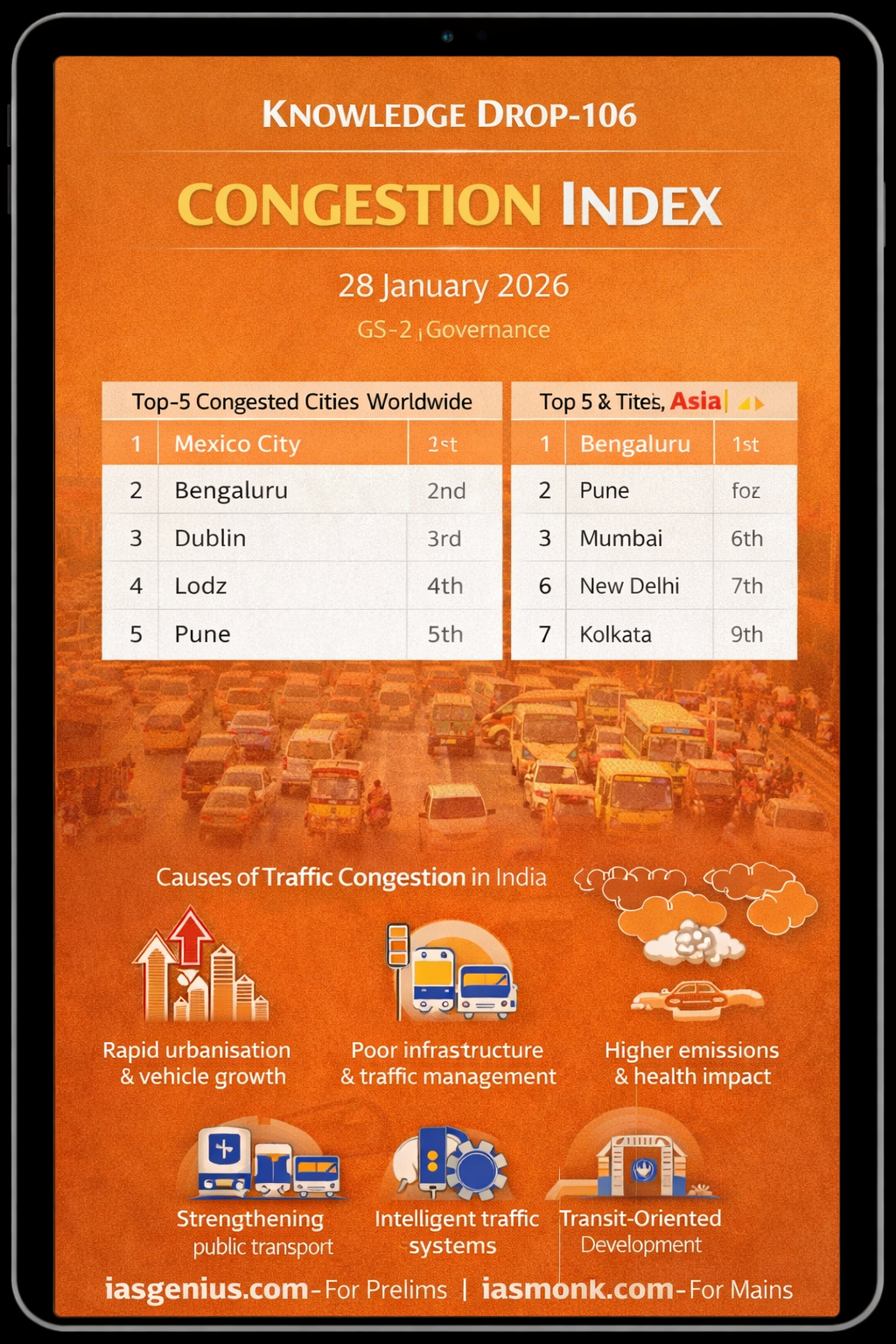
According to the 2025 TomTom Traffic Index, India has been ranked the fifth most traffic-congested country globally and second in Asia, highlighting the growing crisis of urban mobility in Indian cities.
📘 About the TomTom Traffic Index
• The index evaluates cities worldwide based on average travel time, congestion levels, and vehicle speeds.
• It is widely used to track changes in urban mobility and compare congestion trends across regions and countries.
• Bengaluru emerged as India’s most traffic-congested city, recording an average congestion level of 74.4%.
• Bengaluru and Kolkata were both listed among the world’s five slowest cities.
• Among the top 10 most congested cities in Asia, six are from India:
– Bengaluru (1)
– Pune (2)
– Mumbai (6)
– New Delhi (7)
– Kolkata (9)
– Jaipur (10)
🌍 Top 10 Most Congested Cities (Worldwide, 2025)
- Mexico City, Mexico – Highest congestion globally.
- Bengaluru, India – World #2 with ~74.4 % congestion.
- Dublin, Ireland – High congestion in Europe.
- Lodz, Poland – Among global top congested cities.
- Pune, India – World #5.
- Bogotá, Colombia – Appears among top-10 in some listings.
- Lima, Peru – Listed among global traffic hotspots.
- Medellín, Colombia – Among top-10 in congestion analysis.
- Arequipa, Peru – Appears in continental congestion breakdowns.
- Barranquilla, Colombia – Frequently cited as among the slowest cities by travel time.
🚦 Causes of Traffic Congestion in India
• Rapid Urbanisation and Population Growth:
Increasing urban populations are putting enormous pressure on limited road space.
• Rising Private Vehicle Ownership:
Higher incomes and inadequate public transport have led to a surge in private vehicles, outpacing road capacity growth.
• Inadequate and Poorly Planned Infrastructure:
Narrow roads, missing bypasses, and weak network planning reduce road efficiency.
• Mixed Traffic Conditions:
Vehicles of different speeds and sizes share the same roads, and the lack of lane discipline slows traffic flow.
• Poor Traffic Management and Enforcement:
Weak enforcement of traffic rules and inefficient signal management worsen congestion.
• Encroachments and On-Street Parking:
These reduce the effective road width, further choking traffic movement.
⚠️ Implications of Traffic Congestion
• Economic Losses:
Fuel wastage, delayed logistics, and reduced productivity increase overall economic costs.
• Environmental Degradation:
Higher air and noise pollution worsen urban health outcomes and quality of life.
• Climate Impact:
Increased carbon emissions undermine climate and sustainability goals.
• Public Health and Well-being:
Long waiting hours raise stress levels and road rage, affecting mental health and social well-being.
• Emergency Services at Risk:
Congested roads delay ambulances and fire services, putting lives in danger.
• Road Safety Concerns:
Chaotic traffic and rule violations increase the risk of road accidents.
• Urban Livability and Business Climate:
Persistent congestion reduces the quality of urban life and the ease of doing business.
🛠️ Initiatives to Combat Traffic Congestion in India
• Strengthening Public Transport:
Expansion of metro rail, BRTS, suburban rail, and electric buses to reduce dependence on private vehicles.
• Intelligent Traffic Management Systems (ITMS):
Use of AI, sensors, and adaptive traffic signals to improve traffic flow and reduce bottlenecks.
• Transit-Oriented Development (TOD):
Integrating land use planning with mass transit corridors to reduce travel distances and car dependency.
• Urban Road Infrastructure Upgrades:
Construction of flyovers, ring roads, and dedicated lanes to improve network capacity.
• Parking Management Reforms:
Introduction of parking pricing, multi-level parking facilities, and no-parking zones to manage road space better.
• Promotion of Non-Motorised Transport:
Development of footpaths and cycle tracks to encourage walking and cycling for short trips.
• Policy and Behavioural Measures:
Steps such as congestion pricing, staggered office timings, and stricter enforcement of traffic rules to manage demand.
🧭 IAS Monk Whisper
A city does not choke only on vehicles; it chokes on choices. When movement becomes a daily struggle, governance must learn to move faster than traffic.
Target IAS-2026+: Highly Expected Prelims MCQs :
📌 Prelims Practice MCQs
Topic: 🧠 Knowledge Drop-106 | Tom Tom Congestion Index
MCQ 1 | TYPE 1 — How Many Statements Are Correct?
Consider the following statements regarding the TomTom Traffic Index 2025:
1)The index ranks cities based on average travel time, congestion levels, and vehicle speeds.
2)India was ranked among the top five most traffic-congested countries globally.
3)Bengaluru recorded an average congestion level of about 74.4 percent.
4)The index measures only air pollution and not traffic movement.
How many of the above statements are correct?
A)Only one
B)Only two
C)Only three
D)All four
🌀 Didn’t get it? Click here (▸) for the Correct Answer & Explanation.
🟩 Correct Answer: C) Only three
🧠 Explanation:
Correct Answer: C) Only three
1)✅ True – The index uses travel time, congestion, and speed indicators.
2)✅ True – India was ranked fifth globally for congestion.
3)✅ True – Bengaluru recorded about 74.4 percent congestion.
4)❌ False – The index measures traffic conditions, not air pollution.
MCQ 2 | TYPE 2 — Two-Statement Type
Consider the following statements:
Statement 1: Bengaluru and Kolkata were listed among the world’s five slowest cities.
Statement 2: All of the top ten most congested cities in Asia are from India.
Which of the statements given above is/are correct?
A)Only 1 is correct
B)Only 2 is correct
C)Both are correct
D)Neither is correct
🌀 Didn’t get it? Click here (▸) for the Correct Answer & Explanation.
🟩 Correct Answer: A) Only 1 is correct
🧠 Explanation:
Correct Answer: A) Only 1 is correct
Statement 1:✅ True – Both Bengaluru and Kolkata feature among the world’s slowest cities.
Statement 2:❌ False – Six of the top ten in Asia are from India, not all ten.
MCQ 3 | TYPE 3 — Code-Based Statement Selection
Consider the following statements regarding causes of traffic congestion in India:
1)Rapid urbanisation and population growth increase pressure on limited road space.
2)Rising private vehicle ownership has outpaced road capacity growth.
3)Uniform vehicle speeds and strict lane discipline are major causes of congestion.
4)Encroachments and on-street parking reduce effective road width.
Which of the statements given above are correct?
A)1, 2 and 4 only
B)1 and 3 only
C)2 and 3 only
D)1, 2, 3 and 4
🌀 Didn’t get it? Click here (▸) for the Correct Answer & Explanation.
🟩 Correct Answer: A) 1, 2 and 4 only
🧠 Explanation:
Correct Answer: A) 1, 2 and 4 only
1)✅ True – Urban growth increases pressure on limited road space.
2)✅ True – Vehicle growth has exceeded road capacity expansion.
3)❌ False – Mixed traffic and lack of lane discipline, not uniform speeds, worsen congestion.
4)✅ True – Encroachments and parking reduce usable road width.
MCQ 4 | TYPE 4 — Direct Factual Question
Which one of the following cities was identified as India’s most traffic-congested city in the TomTom Traffic Index 2025?
A)Mumbai
B)New Delhi
C)Bengaluru
D)Kolkata
🌀 Didn’t get it? Click here (▸) for the Correct Answer & Explanation.
🟩 Correct Answer: C) Bengaluru
🧠 Explanation:
Correct Answer: C) Bengaluru
A)❌ Incorrect – Mumbai is highly congested but not ranked first in India in this index.
B)❌ Incorrect – New Delhi features among top congested cities but not at the top in India.
C)✅ Correct – Bengaluru recorded the highest congestion level in India.
D)❌ Incorrect – Kolkata is among the slowest cities but not the most congested in India.
MCQ 5 | TYPE 5 — UPSC 2025 Linkage Reasoning Format (I, II, III)
Consider the following statements:
Statement I:
Traffic congestion in Indian cities has serious economic, environmental, and social consequences.
Statement II:
Congestion leads to fuel wastage, delayed logistics, and higher carbon emissions.
Statement III:
Measures such as strengthening public transport, intelligent traffic systems, and transit-oriented development aim to reduce private vehicle dependence and improve traffic flow.
Which one of the following is correct?
A) Both Statements II and III are correct and both explain Statement I
B) Both Statements II and III are correct but only one explains Statement I
C) Only one of the Statements II and III is correct and that explains Statement I
D) Neither Statement II nor Statement III is correct
🌀 Didn’t get it? Click here (▸) for the Correct Answer & Explanation.
🟩 Correct Answer: A)
🧠 Explanation:
Correct Answer: A) Both Statements II and III are correct and both explain Statement I
Statement II:✅ True – These impacts explain the economic and environmental consequences of congestion.
Statement III:✅ True – These measures address the root causes and show why congestion is a governance and policy issue.