

🏭 Knowledge Drop-99 | Achieving Efficiencies in MSME Sector through Convergence of Schemes: NITI Aayog Report | IAS Prelims 2026-27 Highly Expected MCQs | Current Affairs & GS Essays on iasmonk.com
🏭 KD-99 | Achieving Efficiencies in MSME Sector through Convergence of Schemes: NITI Aayog Report
Post Date: 21 January 2026
Syllabus: GS3 | Economy
📌 Context
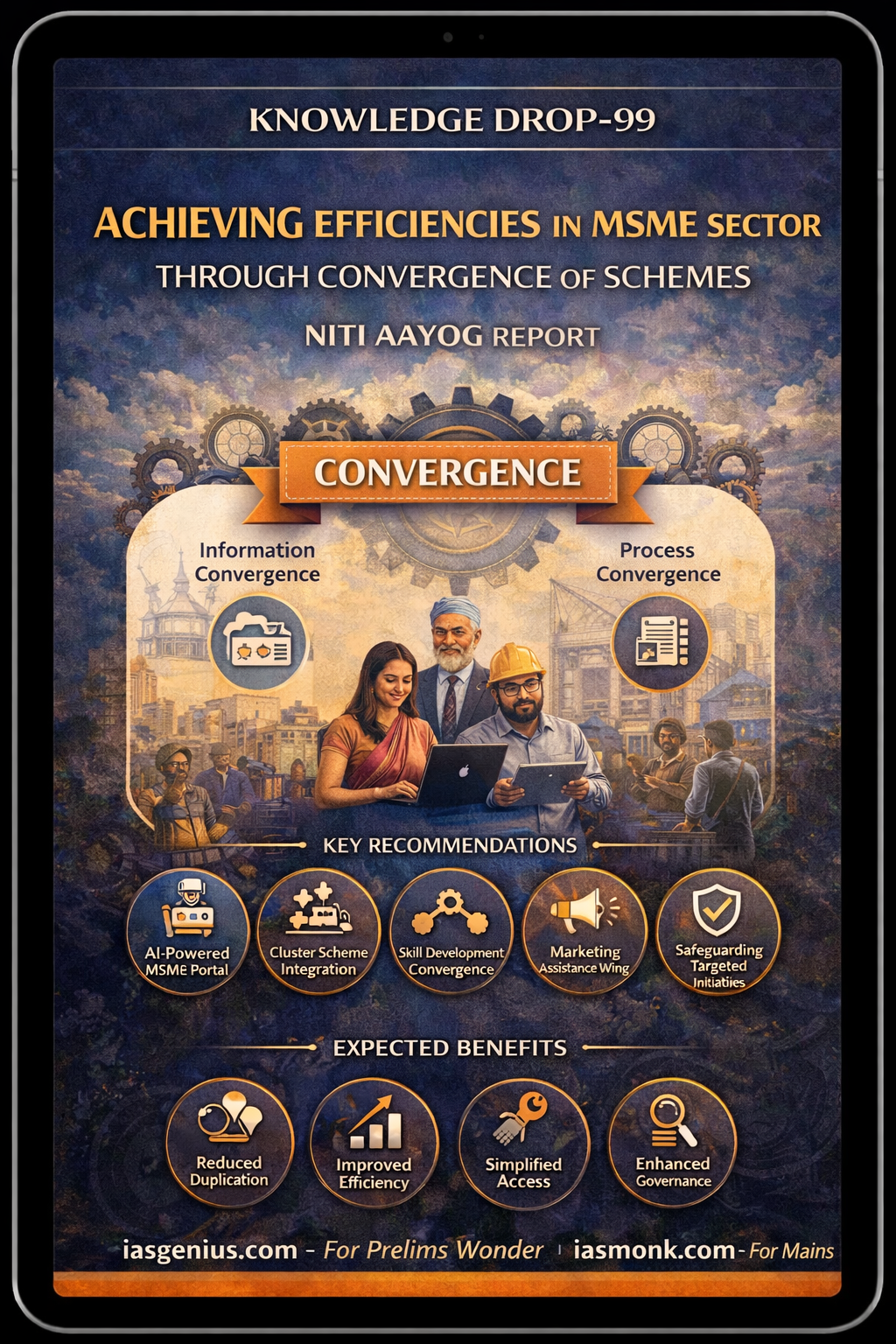
The NITI Aayog has released a report titled “Achieving Efficiencies in MSME Sector through Convergence of Schemes”, presenting a detailed framework to strengthen the effectiveness of government interventions in the MSME sector through better coordination, integration, and governance.
🔄 Why Convergence of Schemes is Needed
1) Avoid Duplication and Inefficiency
- The Ministry of MSME currently oversees 18 schemes with overlapping objectives.
- This leads to fragmented implementation, duplication of efforts, and reduced outreach to beneficiaries.
2) Enhance Efficiency and Outcomes
- Convergence:
- Simplifies access for beneficiaries
- Reduces administrative complexity
- Ensures that public resources translate into measurable development outcomes
🧩 Framework for Convergence: Two-Pronged Model
🔹 1) Information Convergence
Integration of data across central and state levels to:
- Enable informed policy decisions
- Improve inter-ministerial coordination
- Strengthen governance, monitoring, and evaluation
🔹 2) Process Convergence
Streamlining scheme structures to:
- Merge similar or overlapping programmes
- Combine common operational components
- Encourage collaboration across ministries and states
📋 Key Recommendations of the Report
🖥️ Centralised Digital Portal
- An AI-powered MSME portal integrating:
- All schemes
- Compliance mechanisms
- Finance options
- Market intelligence
- Features include:
- Unified access to scheme details
- AI chatbots and dashboards for guidance
- Real-time mobile accessibility
- Data-driven decision support
🏗️ Cluster Development Scheme Integration
- Proposes merging:
- SFURTI (Scheme of Fund for Regeneration of Traditional Industries)
- With MSE-CDP (Micro and Small Enterprises – Cluster Development Programme)
- Key elements:
- A dedicated sub-scheme for traditional industries
- Unified governance under MSE-CDP
- Consolidated funding for scale and efficiency
🎓 Skill Development Convergence
- Rationalisation of skill programmes into a three-tier structure:
- Entrepreneurship and business management
- MSME technical and digital skills
- Training for rural and women artisans
- Benefits:
- Better coordination
- Retains inclusivity
- Promotes traditional and local crafts
📢 Dedicated Marketing Assistance Wing
- Creation of a Marketing Wing with two divisions:
Domestic Wing:
- Facilitates:
- Trade fairs
- Buyer-seller meets
- National exhibitions
International Wing:
- Supports:
- Overseas trade fairs
- Global B2B events
- Market access for Indian MSMEs
🌱 Integration of Innovation and ASPIRE Schemes
- Proposes integration of:
- ASPIRE (A Scheme for Promoting Innovation, Rural Industry & Entrepreneurship)
- Into MSME Innovative
- To create a unified innovation framework for agro-rural enterprises
- Existing ASPIRE funds will continue
- Future budgets will earmark a portion for rural incubation
🛡️ Safeguarding Targeted Initiatives
The report stresses that some schemes must remain independent due to their scale and strategic importance, including:
- National SC/ST Hub
- Promotion of MSMEs in the North Eastern Region (NER)
- PMEGP
- PM Vishwakarma
🏛️ Implementation Strategy and Governance
- The convergence strategy recommends a cautious and phased approach:
- Merge schemes with overlapping objectives
- Preserve the identity of flagship and targeted initiatives
- Where mergers are not feasible, the report suggests:
- Joint workshops for inter-ministerial coordination
- Shared capacity-building initiatives
- Continuous tracking of outcomes to ensure sustained impact
- Overall Goal:
- Improve governance efficiency
- Reduce administrative burden
- Maximise the economic contribution of MSMEs to India’s growth
🌍 MSMEs and the Indian Economic Landscape
- Global Perspective (World Bank):
- MSMEs account for about 90% of formal businesses
- And nearly 50% of global employment
- India’s MSME Sector:
- Over 74 million registered enterprises
- Including 29 million women-led businesses
- Providing employment to over 320 million people
- Economic Contribution:
- ~30% of GDP
- ~45% of manufacturing output
- ~40% of exports
- MSME Classification (Revised in 2020):
a) Micro Enterprises: Investment ≤ ₹1 crore and turnover ≤ ₹5 crore
b) Small Enterprises: Investment ≤ ₹10 crore and turnover ≤ ₹50 crore
c) Medium Enterprises: Investment ≤ ₹50 crore and turnover ≤ ₹250 crore - The 2020 revision made the framework more inclusive and growth-oriented.
🏁 Conclusion
The NITI Aayog’s convergence framework seeks to transform the governance architecture of MSME support in India. By reducing fragmentation, improving coordination, and leveraging digital integration, the approach promises to enhance efficiency, scale impact, and strengthen MSMEs as a backbone of India’s growth, employment, and exports.
🪔 IAS Monk Whisper
When many schemes learn to walk as one, the smallest enterprise begins to carry the weight of a nation’s ambition.
Target IAS-2026+: Highly Expected Prelims MCQs :
📌 Prelims Practice MCQs
Topic: 🏭 KD-99 | Achieving Efficiencies in MSME Sector through Convergence of Schemes: NITI Aayog Report
MCQ 1 | TYPE 1 — How Many Statements Are Correct?
Consider the following statements regarding the NITI Aayog report on MSME scheme convergence:
1)The Ministry of MSME oversees 18 schemes with overlapping objectives.
2)The report recommends both information convergence and process convergence.
3)The primary goal of convergence is to replace all existing MSME schemes with a single umbrella scheme.
4)Convergence aims to simplify beneficiary access and improve governance outcomes.
How many of the above statements are correct?
A)Only one
B)Only two
C)Only three
D)All four
🌀 Didn’t get it? Click here (▸) for the Correct Answer & Explanation.
🟩 Correct Answer: C) Only three
🧠 Explanation:
1)✅ True – The Ministry of MSME currently oversees 18 schemes with overlapping objectives.
2)✅ True – The framework proposes both information and process convergence.
3)❌ False – The aim is not to replace all schemes with one, but to streamline and integrate where appropriate.
4)✅ True – Convergence is meant to simplify access, reduce complexity, and improve outcomes.
MCQ 2 | TYPE 2 — Two-Statement Type
Consider the following statements:
Statement 1: Information convergence focuses on integrating data across central and state levels to improve policy coordination and monitoring.
Statement 2: Process convergence primarily aims at increasing the number of MSME schemes to ensure wider coverage.
Which of the following is correct?
A)Only Statement 1 is correct
B)Only Statement 2 is correct
C)Both statements are correct
D)Neither statement is correct
🌀 Didn’t get it? Click here (▸) for the Correct Answer & Explanation.
🟩 Correct Answer: A) Only 1 is correct
🧠 Explanation:
Statement 1)✅ True – Information convergence is about data integration for better governance and coordination.
Statement 2)❌ False – Process convergence seeks to merge and streamline schemes, not increase their number.
MCQ 3 | TYPE 3 — Code-Based Statement Selection
Consider the following statements regarding key recommendations of the NITI Aayog report:
1)An AI-powered centralized MSME portal integrating schemes, compliance, finance, and market intelligence has been proposed.
2)The report suggests merging SFURTI with MSE-CDP under a unified cluster development framework.
3)Skill development programmes are to be expanded without any structural rationalisation.
4)A dedicated Marketing Assistance Wing with domestic and international divisions has been recommended.
Which of the above statements are correct?
A)1, 2 and 3 only
B)1, 2 and 4 only
C)2 and 3 only
D)1, 2, 3 and 4
🌀 Didn’t get it? Click here (▸) for the Correct Answer & Explanation.
🟩 Correct Answer: B)1, 2 and 4 only
🧠 Explanation:
1)✅ True – The report proposes an AI-powered centralized MSME portal.
2)✅ True – It recommends integrating SFURTI with MSE-CDP.
3)❌ False – The report proposes rationalisation into a three-tier skill structure.
4)✅ True – A Marketing Assistance Wing with domestic and international divisions is recommended.
MCQ 4 | TYPE 4 — Direct Factual Question
Which of the following schemes is proposed to be integrated into ‘MSME Innovative’ to create a unified innovation framework for agro-rural enterprises?
A)PMEGP
B)SFURTI
C)ASPIRE
D)PM Vishwakarma
🌀 Didn’t get it? Click here (▸) for the Correct Answer & Explanation.
🟩 Correct Answer: C)ASPIRE
🧠 Explanation:
The report proposes integrating ASPIRE into MSME Innovative to create a unified innovation framework for agro-rural enterprises.
MCQ 5 | TYPE 5 — UPSC 2025 Linkage Reasoning Format (I, II, III)
Consider the following statements:
Statement I:
Convergence of MSME schemes is expected to improve governance efficiency and development outcomes.
Statement II:
Merging overlapping schemes and integrating data systems can reduce administrative complexity and duplication.
Statement III:
Safeguarding targeted initiatives like PMEGP, PM Vishwakarma, and National SC/ST Hub ensures focused support where scale and strategic importance demand it.
Which one of the following is correct?
A)Both Statements II and III are correct and both explain Statement I
B)Both Statements II and III are correct but only one explains Statement I
C)Only one of the Statements II and III is correct and that explains Statement I
D)Neither Statement II nor Statement III is correct
🌀 Didn’t get it? Click here (▸) for the Correct Answer & Explanation.
🟩 Correct Answer: A)
🧠 Explanation:
Statement II)✅ True – Reducing duplication and complexity through mergers and data integration directly improves governance efficiency.
Statement III)✅ True – Preserving targeted schemes ensures effectiveness while pursuing convergence, strengthening overall outcomes.
Together, both statements explain why convergence is expected to improve governance efficiency and development outcomes, as stated in Statement I.