

🚜 Knowledge Drop-97 | National Campaign on Entrepreneurship for Rural Women under DAY-NRLM: Boosting Non-Farm Livelihoods | IAS Prelims 2026-27 Highly Expected MCQs | Current Affairs & GS Essays on iasmonk.com
🚜 KD-97 | National Campaign on Entrepreneurship for Rural Women under DAY-NRLM: Boosting Non-Farm Livelihoods
Post Date: 19 January 2026
Syllabus: GS2 | Governance, Rural Development
📌 In News
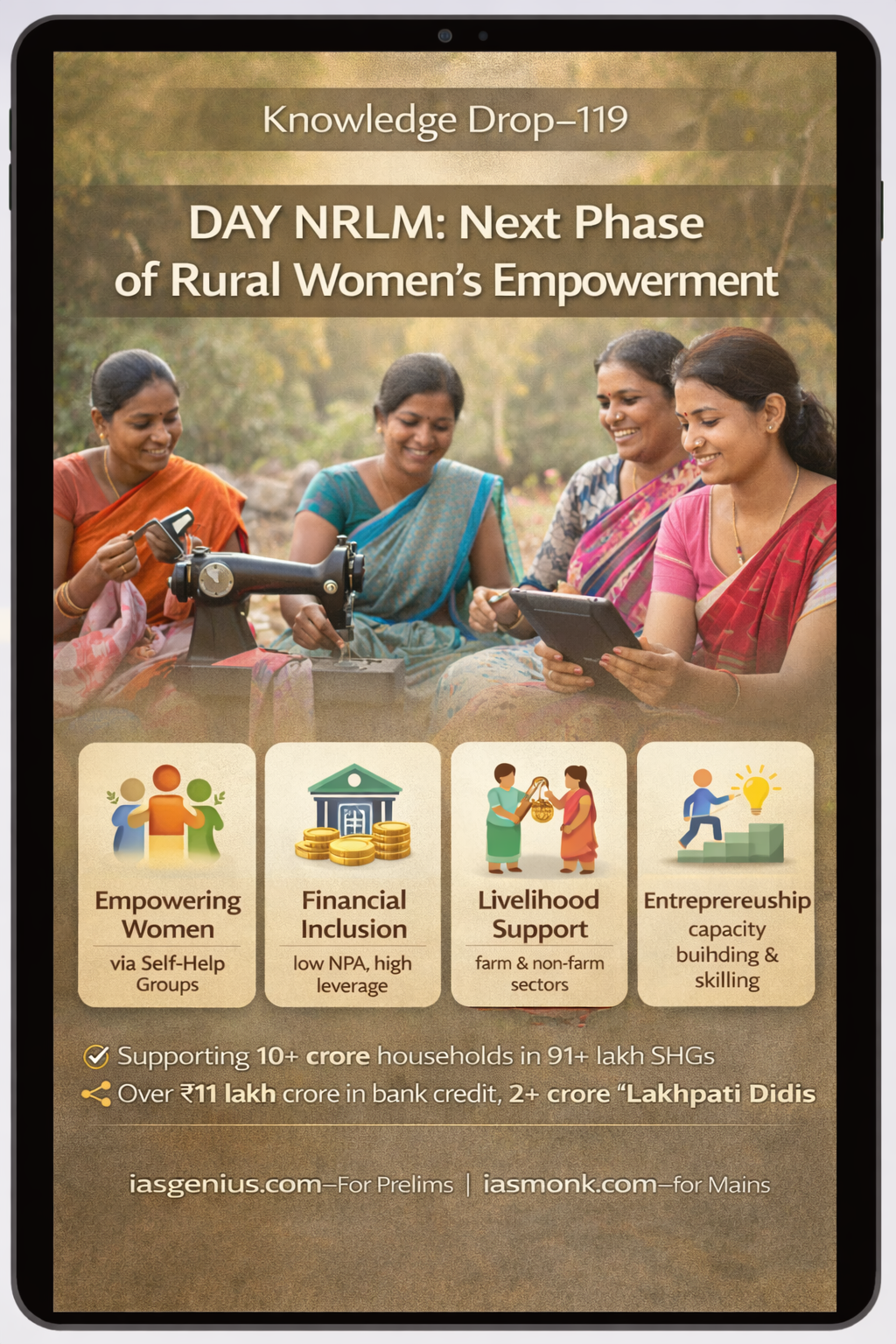
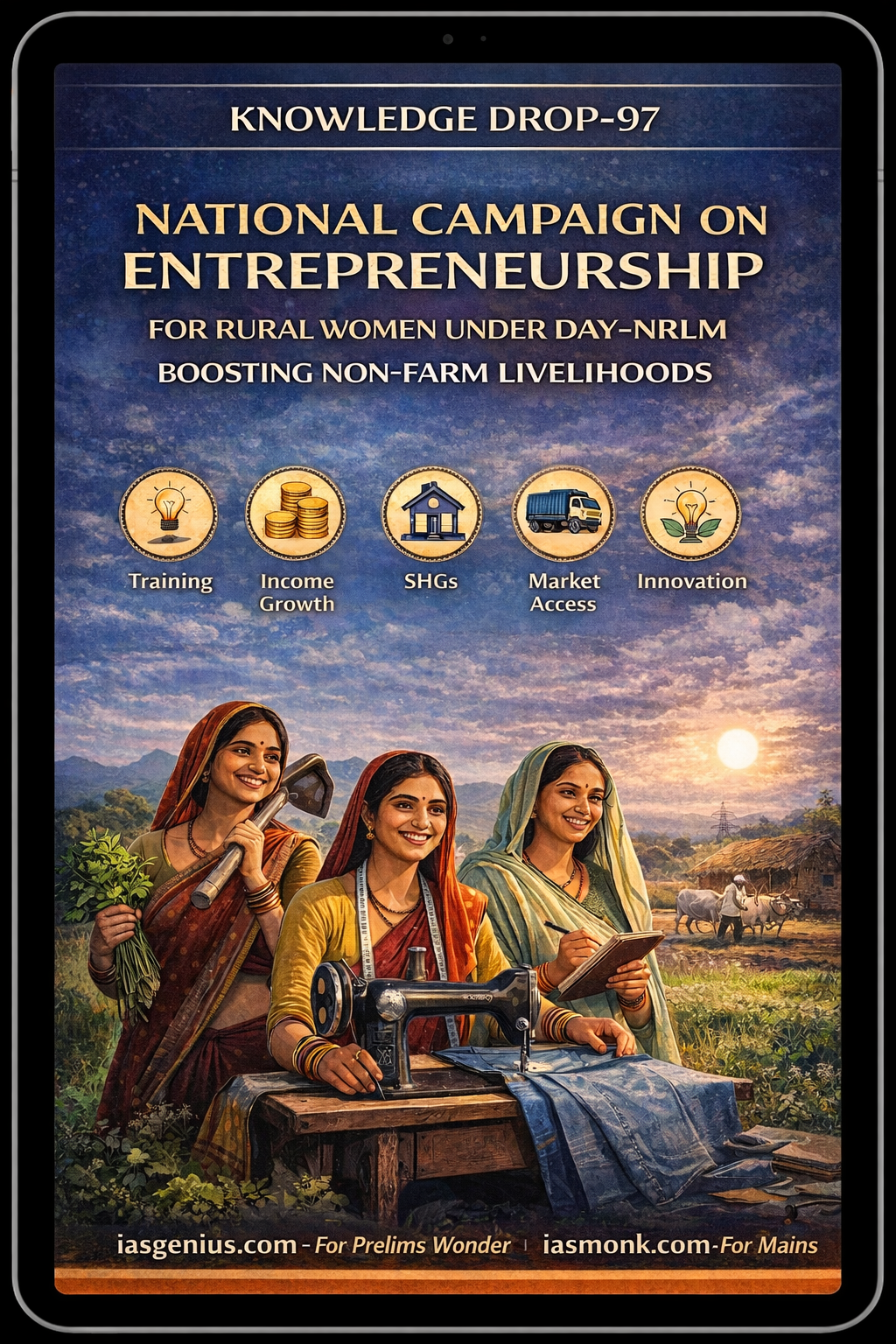
The Ministry of Rural Development has launched a National Campaign on Entrepreneurship to strengthen non-farm livelihoods for rural women under the Deendayal Antyodaya Yojana – National Rural Livelihoods Mission (DAY-NRLM).
- The campaign aims to:
- Train 50,000 Community Resource Persons (CRPs) on enterprise promotion
- Impart Entrepreneurship Development Programme (EDP) training to 50 lakh SHG members
🌾 Why Rural Entrepreneurship Matters
1) Reducing Overdependence on Agriculture
- Agriculture still employs about 45% of India’s workforce but contributes only around 18% to GDP.
- Non-farm rural enterprises help absorb surplus labour and diversify rural incomes.
2) Employment and Income Generation
- MSMEs contribute about 30% of India’s GDP and 45% of exports.
- Promoting rural enterprises expands the MSME base beyond urban centres.
3) Women-Led Development
- SHG-based enterprises improve female labour force participation, which remains around 25%.
- When women control income, it leads to better nutrition, health, and education outcomes.
4) Migration Reduction
- Local enterprises help reduce seasonal and distress migration from rural to urban areas.
🏛️ Government Steps to Foster Rural Entrepreneurship
🔹 Pradhan Mantri Employment Generation Programme (PMEGP)
- Implemented by KVIC
- Provides subsidies up to 35% on project costs (higher in rural areas)
- Supports new micro-enterprises in manufacturing and services
- Targets unemployed youth and artisans
- Loans up to ₹25 lakh
🔹 ASPIRE Scheme
- Launched by the Ministry of MSME
- Funds Livelihood Business Incubators (LBIs) in rural areas
- Provides up to ₹1 crore for:
- Infrastructure
- Skill programmes
- Innovation support
- Aims to nurture agro-rural startups
🔹 Lakhpati Didi Initiative
- Recognises SHG women achieving ₹1 lakh+ annual household income (₹10,000+ monthly)
- Achieved over four seasons/cycles through farm and non-farm activities
- Acts as a motivational and outcome-based benchmark for women-led livelihoods
🔹 NABARD’s Role
- Supports rural non-farm sectors through:
- Refinancing
- Infrastructure creation (e.g., rural haats)
- Capacity-building for SHGs and FPOs
- Programmes like MEDPs and LEDPs
⚠️ Challenges in Rural Entrepreneurship
- Limited access to credit and markets
- Inadequate skills, training, and mentoring
- Weak infrastructure and logistics
- Low technology adoption
- Market volatility and scale constraints for rural enterprises
📘 About DAY-NRLM (Deendayal Antyodaya Yojana – NRLM)
- Launch: 2011 (restructured from Swarnajayanti Gram Swarojgar Yojana – SGSY)
- Renamed as DAY-NRLM in 2016
- Nodal Ministry: Ministry of Rural Development
- Funding Pattern: Centrally Sponsored Scheme
- 60:40 (Centre:State)
- 90:10 for North-Eastern and Himalayan states
🎯 Objective
- Reduce poverty by enabling poor rural households to access sustainable livelihoods and enhanced incomes
🧩 Core Strategy
a) Universal mobilisation of rural poor women into Self-Help Groups (SHGs)
b) Capacity building, access to credit, and livelihood diversification
🔍 Key Focus Areas
a) Farm livelihoods
b) Non-farm livelihoods and enterprises
c) Financial inclusion and social empowerment
🏁 Conclusion
The National Campaign on Entrepreneurship under DAY-NRLM strengthens India’s push toward diversified, women-led, and resilient rural livelihoods. By scaling skills, enterprise promotion, and institutional support, it addresses structural challenges of rural underemployment, migration, and income insecurity while deepening the foundations of inclusive growth.
🪔 IAS Monk Whisper
When a village learns to create, not just cultivate, it stops waiting for opportunity and begins manufacturing dignity.
Target IAS-2026+: Highly Expected Prelims MCQs :
📌 Prelims Practice MCQs
Topic: 🚜 KD-97 | National Campaign on Entrepreneurship for Rural Women under DAY-NRLM: Boosting Non-Farm Livelihoods
MCQ 1 | TYPE 1 — How Many Statements Are Correct?
Consider the following statements regarding the National Campaign on Entrepreneurship under DAY-NRLM:
1)The campaign aims to strengthen non-farm livelihoods for rural women.
2)It targets training of 50,000 Community Resource Persons (CRPs) in enterprise promotion.
3)It seeks to provide Entrepreneurship Development Programme (EDP) training to 5 lakh SHG members.
4)The campaign is implemented under the Deendayal Antyodaya Yojana – National Rural Livelihoods Mission.
How many of the above statements are correct?
A)Only one
B)Only two
C)Only three
D)All four
🌀 Didn’t get it? Click here (▸) for the Correct Answer & Explanation.
🟩 Correct Answer: C) Only three
🧠 Explanation:
1)✅ True – The campaign focuses on strengthening non-farm livelihoods for rural women.
2)✅ True – It targets training 50,000 CRPs on enterprise promotion.
3)❌ False – The target is 50 lakh SHG members, not 5 lakh.
4)✅ True – The campaign is under DAY-NRLM.
MCQ 2 | TYPE 2 — Two-Statement Type
Consider the following statements:
Statement 1: Agriculture employs about 45% of India’s workforce but contributes only around 18% to GDP.
Statement 2: Promoting non-farm rural enterprises helps absorb surplus labour and diversify rural incomes.
Which of the following is correct?
A)Only Statement 1 is correct
B)Only Statement 2 is correct
C)Both statements are correct
D)Neither statement is correct
🌀 Didn’t get it? Click here (▸) for the Correct Answer & Explanation.
🟩 Correct Answer: C)Both statements are correct
🧠 Explanation:
Statement 1)✅ True – This reflects the structural imbalance in employment and GDP contribution.
Statement 2)✅ True – Non-farm enterprises are crucial for labour absorption and income diversification.
MCQ 3 | TYPE 3 — Code-Based Statement Selection
Consider the following statements regarding government initiatives for rural entrepreneurship:
1)PMEGP provides subsidies on project costs for setting up new micro-enterprises in manufacturing and services.
2)The ASPIRE scheme supports Livelihood Business Incubators (LBIs) in rural areas.
3)Lakhpati Didi Initiative recognises SHG women achieving ₹1 lakh or more annual household income.
4)NABARD’s role is limited only to refinancing and does not include capacity building or infrastructure support.
Which of the above statements are correct?
A)1, 2 and 3 only
B)1 and 3 only
C)2 and 4 only
D)1, 2, 3 and 4
🌀 Didn’t get it? Click here (▸) for the Correct Answer & Explanation.
🟩 Correct Answer: A)1, 2 and 3 only
🧠 Explanation:
1)✅ True – PMEGP offers subsidies for new micro-enterprises.
2)✅ True – ASPIRE funds LBIs in rural areas.
3)✅ True – Lakhpati Didi recognises SHG women crossing ₹1 lakh annual income.
4)❌ False – NABARD also supports infrastructure and capacity building, not just refinancing.
MCQ 4 | TYPE 4 — Direct Factual Question
Which of the following statements best describes the funding pattern of DAY-NRLM?
A)A fully Central Sector Scheme with 100% central funding
B)A Centrally Sponsored Scheme with 60:40 Centre–State sharing and 90:10 for NE and Himalayan states
C)A State Sector Scheme funded entirely by States
D)A Centrally Sponsored Scheme with 75:25 Centre–State sharing for all States
🌀 Didn’t get it? Click here (▸) for the Correct Answer & Explanation.
🟩 Correct Answer: B)A Centrally Sponsored Scheme with 60:40 Centre–State sharing and 90:10 for NE and Himalayan states
🧠 Explanation:
DAY-NRLM follows a 60:40 Centre–State pattern and 90:10 for North-Eastern and Himalayan states.
MCQ 5 | TYPE 5 — UPSC 2025 Linkage Reasoning Format (I, II, III)
Consider the following statements:
Statement I:
Promoting rural entrepreneurship is essential for achieving inclusive and sustainable rural development in India.
Statement II:
Rural non-farm enterprises help reduce overdependence on agriculture and absorb surplus rural labour.
Statement III:
Women-led SHG enterprises improve household welfare outcomes and reduce distress migration.
Which one of the following is correct?
A)Both Statements II and III are correct and both explain Statement I
B)Both Statements II and III are correct but only one explains Statement I
C)Only one of the Statements II and III is correct and that explains Statement I
D)Neither Statement II nor Statement III is correct
🌀 Didn’t get it? Click here (▸) for the Correct Answer & Explanation.
🟩 Correct Answer: A)
🧠 Explanation:
Statement II)✅ True – Diversifying into non-farm enterprises explains why entrepreneurship supports inclusive growth.
Statement III)✅ True – Improved welfare and reduced migration through women-led enterprises further explain the development impact.
Together, both statements explain why promoting rural entrepreneurship is central to inclusive and sustainable rural development.