











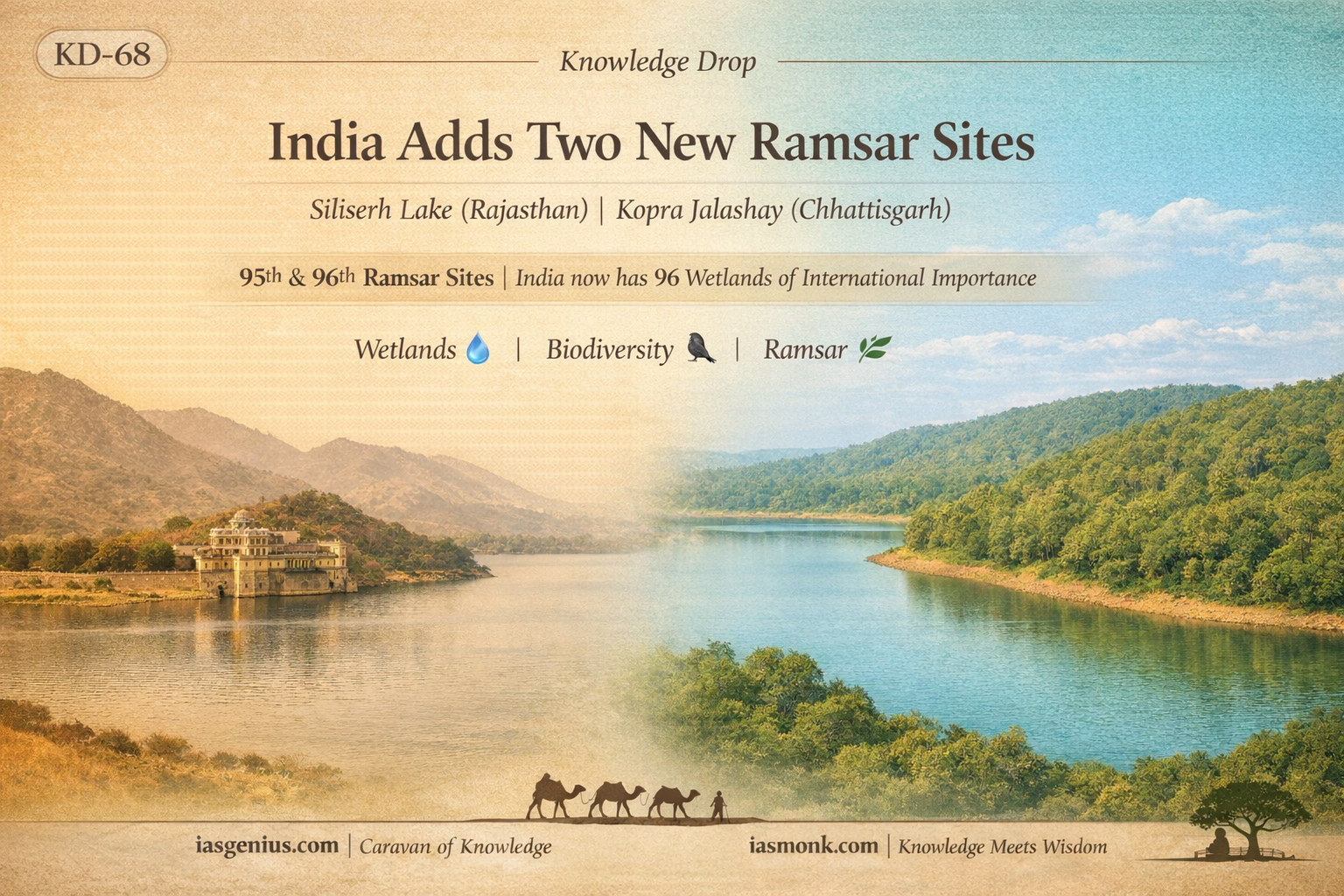
🌑Knowledge Drop – 68: Siliserh Lake and Kopra Jalashay Designated as New Ramsar Sites | For prelims: Highly expected MCQs | For Mains, All G.S Papers: High Quality Essays on iasmonk.com
Siliserh Lake and Kopra Jalashay Designated as New Ramsar Sites
Posted On: 21-12-2025
Syllabus: GS-3 | 🌱 Environment & Ecology
Context 🌍
India has designated Siliserh Lake and Kopra Jalashay as its 95th and 96th Ramsar Sites, raising the total number of Ramsar sites in the country to 96, up from 26 in 2014.
This marks a significant strengthening of India’s commitment to wetland conservation and biodiversity protection.
What are Wetlands? 💧
Wetlands are ecosystems where land and water intersect, playing a critical role in ecological stability, climate regulation, and human livelihoods.
According to the Ramsar Convention, wetlands include:
“Areas of marsh, fen, peatland or water, whether natural or artificial, permanent or temporary, with water that is static or flowing, fresh, brackish or salt, including areas of marine water the depth of which at low tide does not exceed six metres.”
Key Ecological Functions of Wetlands 🌿
- Act as natural flood buffers and recharge groundwater
- Function as carbon sinks, aiding climate mitigation
- Support rich biodiversity, especially migratory birds
- Provide livelihoods through fisheries, agriculture, and eco-tourism
Human-made Wetlands 🏗️
The Ramsar Convention also recognizes artificial wetlands, such as:
- Fish and shrimp ponds
- Farm ponds and irrigated agricultural lands
- Salt pans and reservoirs
- Gravel pits, sewage farms, and canals
What is the Ramsar Convention? 📜
The Ramsar Convention is one of the oldest inter-governmental environmental treaties, aimed at conserving wetlands of international importance and promoting their wise use.
Key Facts 🗓️
- Signed on February 2, 1971 at Ramsar, Iran
- Came into force in 1975
- India became a signatory in 1982
- February 2 is observed as World Wetlands Day
Core Focus 🎯
- Conservation of wetland ecosystems
- Sustainable use of wetland resources
- International cooperation for shared wetlands
Newly Designated Ramsar Sites 🏞️
1. Siliserh Lake (Rajasthan)
- Man-made freshwater lake built in 1845
- Constructed by Maharaja Vinay Singh of Alwar
- Originally developed to meet drinking water needs of Alwar city
- Located near the Sariska Tiger Reserve, enhancing ecological value
- Supports regional water security and aquatic biodiversity
2. Kopra Jalashay (Chhattisgarh)
- Located near Bilaspur
- 🏅 First Ramsar Site in Chhattisgarh
- A reservoir in the upper catchment of the Mahanadi River
- Functions as:
- A freshwater resource
- A biodiversity habitat for wetland species
Why This Matters for UPSC 🎓
- Reflects India’s alignment with global environmental commitments
- High-probability Prelims factual + conceptual area
- Useful for GS-3 answers on wetlands, biodiversity, and climate resilience
- Strong example for Essay topics on sustainable development
IAS Monk Whisper 🌀
When a nation protects its wetlands, it protects water, memory, migration, and the silent intelligence of nature.
Target IAS-2026+: Highly Expected Prelims MCQs :
📌 Prelims Practice MCQs
Topic: Siliserh Lake and Kopra Jalashay Designated as New Ramsar Sites
MCQ 1 | TYPE 1 — How Many Statements Are Correct?
Consider the following statements regarding wetlands under the Ramsar Convention:
1)Wetlands include both natural and human-made ecosystems.
2)Only freshwater ecosystems qualify as wetlands under the Ramsar definition.
3)Marine areas with water depth not exceeding six metres at low tide can be classified as wetlands.
4)Wetlands play a role in groundwater recharge and flood mitigation.
How many of the above statements are correct?
(a)Only two
(b)Only three
(c)All four
(d)Only one
🌀 Didn’t get it? Click here (▸) for the Correct Answer & Explanation.
🟩 Correct Answer: (b)Only three
🧠 Explanation:
1)✅True – Ramsar includes natural and artificial wetlands.
2)❌False – Wetlands may be fresh, brackish, or saline.
3)✅True – Shallow marine waters up to 6 metres are included.
4)✅True – Flood control and groundwater recharge are key functions.
MCQ 2 | TYPE 2 — Two-Statement Type
Consider the following statements:
Statement I:The Ramsar Convention is one of the oldest inter-governmental treaties focused on environmental conservation.
Statement II:India became a signatory to the Ramsar Convention immediately after it came into force.
Which of the statements given above is/are correct?
(a)Only Statement I
(b)Only Statement II
(c)Both Statement I and II
(d)Neither Statement I nor II
🌀 Didn’t get it? Click here (▸) for the Correct Answer & Explanation.
🟩 Correct Answer: (a)Only Statement I
🧠 Explanation:
Statement I:✅True – Ramsar (1971) is among the oldest environmental treaties.
Statement II:❌False – India joined the Convention in 1982.
MCQ 3 | TYPE 3 — Code-Based Statement Selection
With reference to Siliserh Lake, consider the following statements:
1)It is a natural freshwater lake located in Rajasthan.
2)It was constructed during the 19th century.
3)It lies close to a major tiger reserve in Rajasthan.
Which of the statements given above is/are correct?
(a)2 and 3 only
(b)1 and 2 only
(c)1 and 3 only
(d)1,2 and 3
🌀 Didn’t get it? Click here (▸) for the Correct Answer & Explanation.
🟩 Correct Answer: (a)2 and 3 only
🧠 Explanation:
1)❌False – Siliserh Lake is man-made.
2)✅True – Constructed in 1845.
3)✅True – Located near Sariska Tiger Reserve.
MCQ 4 | TYPE 4 — Direct Factual Question
Kopra Jalashay, recently designated as a Ramsar Site, is located in which of the following States?
(a)Odisha
(b)Madhya Pradesh
(c)Chhattisgarh
(d)Jharkhand
🌀 Didn’t get it? Click here (▸) for the Correct Answer & Explanation.
🟩 Correct Answer: (c)Chhattisgarh
🧠 Explanation:
Kopra Jalashay is the first Ramsar Site of Chhattisgarh, located near Bilaspur in the upper catchment of the Mahanadi River.
MCQ 5 | TYPE 5 — UPSC 2025 Linkage Reasoning Format (I, II, III)
Which of the following best explains the ecological importance of designating reservoirs as Ramsar Sites?
(a)They enhance irrigation potential exclusively
(b)They promote tourism without ecological safeguards
(c)They integrate biodiversity conservation with sustainable water use
(d)They convert wetlands into protected forests
🌀 Didn’t get it? Click here (▸) for the Correct Answer & Explanation.
🟩 Correct Answer: (c)They integrate biodiversity conservation with sustainable water use
🧠 Explanation:
Ramsar designation emphasizes wise use, balancing human needs such as water supply with biodiversity conservation, especially in reservoirs and human-made wetlands.