


📅 May 10, 2025, Post 2: 🌐 TÜRKİYE–PAKISTAN NEXUS: STRATEGIC CHALLENGES FOR INDIA | Mains Essay / Target IAS-26 MCQs Attached: A complete Package, Dear Aspirants!
🌐 TÜRKİYE–PAKISTAN NEXUS: STRATEGIC CHALLENGES FOR INDIA — PETAL 002
May 10, 2025 | Category: News Drop / International Relations / Defense Diplomacy
🕊️ Intro Whisper:
In the shifting chessboard of Eurasian diplomacy, Türkiye and Pakistan have found common cause—India must now play a smarter game.
📜 Key Highlights
Historic Ties and Ideological Bond
• Türkiye and Pakistan share Cold War legacies—CENTO, RCD, and mutual support in Cyprus and Kashmir.
• Pakistan pledged early recognition to Turkish Cyprus; Türkiye supports Pakistan’s position on Kashmir in global forums.
Türkiye’s Strategic Expansion
• Opened its largest foreign military base in Somalia (2017) and supplied Baykar TB2 drones to Maldives (2024).
• Joint naval drills with Pakistan Navy, but minimal interaction with India’s defense forces.
Defense & Intelligence Nexus
• Türkiye is Pakistan’s 2nd largest arms supplier, after China.
• Deals include:
– Ada-class anti-submarine corvettes
– Drone tech transfers
• Pakistan-Türkiye High-Level Strategic Cooperation Council enables defense, trade & intelligence collaboration.
Türkiye’s Kashmir Stance
• Regularly raises Kashmir in international platforms, aligning with Pakistan, China, and Azerbaijan.
• Part of a trilateral anti-Armenia bloc (with Pakistan & Azerbaijan), with military backing.
🧭 GS Mapping
GS Paper 2 – International Relations (Bilateral & Trilateral Tensions)
GS Paper 3 – Defense Preparedness & Strategic Partnerships
Essay – Diplomacy in a Multipolar World
⚔️ India’s Strategic Response
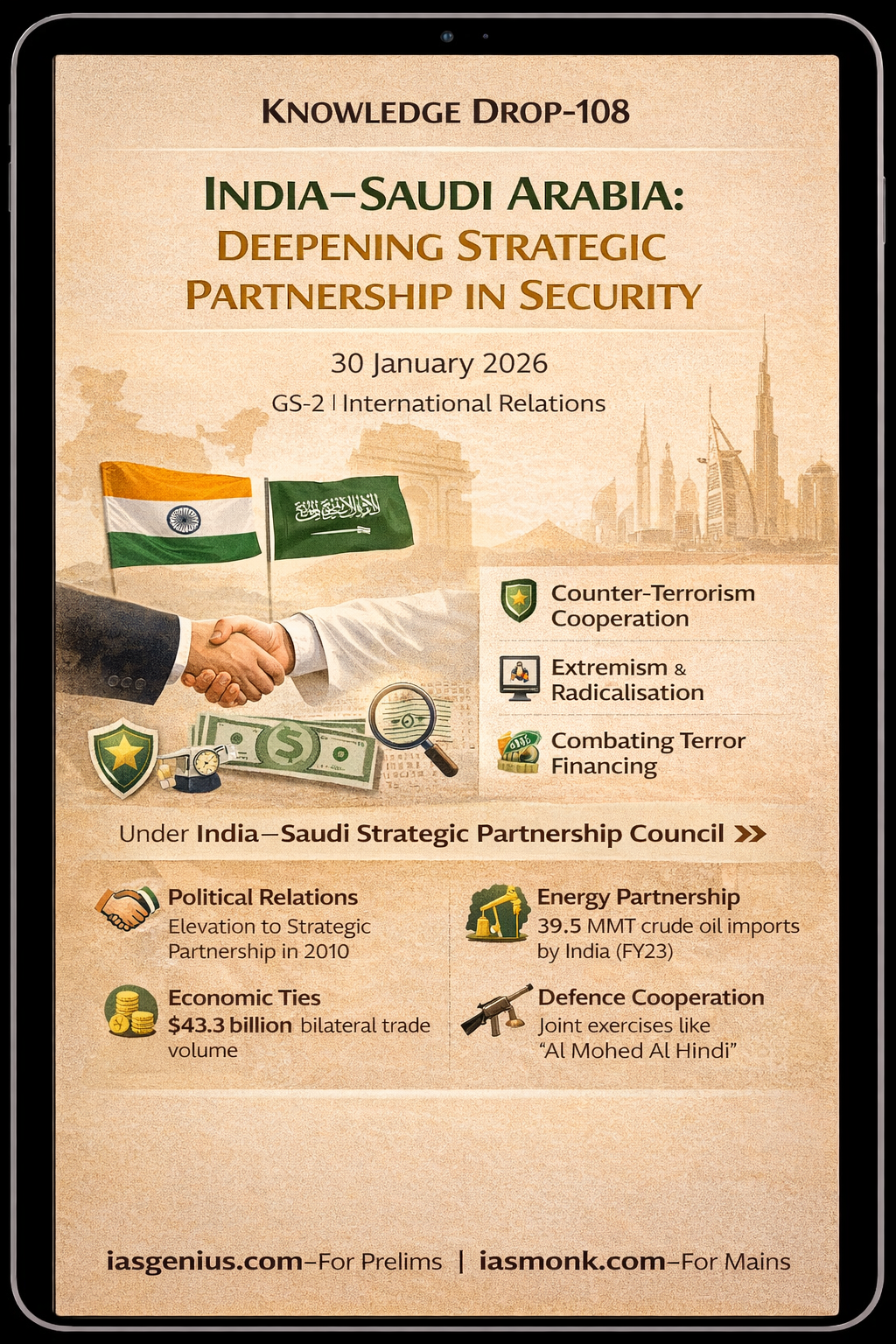
• Strengthening ties with Greece, Armenia, Saudi Arabia & UAE.
• Largest arms supplier to Armenia (2024), countering Turkish-Azeri-Pakistani bloc.
• Enhancing defense systems: S-400s, indigenous missiles, naval build-up.
• Rejecting Türkiye’s Kashmir stance as external interference in a bilateral issue.
📈 India-Türkiye Relations
• Formal ties since 1948; Trade crossed $10.7 billion in 2023.
• Areas of cooperation: Infrastructure, machinery, pharmaceuticals, textiles.
• Recent bilateral meetings at G20 and ASEAN platforms.
💭 A Thought Spark — by IAS Monk
When allies shape maps in shadows, a nation must strengthen its own light. India’s real strength lies not just in reaction, but in resilience, reach, and readiness.
High Quality Mains Essay For Practice :
Word Limit 1000-1200
Diplomacy in a Multipolar World
— Navigating Alliances, Asserting Autonomy, and Preserving Peace
Introduction: The Return of Many Poles
The post-Cold War dream of a unipolar world led by the United States was brief and turbulent. As new powers rise and old powers reassert themselves, the 21st century has unmistakably shifted into a multipolar global order—where power is dispersed among several influential nations, and no single superpower holds uncontested sway. In such a landscape, diplomacy is no longer a linear strategy of alignment, but a multidimensional art of balance.
From India’s ties with both the US and Russia, to Turkey’s simultaneous engagement with NATO and the SCO, diplomacy today demands adaptability, finesse, and strategic foresight. Multipolarity may be a challenge to dominance, but it is also an opportunity for autonomy and dialogue.
Understanding Multipolarity: A Framework of Fluidity
A multipolar world is one in which multiple nations—militarily, economically, or culturally—hold substantial global influence. This is distinct from bipolarity (e.g., Cold War US–USSR rivalry) or unipolarity (e.g., post-1991 US dominance).
Key features of a multipolar world:
- Shifting alliances, not rigid blocs
- Multiple power centers: US, China, Russia, EU, India, and regional powers like Brazil, Turkey, and Saudi Arabia
- Competing norms: Western liberalism vs. Asian sovereignty-driven models
- Issue-based cooperation: Nations cooperate in one domain while contesting in another
In such a world, diplomacy becomes dynamic, responding to a kaleidoscope of interests rather than ideological binaries.
Why Diplomacy Becomes Crucial in a Multipolar Setup
1. Preventing Fragmentation and Conflict
With multiple power nodes, the risk of proxy wars, regional disputes, and ideological fragmentation increases. Diplomacy becomes the first line of defense to manage tensions before they escalate.
2. Enabling Strategic Autonomy
For countries like India, multipolarity allows non-alignment 2.0—cooperating with the US on defense and with Russia on energy, while deepening ties with Iran and ASEAN. Diplomacy is the means to maintain such flexibility.
3. Driving Global Governance
From climate action to AI regulation, multilateral challenges require multi-stakeholder diplomacy. In a multipolar world, no challenge can be addressed without sustained diplomatic negotiation.
4. Economic Corridors and Connectivity
Initiatives like IMEC, BRI, and Iraq Development Road are not merely infrastructure projects—they are diplomatic instruments competing for influence. Countries must negotiate participation, rules, and terms of trade.
Case Studies: Diplomacy in Action in a Multipolar Context
India’s Balancing Act
India has pursued a multi-aligned foreign policy:
- QUAD with US, Japan, Australia
- SCO with China, Russia, Central Asia
- Energy ties with Iran and Saudi Arabia
- Defense trade with Israel, France, and Russia
Amid the Russia-Ukraine war, India maintained strategic neutrality, buying Russian oil while engaging with Western partners on Indo-Pacific security. This exemplifies issue-based diplomacy, where sovereignty and interests guide decisions.
Türkiye’s Cross-Platform Diplomacy
Türkiye is in NATO, engages with Russia, supports Azerbaijan militarily, and expands ties in Africa and Central Asia. Its diplomacy uses historical memory, religious affiliations, and defense exports as tools of influence.
China’s Assertive Diplomacy
China’s wolf warrior diplomacy, economic coercion, and Belt and Road Initiative mark a shift toward a power-projection model of diplomacy, seeking to build parallel institutions to Western dominance.
Europe’s Middle Path
The EU is trying to maintain transatlantic ties while asserting “strategic autonomy”, particularly in defense, digital regulation, and energy diversification post-Ukraine crisis.
Challenges of Diplomacy in a Multipolar World
1. Lack of Global Consensus
Global institutions like the UN, WTO, and WHO are struggling to adapt, often paralyzed by divergent interests of powerful member states.
2. Information Wars and Disinformation
Digital diplomacy is often disrupted by fake news, cyber-attacks, and AI-generated propaganda, complicating bilateral trust.
3. Weaponization of Trade and Technology
Semiconductors, rare earths, and AI are now tools of techno-nationalism. Sanctions and export controls are being used to further geopolitical agendas.
4. Crisis Multiplicity
Pandemics, climate disasters, energy shocks, and regional wars—diplomacy now juggles multiple parallel emergencies, each demanding real-time response and coalition-building.
India’s Diplomatic Doctrine for a Multipolar World
India’s evolving foreign policy reflects a nuanced understanding of multipolarity:
- “Vishwa Bandhu” (Friend to the World) – promotes India as a neutral, moral voice
- Neighbourhood First, Act East, Link West – regionally diversified approach
- Vaccine Maitri, Operation Ganga, Operation Kaveri – humanitarian diplomacy
- Digital and Climate Diplomacy – championing Global South needs at COP, G20
India’s leadership in G20 (2023) was a masterclass in navigating conflicting interests—bringing consensus amid Ukraine tensions, Global South advocacy, and focus on inclusive growth.
The Road Ahead: Redefining Global Diplomacy
To navigate a multipolar future, the nature of diplomacy must transform:
• From Static Protocol to Agile Engagement
– Real-time crises require flexible, digital diplomacy, not just formal envoys.
• From Ideology to Interest-Based Alliances
– Nations must build issue-specific coalitions—on climate, technology, or trade.
• From State-Centric to People-Centric
– Diplomacy must speak to diasporas, civil societies, start-ups, and youth.
• From Rhetoric to Resilience
– Future diplomacy must withstand disruption, adapt to AI governance, and manage space and cyberspace as new frontiers.
Conclusion: The Diplomat’s Dance in a Fractured World
In a world with many centers, no one power can dictate terms. But equally, no single pole can be ignored. The art of diplomacy today is like walking a tightrope over shifting sands—requiring balance, adaptability, and purpose.
As the world realigns along geography, ideology, technology, and economics, diplomacy must evolve from posturing to problem-solving, from silos to synergy. In this age of multipolarity, diplomacy is not just the art of negotiation—it is the architecture of peace.
Target IAS-26: Daily MCQs :
📌 Prelims Practice MCQs
Topic:
MCQ 1 (Type 1)
Consider the following statements about the nature of diplomacy in a multipolar world:
1. Diplomacy is based solely on permanent alliances between nations.
2. Multipolar diplomacy enables issue-based and flexible cooperation.
3. Strategic autonomy becomes increasingly difficult in a multipolar world.
4. Multipolarity reduces the possibility of unilateral dominance.
How many of the above statements are correct?
A) Only two
B) Only three
C) All four
D) Only one
🌀 Didn’t get it? Click here (▸) for the Correct Answer & Explanation
✅ Correct Answer: B) Only three
🧠 Explanation:
1) Incorrect – Multipolar diplomacy is not solely based on permanent alliances, but favors shifting alignments.
2) Correct – Multipolarity allows for issue-based coalitions and greater flexibility.
3) Incorrect – It actually enhances the ability of countries like India to pursue strategic autonomy.
4) Correct – By distributing power, multipolarity reduces unilateral global control. ✅ Statements 2, 3, and 4 are correct.
MCQ 2 (Type 2)
Statement 1: In a multipolar world, a country can simultaneously maintain strong ties with rival powers without being part of formal military blocs.
Statement 2: The only superpower recognized in a multipolar system is the United States.
Which of the above statements is/are correct?
A) Only 1 is correct
B) Only 2 is correct
C) Both are correct
D) Neither is correct
🌀 Didn’t get it? Click here (▸) for the Correct Answer & Explanation
✅ Correct Answer: A) Only 1 is correct
🧠 Explanation:
•1) Correct – Multipolar diplomacy allows simultaneous strategic partnerships, e.g., India–Russia–US ties.
• 2) Incorrect – A multipolar world includes many influential powers (China, EU, Russia, etc.), not just the US.
✅ Only Statement 1 is correct.
MCQ 3 (Type 3)
Which of the following examples demonstrate diplomacy in a multipolar world?
1. India’s membership in both the QUAD and the Shanghai Cooperation Organisation (SCO)
2. Türkiye conducting joint military exercises with NATO and purchasing Russian S-400 missile systems
3. The European Union maintaining strategic autonomy despite being part of Western alliances
4. Russia and China forming a military bloc that excludes all democratic countries
Select the correct answer using the code below:
A) 1, 2 and 3 only
B) 2 and 4 only
C) 1 and 3 only
D) All four
🌀 Didn’t get it? Click here (▸) for the Correct Answer & Explanation
✅ Correct Answer: A) 1, 2 and 3 only
🧠 Explanation:
1) Yes – India’s presence in both QUAD and SCO shows multi-alignment.
• 2) Yes – Türkiye’s defense strategy reflects non-linear alliances.
• 3) Yes – EU’s push for strategic autonomy fits the multipolar framework.
• 4) No – Russia and China’s ties are strong, but there is no formal anti-democracy military bloc.
✅ Only 1, 2, and 3 are correct.
MCQ 4 (Type 4 – Direct Factual)
Which global forum did India chair in 2023 that exemplified its diplomatic leadership in a multipolar world?
A) BRICS
B) SCO
C) UNGA
D) G20
🌀 Didn’t get it? Click here (▸) for the Correct Answer & Explanation.
✅ Correct Answer: D) G20
🧠 Explanation:
India chaired the G20 in 2023, navigating conflicting interests between Russia, the West, and the Global South. • It showcased India’s diplomatic maturity in a multipolar context, emphasizing inclusivity, sustainability, and digital public goods.
✅ Correct answer: G20