










007-Apr 22, 2025: 🌌 When a Whisper Crossed the Stars: K2-18b and the Clues of Cosmic Life
📅 April 22, 2025
📌 Highlight: Relevant Essay Attached

Thematic Focus
🌠 Astrobiology | 🔭 Space Science | 🧪 Scientific Method & Speculation
Intro
On April 22, 2025, starlight carried whispers of possibility.
With the help of the James Webb Space Telescope, scientists spotted traces of a molecule linked to life—dimethyl sulfide (DMS)—in the atmosphere of a distant planet called K2-18b.
Though far from confirmation, this fragile thread of data holds a question older than civilization: Are we alone?
Heroic Highlights
- K2-18b, a “sub-Neptune” planet 124 light years away, may contain DMS or DMDS, molecules tied to microbial life on Earth.
- Using transmission spectroscopy, scientists analyzed starlight filtered through its atmosphere.
- Prior discoveries revealed methane and carbon dioxide, suggesting possible habitability.
- K2-18b could be a Hycean world—a hydrogen-rich planet with oceans beneath.
- DMS is biologically produced on Earth by marine microorganisms—but also found on comets, meaning it’s not uniquely biological.
- Scientists urge caution: conditions on K2-18b could be hostile, even if chemistry seems promising.
Concept Explainer
1. What is a Biosignature?
A biosignature is a molecule, pattern, or structure that may indicate the presence of life. On Earth, gases like oxygen, methane, and DMS are shaped by biology. But nature can also mimic life—so biosignatures must be interpreted carefully.
2. How We Scan Alien Atmospheres
Telescopes like JWST capture starlight that passes through exoplanet atmospheres during a transit. Subtle absorption lines reveal the chemical composition—a technique that turns light into language.
3. Other Celestial Clues to Life
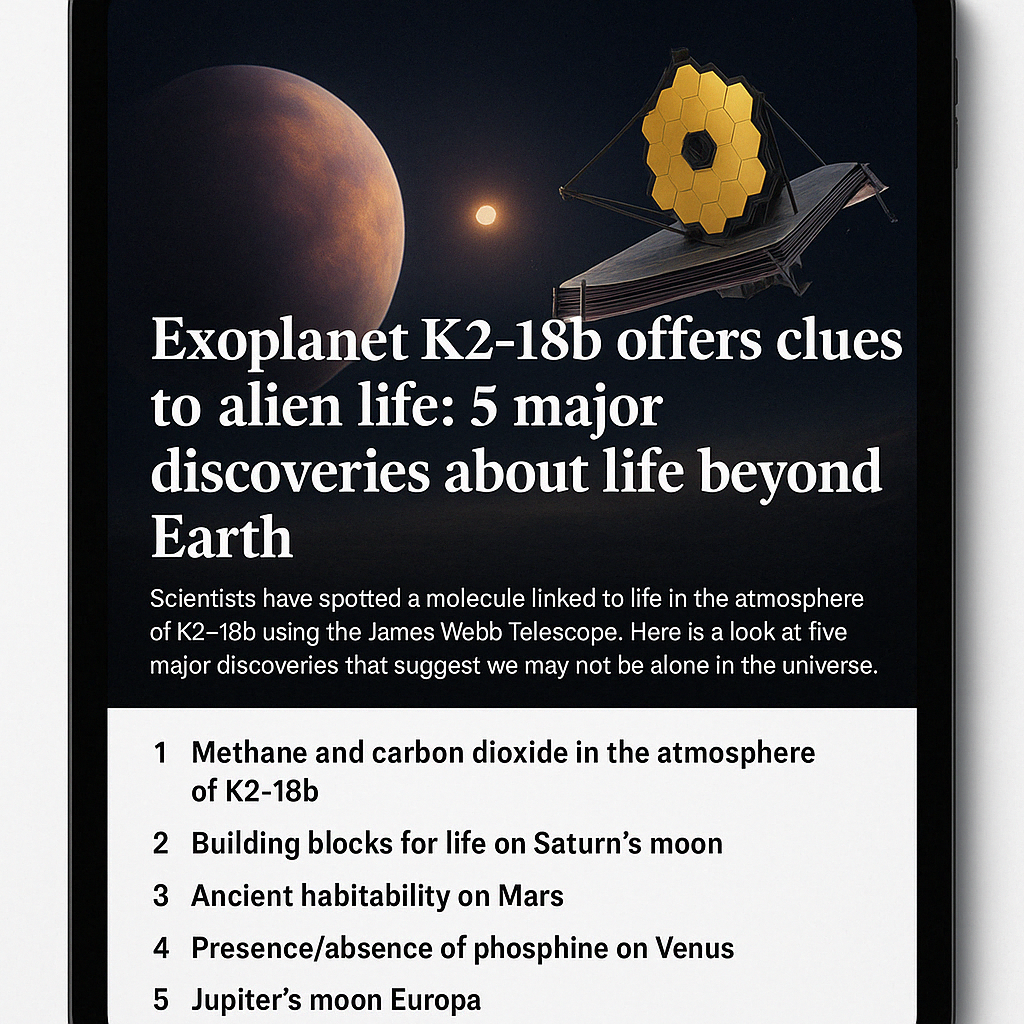
Here are five moments where Earth’s telescopes and rovers glimpsed signs of potential life:
- 🪐 K2-18b (2023–2025): Methane, CO₂, and possibly DMS detected — potential signs of life.
- 🌊 Enceladus (Saturn’s Moon): Cassini discovered organic molecules and phosphates in water plumes from a subsurface ocean.
- 🔴 Mars (2024–2025): Curiosity rover found fossilized lake ripples and siderite-rich rocks, extending the red planet’s habitability timeline.
- ☁️ Venus (2020–2022): Contested detection of phosphine in its clouds sparked debate about microbial life in acidic skies.
- 🌊 Europa (Jupiter’s Moon): Magnetic field anomalies and water plumes suggest a vast salty ocean beneath ice—Europa Clipper mission is on its way.
GS Paper Mapping
- GS Paper 3: Science & Technology – Space missions, remote sensing, planetary exploration
- GS Paper 1 (Geography): Solar system, exoplanets, planetary composition
- Essay Paper: Cosmic humility and the evolving definition of life
A Thought Spark — by IAS Monk
“Planets no longer twinkle alone; they now carry a scent.”
The cosmos may not be silent.
It may just be subtle—and finally,
we’re learning how to listen.
Essay:
Whispers from K2-18b – Searching for Life in the Universe
“The cosmos may not be silent. It may just be subtle — and finally, we’re learning how to listen.”
Introduction
In April 2025, the James Webb Space Telescope (JWST) offered a glimpse into the chemical soul of a distant world—K2-18b. Located 124 light years away, this sub-Neptune planet became the subject of scientific awe as researchers detected the possible presence of dimethyl sulfide (DMS), a molecule associated with life on Earth.
Though far from definitive, this detection represents a frontier moment in the search for life beyond our planet. It is not a confirmation—but a question. A whisper. And science, for once, is pausing to listen.
The Case of K2-18b
K2-18b is roughly 8.6 times the mass of Earth, orbiting a red dwarf star in the constellation Leo. It exists within its star’s habitable zone—where liquid water might persist.
Previous observations detected methane and carbon dioxide in its atmosphere, sparking hopes of a hydrogen-rich ocean world. The recent possible detection of DMS—an organic molecule produced by marine organisms on Earth—adds a provocative layer. On Earth, DMS is a known biosignature gas, emitted by plankton and bacteria in marine ecosystems.
The detection was made using transmission spectroscopy—a method where starlight filters through a planet’s atmosphere during transit, revealing the composition of gases present. While DMS is exciting, scientists urge caution. It has also been detected in non-biological contexts, such as comet 67P, and the atmospheric model of K2-18b is still uncertain.
What Are Biosignatures?
Biosignatures are indicators of life, whether gases, molecules, or patterns. On Earth, molecules like methane, oxygen, and DMS are tied to biological activity. But in space, caution is crucial. Nature can mimic biology. A biosignature must be confirmed through multiple lines of evidence—molecular, environmental, and contextual.
DMS, while biologically significant on Earth, is not a ‘smoking gun.’ But its detection marks a step in learning how to listen for life-like signals in alien skies.
Other Celestial Clues
K2-18b is not alone in raising the question of life beyond Earth. Here are five significant discoveries:
1. Enceladus (Saturn’s moon): Cassini mission discovered water plumes and organic compounds in 2005–2017. In 2023, detection of phosphates further strengthened its potential habitability.
2. Mars: In 2025, NASA’s Curiosity rover detected ancient ripple patterns and siderite-rich rocks, indicating warm, shallow lakes and a CO₂-enriched atmosphere billions of years ago.
3. Venus: In 2020, scientists claimed phosphine in Venus’s atmosphere—a possible biosignature. Later studies challenged this, and the detection remains unconfirmed.
4. Europa (Jupiter’s moon): Data suggests a salty subsurface ocean beneath its icy crust. NASA’s Europa Clipper, launched in 2024, is en route to explore this potential life-harbor.
5. K2-18b (2023–2025): The detection of carbon-bearing molecules and the possible presence of DMS hint at the possibility of a Hycean ocean world.
Why It’s Too Early to Celebrate
The excitement surrounding K2-18b must be tempered with caution. First, the detection of DMS is weak and requires confirmation. Second, non-biological pathways for DMS and other molecules are plausible. Third, we still do not know if K2-18b has surface conditions suitable for life—it could be a molten world or one locked under crushing pressure.
This uncertainty does not diminish the discovery’s significance. It simply reminds us that **science is a dialogue with the unknown**—not a declaration of certainty.
Conclusion
We are entering an age where planets are no longer silent dots in the sky, but chemically knowable landscapes. K2-18b may not host life—but it is teaching us how to ask the right questions.
With each telescope, each transit, and each spectrum, we edge closer to an answer. The cosmos may be speaking—slowly, distantly, humbly—and now, for the first time, we are learning to listen with understanding.
We may not have found life yet. But we have found the tools, the language, and the courage to look for it.
“To see a glimmer of life in a molecule, across a hundred light years, is to know that we are not alone in our curiosity.”
📘 Download this Essay as a PDF
(Currently free — soon a nominal ₹5 download fee will apply)