

May 15, 2025, Post 4: India’s Blue Arteries — Reviving Inland Waterways for the Future |High Quality Mains Essay | Prelims MCQs
India’s Blue Arteries — Reviving Inland Waterways for the Future
NATIONAL HERO — PETAL 004
📅 May 15, 2025
Thematic Focus: Infrastructure | Sustainable Transport | River Economy
🚢 Intro Whisper
Where roads end and rivers begin, a silent revolution sails on — reviving India’s inland waters not only as lifelines of history but as pathways of tomorrow.
🔍 Key Highlights
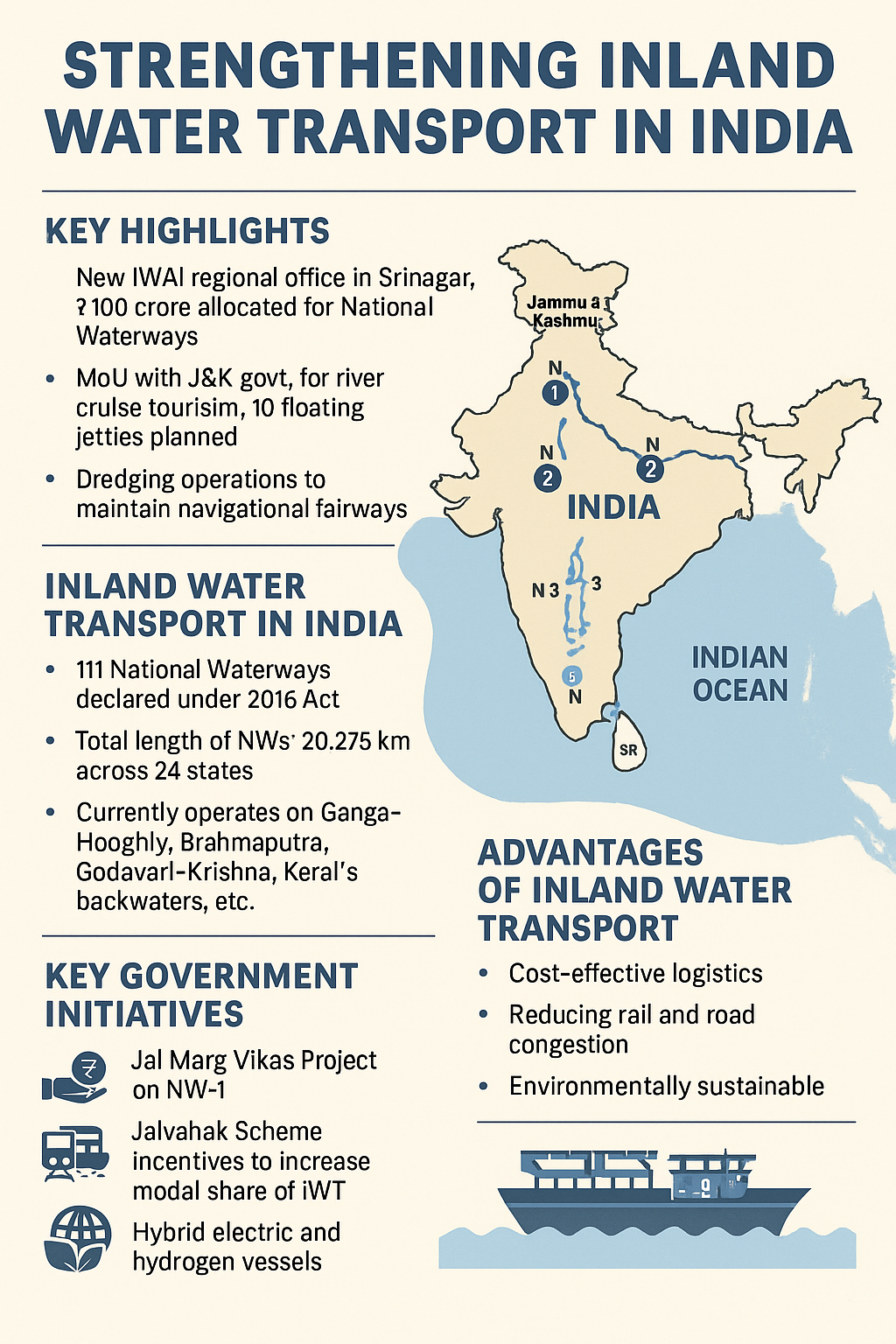
- New IWAI Office in Srinagar: The Inland Waterways Authority of India has opened a regional office in J&K and committed ₹100 crore to develop three National Waterways — River Chenab (NW-26), River Jhelum (NW-49), and River Ravi (NW-84).
- River Tourism Boost: MoU signed with the J&K government to promote cruise tourism, supported by 10 new floating jetties at sites like Akhnoor, Reasi, and Srinagar’s Zero Bridge.
- Inland Water Transport (IWT) Expansion:
- 111 National Waterways declared under the National Waterways Act, 2016
- Total length: 20,275 km across 24 states
- IWAI’s key functions: fairway development, hydrographic surveys, policy execution, promotion of tourism
- Operational Corridors:
- NW-1: Ganga–Hooghly (1,620 km)
- NW-2: Brahmaputra (891 km)
- NW-3: Kerala’s backwaters (205 km)
- NW-4: Godavari-Krishna-Buckingham Canal (1,095 km)
- NW-5 & NW-16: Odisha’s rivers and Barak River system
📘 Concept Explainer
🚢 Inland Waterways Authority of India (IWAI)
- Autonomous body under the Ministry of Ports, Shipping & Waterways (est. 1986)
- HQ: Noida, with regional offices across Patna, Kolkata, Guwahati, Kochi, and now Srinagar
- Key Responsibilities:
- Developing National Waterways
- Setting navigational standards
- Constructing terminals, jetties, and passenger facilities
- Promoting inland cruise and cargo movement
⚓ Why IWT Matters
- Economical: 1 litre of fuel moves 215 tonnes by water vs. 95 by rail and 24 by road
- Sustainable: Lowest carbon footprint among transport modes
- Logistics Efficiency: Reduces congestion on roads and railways
- Multi-modal Connectivity: Complements coastal shipping and national highways
🌊 Strategic Projects and Innovations
- Jal Marg Vikas Project (JMVP):
Transforming NW-1 into a cargo superhighway with multimodal terminals, locks, and fairway enhancement - Jalvahak Scheme:
Operating incentives to increase IWT’s modal share from 2% to 5% by 2030 - Green Navigation:
- Introduction of hybrid-electric and hydrogen-powered vessels
- Coastal Green Shipping Corridors (e.g., Kandla–Tuticorin)
- Harbour Craft Green Transition Programme
- New Regulations (2025):
Streamlined processes for terminal construction and private investment under National Waterways Jetty/Terminal Rules
🛶 Beyond Cargo — The River Renaissance
- Ro-Ro Services: Carry trucks and vehicles over rivers to reduce road congestion
- Tourism Boost: River cruises, houseboats, and eco-tourism in scenic and heritage zones
- Ferry Services: Affordable water-based transport for rural and remote communities
⚠️ Challenges and Way Ahead
- River Depth Fluctuations: Dredging and water flow management essential
- Infrastructure Deficits: Need for better last-mile and port linkages
- Private Sector Involvement: Boosting participation through PPP models and incentives
🗺️ GS Paper Mapping
| 📘 GS Paper 3 | Infrastructure – Waterways, Blue Economy, Logistics & Sustainable Transport |
|---|---|
| 📘 GS Paper 2 | Government Policies & Implementation – Transport Policies, Federal Coordination |
💭 A Thought Spark — by IAS Monk
A river is not just a flow of water — it’s a thread of movement, memory, and possibility. India’s waterways, once abandoned, now ripple with the promise of cleaner growth, inclusive tourism, and economic renewal.
High Quality Mains Essay For Practice :
Word Limit 1000-1200
“India’s Inland Waterways: Reclaiming the Arteries of a Riverine Civilization”
Introduction
India, the land of ancient rivers, has always been a civilization shaped by water. From the sacred Ganga to the mighty Brahmaputra, waterways once served as the natural highways of the subcontinent. Yet, with the march of mechanized transport in the modern era, these riverine routes fell into neglect. Now, with growing environmental concerns, logistical bottlenecks, and a renewed focus on green infrastructure, India is witnessing a strategic revival of Inland Water Transport (IWT). This essay examines the infrastructural evolution, strategic significance, government initiatives, and future prospects of India’s inland waterways.
The Case for Inland Water Transport
India’s transport ecosystem has historically over-relied on road (65%) and rail (25%), while IWT accounts for barely 2% of freight movement. This imbalance has created multiple issues — traffic congestion, rising logistics costs (14% of GDP), and high carbon emissions. In contrast, IWT is:
- Cost-Effective: 1 litre of fuel moves 215 tonnes over water, compared to 95 tonnes by rail and only 24 tonnes by road.
- Energy-Efficient: Inland navigation emits far fewer greenhouse gases than road or rail transport.
- Eco-Friendly: It helps decongest urban traffic and reduces air pollution.
- Ideal for Bulk Cargo: Perfect for transporting coal, cement, grains, and even vehicles using Ro-Ro services.
The untapped potential is enormous, and the government’s goal is to raise IWT’s modal share to 5% by 2030.
Institutional Backbone: IWAI
The Inland Waterways Authority of India (IWAI), established in 1986 under the IWAI Act, is the nodal agency overseeing development, regulation, and maintenance of declared national waterways. Headquartered in Noida, IWAI manages hydrographic surveys, fairway development, construction of terminals and jetties, promotion of tourism, and implementation of navigation-related policies.
With regional offices across key locations like Kolkata, Guwahati, Kochi, and now Srinagar, IWAI is expanding its geographic and strategic footprint.
National Waterways Network
The National Waterways Act, 2016 was a watershed moment, declaring 111 waterways across 24 states as National Waterways (NWs) — totaling over 20,000 km.
Key examples include:
- NW-1 (Ganga–Bhagirathi–Hooghly): From Haldia to Prayagraj, 1,620 km
- NW-2 (Brahmaputra): From Dhubri to Sadiya, 891 km
- NW-3 (West Coast Canal, Kerala): From Kottapuram to Kollam, 205 km
- NW-4 (Godavari–Krishna rivers + Buckingham Canal): From Kakinada to Puducherry, 1,095 km
- NW-5 (Odisha): Brahmani and Mahanadi river system
- NW-16 (Barak River): From Lakhipur to Bhanga, North-East corridor
This network creates the backbone of a multi-modal logistics revolution.
Jammu & Kashmir Breakthrough
In a landmark step, IWAI has launched a new regional office in Srinagar and committed ₹100 crore for the development of three strategic river stretches:
- NW-26 (Chenab)
- NW-49 (Jhelum)
- NW-84 (Ravi)
This project aims to promote river cruise tourism and eco-friendly cargo movement in a fragile Himalayan zone. Ten floating jetties are being planned in locations such as Akhnoor, Reasi, and Srinagar’s Zero Bridge. These investments signal a strong alignment with India’s Blue Economy and regional development goals.
Flagship Schemes & Green Innovations
1. Jal Marg Vikas Project (JMVP)
A ₹5,369 crore mega project focused on enhancing navigation on NW-1. It includes:
- Multimodal terminals at Varanasi, Haldia, and Sahibganj
- Navigation locks, river information systems, and night navigation aids
- Fairway development to ensure year-round movement
2. Jalvahak Scheme
An incentive-based framework launched to encourage private players and cargo owners to shift to water transport. It offers viability gap funding and operational cost incentives.
3. Hybrid Electric & Hydrogen Vessels
India is transitioning to green vessels through innovations in hybrid fuel systems, hydrogen-powered boats, and solar charging platforms, reducing dependency on fossil fuels.
4. Coastal Green Shipping Corridor
First corridor: Kandla to Tuticorin — a model for integrating port sustainability, inland navigation, and cargo consolidation.
5. New Regulatory Framework (2025)
The National Waterways (Construction of Jetties/Terminals) Rules, 2025 streamlines approval processes and enables greater private participation.
Beyond Cargo: River Renaissance in India
India’s IWT revival goes beyond goods transport:
- Ro-Ro Services: Enable trucks and cars to be ferried across rivers, reducing highway congestion.
- River Cruise Tourism: Especially in Varanasi, Assam, and now Jammu & Kashmir, promoting cultural and eco-tourism.
- Passenger Ferry Services: Affordable, fast mobility in remote and island regions like Gujarat, Kerala, and Andaman-Nicobar.
This aligns with India’s Blue Economy vision and fosters local employment, craft markets, and regional development.
Challenges and the Road Ahead
- Depth Fluctuations: Seasonal variations and siltation demand continuous dredging and river engineering.
- Infrastructure Gaps: Limited multimodal terminals and poor last-mile connectivity hinder logistics integration.
- Low Private Investment: Risk perception and lack of regulatory clarity deter major industry participation.
- Environmental Concerns: Dredging and large-scale navigation must balance biodiversity protection.
To address these, the government must focus on:
- Public-private partnerships (PPP)
- Cross-ministerial coordination with Environment, Railways, and Tourism ministries
- Building integrated port-logistics-inland clusters
- Using satellite and AI-based navigation and mapping tools
Conclusion
India’s inland waterways, long neglected, are returning to the national imagination not just as transport routes, but as green arteries of inclusive growth. With sustained investment, policy innovation, and stakeholder participation, the IWT sector can reduce logistics costs, cut emissions, and rejuvenate riverine economies.
This journey is not merely about moving goods. It is about reconnecting India with its own fluid heritage — restoring the primacy of rivers in shaping the nation’s destiny. As India sails toward 2047, inland waterways could be the gentle current propelling the country into a cleaner, smarter, and more connected future.
Target IAS-26: Daily MCQs :
📌 Prelims Practice MCQs
Topic:
Type 1: How many of the above statements are correct?
Consider the following statements regarding Inland Waterways in India:
1)Inland Waterways Authority of India (IWAI) is a statutory body under the Ministry of Ports, Shipping and Waterways.
2)The Jal Marg Vikas Project aims to develop the Ganga-Brahmaputra corridor for river cruise tourism.
3)The Jalvahak Scheme provides financial incentives to increase the modal share of IWT.
4)Hybrid-electric and hydrogen vessels are being promoted under India’s green transition plan for inland waterways.
How many of the above statements are correct?
A) Only two
B) Only three
C) All four
D) Only one
🌀 Didn’t get it? Click here (▸) for the Correct Answer & Explanation
✅ Correct Answer: B) Only three
🧠 Explanation:
B) Only three
1)True – IWAI was constituted under the IWAI Act, 1985.
2)False – The Jal Marg Vikas Project is focused on NW-1 (Ganga) for cargo transport, not cruise tourism specifically.
3)True – Jalvahak Scheme provides operating cost incentives for cargo owners using inland waterways.
4)True – Green transition includes hybrid and hydrogen-fueled vessels to reduce emissions.
Type 2: Two-Statement Check
Consider the following statements:
1)IWAI has recently opened a regional office in Srinagar to promote waterway development in Jammu & Kashmir.
2)National Waterway 16 (NW-16) runs along the Krishna River connecting Prayagraj to Puducherry.
Which of the above statements is/are correct?
A) Only 1 is correct
B) Only 2 is correct
C) Both are correct
D) Neither is correct
🌀 Didn’t get it? Click here (▸) for the Correct Answer & Explanation
✅ Correct Answer: A) Only 1 is correct
🧠 Explanation:
A) Only 1 is correct
1)True – A new regional office has been opened in Srinagar with ₹100 crore allocated to develop three National Waterways in the region.
2)False – NW-16 runs along the Barak River in the northeast, not the Krishna River.
Type 3: Code-Based Selection
Which of the following are advantages of Inland Water Transport (IWT) in India?
1)Lower logistics cost per tonne-kilometre compared to road and rail
2)Reduces urban air pollution and highway congestion
3)Offers fastest transport for perishable goods across short distances
4)Environmentally sustainable and fuel efficient
Select the correct code:
A) 1, 2 and 4 only
B) 1, 3 and 4 only
C) 2, 3 and 4 only
D) 1, 2, 3 and 4
🌀 Didn’t get it? Click here (▸) for the Correct Answer & Explanation
✅ Correct Answer: A) 1, 2 and 4 only
🧠 Explanation:
A) 1, 2 and 4 only
1)True – IWT has the lowest fuel cost per tonne-km.
2)True – Reduces congestion on roads and cuts down emissions.
3)False – IWT is generally slower; not ideal for perishable short-haul transport.
4)True – It has a significantly lower carbon footprint.
Type 4: Direct Fact
Which of the following National Waterways runs from Haldia to Prayagraj through the Ganga river system?
A) NW-2
B) NW-3
C) NW-1
D) NW-5
🌀 Didn’t get it? Click here (▸) for the Correct Answer & Explanation.
✅ Correct Answer: C) NW-1
🧠 Explanation:
C)True – National Waterway 1 (NW-1) runs 1,620 km from Haldia (West Bengal) to Prayagraj (Uttar Pradesh) along the Ganga–Bhagirathi–Hooghly river system.