



🧠 Knowledge Drop-120 | 2026 Delhi Declaration: India’s Balancing Act in a Fragmenting West Asia | IAS Prelims 2026-27 Highly Expected MCQs | Current Affairs & GS Essays on iasmonk.com
Post Date: 11-Feb-2026
🧭 Knowledge Drop-120
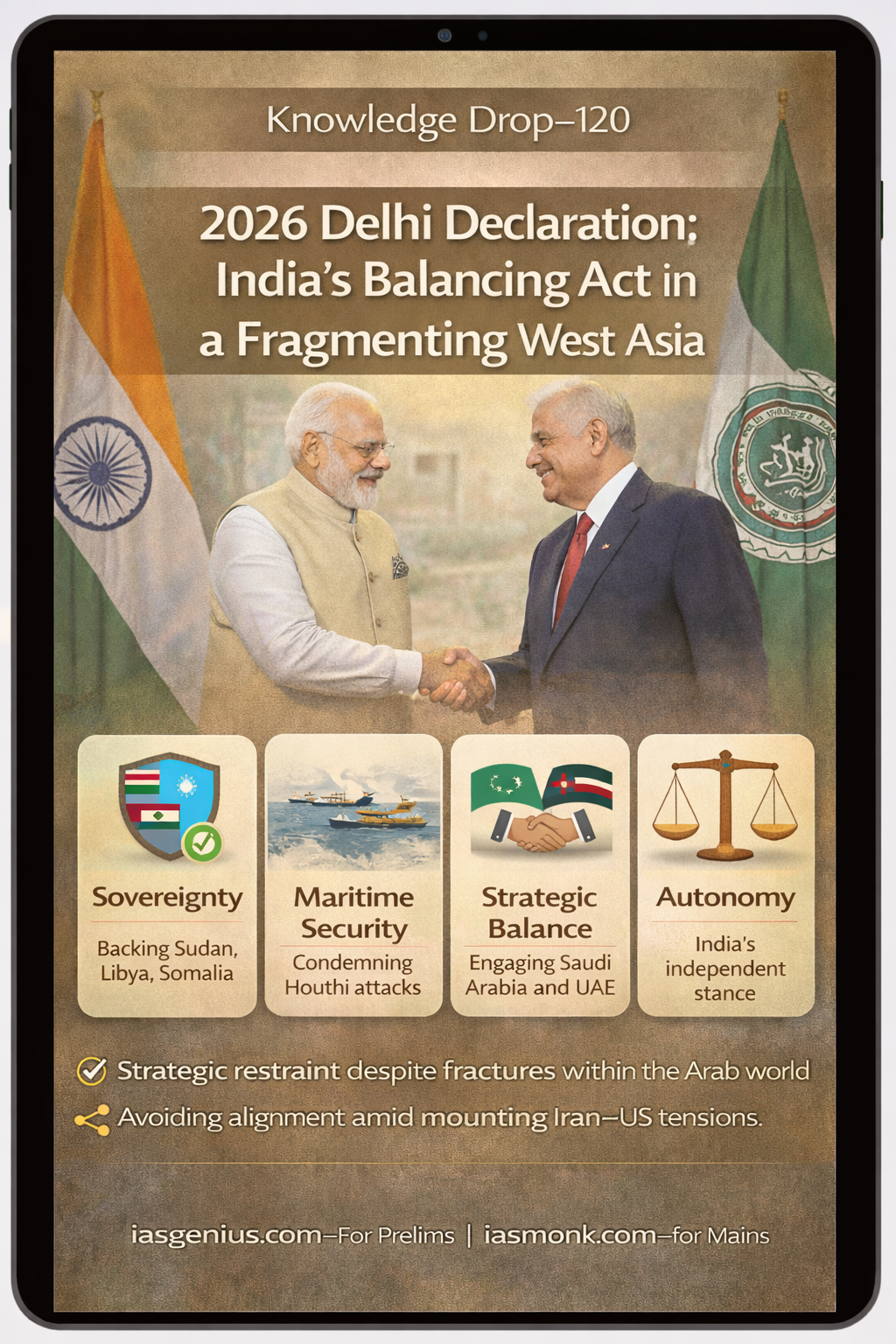
2026 Delhi Declaration: India’s Balancing Act in a Fragmenting West Asia
Syllabus: GS2 | International Relations
Context
India hosted the second India–Arab Foreign Ministers’ Meeting in 2026, bringing together representatives of all 22 members of the League of Arab States (Arab League), ten years after the first meeting held in Bahrain. The meeting took place amid heightened regional turbulence, including Iran–US tensions, visible rifts within the Gulf (notably Saudi Arabia–UAE differences), and renewed international attempts to reshape the Israel–Palestine peace process.
The joint statement issued at the end of the meeting, known as the Delhi Declaration (2026), outlined shared positions on regional conflicts and reaffirmed commitments to deepen India–Arab cooperation.
India–Arab League Engagement: Background
The League of Arab States, established in 1945 in Cairo, currently has 22 member states spanning West Asia and North Africa. India holds observer status in the organisation.
Institutional engagement evolved over time:
- In 2002, India and the Arab League signed a Memorandum of Understanding to establish a regular consultation framework.
- In 2008, a Memorandum of Cooperation led to the creation of the Arab–India Cooperation Forum (AICF).
- The framework was revised in 2013 to streamline cooperation and improve effectiveness.
The India–Arab Foreign Ministers’ Meeting now serves as the highest institutional mechanism guiding India’s engagement with the Arab League. The 3rd Ministerial Meeting is scheduled to be held in 2028 in an Arab country.
Key Highlights of the Delhi Declaration
1. Emphasis on Sovereignty and Territorial Integrity
The Declaration reaffirmed support for the sovereignty, unity and territorial integrity of Sudan, Libya and Somalia, rejecting external interference. This stance indirectly reflects internal fractures within the Arab world.
- Sudan: The Declaration aligned with the Sudanese state against the Rapid Support Forces (RSF), which have been fighting the government since 2023 and formed a parallel authority in 2025. It condemned civilian atrocities and supported the internationally recognised government.
- Somalia: While Israel alone recognises Somaliland, and the UAE has accepted Somaliland passports, the Declaration reaffirmed support for Somalia’s territorial integrity. India clearly rejected any recognition of Somaliland.
- Yemen: India and the Arab League explicitly condemned Houthi attacks in the Red Sea, marking a shift from India’s earlier, more cautious language after 2023. Support for Yemen’s unity also aligns with Saudi Arabia’s position against the UAE-backed Southern Transitional Council.
2. Maritime Security and Regional Stability
By condemning attacks in the Red Sea and supporting state authority in conflict zones, the Declaration underlined the importance of maritime security, stability of trade routes, and the broader regional order in West Asia.
India’s Policy Signals in West Asia
1. Primacy of Sovereignty and International Legitimacy
India’s repeated emphasis on sovereignty, unity and territorial integrity in Sudan, Libya, Somalia and Yemen reflects its long-standing opposition to secessionism, parallel governments, and externally backed non-state actors. This position also mirrors India’s own concerns regarding territorial integrity and internal security. By backing internationally recognised governments, India stays aligned with international law without entering military alliances.
2. Quiet Convergence with the Saudi-Led Order
Without openly taking sides, the Declaration subtly aligns with Saudi Arabia’s positions on Yemen’s unity, reconciliation-based approaches in Libya, and support for the Sudanese state against militias. This reflects India’s strategic calculation that Saudi Arabia remains crucial for energy security, diaspora welfare, and Gulf economic stability.
3. Managing, Not Confronting, the UAE
Despite clear divergences with the UAE on issues such as Sudan, Libya and Somaliland, the Declaration avoids naming or criticising Abu Dhabi directly. This is significant because the UAE is one of India’s most important partners in trade, logistics and connectivity initiatives (including CEPA, I2U2 and IMEC). India’s approach indicates issue-based disagreement without strategic rupture.
4. Preserving Strategic Autonomy
Notably, the Declaration made no reference to US military presence around Iran. This silence allows India to maintain working relationships simultaneously with Iran, Arab states and the United States, reinforcing its policy of strategic autonomy.
Strategic Implications
Taken together, India’s positions in the Delhi Declaration indicate:
- Autonomy from rigid US–Israeli geopolitical framing, despite cooperation with both.
- Avoidance of ideological or factional entanglement in Arab power rivalries.
- A preference for status-quo stability over revolutionary or militia-driven political change.
India emerges not as a bloc leader, but as a balancing power seeking stability, legality and continuity in a fragmented West Asian order.
Conclusion
The 2026 Delhi Declaration highlights India’s evolution into a status-quo and stability-oriented power in West Asia. By prioritising sovereignty, international legitimacy and maritime security, while carefully balancing rival regional camps, India has signalled a diplomacy of prudence, autonomy and strategic restraint rather than overt alignment in a deeply fractured region.
Target IAS-2026+: Highly Expected Prelims MCQs :
📌 Prelims Practice MCQs
Topic: 2026 Delhi Declaration: India’s Balancing Act in a Fragmenting West Asia
MCQ 1 | TYPE 1 — How Many Statements Are Correct?
Consider the following statements regarding the 2026 Delhi Declaration:
1)It was adopted at the second India–Arab Foreign Ministers’ Meeting.
2)The Arab League currently has 22 member states.
3)India is a full member of the League of Arab States.
4)The third India–Arab Ministerial Meeting is scheduled to be held in 2028.
How many of the above statements are correct?
A)Only two
B)Only three
C)All four
D)Only one
🌀 Didn’t get it? Click here (▸) for the Correct Answer & Explanation.
🟩 Correct Answer: B) Only three
🧠 Explanation:
Correct Answer: B) Only three
1)✅ True – The Delhi Declaration was issued at the second India–Arab FMM.
2)✅ True – The Arab League has 22 member states.
3)❌ False – India holds observer status, not full membership.
4)✅ True – The third meeting is scheduled for 2028.
MCQ 2 | TYPE 2 — Two-Statement Type
Consider the following statements:
Statement 1: The Delhi Declaration reaffirmed support for the sovereignty and territorial integrity of Sudan, Libya and Somalia.
Statement 2: The Declaration explicitly criticised the UAE for its positions on Sudan and Somaliland.
Which one of the following is correct?
A)Only Statement 1 is correct
B)Only Statement 2 is correct
C)Both statements are correct
D)Neither statement is correct
🌀 Didn’t get it? Click here (▸) for the Correct Answer & Explanation.
🟩 Correct Answer: A) Only 1 is correct
🧠 Explanation:
Correct Answer: A) Only Statement 1 is correct
1)✅ True – The Declaration reiterated support for sovereignty and unity of these states.
2)❌ False – The UAE was not named or criticised directly.
MCQ 3 | TYPE 3 — Code-Based Statement Selection
Consider the following statements regarding India–Arab League engagement:
1)The dialogue process was institutionalised in 2002 through a Memorandum of Understanding.
2)The Arab–India Cooperation Forum was established following a Memorandum of Cooperation in 2008.
3)The cooperation framework was revised in 2013 to improve effectiveness.
4)India holds full membership status in the Arab League.
Which of the statements given above are correct?
A)1,2 and 3 only
B)1 and 4 only
C)2 and 4 only
D)1,2,3 and 4
🌀 Didn’t get it? Click here (▸) for the Correct Answer & Explanation.
🟩 Correct Answer: A) 1,2 and 3 only
🧠 Explanation:
Correct Answer: A) 1,2 and 3 only
1)✅ True – The MoU of 2002 institutionalised dialogue.
2)✅ True – The 2008 MoC led to the AICF.
3)✅ True – The framework was revised in 2013.
4)❌ False – India has observer status, not full membership.
MCQ 4 | TYPE 4 — Direct Factual Question
Which of the following was explicitly condemned in the 2026 Delhi Declaration?
A)US military presence around Iran
B)Houthi attacks in the Red Sea
C)Recognition of Somaliland by Israel
D)Saudi–UAE rivalry in the Gulf
🌀 Didn’t get it? Click here (▸) for the Correct Answer & Explanation.
🟩 Correct Answer: B) Houthi attacks in the Red Sea
🧠 Explanation:
Correct Answer: B) Houthi attacks in the Red Sea
The Declaration explicitly condemned Houthi attacks in the Red Sea, marking a shift in India’s earlier cautious language.
MCQ 5 | TYPE 5 — UPSC 2025 Linkage Reasoning Format (I, II, III)
Consider the following statements:
Statement I: The 2026 Delhi Declaration reflects India’s role as a balancing power in West Asia.
Statement II: India emphasised sovereignty and territorial integrity of states such as Sudan, Libya and Somalia.
Statement III: The Declaration avoided naming regional partners directly despite visible policy divergences.
Which one of the following is correct?
A)Both Statements II and III are correct and both explain Statement I
B)Both Statements II and III are correct but only one explains Statement I
C)Only one of the Statements II and III is correct and that explains Statement I
D)Neither Statement II nor Statement III is correct
🌀 Didn’t get it? Click here (▸) for the Correct Answer & Explanation.
🟩 Correct Answer: A)
🧠 Explanation:
Correct Answer: A) Both Statements II and III are correct and both explain Statement I
Statement II shows India’s principled, sovereignty-first positioning.
Statement III shows its cautious diplomacy to avoid alienating key partners.
Together, they explain India’s balancing approach reflected in the Declaration.