





🧠 Knowledge Drop-118 | India–US Signed Trade Agreement | IAS Prelims 2026-27 Highly Expected MCQs | Current Affairs & GS Essays on iasmonk.com
Post Date 9-Feb-2026
🧠 Knowledge Drop-118
India–US Signed Trade Agreement
Syllabus: GS-2 | International Relations
📌 Context
India and the United States have announced a new trade agreement aimed at lowering tariffs and setting ambitious targets for bilateral trade. This comes in the backdrop of heightened trade frictions in August 2025, when the US imposed tariffs up to 50% (25% reciprocal + 25% additional duty) on certain Indian goods, partly linked to India’s imports of Russian oil. The new agreement signals a recalibration of economic ties between the two strategic partners.
📘 Key Features of the India–US Trade Deal
1. Tariff Reductions
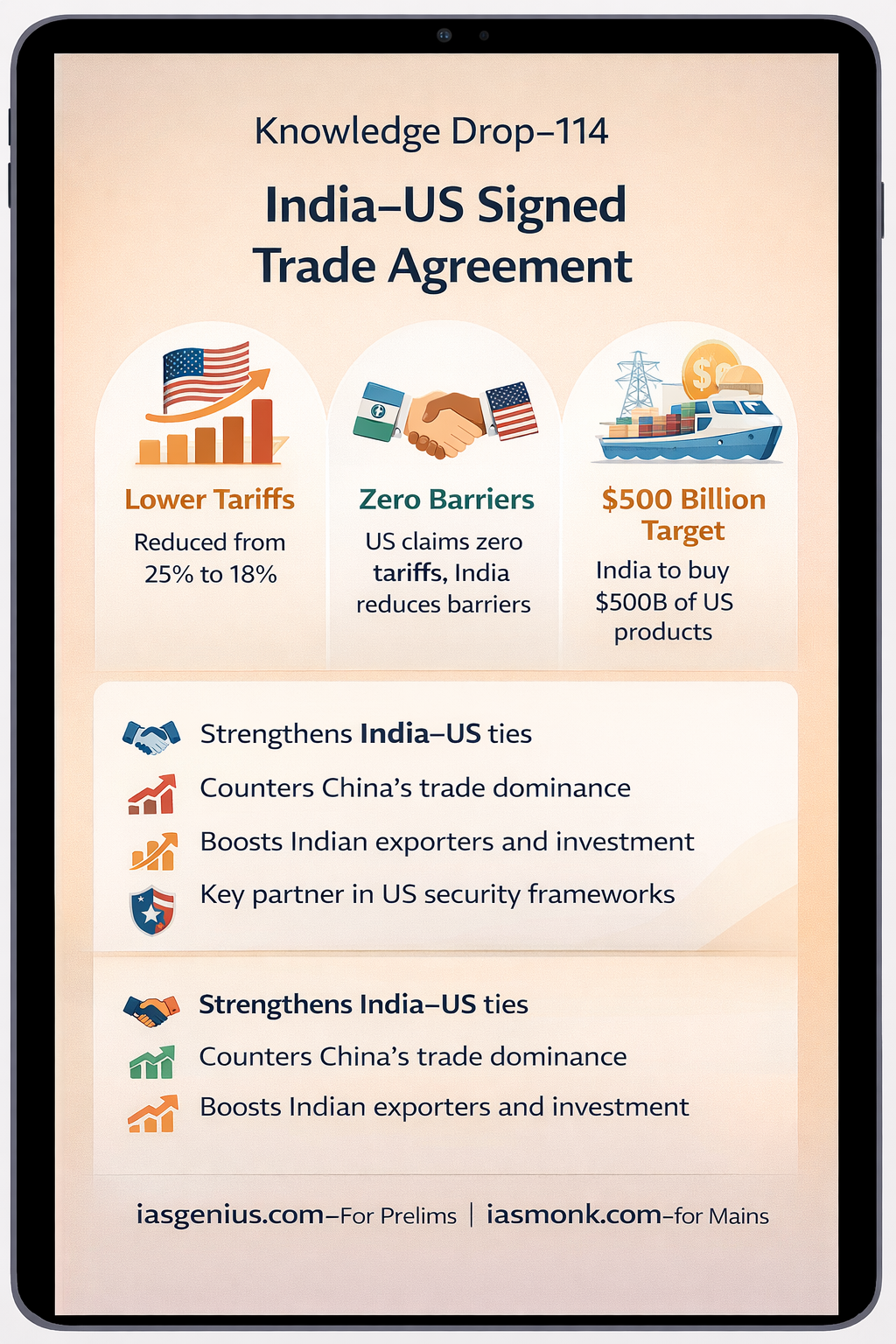
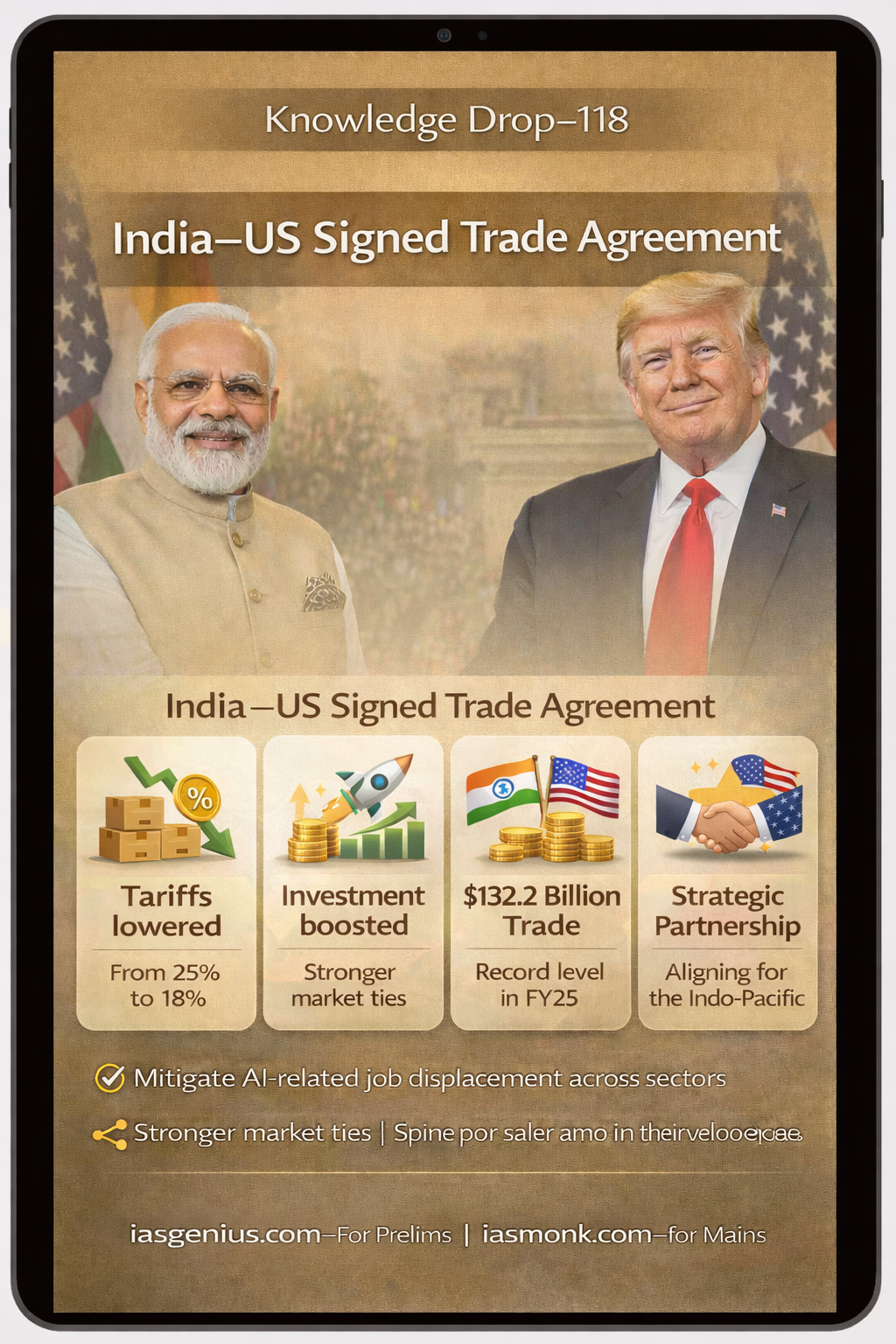
- US reciprocal tariffs on Indian goods have been reduced from 25% to 18%, with immediate effect.
- The additional 25% duty imposed earlier has been withdrawn.
- India will progressively reduce tariffs and non-tariff barriers on US goods.
2. US Claims on Market Access
- The US has stated that the agreement includes commitments towards zero tariffs and non-tariff barriers for certain US goods.
- It has also claimed that India has committed to purchasing over USD 500 billion worth of US products across sectors such as energy, technology, agriculture, coal and related areas.
- India has indicated a phased and calibrated approach to market opening, keeping domestic sensitivities in mind.
🌍 Significance of the Deal
1. Strategic and Geopolitical Dimension
- The agreement strengthens India–US ties amid shifting global geopolitics, particularly in the context of China’s growing economic and strategic influence.
- It reinforces India’s position as a key partner in US-led trade and security frameworks in the Indo-Pacific.
2. Economic and Trade Impact
- Lower tariffs are expected to improve the competitiveness of Indian exports, especially for farmers, MSMEs and manufacturing enterprises.
- The deal can attract greater investment flows and support the vision of “Make, Design and Innovate in India for the World.”
- Enhanced trade and investment linkages can contribute to stabilising the rupee during periods of global economic uncertainty.
3. Energy and Supply Chain Diversification
- The agreement may encourage diversification of India’s oil and energy imports, potentially reducing dependence on Russia, though this could come at higher costs.
- It also aligns with broader efforts to integrate India more deeply into resilient global supply chains.
⚠️ Challenges and Concerns
- Agriculture and Domestic Politics: Opening agricultural markets to US imports faces strong domestic resistance in India.
- Energy Costs: Reducing reliance on discounted Russian crude could raise input costs for Indian refiners and impact inflation.
- Services and Mobility Issues: Higher US H-1B visa fees continue to affect Indian IT professionals, and services trade issues remain largely unaddressed.
- Geopolitical Pressures: US threats of tariffs related to Iran trade have already forced India to scale back trade with Iran and pause investments such as in the Chabahar port, constraining India’s strategic options.
📊 Snapshot of India–US Trade Relations
- The US is among India’s largest trading partners, and India runs a trade surplus with the US, largely driven by services and high-value exports.
- Bilateral trade rose from USD 119.71 billion in FY24 to a record USD 132.2 billion in FY25, reflecting deepening economic ties.
- The US is the 3rd largest investor in India, with cumulative FDI inflows (2000–2025) of USD 70.65 billion.
- Key Indian exports to the US include pharmaceuticals, engineering goods, electronics, and gems and jewellery.
🧭 Way Forward
The India–US trade agreement represents both an economic opportunity and a strategic balancing act. While it can boost exports, investment, and geopolitical alignment, its long-term success will depend on how effectively both sides manage domestic sensitivities, energy security concerns, and unresolved issues in services trade and mobility. A calibrated, interest-based approach will be crucial to ensure that deeper integration translates into sustainable and inclusive gains for India.
🌱 Monk’s Whisper
Trade is not merely the exchange of goods, but the exchange of trust between nations. When tariffs fall, what must rise is not dependence, but mutual confidence and strategic balance.
Target IAS-2026+: Highly Expected Prelims MCQs :
📌 Prelims Practice MCQs
Topic: India–US Signed Trade Agreement
MCQ 1 | TYPE 1 — How Many Statements Are Correct?
Consider the following statements regarding the recent India–US trade agreement:
1)US reciprocal tariffs on Indian goods were reduced from 25% to 18%.
2)The additional 25% duty imposed earlier by the US has been withdrawn.
3)India has immediately agreed to zero tariffs on all US goods.
How many of the above statements are correct?
A)Only one
B)Only two
C)All three
D)Only three
🌀 Didn’t get it? Click here (▸) for the Correct Answer & Explanation.
🟩 Correct Answer: B) Only two
🧠 Explanation:
Correct Answer: B) Only two
1)✅ True – Tariffs were reduced from 25% to 18%.
2)✅ True – The additional 25% duty has been withdrawn.
3)❌ False – India has not agreed to immediate zero tariffs on all US goods; reductions are to be progressive.
MCQ 2 | TYPE 2 — Two-Statement Type
Consider the following statements:
Statement 1: The India–US trade deal is expected to improve the competitiveness of Indian exporters.
Statement 2: Lower tariffs can help attract greater foreign investment into India.
Which of the following is correct?
A)Only Statement 1 is correct
B)Only Statement 2 is correct
C)Both Statement 1 and Statement 2 are correct
D)Neither Statement 1 nor Statement 2 is correct
🌀 Didn’t get it? Click here (▸) for the Correct Answer & Explanation.
🟩 Correct Answer: C) Both Statement 1 and Statement 2 are correct
🧠 Explanation:
Correct Answer: C) Both Statement 1 and Statement 2 are correct
Statement 1)✅ True – Lower tariffs reduce cost barriers and improve export competitiveness.
Statement 2)✅ True – Improved market access and predictability encourage investment flows.
MCQ 3 | TYPE 3 — Code-Based Statement Selection
Consider the following statements regarding India–US trade relations:
1)The US is among India’s largest trading partners.
2)India runs a trade surplus with the US mainly due to services and high-value exports.
3)The US is India’s largest source of crude oil imports.
Which of the above statements are correct?
A)1 and 2 only
B)2 and 3 only
C)1 and 3 only
D)1,2 and 3
🌀 Didn’t get it? Click here (▸) for the Correct Answer & Explanation.
🟩 Correct Answer: A) 1 and 2 only
🧠 Explanation:
Correct Answer: A) 1 and 2 only
1)✅ True – The US is one of India’s largest trading partners.
2)✅ True – India’s surplus is driven largely by services and high-value exports.
3)❌ False – The US is not India’s largest source of crude oil imports.
MCQ 4 | TYPE 4 — Direct Factual Question
Which one of the following figures best reflects the recent trend in India–US bilateral trade?
A)It declined below USD 100 billion in FY25
B)It stagnated around USD 110 billion in FY25
C)It rose to a record level of about USD 132.2 billion in FY25
D)It crossed USD 200 billion in FY25
🌀 Didn’t get it? Click here (▸) for the Correct Answer & Explanation.
🟩 Correct Answer: C)It rose to a record level of about USD 132.2 billion in FY25
🧠 Explanation:
Correct Answer: C) It rose to a record level of about USD 132.2 billion in FY25
The bilateral trade increased from about USD 119.71 billion in FY24 to around USD 132.2 billion in FY25.
MCQ 5 | TYPE 5 — UPSC 2025 Linkage Reasoning Format (I, II, III)
Consider the following statements:
Statement I: The India–US trade agreement has strategic significance beyond pure economics.
Statement II: It strengthens India–US ties in the context of shifting global geopolitics, especially regarding China.
Statement III: It positions India as a key partner in US-led trade and security frameworks.
Which one of the following is correct?
A)Both Statements II and III are correct and both explain Statement I
B)Both Statements II and III are correct but only one explains Statement I
C)Only one of the Statements II and III is correct and that explains Statement I
D)Neither Statement II nor Statement III is correct
🌀 Didn’t get it? Click here (▸) for the Correct Answer & Explanation.
🟩 Correct Answer: A)
🧠 Explanation:
Correct Answer: A) Both Statements II and III are correct and both explain Statement I
Statement II)✅ True – The deal deepens ties amid geopolitical shifts, especially vis-à-vis China.
Statement III)✅ True – It places India firmly within US-led trade and security frameworks.
Both together explain why the agreement has strategic, not just economic, significance.