




🧠 Knowledge Drop-116 | 16th Finance Commission Report | IAS Prelims 2026-27 Highly Expected MCQs | Current Affairs & GS Essays on iasmonk.com
Post Date: 7-Feb-2026
📘 Knowledge Drop-116
16th Finance Commission Report
Syllabus: GS2 / Polity
📌 In News
The 16th Finance Commission (FC), constituted in 2023 under the chairmanship of Dr. Arvind Panagariya, has had its key recommendations accepted by the Government for implementation for the period 2026–27 to 2030–31.
🌙 Monk’s Whisper
Fiscal federalism is not merely a formula of percentages, nor a ledger of transfers between Delhi and the States. It is a quiet moral contract between unity and diversity. When the Centre shares, it does not lose. When States receive, they do not beg. In the careful arithmetic of the Finance Commission lies a deeper geometry of trust, where cooperation becomes strength and balance becomes stability. A nation endures not by how tightly it holds its resources, but by how wisely it lets them flow.
🏛️ What is the Finance Commission?
- Constitutional Body: Established under Article 280 of the Constitution of India.
- Constitution: Appointed by the President of India every five years (or earlier).
- Composition: A Chairman and four other members.
- Core Role: Acts as the balancing wheel of fiscal federalism by making recommendations on:
- Vertical Devolution: Sharing of net tax proceeds between the Centre and the States.
- Horizontal Devolution: Distribution of the States’ share among the States.
- Grants-in-Aid: Principles governing financial assistance to States from the Consolidated Fund of India (Article 275).
- Local Bodies: Measures to augment State Consolidated Funds to support Panchayats and Municipalities.
- Nature of Recommendations: Advisory in nature, though traditionally accepted by the Government.
- Important Note: Cesses and surcharges levied by the Centre are not part of the divisible pool.
🔑 Key Highlights of the 16th Finance Commission
1️⃣ Vertical Devolution (Tax Sharing)
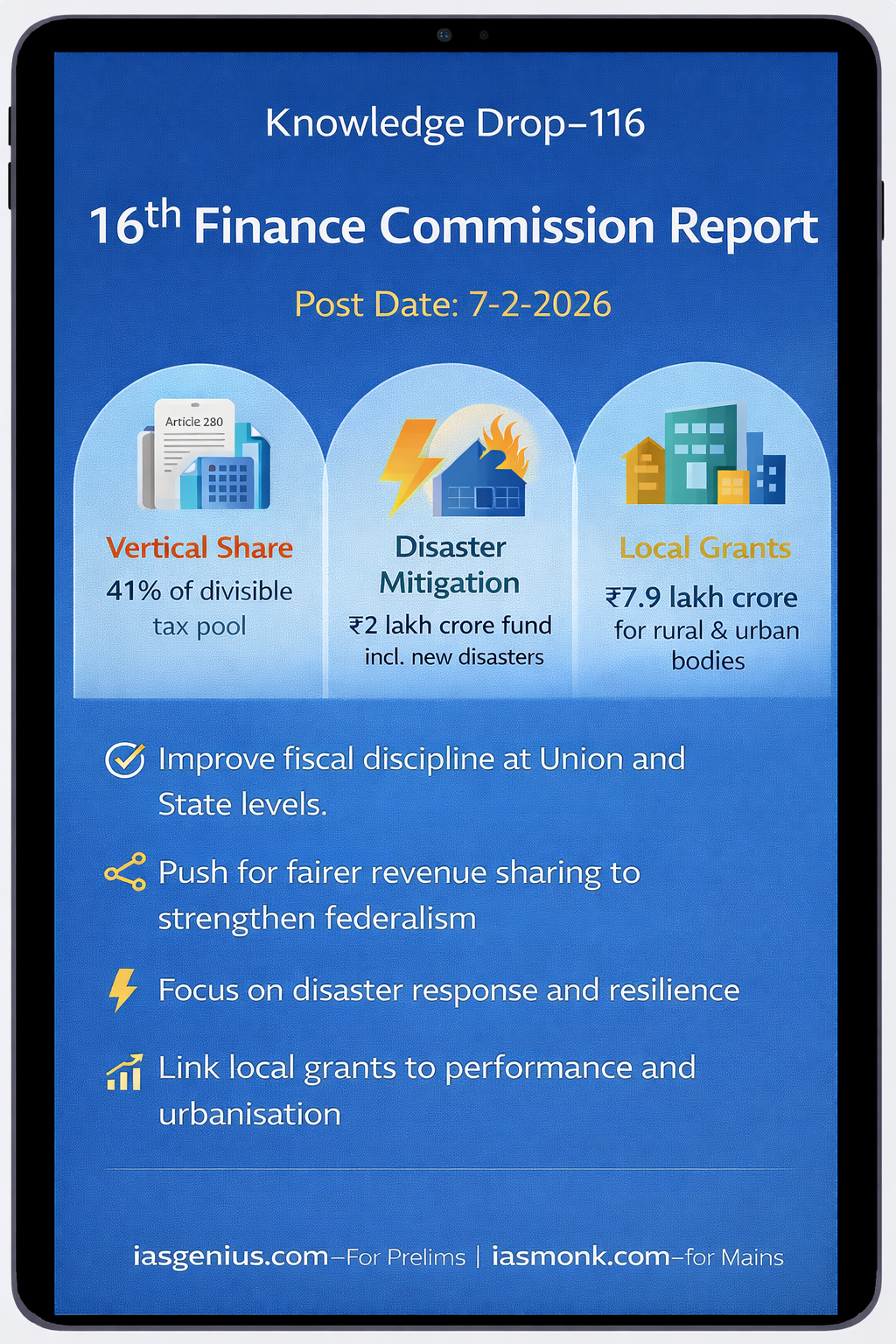
- States’ Share Retained at 41%: The Commission has recommended keeping the states’ share in the divisible tax pool at 41%, same as the 15th Finance Commission.
- The “Grand Bargain” Proposal:
Although the share remains 41%, the effective divisible pool has shrunk due to the rising use of cesses and surcharges by the Centre, which are not shareable.
The Commission has suggested that, in the future, these should be folded into the regular tax pool to restore the spirit of cooperative federalism.
2️⃣ Disaster Management Grants
- New Disasters Included: The 16th FC recommended Heatwaves and Lightning to be included in the list of nationally notified disasters, enabling states to access central assistance for these events.
- Total Corpus: ₹2,04,401 crore for the five-year period.
- Allocation Pattern:
- 80% to the State Disaster Response Fund (SDRF)
- 20% to the State Disaster Mitigation Fund (SDMF)
This marks a shift towards greater emphasis on disaster mitigation and resilience, not just relief.
3️⃣ Grants to Local Bodies
- Total Allocation: ₹7,91,493 crore for rural and urban local bodies.
- Performance Orientation:
- 80% Basic Grants
- 20% Performance-Linked Grants
- Urbanisation Premium: A dedicated ₹10,000 crore fund to incentivise the merger of peri-urban villages into larger Urban Local Bodies (ULBs), supporting planned urban expansion and governance efficiency.
4️⃣ Fiscal Roadmap
- States’ Fiscal Deficit: Recommended to be capped at 3% of GSDP.
- Union Fiscal Deficit: Target to bring it down to 3.5% of GDP by FY31.
- End of Revenue Deficit Grants:
Unlike previous Finance Commissions, the 16th FC has discontinued Post-Devolution Revenue Deficit Grants, urging states to strengthen their own tax administration and fiscal discipline.
🧭 Significance of the 16th Finance Commission’s Approach
- Reinforces fiscal discipline at both Union and State levels.
- Pushes for greater transparency and fairness in tax devolution by questioning excessive use of cesses and surcharges.
- Strengthens local governance through performance-linked grants and urbanisation incentives.
- Recognises climate and disaster risks by expanding the scope of disaster management funding.
- Encourages states to move towards self-reliant and efficient revenue systems rather than dependence on deficit grants.
🏁 Conclusion
The 16th Finance Commission continues the 41% devolution formula but introduces important structural correctives through the “Grand Bargain” idea, stronger disaster funding, performance-linked local body grants, and a tighter fiscal roadmap. Its recommendations aim to rebalance fiscal federalism, improve accountability, and strengthen India’s long-term macro-fiscal stability in an era of rising development and climate challenges.
Target IAS-2026+: Highly Expected Prelims MCQs :
📌 Prelims Practice MCQs
Topic: 16th Finance Commission
MCQ 1 | TYPE 1 — How Many Statements Are Correct?
Consider the following statements regarding the Finance Commission:
1)It is a constitutional body established under Article 280.
2)It is constituted by the President of India every five years or earlier.
3)Its recommendations are legally binding on the Government.
4)Cesses and surcharges levied by the Centre are part of the divisible pool.
How many of the above statements are correct?
A)Only one
B)Only two
C)Only three
D)All four
🌀 Didn’t get it? Click here (▸) for the Correct Answer & Explanation.
🟩 Correct Answer: B) Only two
🧠 Explanation:
Correct Answer: B)
1)✅ True – Article 280 provides for the Finance Commission.
2)✅ True – It is constituted every five years or earlier.
3)❌ False – Its recommendations are advisory in nature.
4)❌ False – Cesses and surcharges are not part of the divisible pool.
MCQ 2 | TYPE 2 — Two-Statement Type
Consider the following statements:
Statement 1: The 16th Finance Commission retained the states’ share in the divisible pool at 41%.
Statement 2: The “Grand Bargain” proposal suggests folding cesses and surcharges into the regular tax pool in the future.
Which of the above statements is/are correct?
A)Only 1 is correct
B)Only 2 is correct
C)Both 1 and 2 are correct
D)Neither 1 nor 2 is correct
🌀 Didn’t get it? Click here (▸) for the Correct Answer & Explanation.
🟩 Correct Answer: C)Both 1 and 2 are correct
🧠 Explanation:
Correct Answer: C)
Statement 1:✅ True – The share remains 41%, same as the 15th FC.
Statement 2:✅ True – The Commission highlighted this reform to restore the effective pool.
MCQ 3 | TYPE 3 — Code-Based Statement Selection
Consider the following statements regarding Disaster Management Grants recommended by the 16th Finance Commission:
1)Heatwaves and Lightning were recommended to be included as nationally notified disasters.
2)The total disaster grant corpus is ₹2,04,401 crore for five years.
3)60% of the corpus is allocated to SDRF and 40% to SDMF.
4)The recommendations indicate a shift towards both response and mitigation.
Which of the statements given above are correct?
A)1, 2 and 4 only
B)1 and 3 only
C)2 and 3 only
D)1, 2, 3 and 4
🌀 Didn’t get it? Click here (▸) for the Correct Answer & Explanation.
🟩 Correct Answer: A)1, 2 and 4 only
🧠 Explanation:
Correct Answer: A)
1)✅ True – Both Heatwaves and Lightning are proposed additions.
2)✅ True – The total corpus is ₹2,04,401 crore.
3)❌ False – Allocation is 80% to SDRF and 20% to SDMF.
4)✅ True – It reflects emphasis on response and mitigation.
MCQ 4 | TYPE 4 — Direct Factual Question
Which one of the following best describes the structure of grants to local bodies recommended by the 16th Finance Commission?
A)100% unconditional basic grants
B)50% basic grants and 50% performance-linked grants
C)80% basic grants and 20% performance-linked grants
D)Only urban local bodies receive performance-linked grants
🌀 Didn’t get it? Click here (▸) for the Correct Answer & Explanation.
🟩 Correct Answer: C)80% basic grants and 20% performance-linked grants
🧠 Explanation:
Correct Answer: C)
A)❌ Incorrect – Grants are not entirely unconditional.
B)❌ Incorrect – The split is not 50–50.
C)✅ Correct – 80% basic and 20% performance-linked.
D)❌ Incorrect – Both rural and urban local bodies are covered.
MCQ 5 | TYPE 5 — UPSC 2025 Linkage Reasoning Format (I, II, III)
Consider the following statements:
Statement I: The 16th Finance Commission seeks to strengthen fiscal discipline and cooperative federalism.
Statement II: It recommends capping states’ fiscal deficit at 3% of GSDP and reducing the Union’s fiscal deficit to 3.5% of GDP by FY31.
Statement III: It discontinues Post-Devolution Revenue Deficit Grants and urges states to improve their own tax administration.
Which one of the following is correct?
A)Both Statements II and III are correct and both explain Statement I
B)Both Statements II and III are correct but only one explains Statement I
C)Only one of the Statements II and III is correct and that explains Statement I
D)Neither Statement II nor Statement III is correct
🌀 Didn’t get it? Click here (▸) for the Correct Answer & Explanation.
🟩 Correct Answer: A)
🧠 Explanation:
Correct Answer: A)
✅Statement I is correct.
✅Statement II is correct and explains the push for fiscal discipline.
✅Statement III is correct and explains the move towards state-level fiscal responsibility.