




🧠 Knowledge Drop-112 | Economic Survey 2025–26: Key Highlights | IAS Prelims 2026-27 Highly Expected MCQs | Current Affairs & GS Essays on iasmonk.com
🧠 Knowledge Drop–112 | Economic Survey 2025–26: Key Highlights
Post Date: 3-2-2026
Syllabus: GS3/Economy
📌 Context
Recently, the Union Minister for Finance and Corporate Affairs tabled the Economic Survey 2025–26 in Parliament. The Survey presents a comprehensive assessment of India’s macroeconomic performance, sectoral trends, fiscal position, and future policy directions ahead of the Union Budget.
📘 What is the Economic Survey?
The Economic Survey is an official annual document reviewing the state of the Indian economy over the past year and outlining key economic trends, challenges, and policy priorities.
It is prepared by the Economic Division, Department of Economic Affairs (DEA), Ministry of Finance, under the supervision of the Chief Economic Adviser (CEA) and is tabled in Parliament just before the Union Budget every year.
It typically covers:
- Overview of the Economy: GDP growth, inflation, employment, fiscal deficit, external sector
- Sector-wise Analysis: Agriculture, Industry, Services
- Public Finance: Government revenue, expenditure, taxes, subsidies and welfare spending
- Social Sector: Education, health, poverty, inequality and human development
- Special Themes: Such as climate change & green growth, digital economy, inclusive growth, productivity and reforms
🌍 Global Context and India’s Growth Advantage
The global economy remains fragile, marked by geopolitical tensions, trade fragmentation, and financial vulnerabilities.
Against this backdrop, India stands out as the fastest-growing major economy for the fourth consecutive year.
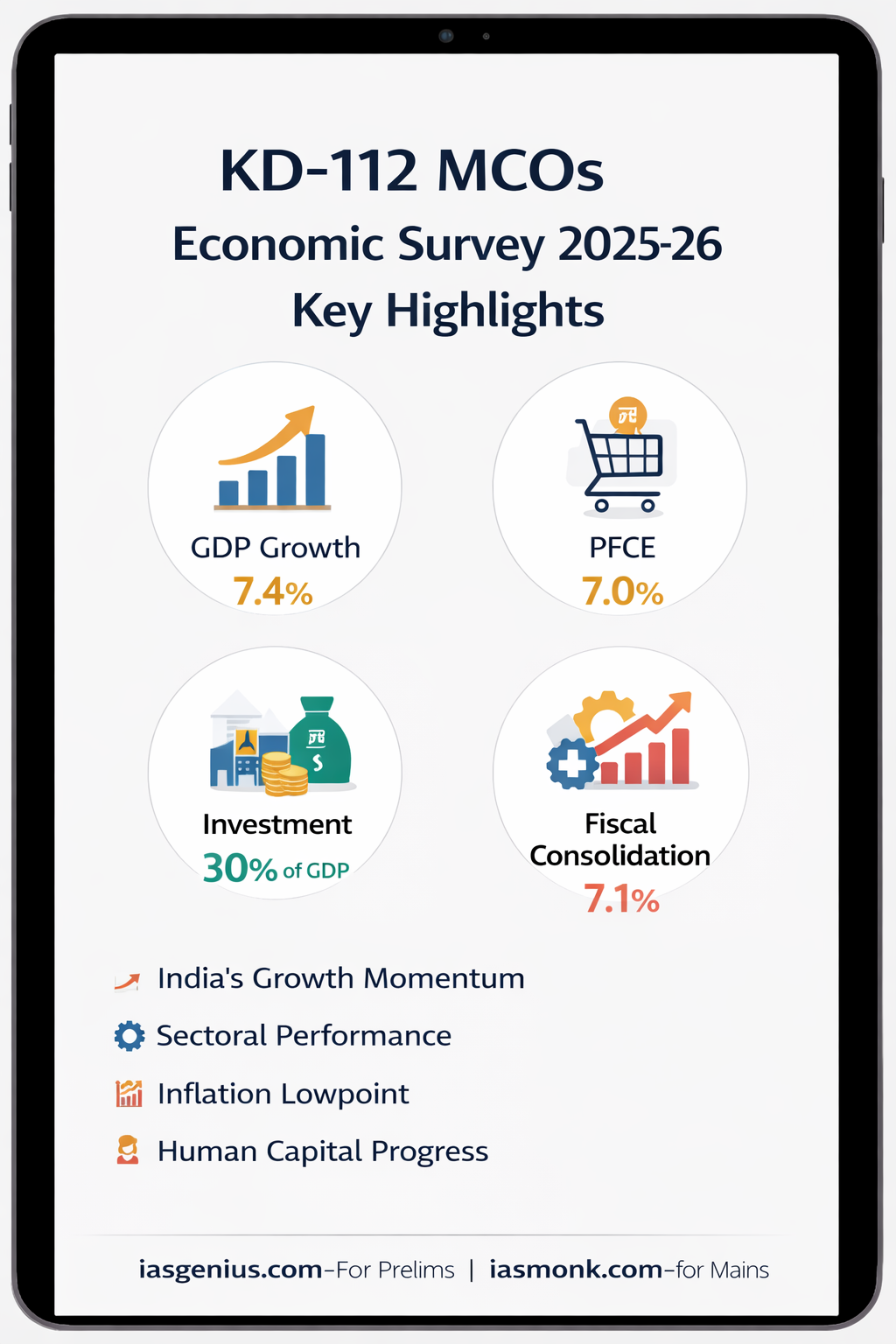
- As per the First Advance Estimates, real GDP growth in FY26 is pegged at 7.4%, with GVA growth at 7.3%, underlining strong domestic fundamentals.
📈 Demand-Led Growth: Consumption and Investment
Consumption Momentum:
- Private Final Consumption Expenditure (PFCE) grew 7.0% in FY26, reaching 61.5% of GDP, the highest since 2012.
- This reflects low and stable inflation, steady employment, and rising real incomes.
- Strong agricultural output boosted rural consumption, while tax rationalisation and income growth supported urban demand.
Investment Revival:
- Gross Fixed Capital Formation expanded by 7.8%, maintaining around 30% of GDP.
- Investment growth was driven by sustained public capital expenditure and renewed private sector investment, reflected in corporate announcements.
🏭 Sectoral Performance: Services Lead, Industry Accelerates
Services as the Growth Engine:
- Services GVA grew 9.3% in H1 FY26 and is estimated to grow 9.1% for the full year.
- Services now account for 56.4% of total GVA, driven by modern, tradable and digitally delivered services.
Industry and Manufacturing Upswing:
- Industry GVA grew 7.0% in H1 FY26.
- Manufacturing GVA accelerated to 7.72% in Q1 and 9.13% in Q2.
- PLI schemes have attracted over ₹2 lakh crore in investments, generated ₹18.7 lakh crore in incremental output, and created over 12.6 lakh jobs.
🏛️ Fiscal Developments: Credibility Through Consolidation
Prudent fiscal management strengthened macroeconomic stability and led to three sovereign credit rating upgrades in 2025.
Key trends:
- Centre’s revenue receipts rose to 9.2% of GDP in FY25
- Non-corporate tax collections increased from 2.4% (pre-pandemic) to 3.3% of GDP
- Income tax filers rose from 6.9 crore (FY22) to 9.2 crore (FY25)
- Effective capital expenditure reached 4% of GDP in FY25
- General government debt-to-GDP ratio reduced by 7.1 percentage points since 2020, while maintaining high investment levels
🏦 Monetary Management and Financial Intermediation
Banking Sector Strength:
- GNPA at 2.2% and net NPA at 0.5% (September 2025)
- Credit growth accelerated to 14.5% YoY by December 2025
Financial Inclusion:
- PMJDY: 55.02 crore accounts
- PMMY: ₹36.18 lakh crore disbursed across 55.45 crore loans
- Capital markets deepened: Demat accounts crossed 21.6 crore, with women forming nearly one-fourth of investors
- IMF–World Bank FSAP (2025) validated India’s resilient, well-capitalised financial system
🌐 External Sector: Resilience in a Volatile World
- India’s share in global merchandise exports: 1.8%
- Share in global services exports: 4.3%
- Total exports hit a record USD 825.3 billion in FY25, led by services
- Current Account Deficit: 1.3% of GDP (Q2 FY26)
- Remittances: USD 135.4 billion (highest globally)
- Forex reserves: USD 701.4 billion, covering ~11 months of imports
- India ranked 4th globally in Greenfield investments and emerged as the largest destination for digital Greenfield projects (2020–24)
📉 Inflation
- India recorded its lowest-ever CPI inflation, with average headline inflation at 1.7% (April–December 2025)
- Driven by declining food and fuel prices and effective supply-side management
- India saw one of the largest declines in inflation during 2025 among emerging economies
🌾 Agriculture and Food Management
- Foodgrain production: 357.7 million tonnes (AY 2024–25)
- Horticulture output: 362.08 MT, accounting for 33% of agricultural GVA
- e-NAM expanded to 1.79 crore farmers
- Income support continued through MSP, PM-KISAN (₹4.09 lakh crore disbursed) and PMKMY pensions
🏗️ Industry and Manufacturing
- Industry GVA grew 7.0% in H1 FY26
- Manufacturing accelerated to 9.13% in Q2
- PLI attracted ₹2 lakh crore investment and created 12.6 lakh jobs
- India’s Global Innovation Index rank improved to 38th (2025)
- Semiconductor Mission approved projects worth ₹1.6 lakh crore
👩🎓 Human Capital: Education, Health and Skills
Education:
- 24.69 crore students across 14.71 lakh schools
- Higher education institutions increased to 70,018
- NEP reforms enabled flexible learning and skills integration
Health:
- MMR declined by 86% since 1990
- IMR reduced to 25 (2023)
- Under-five mortality declined by 78%
Employment and Social Progress:
- 56.2 crore employed in Q2 FY26
- Organised manufacturing added 10 lakh jobs in FY24
- e-Shram registered 31 crore workers, over 54% women
- Social services expenditure rose to 7.9% of GDP (FY26 BE)
🚀 Emerging Frontiers: AI, Urbanisation and Strategic Resilience
India’s AI ecosystem is evolving around practical, low-cost, and local solutions across agriculture, healthcare and governance.
Urban connectivity projects are reshaping labour markets and easing metropolitan pressures.
Strategically, India is moving from narrow import substitution towards strategic resilience and global indispensability, embedding itself deeply into global value chains.
🔮 Looking Ahead: Strategic Resilience and Indispensability
India’s development strategy is shifting from import substitution to strategic resilience and global indispensability.
A disciplined indigenisation framework, lower input costs, AI diffusion tailored to real-world needs, and integrated urbanisation models are positioning India to move from “buying Indian” to “buying Indian without thinking.”
Target IAS-2026+: Highly Expected Prelims MCQs :
📌 Prelims Practice MCQs
Topic: 🧠 Knowledge Drop–112 | Economic Survey 2025–26: Key Highlights
MCQ 1 | TYPE 1 — How Many Statements Are Correct?
Consider the following statements regarding the Economic Survey 2025–26:
It is prepared by the Economic Division of the Department of Economic Affairs under the supervision of the Chief Economic Adviser.
It is tabled in Parliament after the Union Budget.
It reviews the state of the economy and outlines policy directions.
It is a constitutional document mandatorily required under Article 112.
How many of the above statements are correct?
A) Only one
B) Only two
C) Only three
D) All four
🌀 Didn’t get it? Click here (▸) for the Correct Answer & Explanation.
🟩 Correct Answer: B) Only two
🧠 Explanation:
Correct Answer: B)
1)✅ True – Prepared by DEA under CEA.
2)❌ False – It is tabled before the Union Budget.
3)✅ True – That is its core purpose.
4)❌ False – It is not a constitutional document.
MCQ 2 | TYPE 2 — Two-Statement Type
Consider the following statements:
Statement 1: India recorded its lowest-ever average CPI inflation during April–December 2025.
Statement 2: The decline in inflation was mainly due to falling food and fuel prices and supply-side management.
Which of the above statements is/are correct?
A)Only 1 is correct
B)Only 2 is correct
C)Both 1 and 2 are correct
D)Neither 1 nor 2 is correct
🌀 Didn’t get it? Click here (▸) for the Correct Answer & Explanation.
🟩 Correct Answer: C)Both 1 and 2 are correct
🧠 Explanation:
Correct Answer: C)
1)✅ True – Average headline inflation was at a historic low.
2)✅ True – Food, fuel prices and supply-side measures drove the decline.
MCQ 3 | TYPE 3 — Code-Based Statement Selection
Consider the following statements regarding growth trends in FY26:
1)Services account for more than half of India’s total GVA.
2)Gross Fixed Capital Formation maintained around 30% of GDP.
3)Manufacturing GVA growth decelerated in Q2 FY26.
4)PFCE reached its highest share of GDP since 2012.
Which of the statements given above are correct?
A)1, 2 and 4 only
B)1 and 3 only
C)2 and 3 only
D)1, 2, 3 and 4
🌀 Didn’t get it? Click here (▸) for the Correct Answer & Explanation.
🟩 Correct Answer: A) 1, 2 and 4 only
🧠 Explanation:
Correct Answer: A)
1)✅ True – Services account for about 56.4% of GVA.
2)✅ True – Investment stayed near 30% of GDP.
3)❌ False – Manufacturing accelerated in Q2 FY26.
4)✅ True – PFCE reached 61.5% of GDP, highest since 2012.
MCQ 4 | TYPE 4 — Direct Factual Question
Which of the following best describes India’s external sector performance as per the Economic Survey 2025–26?
A)India’s forex reserves fell below 6 months of import cover
B)Services exports led total exports to a record high
C)Current Account Deficit widened sharply beyond 3% of GDP
D)Remittances declined due to global slowdown
🌀 Didn’t get it? Click here (▸) for the Correct Answer & Explanation.
🟩 Correct Answer: B)Services exports led total exports to a record high
🧠 Explanation:
Correct Answer: B)
1)❌ False – Forex reserves cover about 11 months of imports.
2)✅ True – Total exports hit a record USD 825.3 billion led by services.
3)❌ False – CAD remained moderate at about 1.3% of GDP.
4)❌ False – Remittances reached a record high.
MCQ 5 | TYPE 5 — UPSC 2025 Linkage Reasoning Format (I, II, III)
Consider the following statements:
Statement I: India is transitioning from import substitution to a strategy of strategic resilience and global indispensability.
Statement II: India is embedding itself deeper into global value chains while strengthening domestic manufacturing and innovation.
Statement III: The Economic Survey highlights AI diffusion, lower input costs, and integrated urbanisation as growth enablers.
Which one of the following is correct?
A)Both Statements II and III are correct and both explain Statement I
B)Both Statements II and III are correct but only one explains Statement I
C)Only one of the Statements II and III is correct and that explains Statement I
D)Neither Statement II nor Statement III is correct
🌀 Didn’t get it? Click here (▸) for the Correct Answer & Explanation.
🟩 Correct Answer: A)
🧠 Explanation:
Correct Answer: A)
1)✅ Statement I is correct.
2)✅ Statement II is correct and explains Statement I.
3)✅ Statement III is correct and also explains Statement I.