




🧠 Knowledge Drop-107 | India’s Energy Sector: A $500-Billion Opportunity for Global Investors | IAS Prelims 2026-27 Highly Expected MCQs | Current Affairs & GS Essays on iasmonk.com
🧠 Knowledge Drop-107 | India’s Energy Sector: A $500-Billion Opportunity for Global Investors
GS-3 | Infrastructure | Energy Resources
Post Date: 29 January 2026
📌 Context
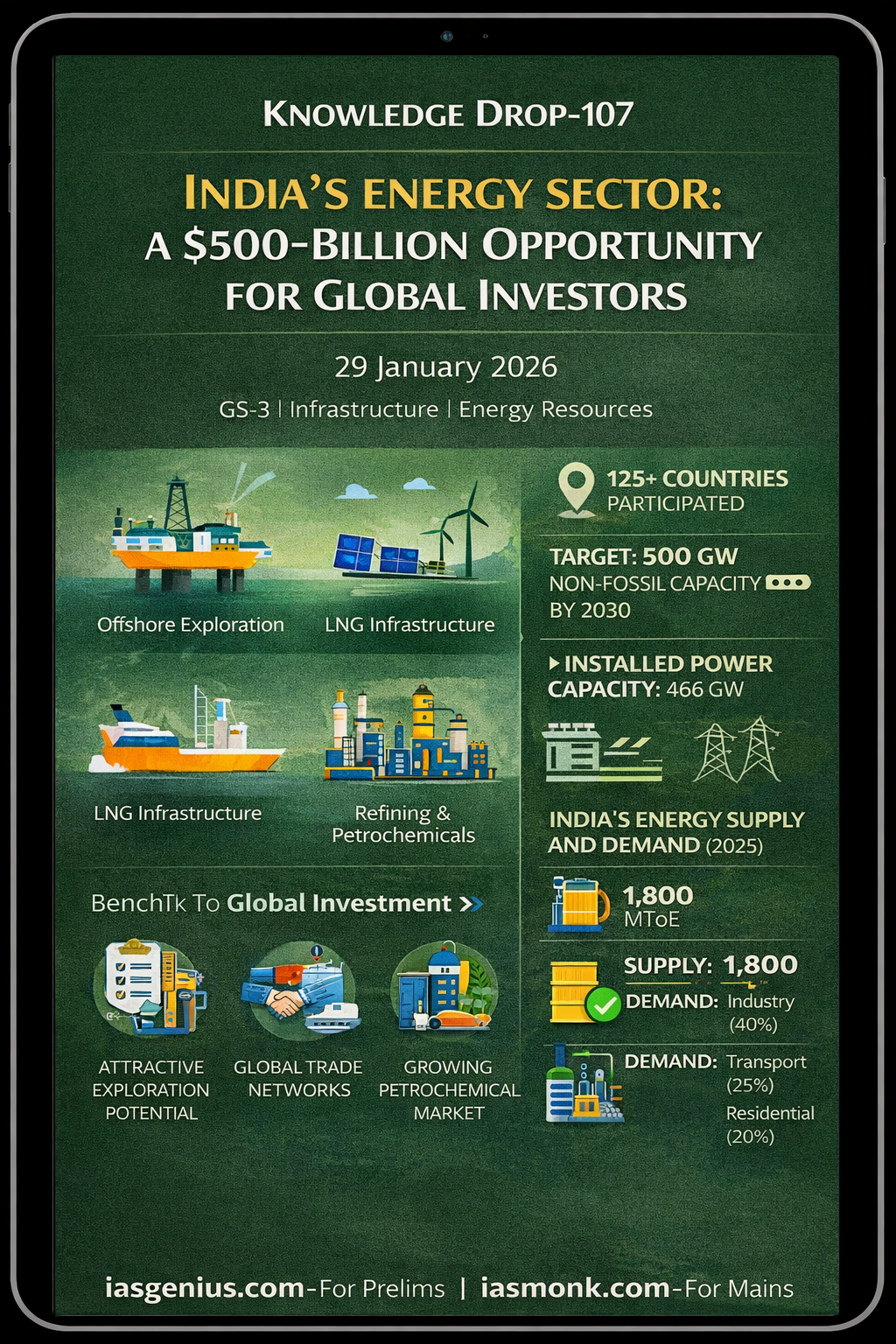
At India Energy Week 2026 in Goa, the Prime Minister invited global investors to partner in India’s rapidly expanding energy sector, describing it as a $500-billion investment opportunity. Participation from representatives of nearly 125 countries underscored India Energy Week’s emergence as a major global energy platform.
⭐ Key Highlights of India Energy Week 2026
• Focus on Energy Independence:
India outlined a shift from energy security to energy independence, backed by long-term, sustainable strategies.
• India as a Reliable Energy Partner:
India is among the top five exporters of petroleum products, supplying over 150 countries, strengthening its role as a dependable global energy partner.
• Major Investment Opportunities:
India showcased $500 billion worth of opportunities across the entire energy value chain, from upstream exploration to downstream sectors.
• Exploration and Deep-Sea Initiatives:
Emphasis on the Samudra Manthan Mission, with plans to attract $100 billion in oil and gas exploration and expand exploration areas to 1 million sq km.
• Refining Powerhouse Vision:
India is on track to become the world’s largest refining hub, already ranking second globally, with capacity expected to exceed 300 MMTPA.
• LNG and Gas Infrastructure Push:
Target to meet 15% of energy demand through LNG, supported by a ₹70,000-crore shipbuilding programme, new terminals, pipelines, and city gas networks.
• Growing Petrochemical Demand:
Rising population and economic growth are driving strong investment prospects in petrochemicals and downstream infrastructure.
⚡ India’s Energy Sector: Key Facts
• Installed Power Capacity:
India is the third-largest producer and consumer of electricity globally, with 466.24 GW installed capacity (as of 31 January 2025).
• Coal-Based Energy:
Coal contributes nearly 55% to the national energy mix and fuels over 70% of total power generation.
• Renewable Energy Growth:
India ranks among global leaders in solar and wind and aims for 500 GW of non-fossil fuel capacity by 2030.
Total installed renewable capacity (including large hydro) stands at 209.45 GW (December 2024):
– Wind: 48.16 GW
– Solar: 97.87 GW
– Biomass/Co-generation: 10.73 GW
– Small Hydro: 5.10 GW
– Waste-to-Energy: 0.62 GW
– Large Hydro: 46.97 GW
• Transmission Infrastructure:
India operates one of the world’s largest synchronised power grids, enabling inter-regional electricity transfer.
The country has achieved near-universal electricity access, with over 99% of villages electrified.
• Total Energy Supply and Demand (2025):
– Supply: About 1,800 MToE, growing at 4.5% annually over 2024
– Demand Drivers: Industry (40%), transport (25%), and residential consumption (20%)
🌍 Why Global Investors Are Attracted to India’s Energy Landscape
• Attractive Exploration Potential:
Reforms in oil and gas exploration, over 170 awarded blocks, reduced No-Go areas, and promising regions like the Andaman & Nicobar basin boost upstream prospects.
• Integration with Global Trade Networks:
Recent FTAs with the EU, UK, and EFTA strengthen supply chains and enhance investor confidence.
• Growing Petrochemical Market:
Industrialisation, urbanisation, and consumer demand are expanding opportunities in petrochemicals and downstream sectors.
• Commitment to Innovation and Sustainability:
Focus on cleaner fuels, advanced technologies, and sustainable energy solutions aligns India with global energy transition goals.
• Stable and Predictable Market:
Democratic governance, policy continuity, and a large domestic market offer long-term stability for investors.
⚠️ Related Concerns and Issues
• Rising Energy Demand Pressure:
Rapid growth is straining the balance between supply, affordability, and sustainability.
• Import Dependence for Crude and Gas:
Despite strong refining capacity, India remains heavily dependent on imports, exposing it to price volatility and geopolitical risks.
• Infrastructure Gaps:
Expanding pipelines, LNG terminals, storage, and transmission networks requires large capital and timely execution.
• Energy Transition Challenges:
Balancing fossil fuel expansion with clean energy commitments and climate targets is complex.
• Technology and Skill Gaps:
Advanced exploration, deep-sea drilling, LNG shipping, and clean technologies demand high-end skills and technology.
• Logistics and Supply Chain Constraints:
Port congestion, shipping availability, and inland transport bottlenecks can affect efficiency.
• Regulatory and Policy Uncertainty:
Ongoing reforms coexist with frequent policy changes and state-level variations, creating uncertainty.
• Financing and Capital Mobilisation:
Mega projects need long-term, low-cost finance, challenging amid global uncertainties.
• Environmental and Social Concerns:
Projects may face environmental clearances, land acquisition issues, and community resistance.
• Geopolitical Risks:
Global conflicts and disruptions can impact energy trade, prices, and investment flows.
🧭 IAS Monk Whisper
Energy is not just what powers machines; it powers nations. In India’s vast energy transition lies not only capital returns, but the quiet architecture of future prosperity.
Target IAS-2026+: Highly Expected Prelims MCQs :
📌 Prelims Practice MCQs
Topic: Knowledge Drop-107 | India’s Energy Sector: A $500-Billion Opportunity for Global Investors
MCQ 1 | TYPE 1 — How Many Statements Are Correct?
Consider the following statements regarding India Energy Week 2026 and investment opportunities:
1)India showcased a $500 billion investment opportunity across the energy value chain.
2)Representatives from nearly 125 countries participated in India Energy Week 2026.
3)India is among the top five exporters of petroleum products globally.
4)The focus was limited only to renewable energy and excluded fossil fuels.
How many of the above statements are correct?
A)Only one
B)Only two
C)Only three
D)All four
🌀 Didn’t get it? Click here (▸) for the Correct Answer & Explanation.
🟩 Correct Answer: C) Only three
🧠 Explanation:
Correct Answer: C) Only three
1)✅ True – The event highlighted $500 billion opportunities across the value chain.
2)✅ True – Nearly 125 countries were represented.
3)✅ True – India is among the top five exporters of petroleum products.
4)❌ False – The focus covered the entire energy spectrum, including fossil fuels and clean energy.
MCQ 2 | TYPE 2 — Two-Statement Type
Consider the following statements:
Statement 1: India aims to meet about 15 percent of its energy demand through LNG, supported by new terminals, pipelines, and city gas networks.
Statement 2: The LNG push is backed by a ₹70,000-crore shipbuilding programme.
Which of the statements given above is/are correct?
A)Only 1 is correct
B)Only 2 is correct
C)Both are correct
D)Neither is correct
🌀 Didn’t get it? Click here (▸) for the Correct Answer & Explanation.
🟩 Correct Answer: C) Both are correct
🧠 Explanation:
Correct Answer: C) Both are correct
Statement 1:✅ True – The target is to meet 15% of energy demand through LNG with supporting infrastructure.
Statement 2:✅ True – The LNG push includes a ₹70,000-crore shipbuilding programme.
MCQ 3 | TYPE 3 — Code-Based Statement Selection
Consider the following statements regarding India’s energy sector profile:
1)India is the third-largest producer and consumer of electricity globally.
2)Coal contributes nearly 55 percent to the national energy mix and fuels over 70 percent of power generation.
3)India’s total installed renewable capacity including large hydro stood at about 209.45 GW as of December 2024.
4)India has already achieved 500 GW of non-fossil fuel capacity.
Which of the statements given above are correct?
A)1, 2 and 3 only
B)1 and 4 only
C)2 and 3 only
D)1, 2, 3 and 4
🌀 Didn’t get it? Click here (▸) for the Correct Answer & Explanation.
🟩 Correct Answer: A) 1 and 2 only
🧠 Explanation:
Correct Answer: A) 1, 2 and 3 only
1)✅ True – India ranks third in production and consumption of electricity.
2)✅ True – Coal accounts for nearly 55% of the energy mix and over 70% of power generation.
3)✅ True – Renewable capacity including large hydro is about 209.45 GW as of December 2024.
4)❌ False – The target is 500 GW by 2030; it has not yet been achieved.
MCQ 4 | TYPE 4 — Direct Factual Question
Which one of the following initiatives focuses on attracting large-scale investments in offshore oil and gas exploration, including deep-sea areas?
A)National Solar Mission
B)Samudra Manthan Mission
C)Ujjwala Yojana
D)National Electric Mobility Mission
🌀 Didn’t get it? Click here (▸) for the Correct Answer & Explanation.
🟩 Correct Answer: B) Samudra Manthan Mission
🧠 Explanation:
Correct Answer: B) Samudra Manthan Mission
A)❌ Incorrect – National Solar Mission focuses on solar energy expansion.
B)✅ Correct – Samudra Manthan Mission targets offshore and deep-sea exploration investments.
C)❌ Incorrect – Ujjwala Yojana is related to LPG connections.
D)❌ Incorrect – This focuses on electric mobility.
MCQ 5 | TYPE 5 — UPSC 2025 Linkage Reasoning Format (I, II, III)
Consider the following statements:
Statement I:
India’s energy sector presents a major long-term opportunity for global investors.
Statement II:
The country offers large-scale opportunities across exploration, refining, LNG infrastructure, and petrochemicals, supported by policy reforms and market size.
Statement III:
India’s commitment to cleaner fuels, renewable energy expansion, and stable governance improves investor confidence despite transition challenges.
Which one of the following is correct?
A) Both Statements II and III are correct and both explain Statement I
B) Both Statements II and III are correct but only one explains Statement I
C) Only one of the Statements II and III is correct and that explains Statement I
D) Neither Statement II nor Statement III is correct
🌀 Didn’t get it? Click here (▸) for the Correct Answer & Explanation.
🟩 Correct Answer: A)
🧠 Explanation:
Correct Answer: A) Both Statements II and III are correct and both explain Statement I
Statement II:✅ True – Broad opportunities across the energy value chain explain the investment potential.
Statement III:✅ True – Clean energy focus and policy stability strengthen investor confidence, reinforcing the opportunity described in Statement I.