



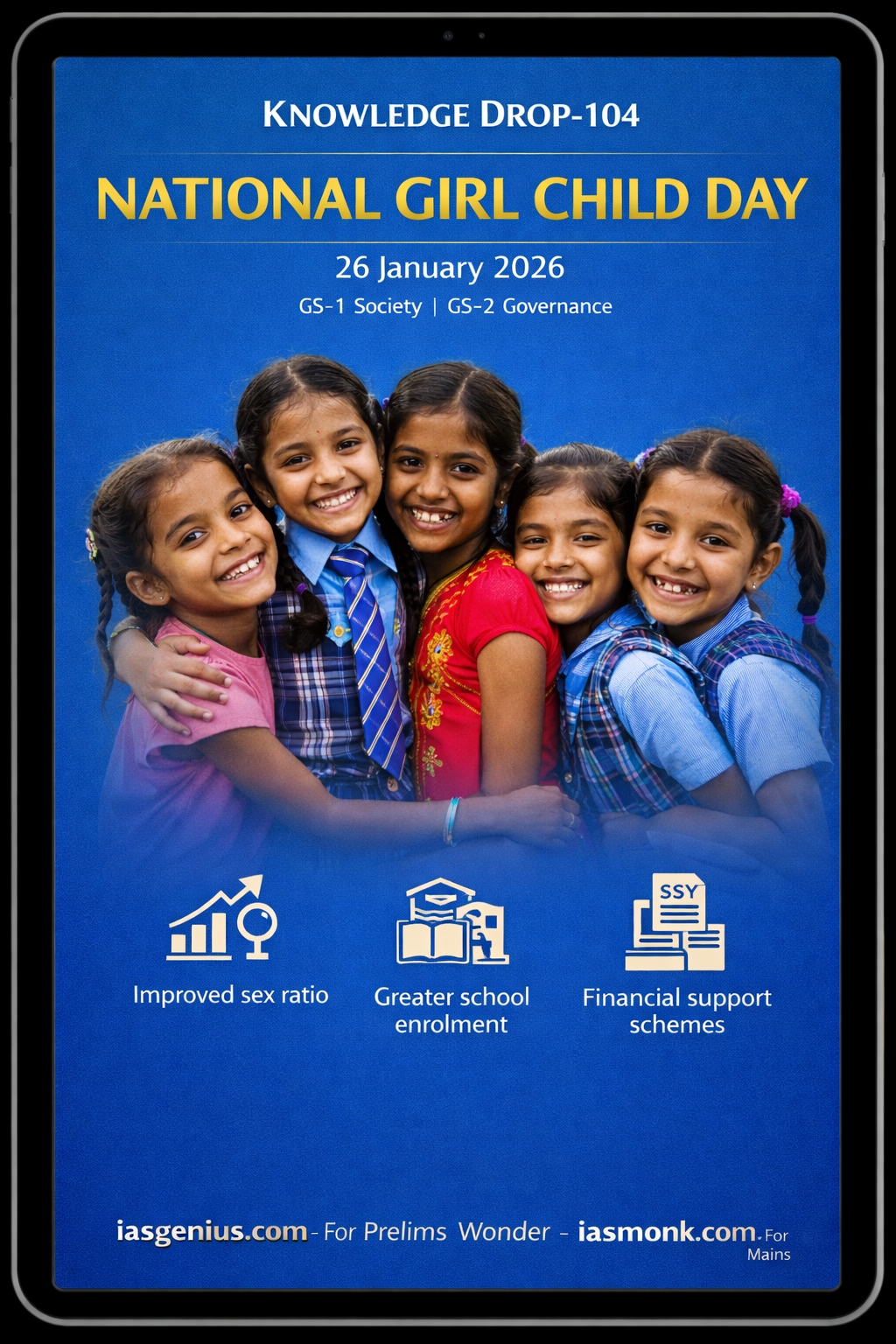
🧠 Knowledge Drop-104 | National Girl Child Day | IAS Prelims 2026-27 Highly Expected MCQs | Current Affairs & GS Essays on iasmonk.com
🧠 Knowledge Drop-104 | National Girl Child Day
GS-1 | Society
GS-2 | Governance
Post Date: 26 January 2026
📌 Context
National Girl Child Day is celebrated annually on January 24 to promote awareness about the rights of the girl child, her empowerment, and the need for equal opportunities in India.
📘 About National Girl Child Day
• National Girl Child Day has been observed every year on January 24 since 2008.
• It is observed under the aegis of the Ministry of Women and Child Development (MWCD).
• The day focuses on:
– Promoting the rights of girls
– Encouraging education and empowerment
– Addressing gender-based discrimination
– Creating awareness about equal opportunities for girls in society
⚠️ Challenges Faced by India in Ensuring Girls’ Rights
• Cultural Preference for Sons:
Sons have traditionally been preferred for carrying forward the family name, performing religious rites, and providing financial support in old age. This led to neglect of daughters, who were often seen as a financial burden due to dowry practices.
• Gender Discrimination:
Girls have historically faced neglect in nutrition, education, and healthcare, contributing to higher mortality and poorer life outcomes for females.
• Female Infanticide:
In some regions, female infants were abandoned or killed because of their perceived lower social and economic value.
• Sex-Selective Abortion:
Advances in medical technology, such as ultrasound, enabled sex determination and led to sex-selective abortions, causing a skewed sex ratio at birth.
• Economic Factors:
In agrarian societies, the labour of sons was considered more valuable for farm work, reinforcing the preference for male children.
• Lack of Access to Education:
Limited access to quality education, especially in rural areas, restricts girls’ future opportunities and economic independence.
• Safety and Security Issues:
High incidence of gender-based violence, including sexual harassment, domestic violence, and trafficking, continues to affect girls and women.
• Child Marriage:
The persistence of child marriage, particularly in rural areas, adversely impacts girls’ health, education, and personal autonomy.
• Restrictive Social Norms:
Rigid social roles and expectations limit women’s freedom, choices, and opportunities for self-development.
🏛️ Government Initiatives and Achievements
• Improved Sex Ratio at Birth (SRB):
Under sustained efforts, especially the Beti Bachao Beti Padhao (BBBP) scheme, the SRB has improved from around 918 in 2014–15 to 930 in 2023–24 at the national level.
• Progress in School Education:
For 2024–2025, the Gross Enrolment Ratio (GER) of girls at the secondary level has reached 80.2%, as per UDISE data.
About 97.5% of schools across the country are now equipped with girls’ toilet facilities, improving retention and attendance.
• Prevention of Child Marriage:
As of January 2026:
– 2,153 child marriages have been prevented
– 60,262 Child Marriage Prohibition Officers have been appointed across the country
• Menstrual Care and Dignity:
Government initiatives have increasingly focused on menstrual hygiene awareness, access to sanitary products, and dignity for adolescent girls.
• Sukanya Samriddhi Yojana (SSY):
By 2024, more than 4.2 crore accounts had been opened nationwide, indicating strong public participation and trust in the scheme aimed at securing the financial future of the girl child.
🛤️ Way Ahead
• Community Awareness and Education:
Campaigns like Beti Bachao Beti Padhao must continue to change mindsets about the value of the girl child and highlight the harms of gender discrimination.
• Improving Women’s Health and Healthcare Access:
Better healthcare facilities, especially in rural and underserved areas, can reduce female mortality and improve overall well-being.
• Changing Social Norms and Attitudes:
Promoting gender-sensitive education, involving men and boys in discussions on gender equality, and tackling the dowry system are essential to break deep-rooted biases.
• Robust Data Collection and Research:
Continuous monitoring of sex ratio trends and gender indicators will help design targeted interventions and evaluate the impact of existing policies.
🧭 IAS Monk Whisper
A nation’s future is not written only in its budgets and laws, but in how gently it holds the hands of its daughters and how far it lets them walk on their own.
Target IAS-2026+: Highly Expected Prelims MCQs :
📌 Prelims Practice MCQs
Topic: National Girl Child Day
MCQ 1 | TYPE 1 — How Many Statements Are Correct?
Consider the following statements regarding National Girl Child Day in India:
1)National Girl Child Day is observed annually on January 24.
2)It has been observed since 2008.
3)It is observed under the Ministry of Women and Child Development.
4)Its primary objective is to promote population control through family planning.
How many of the above statements are correct?
A)Only one
B)Only two
C)Only three
D)All four
🌀 Didn’t get it? Click here (▸) for the Correct Answer & Explanation.
🟩 Correct Answer: C) Only three
🧠 Explanation:
Correct Answer: C) Only three
1)✅ True – It is celebrated every year on January 24.
2)✅ True – It has been observed since 2008.
3)✅ True – It is under the Ministry of Women and Child Development.
4)❌ False – Its focus is on rights, empowerment, and equal opportunities for girls, not population control.
MCQ 2 | TYPE 2 — Two-Statement Type
Consider the following statements:
Statement 1: Cultural preference for sons in India has been linked to practices like dowry and expectations of old-age support.
Statement 2: Sex-selective abortion became possible due to advances in medical technologies such as ultrasound.
Which of the statements given above is/are correct?
A)Only 1 is correct
B)Only 2 is correct
C)Both are correct
D)Neither is correct
🌀 Didn’t get it? Click here (▸) for the Correct Answer & Explanation.
🟩 Correct Answer: C) Both are correct
🧠 Explanation:
Correct Answer: C) Both are correct
Statement 1:✅ True – Son preference is linked to social, religious, and economic factors including dowry and old-age support.
Statement 2:✅ True – Technologies like ultrasound enabled sex determination and sex-selective abortion.
MCQ 3 | TYPE 3 — Code-Based Statement Selection
Consider the following statements regarding government achievements for the girl child:
1)The Sex Ratio at Birth (SRB) has improved under schemes like Beti Bachao Beti Padhao.
2)The Gross Enrolment Ratio of girls at the secondary level has crossed 80 percent.
3)All schools in India are now equipped with girls’ toilet facilities.
4)More than 4 crore Sukanya Samriddhi Yojana accounts have been opened nationwide.
Which of the statements given above are correct?
A)1, 2 and 4 only
B)1 and 3 only
C)2, 3 and 4 only
D)1, 2, 3 and 4
🌀 Didn’t get it? Click here (▸) for the Correct Answer & Explanation.
🟩 Correct Answer: A) 1, 2 and 4 only
🧠 Explanation:
Correct Answer: A) 1, 2 and 4 only
1)✅ True – SRB has improved under BBBP and related efforts.
2)✅ True – GER of girls at secondary level has crossed 80 percent.
3)❌ False – About 97.5 percent of schools have girls’ toilets, not all.
4)✅ True – Over 4.2 crore SSY accounts have been opened.
MCQ 4 | TYPE 4 — Direct Factual Question
Which one of the following schemes is specifically aimed at securing the financial future of the girl child in India?
A)Beti Bachao Beti Padhao
B)Sukanya Samriddhi Yojana
C)Pradhan Mantri Jan Dhan Yojana
D)Poshan Abhiyaan
🌀 Didn’t get it? Click here (▸) for the Correct Answer & Explanation.
🟩 Correct Answer: Correct Answer: B) Sukanya Samriddhi Yojana
🧠 Explanation:
Correct Answer: B) Sukanya Samriddhi Yojana
A)❌ Incorrect – BBBP focuses on awareness, education, and survival of the girl child.
B)✅ Correct – SSY is a savings scheme for the financial security of the girl child.
C)❌ Incorrect – PMJDY is a general financial inclusion scheme.
D)❌ Incorrect – Poshan Abhiyaan focuses on nutrition.
MCQ 5 | TYPE 5 — UPSC 2025 Linkage Reasoning Format (I, II, III)
Consider the following statements:
Statement I:
Improving the status of the girl child is essential for achieving inclusive and sustainable development in India.
Statement II:
Practices such as child marriage, gender-based violence, and limited access to education restrict girls’ health, autonomy, and economic participation.
Statement III:
Government initiatives like Beti Bachao Beti Padhao and Sukanya Samriddhi Yojana aim to address both social attitudes and economic security of girls.
Which one of the following is correct?
A) Both Statements II and III are correct and both explain Statement I
B) Both Statements II and III are correct but only one explains Statement I
C) Only one of the Statements II and III is correct and that explains Statement I
D) Neither Statement II nor Statement III is correct
🌀 Didn’t get it? Click here (▸) for the Correct Answer & Explanation.
🟩 Correct Answer: A)
🧠 Explanation:
Correct Answer: A) Both Statements II and III are correct and both explain Statement I
Statement II:✅ True – These challenges directly hinder health, education, and participation of girls, affecting inclusive development.
Statement III:✅ True – These initiatives target social change and economic security, supporting the broader development goal stated in Statement I.