
🧠 Knowledge Drop-102 | The EV Boom is Accelerating a Copper Crunch | IAS Prelims 2026-27 Highly Expected MCQs | Current Affairs & GS Essays on iasmonk.com
🧠 Knowledge Drop-102 | The EV Boom is Accelerating a Copper Crunch
GS-3 | Economy | Infrastructure | Resources | Energy Transition
Post Date: 24 January 2026
📌 Context
The global shift toward electric vehicles (EVs) is triggering a growing challenge of a copper crunch. As countries race toward decarbonisation and electrified transport, the demand for copper is rising far faster than global supply can comfortably support.
📘 About: Why Copper Matters in the EV Era
Copper forms the backbone of the electric mobility ecosystem. It is a critical input for:
• EV batteries and motors
• Vehicle wiring systems
• Charging infrastructure
• Power transmission and distribution grids
As EV adoption accelerates worldwide, copper demand has entered a phase of exponential growth that many policymakers and markets had underestimated. The clean energy transition is, therefore, not only a technological shift but also a resource-intensive transformation constrained by critical minerals.
🧪 Copper (Cu): Key Facts
• Copper (Cu) is a reddish-orange, soft, and highly malleable metal with atomic number 29.
• It is renowned for its excellent electrical and thermal conductivity.
• These properties make it indispensable for electrical wiring, power transmission, plumbing, and electronics.
• Copper is also a major component of important alloys:
– Brass (copper + zinc)
– Bronze (copper + tin)
These alloys improve strength and corrosion resistance.
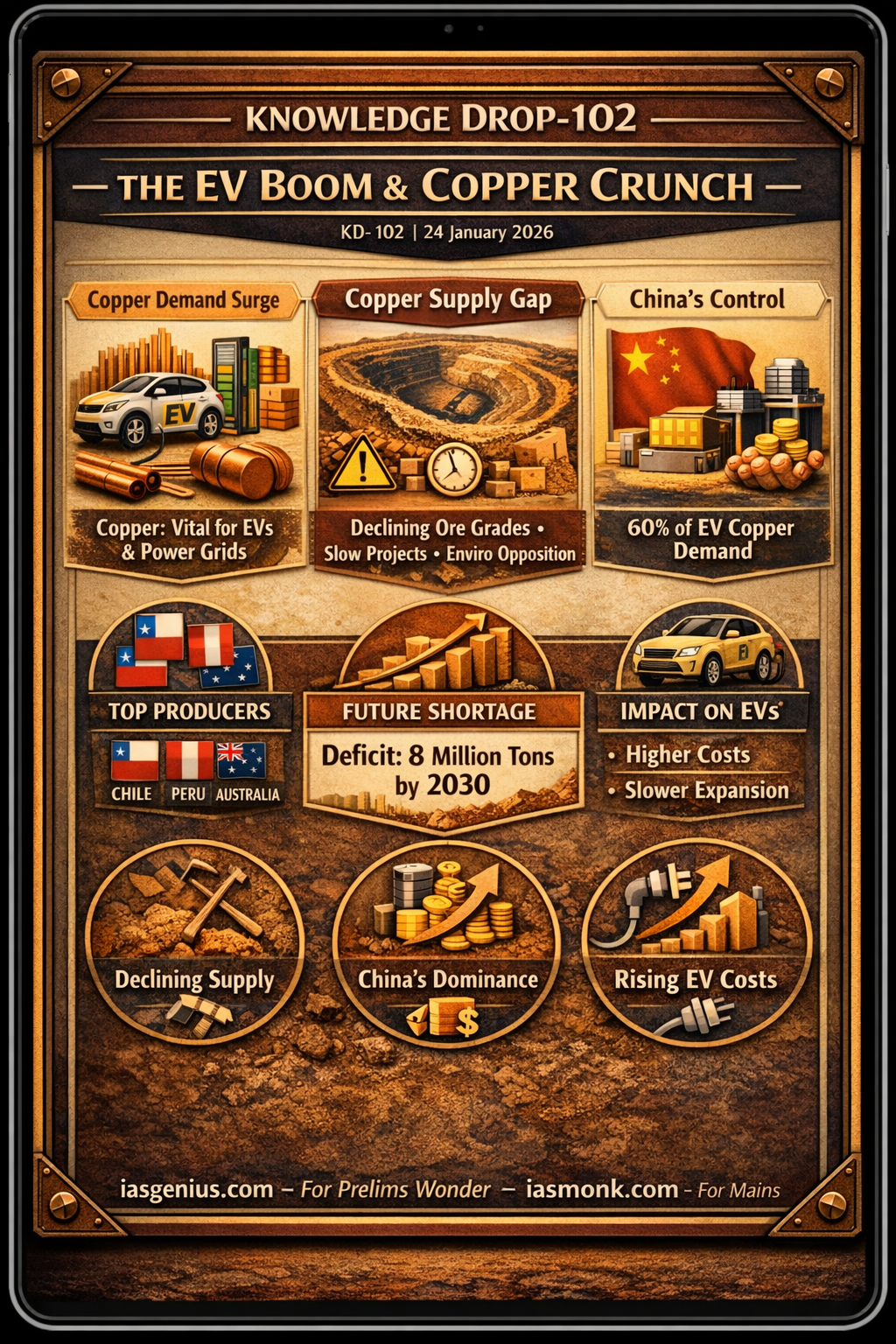
• In 2024, Chile (19%), Peru (12%), and Australia (10%) accounted for a major share of the world’s copper reserves.
• In India, significant copper ore resources are found in:
– Khetri belt (Rajasthan)
– Malanjkhand (Madhya Pradesh)
– Singhbhum belt (Jharkhand)
🚗 Expansion of Electric Vehicles and Copper Demand
Between 2015 and 2025, global EV sales rose from about 0.55 million units to an estimated 20 million units.
During the same period, copper consumption linked to EVs surged from roughly 27.5 thousand tonnes to over 1.28 million tonnes.
This clearly shows that copper is the hidden backbone of the EV revolution. The transition to electric mobility must, therefore, be understood not only as a climate or technology story, but also as a minerals and materials story.
⚠️ Concerns with Rising Copper Demand
1) Emerging Supply Deficit
Copper demand is rising sharply, while global supply growth has begun to plateau, creating a widening gap between demand and availability.
2) Constraints on Major Producers
Major producing regions such as Chile, Peru, and the United States face multiple bottlenecks:
• Declining ore grades at existing mines
• Long development timelines, often a decade or more, for new mining projects
• Environmental and social opposition to mining expansion
These factors severely limit the speed at which supply can respond to rising demand.
3) Alarming Future Projections
The global supply-demand gap is projected to:
• Reach about 4.5 million tonnes by 2028
• Widen further to nearly 8 million tonnes by 2030
This shortfall is roughly equivalent to the combined output of the world’s ten largest copper mines, highlighting the scale of the challenge.
4) Impact on the EV Transition
Such shortages could:
• Increase the cost of EVs
• Slow the expansion of charging infrastructure
• Strain national and global decarbonisation targets
In short, mineral scarcity could become a new bottleneck in the clean energy transition.
🌏 China’s Dominance in the Copper-EV Ecosystem
• China accounts for nearly 60% of global EV-related copper demand.
• It also controls over 70% of global battery cell production.
• Its deeply integrated supply chains give it a structural advantage in:
– Pricing power
– Securing long-term supply contracts
– Exercising strategic leverage over copper-rich regions
This concentration creates geopolitical and economic vulnerabilities for other countries pursuing large-scale electrification.
🇮🇳 Way Ahead for India
• India is not self-sufficient in copper supply.
• Domestic ore production in 2023–24 stood at 3.78 million tonnes, about 8% lower than in 2018–19.
• Copper is a deep-seated mineral, making it more difficult and expensive to explore and mine compared to shallow or bulk minerals.
Therefore, India must:
• Build a resilient copper supply chain
• Invest in exploration and mining technology
• Secure overseas mineral assets
• Strengthen recycling and circular economy approaches
• Optimise every stage of the copper value chain, from mining to manufacturing
🧭 IAS Monk Whisper
The future may run on electrons, but it will still be built on elements. In the quiet veins of copper, the speed of our green dreams is being decided.
Target IAS-2026+: Highly Expected Prelims MCQs :
📌 Prelims Practice MCQs
Topic: 🧠 Knowledge Drop-102 | The EV Boom is Accelerating a Copper Crunch
MCQ 1 | TYPE 1 — How Many Statements Are Correct?
Consider the following statements regarding copper and the EV transition:
1)Copper is a key input for EV batteries, motors, wiring and charging infrastructure.
2)Copper has poor electrical conductivity, which limits its use in power systems.
3)The EV transition is also a resource-intensive mineral transition.
4)Copper is an important component of alloys such as brass and bronze.
How many of the above statements are correct?
A)Only one
B)Only two
C)Only three
D)All four
🌀 Didn’t get it? Click here (▸) for the Correct Answer & Explanation.
🟩 Correct Answer: C) Only three
🧠 Explanation:
1)✅ True – Copper is essential for batteries, motors, wiring, and charging networks.
2)❌ False – Copper has excellent electrical conductivity.
3)✅ True – The energy transition is constrained by critical minerals like copper.
4)✅ True – Brass and bronze are copper-based alloys.
MCQ 2 | TYPE 2 — Two-Statement Type
Consider the following statements:
Statement 1: Chile, Peru and Australia together account for a major share of global copper reserves.
Statement 2: India is currently self-sufficient in copper production.
Which of the statements given above is/are correct?
A)Only 1 is correct
B)Only 2 is correct
C)Both are correct
D)Neither is correct
🌀 Didn’t get it? Click here (▸) for the Correct Answer & Explanation.
🟩 Correct Answer: A) Only 1 is correct
🧠 Explanation:
Statement 1:✅ True – These countries hold a significant share of global copper reserves.
Statement 2:❌ False – India is not self-sufficient in copper and depends on imports.
MCQ 3 | TYPE 3 — Code-Based Statement Selection
Consider the following statements regarding the global copper supply situation:
1)Declining ore grades at existing mines constrain copper output.
2)New copper mining projects usually require long development timelines.
3)Environmental opposition in major producing regions has no impact on supply expansion.
4)The projected copper supply gap by 2030 is comparable to the combined output of the world’s largest copper mines.
Which of the statements given above are correct?
A)1, 2 and 4 only
B)1 and 2 only
C)2 and 3 only
D)1, 3 and 4 only
🌀 Didn’t get it? Click here (▸) for the Correct Answer & Explanation.
🟩 Correct Answer: A)1, 2 and 4 only
🧠 Explanation:
1)✅ True – Declining ore grades reduce output.
2)✅ True – New projects take a decade or more.
3)❌ False – Environmental opposition significantly affects supply expansion.
4)✅ True – The projected gap is of that massive scale.
MCQ 4 | TYPE 4 — Direct Factual Question
Which one of the following regions in India is correctly matched with a major copper belt?
A)Khetri – Rajasthan
B)Jharia – Jharkhand
C)Dalli–Rajhara – Chhattisgarh
D)Bailadila – Odisha
🌀 Didn’t get it? Click here (▸) for the Correct Answer & Explanation.
🟩 Correct Answer: A)Khetri – Rajasthan
🧠 Explanation:
A)✅ Correct – Khetri belt is a major copper region in Rajasthan.
B)❌ Incorrect – Jharia is famous for coal.
C)❌ Incorrect – Dalli–Rajhara is known for iron ore.
D)❌ Incorrect – Bailadila is an iron ore region (and in Chhattisgarh, not Odisha).
MCQ 5 | TYPE 5 — UPSC 2025 Linkage Reasoning Format (I, II, III)
Consider the following statements:
Statement I:
The rapid expansion of electric vehicles is likely to increase the overall cost of the EV ecosystem in the coming years.
Statement II:
Global copper supply growth is constrained by declining ore grades and long development timelines for new mines.
Statement III:
China’s dominance in battery manufacturing and copper demand gives it pricing power in the global supply chain.
Which one of the following is correct?
A) Both Statements II and III are correct and both explain Statement I
B) Both Statements II and III are correct but only one explains Statement I
C) Only one of the Statements II and III is correct and that explains Statement I
D) Neither Statement II nor Statement III is correct
🌀 Didn’t get it? Click here (▸) for the Correct Answer & Explanation.
🟩 Correct Answer: A)
🧠 Explanation:
Statement II:✅ True – Supply constraints in copper raise input costs, pushing up EV ecosystem costs.
Statement III:✅ True – China’s dominance strengthens pricing power, which can also increase costs.