


🌊 Knowledge Drop-100 | UN High Seas Treaty (BBNJ) Comes Into Effect: What It Means for Ocean Governance | IAS Prelims 2026-27 Highly Expected MCQs | Current Affairs & GS Essays on iasmonk.com
🌊 KD-100 | UN High Seas Treaty (BBNJ) Comes Into Effect: What It Means for Ocean Governance
Post Date: 22 January 2026
Syllabus: GS3 | Environment
📌 Context
A UN-backed treaty on biodiversity in international waters, formally known as the Biodiversity Beyond National Jurisdiction (BBNJ) Treaty, has entered into force, creating the first legally binding global framework to conserve and sustainably use the high seas.
🌐 What are the High Seas?
- High seas refer to ocean areas beyond national jurisdiction, i.e., beyond 200 nautical miles (beyond Exclusive Economic Zones – EEZs).
- They cover nearly two-thirds of the global ocean and about half of the Earth’s surface.
- Earlier, they were governed mainly by broad principles under UNCLOS, with limited biodiversity-specific regulation.
📜 About the BBNJ Treaty
✅ Adoption & Background
- The BBNJ Agreement was adopted in 2023 through an intergovernmental conference convened under the United Nations on marine biodiversity of areas beyond national jurisdiction.
✅ Legal Status under UNCLOS
It is the third implementing agreement under UNCLOS, after:
- 1994 Part XI Implementation Agreement (Deep Seabed Mining)
- 1995 UN Fish Stocks Agreement
✅ Objective
- To ensure the conservation and sustainable use of marine biological diversity in Areas Beyond National Jurisdiction (ABNJ), i.e., the high seas.
✅ Institutions and Finance
- Establishes a Conference of the Parties (COP) as the decision-making body
- Creates a Clearing-House Mechanism for data, knowledge and cooperation
- Sets up a Secretariat
- Creates a dedicated funding mechanism to support implementation
✅ Membership Status
- 83 countries have ratified the treaty so far
- India has signed but not yet ratified the BBNJ Agreement
🌟 Significance of the BBNJ Treaty
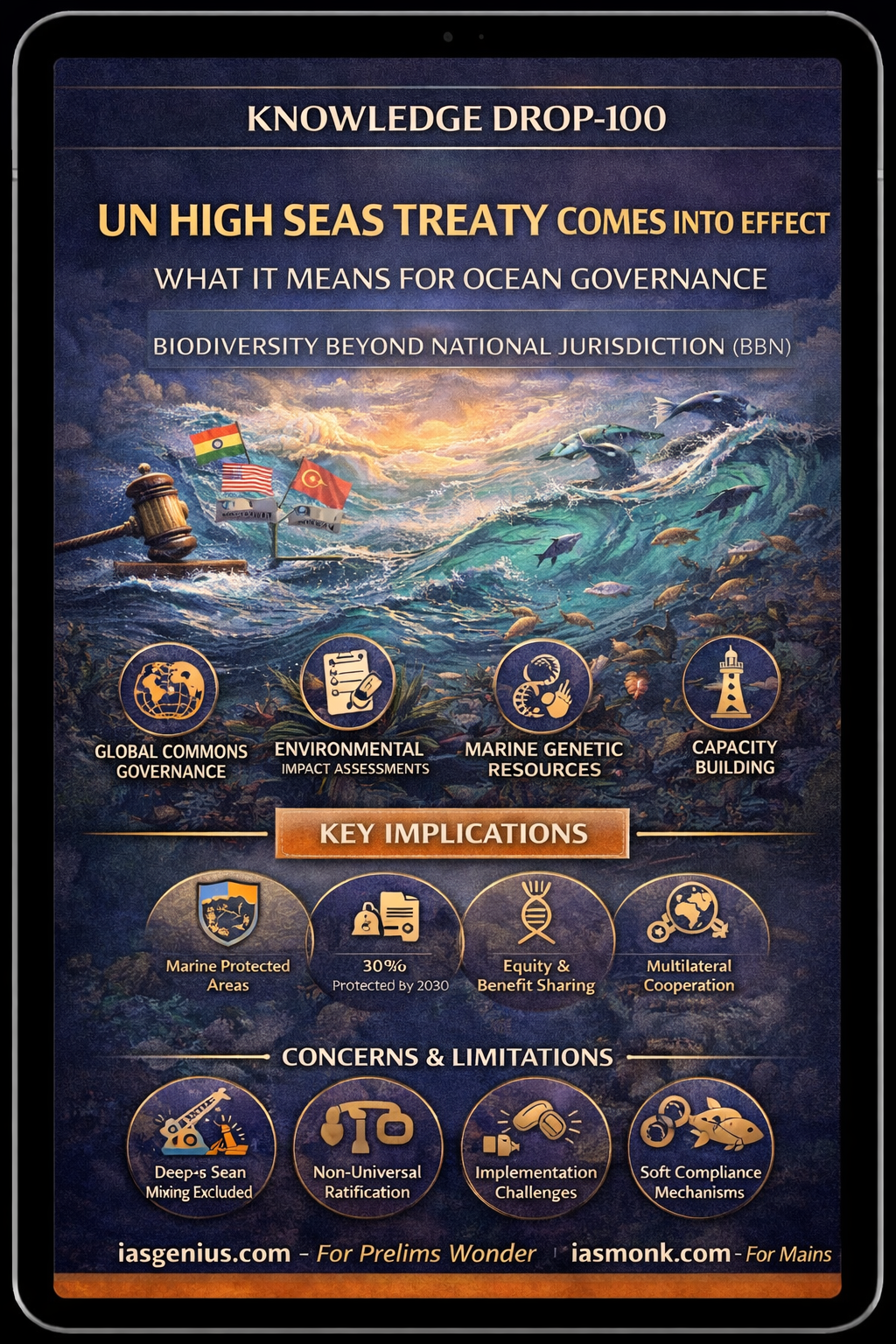
1) Governance of the Global Commons
- Provides the first comprehensive legal framework for biodiversity protection in ABNJ, which form nearly two-thirds of the global ocean.
- Earlier, high seas fishing often faced weak regulation, enabling overfishing of migratory species like tuna.
- BBNJ enables ecosystem-based management, improving long-term sustainability.
2) Helps Achieve the “30×30” Target
- Supports the global goal of protecting 30% of oceans by 2030 by enabling Marine Protected Areas (MPAs) in the high seas.
3) Mandatory Environmental Impact Assessments (EIAs)
- Requires prior EIAs for activities that may cause significant harm to marine ecosystems.
- This introduces accountability before damage becomes irreversible.
4) Equity through Marine Genetic Resources (MGRs)
- Introduces fair and equitable benefit-sharing from marine genetic resources, used in:
- Pharmaceuticals
- Cosmetics
- Biotechnology
5) Capacity Building for Developing Countries
- Promotes:
- Technology transfer
- Scientific cooperation
- Funding support
This is crucial because most high seas governance historically benefited technologically advanced actors.
6) Strengthening Multilateralism
- Reinforces a rules-based global order under the UN at a time of fragmented global governance.
⚠️ Concerns and Limitations
1) Deep-Sea Mining Excluded
- The treaty does not regulate seabed mining.
- Deep-sea mining remains under the International Seabed Authority (ISA).
2) Implementation Challenges
- Monitoring and enforcement in vast high seas is technically and financially demanding.
- Developing countries may struggle to:
- Conduct EIAs
- Participate effectively in COP processes
3) Non-Universal Ratification
- The United States has signed but not ratified, limiting compliance by major maritime powers.
4) Soft Compliance Mechanisms
- The treaty relies more on cooperation than coercive enforcement.
- Concerns remain that Illegal, Unreported and Unregulated (IUU) fishing may persist despite new norms.
🏁 Conclusion
The BBNJ Treaty marks a historic shift from “open access” exploitation toward rules-based stewardship of the high seas. While enforcement, finance, and universal ratification remain hurdles, it establishes the first global legal architecture to protect biodiversity in ocean areas that belong to everyone, yet were protected by almost no one.
🪔 IAS Monk Whisper
The high seas were once a lawless blue silence. Now the world has tried to give that silence a conscience.
Target IAS-2026+: Highly Expected Prelims MCQs :
📌 Prelims Practice MCQs
Topic:
MCQ 1 | TYPE 1 — How Many Statements Are Correct?
Consider the following statements regarding the High Seas and the BBNJ Treaty:
1)High seas refer to ocean areas beyond national jurisdiction, i.e., beyond Exclusive Economic Zones (EEZs).
2)High seas cover nearly two-thirds of the global ocean and about half of the Earth’s surface.
3)The BBNJ Treaty is the first legally binding global framework focused specifically on biodiversity in areas beyond national jurisdiction.
4)India has already ratified the BBNJ Treaty.
How many of the above statements are correct?
A)Only one
B)Only two
C)Only three
D)All four
🌀 Didn’t get it? Click here (▸) for the Correct Answer & Explanation.
🟩 Correct Answer: C)Only three
🧠 Explanation:
1)✅ True – High seas lie beyond national jurisdiction, i.e., beyond EEZs.
2)✅ True – They cover nearly two-thirds of the global ocean and about half of Earth’s surface.
3)✅ True – BBNJ creates the first legally binding global framework for biodiversity in ABNJ.
4)❌ False – India has signed but not yet ratified the treaty.
MCQ 2 | TYPE 2 — Two-Statement Type
Consider the following statements:
Statement 1: The BBNJ Agreement is the third implementing agreement under the United Nations Convention on the Law of the Sea (UNCLOS).
Statement 2: The BBNJ Agreement brings deep-sea mining under its regulatory framework.
Which of the following is correct?
A)Only Statement 1 is correct
B)Only Statement 2 is correct
C)Both statements are correct
D)Neither statement is correct
🌀 Didn’t get it? Click here (▸) for the Correct Answer & Explanation.
🟩 Correct Answer: A) Only 1 is correct
🧠 Explanation:
Statement 1)✅ True – It is the third implementing agreement under UNCLOS after the 1994 and 1995 agreements.
Statement 2)❌ False – Deep-sea mining remains under the International Seabed Authority (ISA) and is excluded from BBNJ.
MCQ 3 | TYPE 3 — Code-Based Statement Selection
Consider the following statements regarding institutional and governance features of the BBNJ Treaty:
1)It establishes a Conference of the Parties (COP) as the decision-making body.
2)It creates a Clearing-House Mechanism to facilitate data sharing and cooperation.
3)It mandates Environmental Impact Assessments (EIAs) for activities that may harm marine ecosystems.
4)It transfers the authority of seabed mining regulation from the ISA to the COP.
Which of the above statements are correct?
A)1, 2 and 3 only
B)1, 2 and 4 only
C)2 and 4 only
D)1, 2, 3 and 4
🌀 Didn’t get it? Click here (▸) for the Correct Answer & Explanation.
🟩 Correct Answer: A) 1, 2 and 3 only
🧠 Explanation:
1)✅ True – The treaty establishes a COP.
2)✅ True – It creates a Clearing-House Mechanism for data and cooperation.
3)✅ True – EIAs are mandatory for potentially harmful activities.
4)❌ False – Seabed mining remains under the ISA, not under the COP.
MCQ 4 | TYPE 4 — Direct Factual Question
The Biodiversity Beyond National Jurisdiction (BBNJ) Agreement was adopted in:
A)2015
B)2018
C)2021
D)2023
🌀 Didn’t get it? Click here (▸) for the Correct Answer & Explanation.
🟩 Correct Answer: D)2023
🧠 Explanation:
The BBNJ Agreement was adopted in 2023 by an intergovernmental conference under the United Nations.
MCQ 5 | TYPE 5 — UPSC 2025 Linkage Reasoning Format (I, II, III)
Consider the following statements:
Statement I:
The BBNJ Treaty marks a shift towards rules-based stewardship of the high seas and strengthens global ocean governance.
Statement II:
The treaty enables the creation of Marine Protected Areas (MPAs) in areas beyond national jurisdiction and mandates Environmental Impact Assessments.
Statement III:
The treaty introduces benefit-sharing of marine genetic resources and promotes capacity building for developing countries.
Which one of the following is correct?
A)Both Statements II and III are correct and both explain Statement I
B)Both Statements II and III are correct but only one explains Statement I
C)Only one of the Statements II and III is correct and that explains Statement I
D)Neither Statement II nor Statement III is correct
🌀 Didn’t get it? Click here (▸) for the Correct Answer & Explanation.
🟩 Correct Answer: A)
🧠 Explanation:
Statement II)✅ True – MPAs and EIAs strengthen biodiversity governance and accountability in the high seas.
Statement III)✅ True – Benefit-sharing and capacity building improve equity and implementation, reinforcing global governance.
Together, both statements explain why the treaty strengthens rules-based stewardship and global ocean governance.