

🚀 Knowledge Drop-98 | A Decade of Startup India: Growth, Challenges and the Road Ahead | IAS Prelims 2026-27 Highly Expected MCQs | Current Affairs & GS Essays on iasmonk.com
🚀 KD-98 | A Decade of Startup India: Growth, Challenges and the Road Ahead
Post Date: 20 January 2026
Syllabus: GS3 | Economy
📌 Context
Prime Minister Narendra Modi participated in a programme marking a decade of the Startup India initiative on National Startup Day.
Startup India was launched on January 16, 2016, as a transformative national programme to promote entrepreneurship and enable investment-driven growth in India.
🌱 India’s Startup Ecosystem: Where India Stands Today
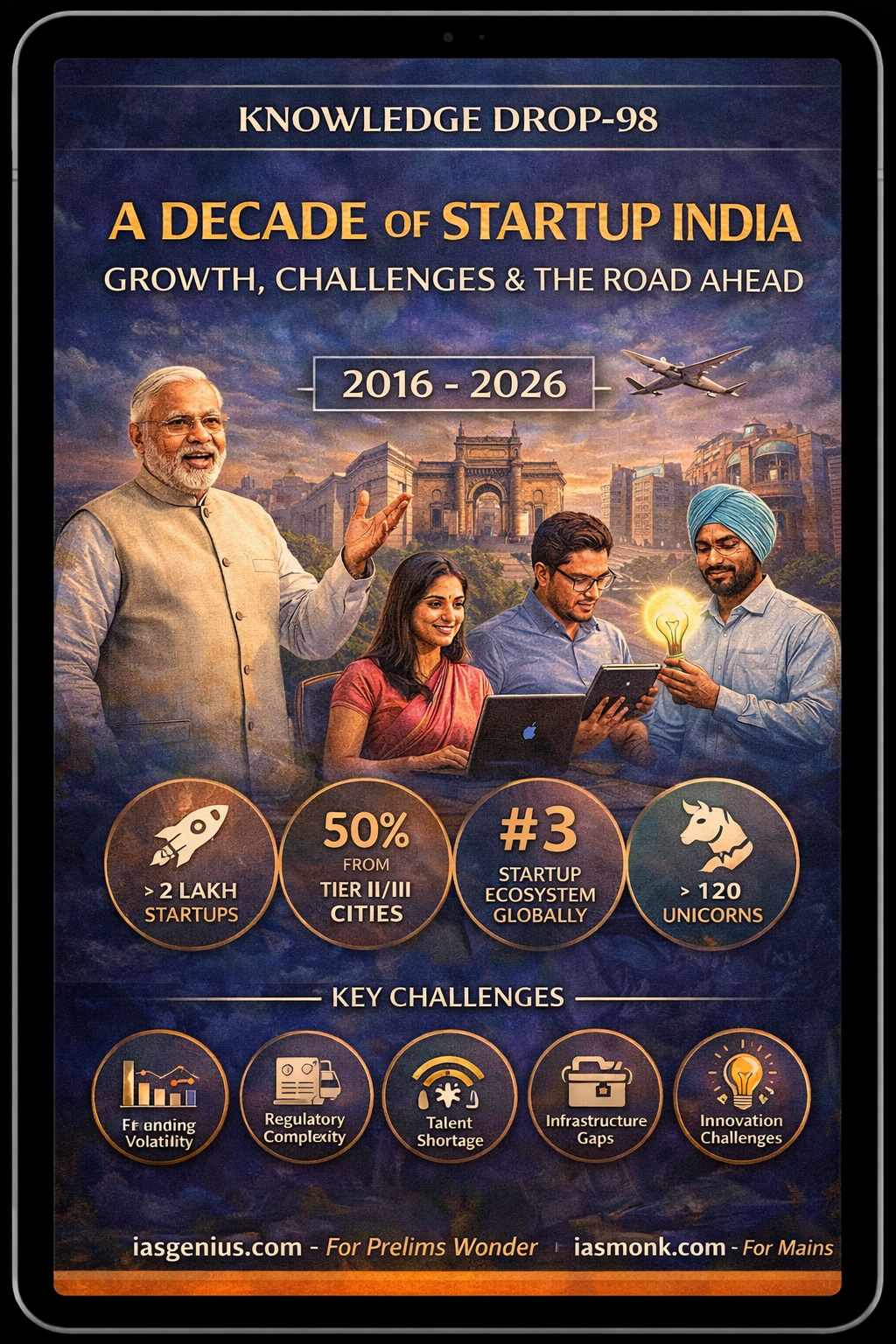
- India has rapidly evolved into one of the world’s largest startup ecosystems, with more than 2 lakh startups as of 2025.
- India now has the 3rd largest startup ecosystem in the world.
- Major hubs such as Bengaluru, Hyderabad, Mumbai, and Delhi-NCR have led this transformation.
- India has over 120 unicorns with a combined valuation exceeding $350 billion.
- Global Innovation Index (GII) 2025:
- The GII ranks around 140 economies on their innovation ecosystems.
- India has climbed steadily from 48th rank in 2020 to 38th rank in 2025.
- Importantly, growth is becoming more broad-based:
- Around 50% of startups are now emerging from Tier-II and Tier-III cities, not just metros.
⚠️ Challenges in India’s Startup Ecosystem
1) Funding Constraints and Capital Volatility
- Indian startups face inconsistent access to capital, especially during global economic slowdowns.
- Heavy dependence on foreign venture capital exposes startups to external shocks.
- Early-stage and deep-tech startups face acute funding shortages due to long gestation periods.
2) Regulatory Complexity and Policy Uncertainty
- Multiple compliance requirements across central and state governments increase operational costs.
- Frequent regulatory changes and tax-related ambiguities discourage risk-taking and innovation.
3) Talent Shortages and Skill Mismatch
- There is a shortage of skilled professionals in emerging technologies such as:
- Artificial Intelligence (AI)
- Semiconductors
- Cybersecurity
4) Infrastructure and Ecosystem Gaps
- Startup-support infrastructure is still concentrated in metro cities, limiting growth in Tier-II and Tier-III regions.
5) Weak Innovation and R&D Culture
- Low private-sector investment in R&D
- Weak industry–academia linkages
- Inadequate awareness of intellectual property rights
These factors constrain innovation and commercialization of indigenous technologies.
🏛️ Government Initiatives to Strengthen the Ecosystem
🔹 Sector-specific and Ministry-led Initiatives
- AI Centers of Excellence
- Establishing dedicated AI hubs and innovation centres across the country
- To support AI startups, research, and product development
- India’s Digital Public Infrastructure (DPI)
- Combines public funding with private sector innovation
- Drives large-scale digital transformation and creates platforms for startup-led solutions
🏁 Conclusion
Over the last 10 years, India’s startup ecosystem has witnessed tremendous growth, emerging as the third-largest in the world.
This dynamic collaboration among government, investors, industry, and innovators has strengthened the ecosystem, driving economic growth and empowering the next generation of entrepreneurs.
The next decade will be crucial for deep-tech, R&D-led innovation, and global competitiveness of Indian startups.
🪔 IAS Monk Whisper
A startup is not just a business in search of profit. It is a nation’s youth testing whether ideas can outrun inertia.
Target IAS-2026+: Highly Expected Prelims MCQs :
📌 Prelims Practice MCQs
Topic:
MCQ 1 | TYPE 1 — How Many Statements Are Correct?
Consider the following statements regarding India’s startup ecosystem:
1)Startup India was launched on January 16, 2016.
2)India has more than 2 lakh startups as of 2025.
3)India currently has the largest startup ecosystem in the world.
4)Around half of Indian startups now emerge from Tier-II and Tier-III cities.
How many of the above statements are correct?
A)Only one
B)Only two
C)Only three
D)All four
🌀 Didn’t get it? Click here (▸) for the Correct Answer & Explanation.
🟩 Correct Answer: C) Only three
🧠 Explanation:
1)✅ True – Startup India was launched on January 16, 2016.
2)✅ True – India has crossed 2 lakh startups by 2025.
3)❌ False – India has the 3rd largest, not the largest, startup ecosystem.
4)✅ True – About 50% of startups now come from Tier-II and Tier-III cities.
MCQ 2 | TYPE 2 — Two-Statement Type
Consider the following statements:
Statement 1: MSME and startup growth in India is concentrated only in metro cities like Bengaluru and Mumbai.
Statement 2: Tier-II and Tier-III cities are increasingly contributing to India’s startup ecosystem.
Which of the following is correct?
A)Only Statement 1 is correct
B)Only Statement 2 is correct
C)Both statements are correct
D)Neither statement is correct
🌀 Didn’t get it? Click here (▸) for the Correct Answer & Explanation.
🟩 Correct Answer: B)Only Statement 2 is correct
🧠 Explanation:
Statement 1)❌ False – The ecosystem is no longer limited to metros; smaller cities are contributing significantly.
Statement 2)✅ True – Around 50% of startups now emerge from Tier-II and Tier-III cities.
MCQ 3 | TYPE 3 — Code-Based Statement Selection
Consider the following statements regarding challenges faced by Indian startups:
1)Heavy dependence on foreign venture capital exposes startups to global financial shocks.
2)Early-stage and deep-tech startups face funding constraints due to long gestation periods.
3)India has surplus skilled manpower in emerging technologies like AI and semiconductors.
4)Weak industry–academia linkages constrain innovation and commercialization.
Which of the above statements are correct?
A)1, 2 and 3 only
B)1, 2 and 4 only
C)2 and 3 only
D)1, 2, 3 and 4
🌀 Didn’t get it? Click here (▸) for the Correct Answer & Explanation.
🟩 Correct Answer: B)1, 2 and 4 only
🧠 Explanation:
1)✅ True – Dependence on foreign capital exposes startups to external shocks.
2)✅ True – Long gestation periods make deep-tech and early-stage startups funding-constrained.
3)❌ False – There is a shortage, not surplus, of skilled talent in AI, semiconductors, cybersecurity.
4)✅ True – Weak industry–academia links hinder innovation and commercialization.
MCQ 4 | TYPE 4 — Direct Factual Question
According to the Global Innovation Index (GII) 2025, India’s rank is:
A)48
B)42
C)38
D)32
🌀 Didn’t get it? Click here (▸) for the Correct Answer & Explanation.
🟩 Correct Answer: C)38
🧠 Explanation:
India improved its ranking from 48 in 2020 to 38 in 2025 in the Global Innovation Index.
MCQ 5 | TYPE 5 — UPSC 2025 Linkage Reasoning Format (I, II, III)
Consider the following statements:
Statement I:
India’s startup ecosystem has become more broad-based and inclusive over the last decade.
Statement II:
A significant proportion of startups are now emerging from Tier-II and Tier-III cities.
Statement III:
Government initiatives like Startup India and Digital Public Infrastructure have strengthened innovation and entrepreneurship.
Which one of the following is correct?
A)Both Statements II and III are correct and both explain Statement I
B)Both Statements II and III are correct but only one explains Statement I
C)Only one of the Statements II and III is correct and that explains Statement I
D)Neither Statement II nor Statement III is correct
🌀 Didn’t get it? Click here (▸) for the Correct Answer & Explanation.
🟩 Correct Answer: A)Both Statements II and III are correct and both explain Statement I
🧠 Explanation:
Statement II)✅ True – The rise of Tier-II and Tier-III city startups shows the ecosystem is broad-based.
Statement III)✅ True – Policy and platform support has strengthened innovation and entrepreneurship.
Together, both statements explain why India’s startup ecosystem has become more inclusive and broad-based.