



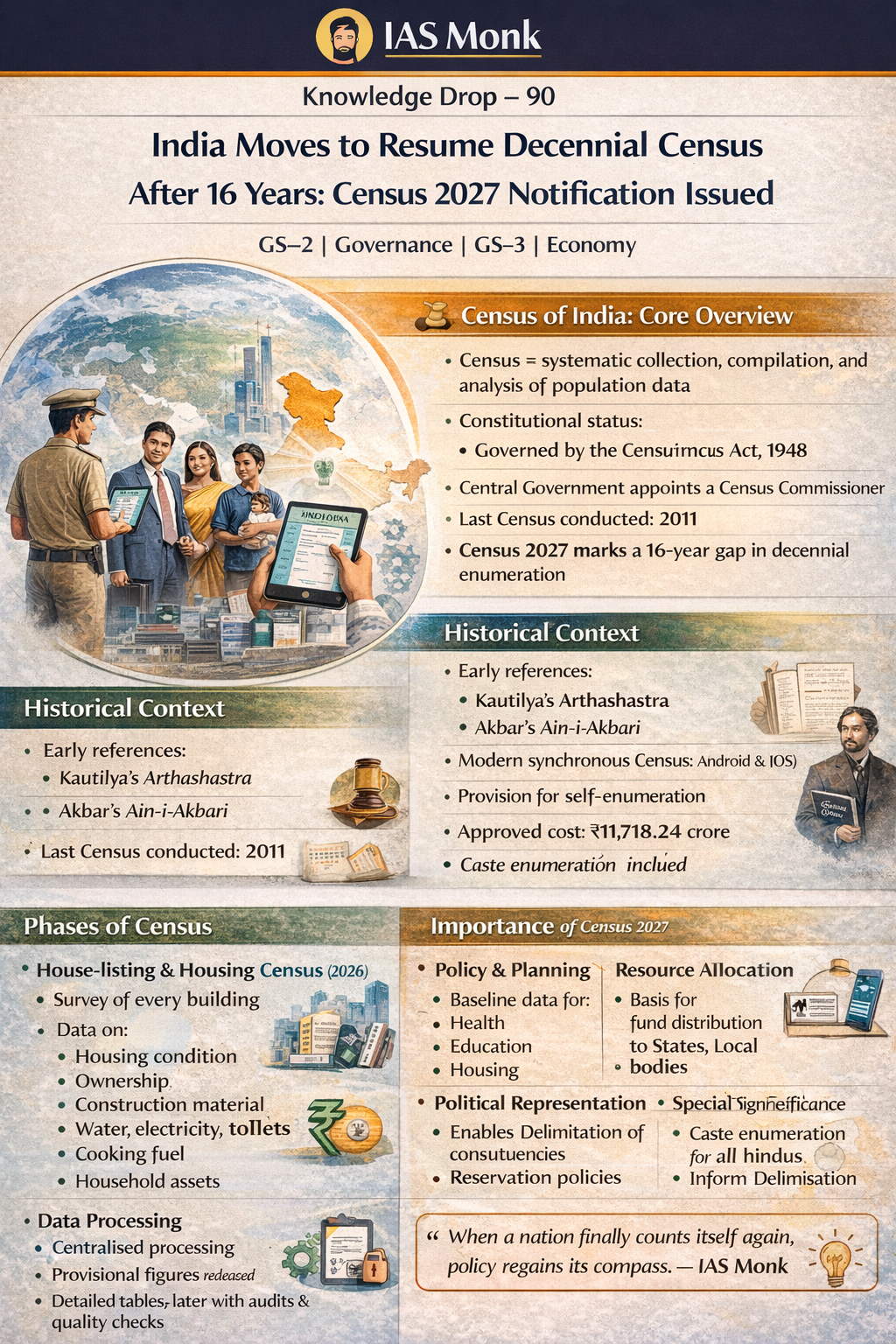
🌑Knowledge Drop – 90: India Moves to Resume Decennial Census After 16 Years: Census 2027 Notification Issued
🔗 This Knowledge Drop has a Mains-focused companion on iasmonk.com
“For answer-writing enrichment beyond Prelims, visit iasmonk.com.”
For prelims: In-depth UPSC Level MCQs; Booster Notes; 20 Word-Flash Facts | You are very much here! For Mains: All G.S Papers: High Quality Essays ; Model Answers; Case Studies and beyond … Visit: iasmonk.com
Post Date : 12-Jan-2026
India Moves to Resume Decennial Census After 16 Years: Census 2027 Notification Issued
GS-2 | Governance | GS-3 | Economy
📍 In News
The Union Government has issued the notification for the first phase of the Census of India 2027, marking the resumption of India’s decennial population census after a gap of 16 years, since the last Census was conducted in 2011.
The prolonged interruption, largely due to the COVID-19 pandemic and subsequent administrative delays, has made Census 2027 a crucial governance exercise, as population data has remained outdated for more than a decade, affecting planning, resource allocation, and representation.
📘 About the Census of India
The Census is the systematic process of collecting, compiling, and analysing population data of a country.
Historical Evolution
- References to population enumeration exist from:
- Kautilya’s Arthashastra
- Akbar’s Ain-i-Akbari
- The modern synchronous Census, where data is collected simultaneously across the country, began in 1881 during British rule.
- W. C. Plowden was India’s first Census Commissioner.
Legal & Constitutional Framework
- Census is a Union List subject
- Governed by the Census Act, 1948
- Authorises the Central Government to conduct the Census
- Empowers appointment of a Census Commissioner
- Union Cabinet approval:
- Estimated cost: ₹11,718.24 crore
- Caste enumeration included in Census 2027
🧩 Key Features of Census 2027
- First fully digital Census in India’s history
- Enumeration through mobile applications (Android & iOS)
- Provision for self-enumeration
- Combines administrative efficiency with technological innovation
🏠 How is the Census Conducted?
The Census is conducted in two major phases:
Phase 1: House-listing & Housing Census (Expected in 2026)
- Survey of every building
- Data collected includes:
- Type and condition of structure
- Ownership status
- Number of rooms
- Construction materials
- Access to water, electricity, toilets
- Cooking fuel
- Household assets
- Provides insights into housing conditions and basic amenities
Phase 2: Population Enumeration
- Individual-level data for every person, including the homeless
- Information collected:
- Age, sex, education, occupation
- Religion, caste/tribe
- Disability status
- Migration history
- Forms the core demographic and socio-economic dataset
Data Processing
- Centralised processing of data
- Release sequence:
- Provisional population figures
- Detailed tables and cross-tabulations
- Quality checks and audits to ensure accuracy
🎯 Importance of Census 2027
Policy & Planning
- Baseline data for:
- Health
- Education
- Housing
- Employment
Resource Allocation
- Basis for:
- Inter-state fund distribution
- Transfers to local bodies
Political Representation
- Determines:
- Delimitation of constituencies
- Reservation policies
Special Significance of Census 2027
- Caste enumeration for all Hindus
- Enables:
- Delimitation of legislative seats
- Implementation of one-third reservation for women
Digital Governance
- Mobile apps and self-enumeration:
- Improve efficiency
- Enhance transparency
- Speed up data release
⚠️ Issues and Concerns
Digital Divide
- Ensuring participation from:
- Rural
- Remote
- Marginalised communities with limited internet access
Data Security & Privacy
- Protection of sensitive demographic and caste data
- Risks of misuse or breaches
Administrative Coordination
- Managing coordination across:
- All States
- Union Territories
- Within tight timelines
Urban Enumeration Challenges
- Migrant populations
- Informal settlements
- Rapid urbanisation complicate accurate counting
🔮 Conclusion & Way Forward
Census 2027 is a landmark governance exercise, blending India’s long census tradition with digital innovation.
Its success will depend on:
- Bridging the digital divide
- Ensuring robust data protection
- Building public trust
Despite challenges, Census 2027 offers an unprecedented opportunity to create a comprehensive, inclusive, and timely demographic profile of India—critical for shaping policies and governance frameworks in the coming decades.
🪶 IAS Monk Whisper
When a nation counts itself honestly, governance begins to listen.
Target IAS-2026+: Highly Expected Prelims MCQs :
📌 Prelims Practice MCQs
Topic:
MCQ 1 | TYPE 1 — How Many Statements Are Correct?
Consider the following statements regarding the Census of India:
1)The Census is a Union List subject under the Constitution of India.
2)The Census Act, 1948 authorises the Central Government to conduct the Census.
3)The Census of India has been conducted without interruption since 1951.
4)Census 2027 will include caste enumeration.
How many of the above statements are correct?
A)Only one
B)Only two
C)Only three
D)All four
🌀 Didn’t get it? Click here (▸) for the Correct Answer & Explanation.
🟩 Correct Answer: C) Only three
🧠 Explanation:
1)✅ True – Census is a Union List subject.
2)✅ True – Census Act, 1948 provides the legal framework.
3)❌ False – Census was last conducted in 2011; Census 2021 was postponed.
4)✅ True – Caste enumeration is included in Census 2027.
MCQ 2 | TYPE 2 — Two-Statement Type
Consider the following statements:
Statement I: Census 2027 will be India’s first fully digital Census.
Statement II: Census data collection will be carried out exclusively through online self-enumeration.
Which of the statements given above is/are correct?
A)Only Statement I is correct
B)Only Statement II is correct
C)Both statements are correct
D)Neither statement is correct
🌀 Didn’t get it? Click here (▸) for the Correct Answer & Explanation.
🟩 Correct Answer: A) Only Statement I is correct
🧠 Explanation:
Statement I: ✅ Correct – Census 2027 will use mobile applications and digital tools.
Statement II: ❌ Incorrect – Enumerator-assisted enumeration will also be used to ensure inclusivity.
MCQ 3 | TYPE 3 — Code-Based Statement Selection
With reference to the phases of Census 2027, consider the following:
1)House-listing and Housing Census
2)Population Enumeration
3)Socio-Economic Caste Census (SECC)
4)Data processing and staged release
Which of the above are components of the Census of India process?
A)1, 2 and 4 only
B)1 and 2 only
C)2, 3 and 4 only
D)1, 2, 3 and 4
🌀 Didn’t get it? Click here (▸) for the Correct Answer & Explanation.
🟩 Correct Answer: A) 1, 2 and 4 only
🧠 Explanation:
1)✅ True – House-listing precedes population enumeration.
2)✅ True – Population enumeration is the core phase.
3)❌ False – SECC is a separate exercise, not part of the regular Census.
4)✅ True – Data is centrally processed and released in stages.
MCQ 4 | TYPE 4 — Direct Factual Question
Who was India’s first Census Commissioner during the modern synchronous Census?
A)Lord Curzon
B)W. C. Plowden
C)R. C. Dutt
D)William Hunter
🌀 Didn’t get it? Click here (▸) for the Correct Answer & Explanation.
🟩 Correct Answer: B)W. C. Plowden
🧠 Explanation:
he modern synchronous Census began in 1881, with W. C. Plowden as India’s first Census Commissioner.
MCQ 5 | TYPE 5 — UPSC 2025 Linkage Reasoning Format (I, II, III)
Consider the following statements:
Statement I:
Census 2027 is expected to have far-reaching implications for India’s governance and political representation.
Statement II:
The Census provides the basis for delimitation of constituencies and reservation policies.
Statement III:
Census 2027 will enumerate caste and facilitate the implementation of one-third reservation for women.
Which one of the following is correct?
A)Both Statements II and III are correct and both explain Statement I
B)Both Statements II and III are correct but only one explains Statement I
C)Only one of the Statements II and III is correct and that explains Statement I
D)Neither Statement II nor Statement III is correct
🌀 Didn’t get it? Click here (▸) for the Correct Answer & Explanation.
🟩 Correct Answer: A) Both Statements II and III are correct and both explain Statement I
🧠 Explanation:
Statement II: ✅ Correct – Census data underpins delimitation and reservation frameworks.
Statement III: ✅ Correct – Caste enumeration and women’s reservation give Census 2027 added political significance.
Linkage: Together, they explain the far-reaching governance impact of Census 2027.
🪶 IAS Monk Whisper
When numbers stay silent for years, governance walks in the dark.
📗 KD-90 Prelims Booster Notes
India Resumes Decennial Census After 16 Years: Census 2027
GS-2 | Governance | GS-3 | Economy
🔹 Census of India: Core Overview
- Census = systematic collection, compilation, and analysis of population data
- Constitutional status:
- Union List subject
- Governed by the Census Act, 1948
- Central Government appoints a Census Commissioner
- Last Census conducted: 2011
- Census 2027 marks a 16-year gap in decennial enumeration
🔹 Historical Context
- Early references:
- Kautilya’s Arthashastra
- Akbar’s Ain-i-Akbari
- Modern synchronous Census:
- Began in 1881 during British rule
- W. C. Plowden – first Census Commissioner
🔹 Key Features of Census 2027
- First fully digital Census in India
- Use of mobile applications (Android & iOS)
- Provision for self-enumeration
- Approved cost: ₹11,718.24 crore
- Caste enumeration included
🔹 Phases of Census
Phase 1: House-listing & Housing Census (2026)
- Survey of every building
- Data on:
- Housing condition
- Ownership
- Construction material
- Water, electricity, toilets
- Cooking fuel and household assets
Phase 2: Population Enumeration
- Individual-level data for every person (including homeless)
- Data collected:
- Age, sex, education, occupation
- Religion, caste/tribe
- Disability
- Migration history
Data Processing
- Centralised processing
- Provisional figures released first
- Detailed tables later with audits and quality checks
🔹 Importance of Census 2027
Policy & Planning
- Baseline data for:
- Health
- Education
- Housing
- Employment schemes
Resource Allocation
- Basis for fund distribution to:
- States
- Local bodies
Political Representation
- Enables:
- Delimitation of constituencies
- Reservation policies
Special Significance
- Caste enumeration for all Hindus
- Informs:
- Delimitation exercise
- One-third reservation for women
Digital Governance
- Faster data processing
- Improved transparency
- Reduced manual errors
⚠️ Issues & Challenges
- Digital divide: Rural, remote, marginalised populations
- Data security & privacy concerns (especially caste data)
- Inter-State coordination under tight timelines
- Urban complexity:
- Migrants
- Informal housing
- Rapid urbanisation
🔮 Way Forward
- Bridge digital divide with enumerator support
- Strengthen data protection frameworks
- Build public trust and awareness
- Ensure inter-governmental coordination
- Use Census data for evidence-based governance
🪶 IAS Monk Whisper
When a nation finally counts itself again, policy regains its compass.