



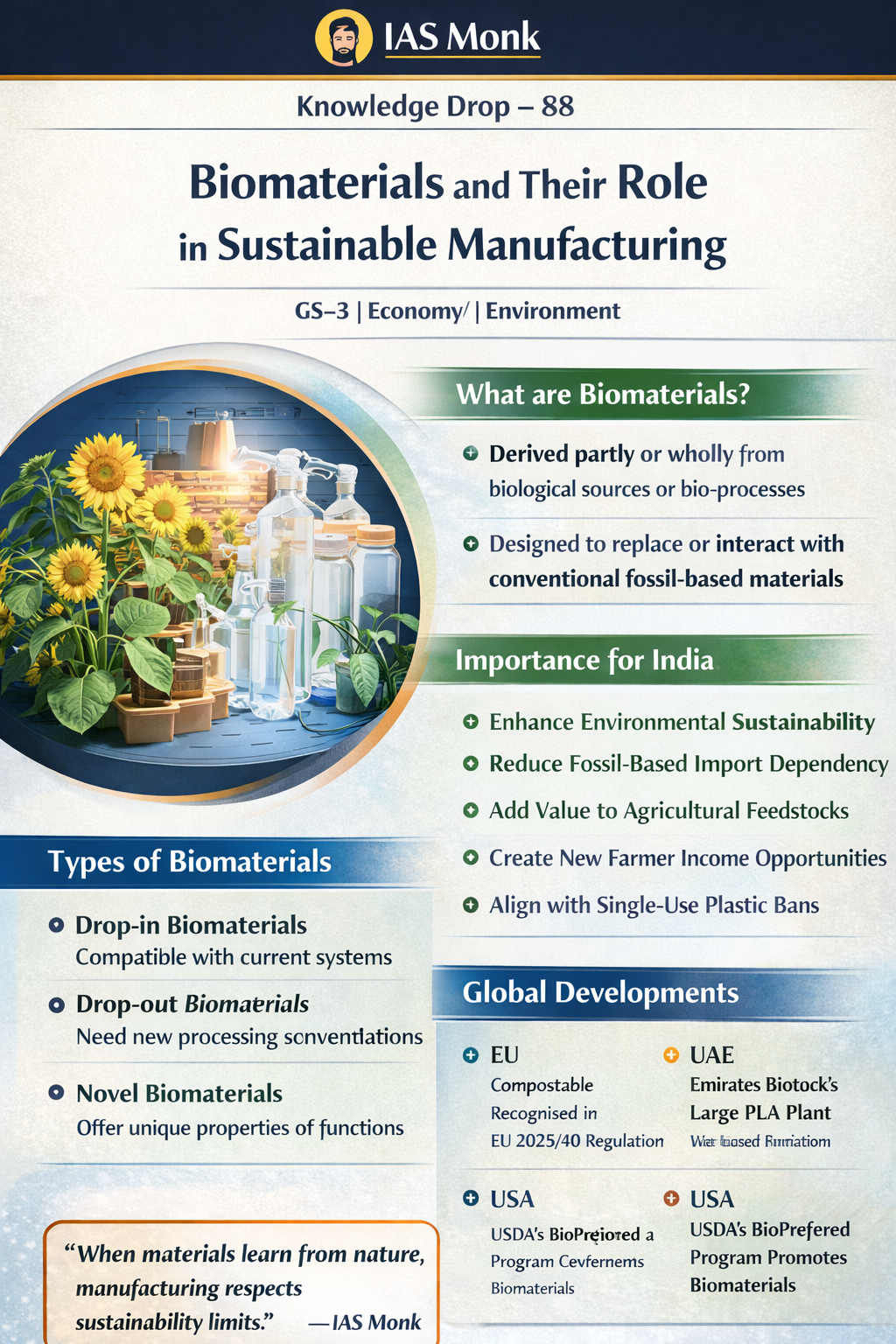
🌑Knowledge Drop – 88: Biomaterials and Their Role in Sustainable Manufacturing
🔗 This Knowledge Drop has a Mains-focused companion on iasmonk.com
“For answer-writing enrichment beyond Prelims, visit iasmonk.com.”
For prelims: In-depth UPSC Level MCQs; Booster Notes; 20 Word-Flash Facts | You are very much here! For Mains: All G.S Papers: High Quality Essays ; Model Answers; Case Studies and beyond … Visit: iasmonk.com
Biomaterials and Their Role in Sustainable Manufacturing
Post Date: 10-Jan-2026
GS-3 | Economy | Environment
📍 In News
Biomaterials are emerging as a central pillar in the transition towards sustainable manufacturing, as countries seek alternatives to fossil-based materials to reduce environmental impact and strengthen circular economies.
🧬 What are Biomaterials?
Biomaterials are materials derived wholly or partly from biological sources, or engineered using biological processes, designed to replace or interact with conventional materials.
They are increasingly used across sectors such as:
- Packaging
- Textiles
- Construction
- Healthcare
Examples include:
- Bioplastics derived from plant sugars or starch
- Bio-based fibres in textiles
- Medical biomaterials such as biodegradable sutures and tissue scaffolds
🧩 Categories of Biomaterials
1. Drop-in Biomaterials
- Chemically similar to petroleum-based materials
- Can be used in existing manufacturing systems without major changes
2. Drop-out Biomaterials
- Require new processing, handling, or disposal systems
3. Novel Biomaterials
- Offer entirely new properties or functions, beyond conventional materials
🌱 Importance and Need (India Focus)
Biomaterials enable India to achieve multiple objectives simultaneously:
- Promote environmental sustainability and climate action
- Support industrial growth and revenue generation
- Reduce dependence on fossil-based imports for plastics and chemicals
- Add value to agricultural feedstocks and residues, enhancing farmer incomes
- Strengthen competitiveness as global markets shift to low-carbon and circular products
- Align with domestic policies such as single-use plastic bans and waste reduction goals
🌍 Global Scenario
European Union
- Adopted the Packaging and Packaging Waste Regulation (EU) 2025/40 (PPWR)
- Recognises that compostable packaging has demonstrable environmental benefits for specific uses
United Arab Emirates
- Positioning itself as a major biomaterials manufacturing hub
- Emirates Biotech plans a PLA plant using Sulzer technology
- Two phases of 80,000 tonnes/year each
- Operations expected to begin in 2028
- Will be the world’s largest PLA facility when fully operational
United States
- Leader in transformative biomaterials technologies
- Strong policy push through USDA’s BioPreferred Program, leveraging federal procurement
🇮🇳 Present Status in India
- India’s biomaterials sector spans bioplastics, biopolymers, and bio-derived materials
- Bioplastics market valued at about $500 million in 2024, with strong growth prospects
- Major investments include Balrampur Chini Mills’ PLA plant in Uttar Pradesh
- Domestic innovation ecosystem:
- Phool.co converting temple flower waste into biomaterials
- Praj Industries operating a demonstration-scale bioplastics plant
⚠️ Issues and Concerns
Despite strong potential, challenges remain:
- Feedstock scaling may compete with food crops
- Intensive agriculture risks water stress and soil degradation
- Limited waste management and composting infrastructure
- Fragmented policies across agriculture, environment, and industry
- Delayed action may increase import dependence as global competitors advance
🔮 Conclusion & Way Forward
To fully harness biomaterials, India must:
- Expand biomanufacturing infrastructure
- Improve feedstock productivity using advanced technologies
- Invest in R&D, standards, and certification frameworks
- Establish clear regulations, labelling norms, and end-of-life pathways
- Use government procurement, targeted incentives, pilot plants, and shared facilities to reduce early investment risks
🪶 IAS Monk Whisper
When materials grow from biology, manufacturing learns to respect limits.
Target IAS-2026+: Highly Expected Prelims MCQs :
📌 Prelims Practice MCQs
Topic:
MCQ 1 | TYPE 1 — How Many Statements Are Correct?
MCQ 1 | Type-1 — Conceptual Understanding
Consider the following statements regarding biomaterials:
1)Biomaterials are derived wholly or partly from biological sources or engineered using biological processes.
2)Biomaterials are used only in packaging and textile industries.
3)Biomaterials are intended to replace or interact with conventional fossil-based materials.
4)All biomaterials require entirely new manufacturing and disposal systems.
How many of the above statements are correct?
A)Only one
B)Only two
C)Only three
D)All four
🌀 Didn’t get it? Click here (▸) for the Correct Answer & Explanation.
🟩 Correct Answer: B) Only two
🧠 Explanation:
1)✅ True – Biomaterials originate from biological sources or bio-processes.
2)❌ False – They are also used in construction, healthcare, and other sectors.
3)✅ True – They are designed to replace or interact with conventional materials.
4)❌ False – Drop-in biomaterials work within existing systems.
MCQ 2 | TYPE 2 — Two-Statement Type
Consider the following statements:
Statement I: Drop-in biomaterials are compatible with existing petroleum-based manufacturing systems.
Statement II: Drop-out biomaterials can be adopted without changes in processing or disposal infrastructure.
Which of the statements given above is/are correct?
A)Only Statement I is correct
B)Only Statement II is correct
C)Both statements are correct
D)Neither statement is correct
🌀 Didn’t get it? Click here (▸) for the Correct Answer & Explanation.
🟩 Correct Answer: A) Only Statement I is correct
🧠 Explanation:
Statement I: ✅ Correct – Drop-in biomaterials are chemically similar to conventional materials.
Statement II: ❌ Incorrect – Drop-out biomaterials require new systems for processing or disposal.
MCQ 3 | TYPE 3 — Code-Based Statement Selection
With reference to the importance of biomaterials for India, consider the following:
1)Reduction in dependence on fossil-based material imports
2)Additional income opportunities for farmers through feedstocks
3)Alignment with single-use plastic bans and climate goals
4)Guaranteed elimination of competition with food crops
Which of the above are correct?
A)1, 2 and 3 only
B)1 and 2 only
C)2, 3 and 4 only
D)1, 2, 3 and 4
🌀 Didn’t get it? Click here (▸) for the Correct Answer & Explanation.
🟩 Correct Answer: A) 1, 2 and 3 only
🧠 Explanation:
1)✅ True – Biomaterials reduce fossil-based import dependence.
2)✅ True – Agricultural residues gain additional value.
3)✅ True – Supports plastic bans and climate action.
4)❌ False – Feedstock scaling may compete with food crops.
MCQ 4 | TYPE 4 — Direct Factual Question
Which of the following best describes the EU’s Packaging and Packaging Waste Regulation (EU) 2025/40?
A)It bans all compostable packaging across the EU
B)It recognises environmental benefits of compostable packaging for specific uses
C)It mandates petroleum-based packaging for recyclability
D)It restricts biomaterials manufacturing outside Europe
🌀 Didn’t get it? Click here (▸) for the Correct Answer & Explanation.
🟩 Correct Answer: B) It recognises environmental benefits of compostable packaging for specific uses
🧠 Explanation:
The EU’s PPWR acknowledges that compostable packaging offers environmental benefits in defined applications.
MCQ 5 | TYPE 5 — UPSC 2025 Linkage Reasoning Format (I, II, III)
Consider the following statements:
Statement I:
Biomaterials are increasingly viewed as a strategic component of sustainable manufacturing.
Statement II:
Biomaterials help reduce dependence on fossil-based materials while supporting circular economy objectives.
Statement III:
Global policy shifts and procurement initiatives are encouraging the adoption of biomaterials.
Which one of the following is correct?
A)Both Statements II and III are correct and both explain Statement I
B)Both Statements II and III are correct but only one explains Statement I
C)Only one of the Statements II and III is correct and that explains Statement I
D)Neither Statement II nor Statement III is correct
🌀 Didn’t get it? Click here (▸) for the Correct Answer & Explanation.
🟩 Correct Answer: A) Both Statements II and III are correct and both explain Statement I
🧠 Explanation:
Statement II: ✅ Correct – Fossil substitution and circularity explain the strategic value of biomaterials.
Statement III: ✅ Correct – Policy and procurement support accelerate adoption.
Linkage: Both II and III jointly explain why biomaterials are central to sustainable manufacturing.
🪶 IAS Monk Whisper
When materials return to biology, industry learns sustainability is not a choice but a necessity.
📗 KD-88 Prelims Booster Notes
Biomaterials and Their Role in Sustainable Manufacturing
GS-3 | Economy | Environment
🔹 Core Concept
Biomaterials are materials derived wholly or partly from biological sources or biological processes, designed to replace or interact with conventional fossil-based materials in manufacturing.
They support the shift towards sustainable, low-carbon, and circular manufacturing systems.
🔹 Major Applications
- Packaging – bioplastics, compostable materials
- Textiles – bio-based fibres
- Construction – bio-composites
- Healthcare – biodegradable sutures, tissue scaffolds
🔹 Categories of Biomaterials
1. Drop-in Biomaterials
- Compatible with existing petroleum-based systems
- Minimal changes in processing or disposal
2. Drop-out Biomaterials
- Require new processing, handling, or disposal systems
3. Novel Biomaterials
- Offer entirely new properties or functions
- Enable innovation beyond conventional materials
🔹 Importance for India
- Reduces dependence on fossil-based imports
- Adds value to agricultural feedstocks and residues
- Generates new income opportunities for farmers
- Supports industrial growth and revenue generation
- Aligns with single-use plastic bans and climate commitments
- Enhances competitiveness in global low-carbon markets
🔹 Global Policy & Industry Trends
- EU: Packaging and Packaging Waste Regulation (EU) 2025/40
- Recognises environmental benefits of compostable packaging for specific uses
- UAE:
- Emirates Biotech’s large-scale PLA plant using Sulzer technology
- Planned capacity: two phases of 80,000 tonnes/year each
- Expected to be the world’s largest PLA facility
- USA:
- Leadership through innovation and USDA BioPreferred Program
- Federal procurement driving biomaterials adoption
🔹 Status in India
- Bioplastics market valued at around $500 million (2024)
- Major investment: Balrampur Chini Mills’ PLA plant (Uttar Pradesh)
- Start-ups and industry initiatives:
- Phool.co – converting temple flower waste into biomaterials
- Praj Industries – demonstration-scale bioplastics plant
⚠️ Issues & Concerns
- Feedstock scaling may compete with food crops
- Risks of water stress and soil degradation
- Inadequate waste management and composting infrastructure
- Fragmented policies across agriculture, environment, and industry
- Risk of import dependence if domestic action is delayed
🔮 Way Forward
- Expand biomanufacturing infrastructure
- Improve feedstock productivity using advanced technologies
- Invest in R&D, standards, and certification
- Establish clear regulations, labelling, and end-of-life pathways
- Use government procurement, incentives, pilot plants, and shared facilities to reduce early-stage risks
🪶 IAS Monk Whisper
When materials follow nature’s cycles, manufacturing learns restraint.