















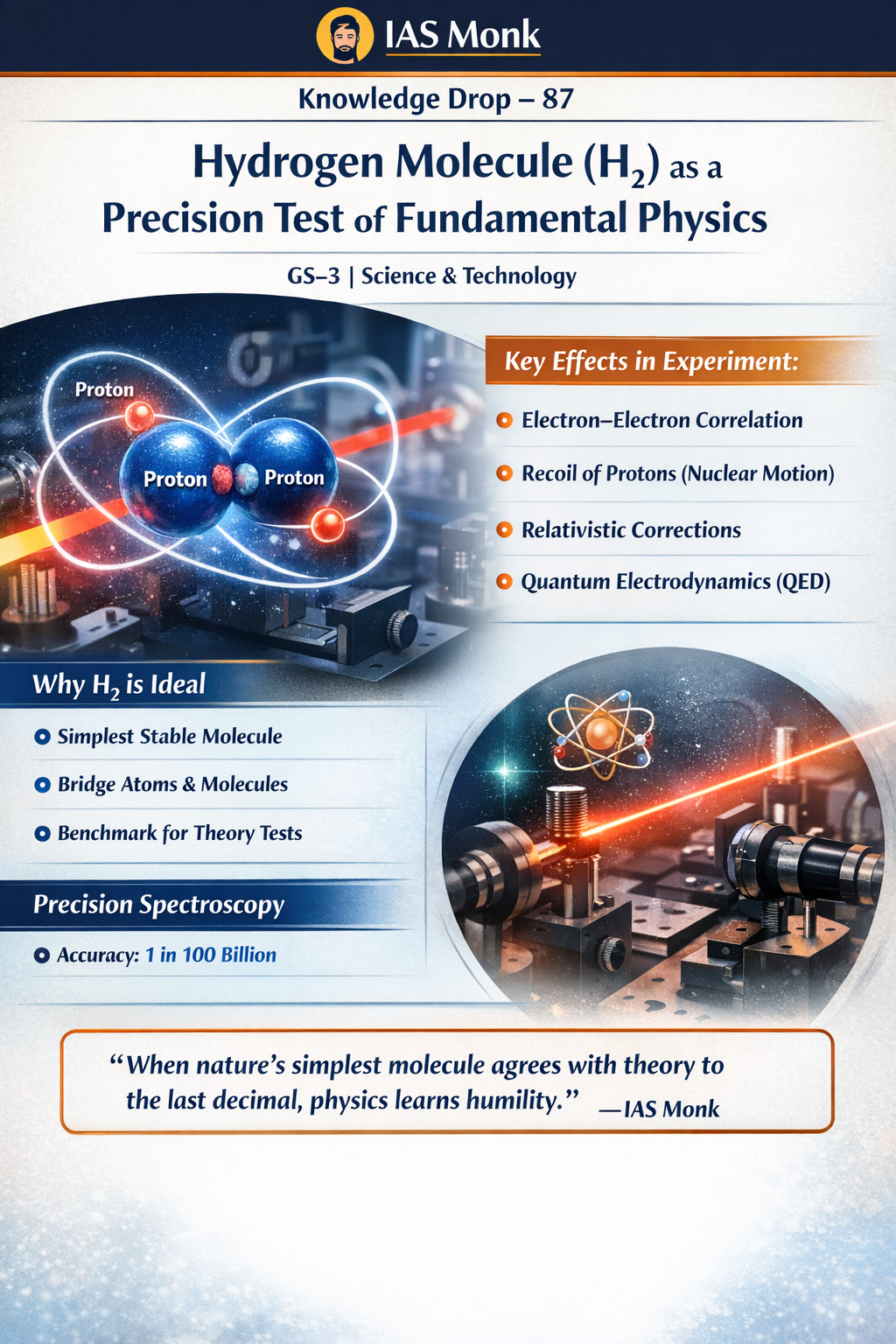
🌑Knowledge Drop – 87: Hydrogen Molecule (H₂) as a Precision Test of Fundamental Physics
🔗 This Knowledge Drop has a Mains-focused companion on iasmonk.com
“For answer-writing enrichment beyond Prelims, visit iasmonk.com.”
For prelims: In-depth UPSC Level MCQs; Booster Notes; 20 Word-Flash Facts | You are very much here! For Mains: All G.S Papers: High Quality Essays ; Model Answers; Case Studies and beyond … Visit: iasmonk.com
Hydrogen Molecule (H₂) as a Precision Test of Fundamental Physics
Post Date: 9-Jan-2026
GS-3 | Science & Technology
📍 Context
Recent advances in theoretical physics and high-precision molecular spectroscopy have enabled scientists to test the very foundations of quantum mechanics and quantum electrodynamics (QED) using the hydrogen molecule (H₂).
🧩 Background
The hydrogen molecule (H₂) has long served as a benchmark system for testing the accuracy of fundamental physical laws.
With modern experimental techniques, scientists can now measure energy gaps between molecular states with an accuracy of one part in 100 billion.
At such extreme precision, even tiny theoretical inaccuracies become detectable, compelling physicists to refine existing quantum models.
🔬 What is Hydrogen?
- Hydrogen is the chemical element with symbol H and atomic number 1.
- It is the lightest and most abundant element in the universe, constituting about 75% of normal matter.
- It is a colourless, odourless, tasteless, non-toxic, and highly combustible gas.
⚛️ Why the Hydrogen Molecule (H₂) is Ideal for Testing Physics
1. Simplest Stable Molecule
H₂ consists of two protons and two electrons, making it the simplest system where molecular bonding occurs.
2. Bridge Between Atom and Molecule Physics
It allows scientists to test whether fundamental theories developed for atoms extend accurately to molecules.
3. Benchmark System
Because of its simplicity, any deviation between theory and experiment in H₂ can signal gaps or limitations in fundamental physics.
🧪 Physical Effects Incorporated in the Experiment
Electron–Electron Correlation
- Accurately captures how the two electrons influence each other’s motion.
- Ignoring this interaction leads to incorrect energy predictions.
Electron–Nucleus Coupled Motion (Recoil Effect)
- Protons are allowed to move slightly in response to electron motion.
- This effect becomes significant at ultra-high measurement precision.
Relativistic Corrections
- Since electrons move at very high speeds, corrections from Einstein’s Special Relativity are included.
Quantum Electrodynamics (QED) Effects
- Tiny corrections arising from interactions between charged particles and electromagnetic fields.
- Earlier considered negligible, but now experimentally measurable.
🔑 Key Scientific Principles Involved
Spectroscopy
A technique used to measure energy-level differences in atoms and molecules by analysing absorbed or emitted light.
Quantum Electrodynamics (QED)
A part of quantum field theory that explains how charged particles interact with electromagnetic fields, predicting subtle corrections beyond classical quantum mechanics.
🪶 IAS Monk Whisper
When nature’s simplest molecule agrees with theory to the last decimal, physics learns how precise truth can be.
Target IAS-2026+: Highly Expected Prelims MCQs :
📌 Prelims Practice MCQs
Topic:
MCQ 1 | TYPE 1 — How Many Statements Are Correct?
MCQ 1 | Type-1 — Conceptual Understanding
Consider the following statements regarding the hydrogen molecule (H₂) as a test system in fundamental physics:
1)H₂ is the simplest stable molecule in which molecular bonding occurs.
2)Its simplicity allows precise comparison between theoretical predictions and experimental results.
3)Any deviation between theory and experiment in H₂ may indicate gaps in fundamental physical theories.
4)H₂ is unsuitable for testing relativistic effects due to low electron velocities.
How many of the above statements are correct?
A)Only one
B)Only two
C)Only three
D)All four
🌀 Didn’t get it? Click here (▸) for the Correct Answer & Explanation.
🟩 Correct Answer: C) Only three
🧠 Explanation:
1)✅ True – H₂ has two protons and two electrons, making it the simplest stable molecule.
2)✅ True – Its simplicity enables highly accurate theoretical–experimental comparison.
3)✅ True – Deviations can reveal limitations in existing physical theories.
4)❌ False – Relativistic corrections are relevant because electrons move at very high speeds.
MCQ 2 | TYPE 2 — Two-Statement Type
Consider the following statements:
Statement I: Electron–electron correlation must be included to accurately predict molecular energy levels in H₂.
Statement II: Ignoring electron–electron interaction has negligible impact at very high experimental precision.
Which of the statements given above is/are correct?
A)Only Statement I is correct
B)Only Statement II is correct
C)Both statements are correct
D)Neither statement is correct
🌀 Didn’t get it? Click here (▸) for the Correct Answer & Explanation.
🟩 Correct Answer: A) Only Statement I is correct
🧠 Explanation:
Statement I: ✅ Correct – Electron–electron correlation significantly affects energy predictions.
Statement II: ❌ Incorrect – At ultra-high precision, ignoring this interaction leads to detectable errors.
MCQ 3 | TYPE 3 — Code-Based Statement Selection
With reference to physical effects incorporated in high-precision H₂ experiments, consider the following:
1)Electron–nucleus coupled motion
2)Relativistic corrections
3)Quantum Electrodynamics (QED) effects
4)Classical Newtonian gravitational effects
Which of the above are taken into account?
A)1, 2 and 3 only
B)1 and 2 only
C)2, 3 and 4 only
D)1, 2, 3 and 4
🌀 Didn’t get it? Click here (▸) for the Correct Answer & Explanation.
🟩 Correct Answer: A) 1, 2 and 3 only
🧠 Explanation:
1)✅ True – Nuclear recoil effects become important at high precision.
2)✅ True – Relativistic corrections refine energy calculations.
3)✅ True – QED effects are tiny but measurable.
4)❌ False – Gravitational effects are negligible at molecular scales.
MCQ 4 | TYPE 4 — Direct Factual Question
Which of the following techniques is primarily used to measure energy-level differences in hydrogen molecules with extremely high precision?
A)Interferometry
B)Spectroscopy
C)Chromatography
D)Radiography
🌀 Didn’t get it? Click here (▸) for the Correct Answer & Explanation.
🟩 Correct Answer: B)Spectroscopy
🧠 Explanation:
Spectroscopy measures absorbed or emitted light to determine energy-level differences in atoms and molecules with very high accuracy.
MCQ 5 | TYPE 5 — UPSC 2025 Linkage Reasoning Format (I, II, III)
Consider the following statements:
Statement I:
The hydrogen molecule (H₂) is used as a precision testing ground for fundamental physical theories.
Statement II:
Modern spectroscopy can measure energy-level differences in H₂ with extremely high accuracy, making tiny theoretical errors detectable.
Statement III:
Quantum Electrodynamics (QED) predicts subtle corrections to molecular energy levels that become significant only at very high precision.
Which one of the following is correct?
A) Both Statements II and III are correct and both explain Statement I
B) Both Statements II and III are correct but only one explains Statement I
C) Only one of the Statements II and III is correct and that explains Statement I
D) Neither Statement II nor Statement III is correct
🌀 Didn’t get it? Click here (▸) for the Correct Answer & Explanation.
🟩 Correct Answer: A) Both Statements II and III are correct and both explain Statement I
🧠 Explanation:
Statement II: ✅ Correct
Ultra-high-precision spectroscopy enables detection of minute discrepancies between theory and experiment, making H₂ suitable for precision tests.
Statement III: ✅ Correct
QED effects introduce tiny corrections to energy levels, and their experimental measurability explains why H₂ is an ideal testing system.
Linkage:
Both II and III jointly explain why the hydrogen molecule functions as a precision testbed for fundamental physics, thereby explaining Statement I.
📗 KD-87 Prelims Booster Notes
Hydrogen Molecule (H₂) as a Precision Test of Fundamental Physics
GS-3 | Science & Technology
🔹 Core Idea
The hydrogen molecule (H₂) is used as a benchmark system to test the accuracy of quantum mechanics and quantum electrodynamics (QED) because of its extreme simplicity and experimental measurability.
🔹 Why H₂ is Special
- Simplest stable molecule: Two protons + two electrons
- Represents the simplest case of molecular bonding
- Acts as a bridge between atomic physics and molecular physics
🔹 Precision Breakthrough
- Modern spectroscopy measures energy gaps between molecular states with accuracy up to 1 part in 100 billion
- At this level, even minute theoretical inaccuracies become detectable
- Forces refinement of existing quantum models
🔹 Physical Effects That Must Be Included
- Electron–Electron Correlation
- Mutual interaction between electrons
- Ignoring it leads to incorrect energy predictions
- Electron–Nucleus Coupled Motion (Recoil Effect)
- Protons respond slightly to electron motion
- Becomes significant at ultra-high precision
- Relativistic Corrections
- Electrons move at very high speeds
- Corrections from Special Relativity required
- Quantum Electrodynamics (QED) Effects
- Tiny corrections due to interaction with electromagnetic fields
- Earlier negligible, now experimentally measurable
🔹 Key Scientific Concepts
- Spectroscopy: Technique to measure energy-level differences using absorbed or emitted light
- Quantum Electrodynamics (QED):
- Part of quantum field theory
- Explains interactions of charged particles with electromagnetic fields
- Predicts subtle energy corrections beyond basic quantum mechanics
🔹 Significance for Fundamental Physics
- Any mismatch between theory and experiment in H₂ may indicate:
- Gaps in quantum mechanics
- Limitations of QED
- Need for refined physical models
- Confirms whether atomic-level theories hold true at molecular scale
🔹 UPSC Prelims Focus Points
- H₂ as benchmark system
- Role of QED corrections
- Importance of spectroscopy
- Link between precision measurement and theory testing
🪶 IAS Monk Whisper
When nature allows no approximation, physics learns humility.