















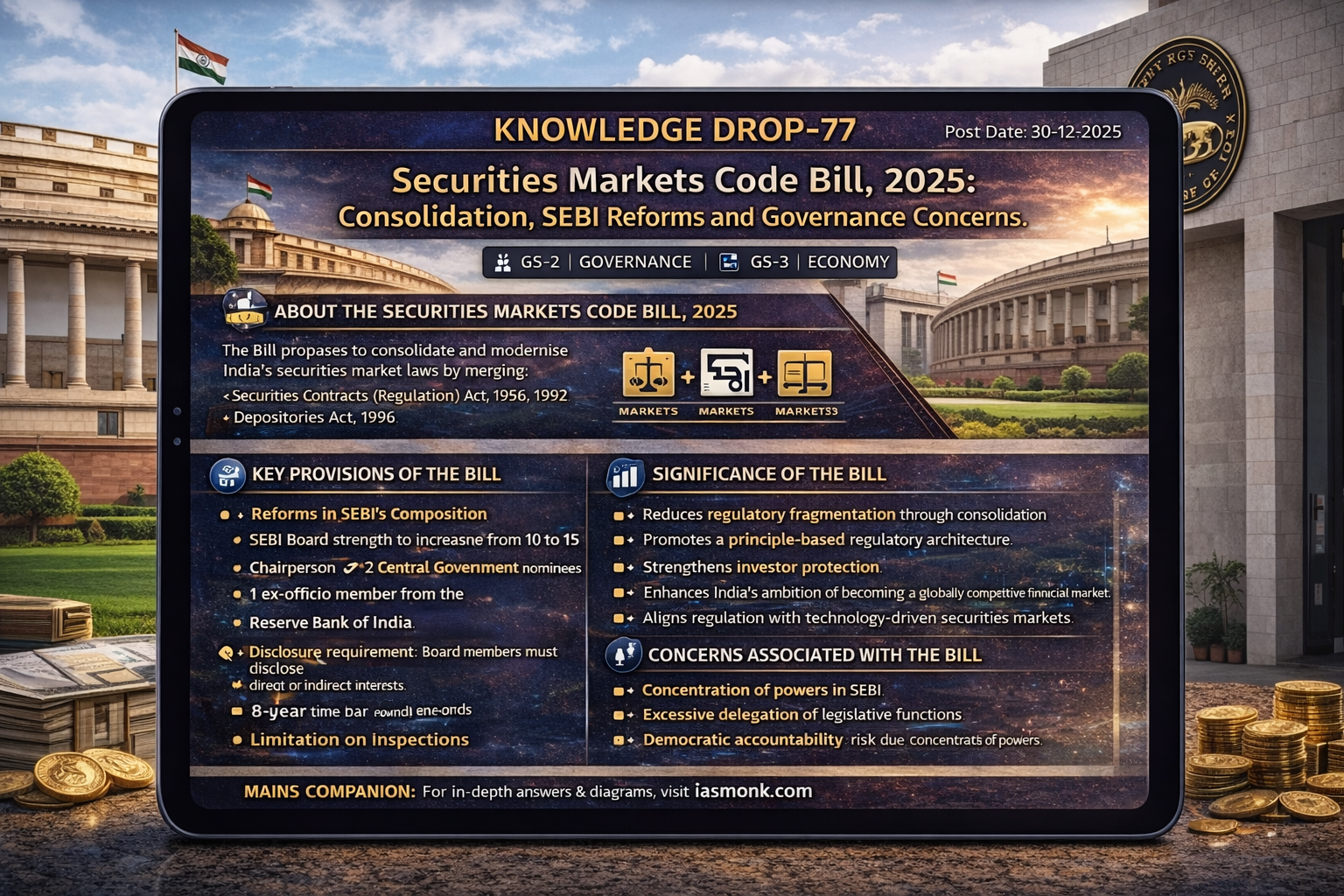
🌑Knowledge Drop – 77: Securities Markets Code Bill, 2025: Consolidation, SEBI Reforms and Governance Concerns
🔗 This Knowledge Drop has a Mains-focused companion on iasmonk.com
“For answer-writing enrichment beyond Prelims, visit iasmonk.com.”
For prelims: In-depth UPSC Level MCQs; Booster Notes; 20 Word-Flash Facts | You are very much here! For Mains: All G.S Papers: High Quality Essays ; Model Answers; Case Studies and beyond … Visit: iasmonk.com
Securities Markets Code Bill, 2025: Consolidation, SEBI Reforms and Governance Concerns
Post Date: 30-12-2025
Syllabus: GS-2 | Governance • GS-3 | Economy
Context 🏛️
The Union Finance Minister introduced the Securities Markets Code Bill, 2025 in the Lok Sabha.
About the Securities Markets Code Bill, 2025 📜
The Bill proposes to consolidate and modernise India’s securities market laws by merging:
- Securities Contracts (Regulation) Act, 1956
- Securities and Exchange Board of India Act, 1992
- Depositories Act, 1996
➡️ Objective: create a single, principle-based legislative framework for securities markets.
Key Provisions of the Bill ⚙️
1. Reforms in SEBI’s Composition
- SEBI Board strength to increase from 9 to 15 members
- Proposed structure:
- Chairperson
- 2 Central Government nominees
- 1 ex-officio member from the Reserve Bank of India
- 11 other members, with at least 5 whole-time members
(currently only 3 whole-time members)
🔎 Disclosure Requirement:
All Board members must disclose direct or indirect interests before decision-making.
2. Decriminalisation & Enforcement Framework
- Violations of minor, procedural, and technical nature to be:
- Decriminalised
- Converted into civil penalties
- Objective:
- Reduce compliance burden
- Improve ease of doing business
- Criminal punishment limited to serious offences such as:
- Insider trading
- Trading on material non-public information
3. Limitation on Inspections ⏳
- No inspection permitted if 8 years have elapsed from the date of contravention
- Introduces a statutory time-bar on regulatory action
Significance of the Bill 🌐
- Reduces regulatory fragmentation through consolidation
- Promotes a principle-based regulatory architecture
- Strengthens investor protection
- Enhances India’s ambition of becoming a globally competitive financial market
- Aligns regulation with technology-driven securities markets
Concerns Associated with the Bill ⚠️
1. Concentration of Powers in SEBI
- SEBI exercises:
- Rule-making
- Enforcement
- Investigation
- Adjudication
➡️ Raises concerns regarding separation of powers and institutional checks.
2. Excessive Delegation of Legislative Functions
- Core policy areas left to subordinate legislation, including:
- Scope of regulation
- Registration norms
- Penalties and exemptions
- Definition of “securities”
➡️ Parliament’s role reduced to an enabling authority.
3. Democratic Accountability
- Broad discretion to:
- Executive
- Regulator
➡️ Weakens parliamentary oversight over securities regulation.
4. Coercive Enforcement Powers
- SEBI empowered with:
- Search and seizure
- Attachment of property
- Freezing of bank accounts
- Ex-parte interim orders
⚠️ Concerns over adequate safeguards and due process.
Way Ahead 🔭
- Separate investigative, enforcement, and adjudicatory wings within SEBI
- Strengthen parliamentary reporting and oversight mechanisms
- Adopt proportionate, risk-based regulation
- Reserve criminal sanctions only for serious market abuse
IASGenius Prelims Takeaway 🧠
The Bill balances market efficiency and investor protection, but raises concerns over regulatory concentration and democratic accountability.
Target IAS-2026+: Highly Expected Prelims MCQs :
📌 Prelims Practice MCQs
Topic:
MCQ 1 | TYPE 1 — How Many Statements Are Correct?
Consider the following statements regarding the Securities Markets Code Bill, 2025:
1)It seeks to consolidate three existing laws governing securities markets.
2)It replaces the SEBI Act, 1992 with subordinate legislation.
3)It aims to reduce compliance burden through a principle-based framework.
4)It proposes to strengthen investor protection.
How many of the above statements are correct?
(a)Only one
(b)Only two
(c)Only three
(d)All four
🌀 Didn’t get it? Click here (▸) for the Correct Answer & Explanation.
🟩 Correct Answer: (c)Only three
🧠 Explanation:
1)✅True – Three Acts are consolidated.
2)❌False – The SEBI Act is consolidated, not replaced by subordinate law.
3)✅True – Principle-based regulation is a key objective.
4)✅True – Investor protection is explicitly stated.
MCQ 2 | TYPE 2 — Two-Statement Type
Consider the following statements:
Statement I:The Bill increases the strength of the SEBI Board and raises the number of whole-time members.
Statement II:The Reserve Bank of India will have no representation on the reconstituted SEBI Board.
Which of the statements given above is/are correct?
(a)Only Statement I
(b)Only Statement II
(c)Both Statement I and II
(d)Neither Statement I nor Statement II
🌀 Didn’t get it? Click here (▸) for the Correct Answer & Explanation.
🟩 Correct Answer: (a)Only Statement I
🧠 Explanation:
Statement I:✅True – Board strength rises to 15 with at least five whole-time members.
Statement II:❌False – One RBI ex-officio member is included.
MCQ 3 | TYPE 3 — Code-Based Statement Selection
With reference to enforcement provisions of the Securities Markets Code Bill, 2025, consider the following statements:
1)Minor and procedural violations are proposed to be decriminalised.
2)All violations under securities law will attract only civil penalties.
3)Insider trading remains subject to criminal punishment.
Which of the statements given above is/are correct?
(a)1 and 3 only
(b)1 only
(c)2 and 3 only
(d)1,2 and 3
🌀 Didn’t get it? Click here (▸) for the Correct Answer & Explanation.
🟩 Correct Answer: (a)1 and 3 only
🧠 Explanation:
1)✅True – Minor violations are decriminalised.
2)❌False – Serious offences still attract criminal punishment.
3)✅True – Insider trading remains criminalised.
MCQ 4 | TYPE 4 — Direct Factual Question
The Securities Markets Code Bill, 2025 introduces a time limitation on inspections. What is the maximum period after which inspection is barred?
(a)Five years
(b)Six years
(c)Eight years
(d)Ten years
🌀 Didn’t get it? Click here (▸) for the Correct Answer & Explanation.
🟩 Correct Answer: (c)Eight years
🧠 Explanation:
The Bill bars inspections if eight years have passed from the date of contravention.
MCQ 5 | TYPE 5 — UPSC 2025 Linkage Reasoning Format (I, II, III)
Consider the following statements:
Statement I:The Securities Markets Code Bill, 2025 raises concerns regarding separation of powers.
Statement II:The Bill vests rule-making, enforcement, investigation, and adjudication powers in SEBI.
Statement III:Wide coercive powers with limited safeguards may affect democratic accountability.
Which one of the following is correct?
A)Both Statements II and III are correct and both explain Statement I
B)Both Statements II and III are correct but only one explains Statement I
C)Only one of the Statements II and III is correct and that explains Statement I
D)Neither Statement II nor Statement III is correct
🌀 Didn’t get it? Click here (▸) for the Correct Answer & Explanation.
🟩 Correct Answer: A)Both Statements II and III are correct and both explain Statement I
🧠 Explanation:
✅ Statement I reflects the constitutional concern.
Statement II explains concentration of powers.
Statement III explains the accountability risk.
Both statements logically explain Statement I.
🧠 IASGenius Prelims Whisper
Market efficiency must grow with accountability, not at its cost.
📘 Knowledge Drop-77 | Prelims Booster Notes (1-Page)
Theme: Securities Markets Code Bill, 2025
GS-2 | Governance • GS-3 | Economy
Why in News?
The Union Finance Minister introduced the Securities Markets Code Bill, 2025 in the Lok Sabha to modernise and consolidate securities market laws.
What Does the Bill Do?
Consolidates three laws:
- Securities Contracts (Regulation) Act, 1956
- Securities and Exchange Board of India Act, 1992
- Depositories Act, 1996
➡️ Creates a single, principle-based framework for securities regulation.
Key Provisions to Remember ⚙️
SEBI Board Reforms
- Board strength: 9 → 15 members
- Composition includes:
- Chairperson
- 2 Central Government nominees
- 1 ex-officio member from the Reserve Bank of India
- 11 other members (≥ 5 whole-time; earlier 3)
- Mandatory disclosure of direct/indirect interests by Board members
Decriminalisation & Enforcement
- Minor/procedural/technical violations → civil penalties
- Criminal punishment retained for:
- Insider trading
- Trading on material non-public information
- Goal: Ease of doing business; lower compliance burden
Limitation on Inspections
- 8-year time-bar from date of contravention for inspections
Why Is It Significant? 🌐
- Reduces regulatory fragmentation
- Improves investor protection
- Aligns regulation with technology-driven markets
- Supports India’s ambition to be a globally competitive financial market
Concerns (Prelims Pointers) ⚠️
- Concentration of powers in SEBI (rule-making, enforcement, investigation, adjudication)
- Excessive delegation to subordinate legislation on core policy matters
- Democratic accountability concerns due to reduced parliamentary role
- Coercive powers (search, seizure, attachment, ex-parte orders) with safeguards debated
One-Line Takeaway
The Bill simplifies market regulation but raises questions on checks, balances, and accountability.
⚡ Knowledge Drop-77 | 20-Word Flash Facts (Prelims)
1)Securities Markets Code Bill was introduced in 2025.
2)The Bill was tabled in the Lok Sabha.
3)It consolidates three securities market laws.
4)SEBI Board strength increases from 9 to 15.
5)At least five SEBI members will be whole-time.
6)An RBI ex-officio member sits on the SEBI Board.
7)Board members must disclose direct and indirect interests.
8)Minor violations are decriminalised.
9)Civil penalties replace jail for procedural offences.
10)Insider trading remains criminally punishable.
11)The Bill introduces an eight-year inspection limit.
12)SEBI gains a principle-based regulatory framework.
13)Investor protection is a stated objective.
14)The Bill aims to improve ease of doing business.
15)Concerns exist over concentration of regulatory powers.
16)Several policy areas are left to subordinate legislation.
17)Parliament’s role becomes largely enabling.
18)SEBI can issue ex-parte interim orders.
19)The Bill supports India’s global financial market ambitions.
20)Regulatory efficiency must balance accountability and safeguards.
🧠 IASGenius Prelims Whisper
Consolidation simplifies markets; safeguards sustain trust.