







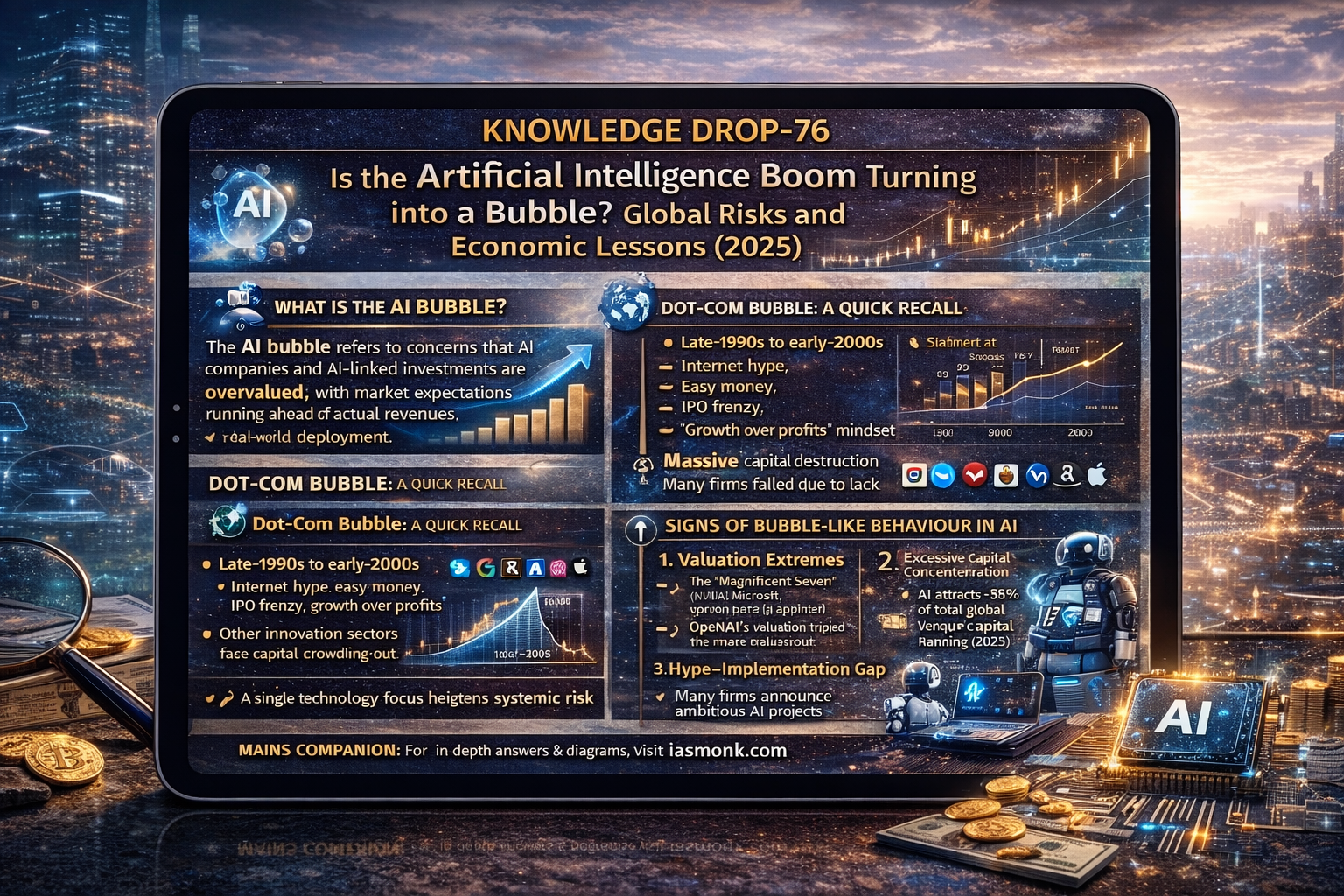
🌑Knowledge Drop – 76: Is the Artificial Intelligence Boom Turning into a Bubble? Global Risks and Economic Lessons (2025)
🔗 This Knowledge Drop has a Mains-focused companion on iasmonk.com
“For answer-writing enrichment beyond Prelims, visit iasmonk.com.”
For prelims: In-depth UPSC Level MCQs; Booster Notes; 20 Word-Flash Facts | You are very much here! For Mains: All G.S Papers: High Quality Essays ; Model Answers; Case Studies and beyond … Visit: iasmonk.com
Is the Artificial Intelligence Boom Turning into a Bubble? Global Risks and Economic Lessons (2025)
Post Date: 29-12-2025
Syllabus: GS-3 | 🧠 Science & Technology | 💹 Economy
Context 📊
Global spending on Artificial Intelligence (AI) is projected to reach $375 billion in 2025 and $500 billion by 2026.
This rapid expansion has sparked debate on whether AI’s valuation reflects genuine technological progress or speculative investor enthusiasm.
What is the AI Bubble? 🫧
The AI bubble refers to concerns that AI companies and AI-linked investments are overvalued, with market expectations running ahead of:
- Actual revenues
- Scalable business models
- Real-world deployment
The phenomenon is often compared to the dot-com bubble of the late 1990s.
Dot-Com Bubble: A Quick Recall 🌐
The dot-com bubble marked the rapid rise and collapse of internet-based company valuations (late-1990s to early-2000s).
Why Did It Burst?
- Internet hype: Belief that profits would follow later
- Easy money & speculation: Oversubscribed IPOs despite weak revenues
- Growth over profits: Traffic valued more than earnings
Impact
- Massive capital destruction
- Many firms failed due to lack of viable models
- Survivors like Google, Amazon, Microsoft adapted and built sustainable businesses
Signs of Bubble-Like Behaviour in AI ⚠️
1. Valuation Extremes
- The “Magnificent Seven” (NVIDIA, Microsoft, Alphabet, Amazon, Meta, Tesla, Apple) now account for ~30% of S&P 500 market capitalisation, largely driven by AI optimism.
- OpenAI’s valuation has more than tripled despite revenues in the hundreds of millions, with ~25% of valuation tied to future AI expectations.
2. Excessive Capital Concentration
- AI attracts ~58% of total global venture capital funding (2025).
- Other innovation sectors face capital crowding-out.
- A single-technology focus heightens systemic risk.
3. Hype–Implementation Gap
- Many firms announce ambitious AI projects without:
- Adequate capital
- Skilled manpower
- Infrastructure readiness
What Makes the AI Boom Different? 🔬
Unlike the dot-com era, today’s AI surge is backed by real, capital-intensive investment, including:
- Data centres
- Semiconductor fabrication
- AI infrastructure
These physical assets create potential for:
- Productivity gains
- Scientific breakthroughs
- Long-term research value
Risks of Market Concentration 🎯
- AI investment dominated by a small group of firms
- If expectations fail:
- Investor spending may contract
- Spillover impacts on suppliers and workers
- Idle data centres risk becoming “abandoned malls” of the AI era
Way Ahead 🔭
- AI is a transformative technology, not merely a speculative trend
- Market correction, if it occurs, is likely to:
- Weed out unsustainable players
- Strengthen viable firms
The Real Challenge
Aligning:
- Innovation
- Regulation
- Skills
- Sustainable business models
AI’s long-term impact will depend on productivity gains, not market exuberance.
IASGenius Prelims Takeaway 🧠
Not every boom is a bubble—but valuation without implementation is a warning signal.
Target IAS-2026+: Highly Expected Prelims MCQs :
📌 Prelims Practice MCQs
Topic:
MCQ 1 | TYPE 1 — How Many Statements Are Correct?
Consider the following statements regarding the Artificial Intelligence (AI) boom:
1)Global spending on AI is projected to reach about $500 billion by 2026.
2)The AI bubble refers to market valuations significantly outpacing real revenues and implementation.
3)The AI boom is driven only by speculative financial instruments.
4)Concerns around AI valuations are often compared to the dot-com bubble.
How many of the above statements are correct?
(a)Only one
(b)Only two
(c)Only three
(d)All four
🌀 Didn’t get it? Click here (▸) for the Correct Answer & Explanation.
🟩 Correct Answer: (c)Only three
🧠 Explanation:
1)✅True – Projections indicate $500 billion by 2026.
2)✅True – This defines the AI bubble concern.
3)❌False – The boom also involves real investment in infrastructure.
4)✅True – Dot-com analogy is widely used.
MCQ 2 | TYPE 2 — Two-Statement Type
Consider the following statements:
Statement I:The dot-com bubble collapsed partly due to ignoring traditional valuation metrics.
Statement II:Companies during the dot-com era focused primarily on profitability and cash flows.
Which of the statements given above is/are correct?
(a)Only Statement I
(b)Only Statement II
(c)Both Statement I and II
(d)Neither Statement I nor Statement II
🌀 Didn’t get it? Click here (▸) for the Correct Answer & Explanation.
🟩 Correct Answer: (a)Only Statement I
🧠 Explanation:
Statement I:✅True – “Growth over profits” dominated.
Statement II:❌False – Profitability was largely ignored.
MCQ 3 | TYPE 3 — Code-Based Statement Selection
With reference to the current AI investment landscape, consider the following statements:
1)The “Magnificent Seven” account for nearly one-third of S&P 500 market capitalisation.
2)AI venture capital funding represents more than half of global VC investments in 2025.
3)AI investment is evenly distributed across firms and sectors.
Which of the statements given above is/are correct?
(a)1 and 2 only
(b)2 and 3 only
(c)1 only
(d)1,2 and 3
🌀 Didn’t get it? Click here (▸) for the Correct Answer & Explanation.
🟩 Correct Answer: (a)1 and 2 only
🧠 Explanation:
1)✅True – Around 30% share.
2)✅True – About 58% of VC funding.
3)❌False – Investment is highly concentrated.
MCQ 4 | TYPE 4 — Direct Factual Question
Which one of the following best distinguishes the current AI boom from the dot-com boom?
(a)Absence of investor speculation
(b)Lack of public market participation
(c)Heavy investment in physical infrastructure
(d)Complete regulatory oversight
🌀 Didn’t get it? Click here (▸) for the Correct Answer & Explanation.
🟩 Correct Answer: (c)Heavy investment in physical infrastructure
🧠 Explanation:
Unlike the dot-com era, AI growth includes capital-intensive assets like data centres and semiconductors.
MCQ 5 | TYPE 5 — UPSC 2025 Linkage Reasoning Format (I, II, III)
Consider the following statements:
Statement I:The risk of an AI bubble arises primarily from valuation–implementation mismatches.
Statement II:AI investments are highly concentrated among a few large technology firms.
Statement III:A sharp correction in AI markets could have spillover effects on broader economic growth.
Which one of the following is correct?
A)Both Statements II and III are correct and both explain Statement I
B)Both Statements II and III are correct but only one explains Statement I
C)Only one of the Statements II and III is correct and that explains Statement I
D)Neither Statement II nor Statement III is correct
🌀 Didn’t get it? Click here (▸) for the Correct Answer & Explanation.
🟩 Correct Answer: A)Both Statements II and III are correct and both explain Statement I
🧠 Explanation:
✅ Concentrated investment magnifies risk, and broader spillovers explain why valuation mismatches raise systemic concerns.
🧠 IASGenius Prelims Whisper
Technological revolutions survive bubbles; weak business models do not.
📘 Knowledge Drop-76 | Prelims Booster Notes (1-Page)
Theme: Artificial Intelligence Boom vs Bubble (2025)
GS-3 | Science & Technology | Economy
Why in News?
Global AI spending is projected at $375 billion (2025) and $500 billion (2026), raising concerns about overvaluation versus real economic returns.
What is the “AI Bubble”?
- Situation where market valuations and investment flows in AI outpace actual revenues, deployment, and cash flows.
- Often compared to the dot-com bubble due to hype-led expectations.
Dot-Com Bubble: Key Recall
- Period: Late-1990s to early-2000s
- Drivers: Internet hype, easy money, IPO frenzy, “growth over profits” mindset
- Outcome: Sharp correction when rates rose and earnings disappointed
- Lesson: Survivors adapted with viable business models (e.g., cloud, platforms).
Bubble-Like Indicators in AI
Valuations
- “Magnificent Seven” account for ~30% of S&P 500 market cap, driven by AI optimism.
- OpenAI valuation surged despite hundreds of millions in revenue; a significant share reflects future expectations.
Capital Concentration
- ~58% of global VC (2025) flows into AI, crowding out other sectors.
- High single-technology concentration risk.
Hype–Implementation Gap
- Announcements outpace capital readiness, skills, and deployment capacity.
What’s Different from Dot-Com?
- Real, capital-intensive investments: data centres, semiconductors, AI infrastructure.
- Potential for productivity gains and research spillovers, not just speculative websites.
Risks of Concentration
- Dominance by a few firms.
- If expectations fail: pullback in spending, spillovers to suppliers/workers, idle data centres risk.
Prelims Traps ⚠️
- ❌ AI boom is purely speculative
- ❌ No real assets backing AI growth
- ❌ Concentration reduces risk
- ❌ Corrections destroy the technology itself
One-Line Takeaway
AI’s promise is real, but valuation without implementation signals bubble risk.
⚡ Knowledge Drop-76 | 20-Word Flash Facts (Prelims)
1)Global AI spending may reach $500 billion by 2026.
2)AI bubble implies valuations exceed revenues and deployment.
3)Dot-com bubble burst due to hype and ignored profitability.
4)“Magnificent Seven” hold ~30% of S&P 500 market cap.
5)AI attracted ~58% of global VC funding in 2025.
6)OpenAI valuation surged despite limited current revenues.
7)AI investment shows high sectoral concentration.
8)Hype–implementation gaps heighten systemic risk.
9)AI boom differs due to heavy physical infrastructure investment.
10)Data centres and semiconductors back AI expansion.
11)Capital-intensive assets can yield productivity gains.
12)Few firms dominate AI investment flows.
13)Failure could trigger spillover economic effects.
14)Idle data centres risk becoming stranded assets.
15)Market corrections may weed out weak models.
16)Technology revolutions often outlive bubbles.
17)Speculation increases when easy money prevails.
18)Sustainable AI needs skills, regulation, and business models.
19)VC crowding-out affects non-AI innovation sectors.
20)Long-term AI impact depends on durable productivity gains.
🧠 IASGenius Prelims Whisper
Innovation thrives on execution; bubbles burst on expectations.