





🌑Knowledge Drop – 73: India’s Science and Technology Ecosystem in 2025: Key Achievements, Missions and Challenges
For prelims: In-depth UPSC Level MCQs; Booster Notes; 20 Word-Flash Facts | You are very much here! For Mains: All G.S Papers: High Quality Essays ; Model Answers; Case Studies and beyond … Visit: iasmonk.com
India’s Science and Technology Ecosystem in 2025: Key Achievements, Missions and Challenges
Post Date: 26-12-2025
Syllabus: GS-3 | 🔬 Science and Technology
Context 🌍
India’s Science & Technology (S&T) ecosystem gained strong momentum in 2025, reflected in improved global rankings, enhanced research output, and large-scale government funding for frontier technologies.
India’s Rising Global Standing 📈
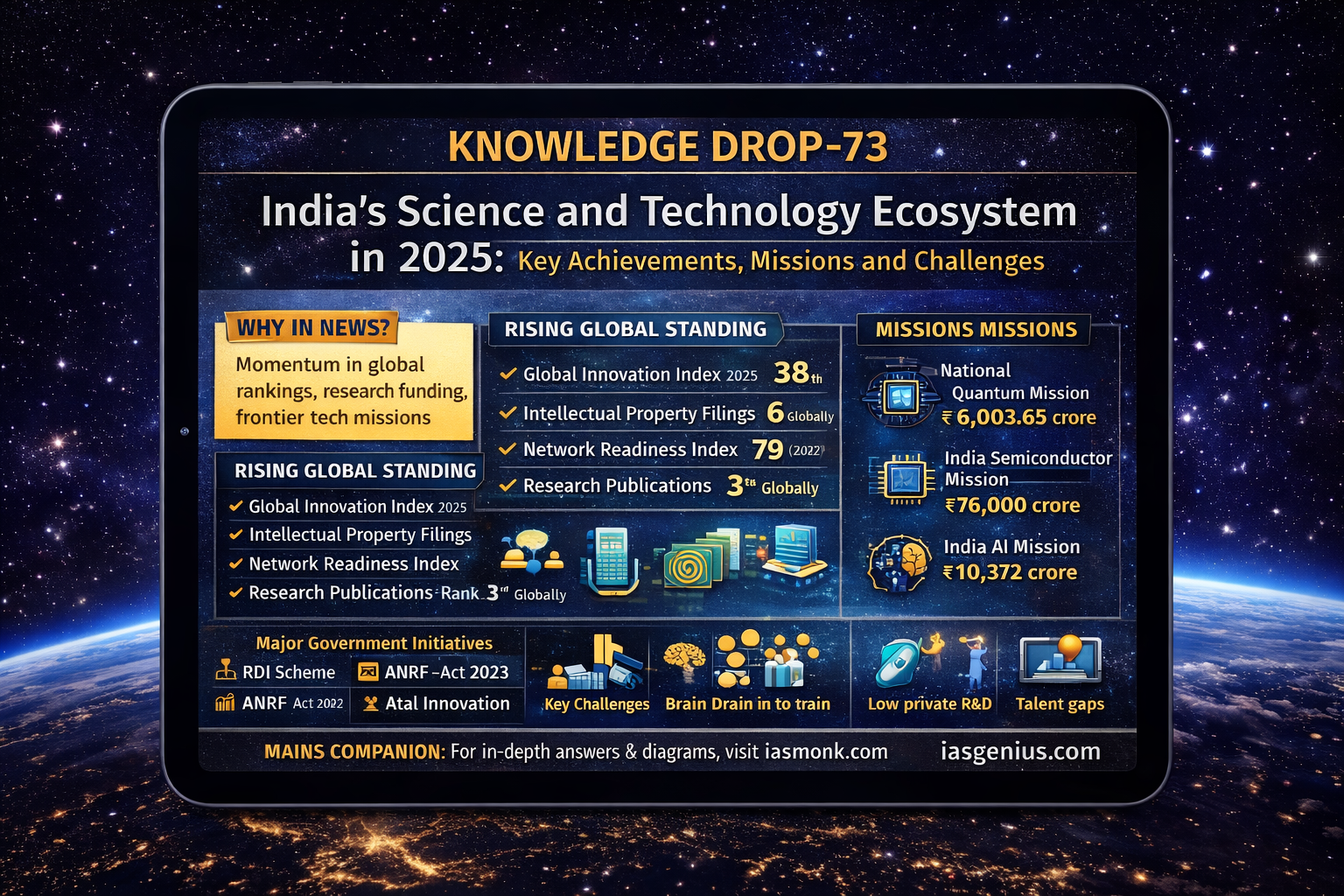
- Global Innovation Index 2025:
India ranked 38th, marking steady progress among innovative economies. - Intellectual Property Filings:
India ranked 6th globally, indicating rising innovation and patent activity. - Network Readiness Index:
Improved from 79th (2019) to 49th (2024), reflecting better digital and technological preparedness. - Research Publications:
India ranked 3rd globally, reinforcing its expanding academic and scientific footprint.
Major Government Initiatives 🏛️
1️⃣ Research, Development and Innovation (RDI) Scheme
- Outlay: ₹1 lakh crore over six years
- Focus areas:
- Artificial Intelligence
- Quantum technologies
- Clean energy
- Biotechnology
- Space
- Digital economy
- Objective: Attract private-sector participation in high-impact research.
2️⃣ Anusandhan National Research Foundation (ANRF)
- Established under the ANRF Act, 2023
- Acts as an apex body for:
- Seeding and promoting R&D
- Fostering research culture across universities and labs
- Provides strategic direction aligned with National Education Policy (NEP).
3️⃣ Atal Innovation Mission (AIM)
- Promotes:
- Startups
- Entrepreneurship
- Student and professional innovation
4️⃣ National Technology Missions 🚀
- National Quantum Mission
- Budget: ₹6,003.65 crore
- Goal: Leadership in quantum technologies & applications
- India Semiconductor Mission
- Budget: ₹76,000 crore
- Objective: Build a domestic semiconductor ecosystem
- India AI Mission
- Budget: ₹10,372 crore
- Focus: Strengthening AI capabilities
- National Mission on Interdisciplinary Cyber-Physical Systems (NM-ICPS)
- Strengthened capacities in:
- Robotics
- AI
- Healthcare
- Cybersecurity
- Mining technologies
- Strengthened capacities in:
Innovation, Startups & Inclusive Science 🧪
- NIDHI (National Initiative for Developing and Harnessing Innovations):
- Expanded startup incubation to Tier-II & Tier-III cities
- Set up:
- New incubators
- Entrepreneur-in-Residence centres
- Research Parks at IITs
- IIT Delhi
- IIT Guwahati
- IIT Kharagpur
- IIT Kanpur
- IIT Chennai
🎯 Purpose:
- Bridge academia–industry collaboration
- Enable joint R&D by students, faculty, and industry.
Key Challenges ⚠️
- Funding Constraints:
Private sector R&D investment remains low by global standards. - Talent Retention Issues:
Brain drain due to better funding and infrastructure abroad. - Weak University–Industry Linkages:
Limits commercialization of research. - Skilled Workforce Shortage:
Deficit in deep-tech and interdisciplinary expertise.
Way Ahead 🔭
- Accelerate capabilities in frontier technologies
- Strengthen talent retention mechanisms
- Improve technology commercialization pipelines
- Deepen global research collaborations
IASGenius Takeaway 🧠
India’s S&T progress in 2025 reflects a strategic push toward innovation-led growth and technological self-reliance.
Target IAS-2026+: Highly Expected Prelims MCQs :
📌 Prelims Practice MCQs
Topic:
MCQ 1 | TYPE 1 — How Many Statements Are Correct?
Consider the following statements regarding India’s global standing in science and innovation:
1)India ranked within the top 40 countries in the Global Innovation Index 2025.
2)India ranked first globally in intellectual property filings.
3)India improved its Network Readiness Index ranking between 2019 and 2024.
4)India ranked among the top three countries globally in research publications.
How many of the above statements are correct?
(a)Only one
(b)Only two
(c)Only three
(d)All four
🌀 Didn’t get it? Click here (▸) for the Correct Answer & Explanation.
🟩 Correct Answer: (c)Only three
🧠 Explanation:
1)✅True – India ranked 38th in GII 2025.
2)❌False – India ranked 6th, not first.
3)✅True – Improved from 79th to 49th.
4)✅True – Ranked third globally.
MCQ 2 | TYPE 2 — Two-Statement Type
Consider the following statements:
Statement I:The Research, Development and Innovation (RDI) Scheme aims to attract private sector participation in sunrise sectors.
Statement II:The RDI Scheme focuses exclusively on public-funded academic research.
Which of the statements given above is/are correct?
(a)Only Statement I
(b)Only Statement II
(c)Both Statement I and II
(d)Neither Statement I nor Statement II
🌀 Didn’t get it? Click here (▸) for the Correct Answer & Explanation.
🟩 Correct Answer: (a)Only Statement I
🧠 Explanation:
Statement I:✅True – Private sector participation is a core objective.
Statement II:❌False – The scheme explicitly seeks private involvement.
MCQ 3 | TYPE 3 — Code-Based Statement Selection
With reference to India’s science and technology missions, consider the following statements:
1)The National Quantum Mission aims to position India as a leader in quantum technologies.
2)The India Semiconductor Mission focuses on building a domestic semiconductor ecosystem.
3)The India AI Mission has a higher budget outlay than the India Semiconductor Mission.
Which of the statements given above is/are correct?
(a)1 and 2 only
(b)2 and 3 only
(c)1 only
(d)1,2 and 3
🌀 Didn’t get it? Click here (▸) for the Correct Answer & Explanation.
🟩 Correct Answer: (a)1 and 2 only
🧠 Explanation:
1)✅True – Leadership in quantum technologies is the mission objective.
2)✅True – Semiconductor ecosystem development is the focus.
3)❌False – Semiconductor Mission outlay (₹76,000 crore) exceeds AI Mission.
MCQ 4 | TYPE 4 — Direct Factual Question
Which one of the following institutions acts as an apex body for providing strategic direction to scientific research in India?
(a)Department of Science and Technology
(b)Council of Scientific and Industrial Research
(c)Anusandhan National Research Foundation
(d)NITI Aayog
🌀 Didn’t get it? Click here (▸) for the Correct Answer & Explanation.
🟩 Correct Answer: (c)Anusandhan National Research Foundation
🧠 Explanation:
ANRF provides high-level strategic direction to scientific research in alignment with the National Education Policy.
MCQ 5 | TYPE 5 — UPSC 2025 Linkage Reasoning Format (I, II, III)
Consider the following statements:
Statement I:Despite strong government initiatives, India faces challenges in translating scientific research into large-scale innovation outcomes.
Statement II:Limited private sector investment and weak university–industry linkages constrain research commercialization.
Statement III:Talent retention challenges and shortages in deep-tech skills affect India’s science and technology ecosystem.
Which one of the following is correct?
A)Both Statements II and III are correct and both explain Statement I
B)Both Statements II and III are correct but only one explains Statement I
C)Only one of the Statements II and III is correct and that explains Statement I
D)Neither Statement II nor Statement III is correct
🌀 Didn’t get it? Click here (▸) for the Correct Answer & Explanation.
🟩 Correct Answer: A)Both Statements II and III are correct and both explain Statement I
🧠 Explanation:
Statement I identifies the innovation translation gap.
Statement II explains structural and investment-related constraints.
Statement III explains human capital and skill-related challenges.
Both statements logically explain Statement I.
📘 KD-73 | Prelims Booster Notes :
Theme: India’s Science and Technology Ecosystem (2025)
GS-3 | Science and Technology
Why in News?
India’s S&T ecosystem showed strong momentum in 2025 through improved global rankings, large-scale funding, and expansion of frontier technology missions.
India’s Global Standing (Key Numbers)
- Global Innovation Index 2025: Rank 38
- Intellectual Property Filings: Rank 6 globally
- Network Readiness Index: Improved from 79 (2019) → 49 (2024)
- Research Publications: Rank 3 globally
Major Government Initiatives
1️⃣ Research, Development and Innovation (RDI) Scheme
- Outlay: ₹1 lakh crore (6 years)
- Objective:
- Attract private-sector participation
- Promote research in sunrise sectors
- Focus areas:
- AI, Quantum Tech, Clean Energy
- Biotechnology, Space, Digital Economy
2️⃣ Anusandhan National Research Foundation (ANRF)
- Established under ANRF Act, 2023
- Acts as an apex body for R&D
- Functions:
- Seed and promote research
- Foster research culture across universities and labs
- Aligned with National Education Policy (NEP)
3️⃣ Atal Innovation Mission (AIM)
- Promotes:
- Startups
- Entrepreneurship
- Student-led innovation
National Technology Missions
- National Quantum Mission
- Budget: ₹6,003.65 crore
- Goal: Leadership in quantum technologies
- India Semiconductor Mission
- Budget: ₹76,000 crore
- Objective: Domestic semiconductor ecosystem
- India AI Mission
- Budget: ₹10,372 crore
- Focus: Strengthening AI capabilities
- NM-ICPS
- Domains: Robotics, AI, Healthcare, Cybersecurity, Mining
Innovation & Inclusive Science
- NIDHI Initiative
- Startup incubation in Tier-II & Tier-III cities
- Incubators and Entrepreneur-in-Residence centres
- Research Parks at IITs
- Delhi, Guwahati, Kharagpur, Kanpur, Chennai
- Industry–academia R&D collaboration
Key Challenges
- Low private sector R&D investment
- Brain drain of skilled researchers
- Weak university–industry linkages
- Shortage of deep-tech and interdisciplinary skills
Prelims Traps ⚠️
- ❌ ANRF replaces DST
- ❌ India ranked top 10 in GII
- ❌ Semiconductor Mission has smaller budget than AI Mission
- ❌ Innovation limited to Tier-I cities
One-Line Takeaway
India’s S&T ecosystem in 2025 reflects a policy-driven push toward innovation, self-reliance, and global competitiveness.
⚡ KD-73 | 20-Word Flash Facts (Prelims)
1)India ranked 38th in Global Innovation Index 2025.
2)India ranked 6th globally in intellectual property filings.
3)India ranked third globally in research publications.
4)Network Readiness Index improved from 79 (2019) to 49 (2024).
5)RDI Scheme outlay is ₹1 lakh crore over six years.
6)RDI Scheme targets sunrise sectors including AI and quantum.
7)ANRF was established under the ANRF Act, 2023.
8)ANRF acts as an apex body for research governance.
9)ANRF aligns research priorities with National Education Policy.
10)Atal Innovation Mission promotes startups and entrepreneurship.
11)National Quantum Mission budget is ₹6,003.65 crore.
12)India Semiconductor Mission budget is ₹76,000 crore.
13)India AI Mission budget is ₹10,372 crore.
14)NM-ICPS focuses on cyber-physical systems.
15)NIDHI expands incubation to Tier-II and Tier-III cities.
16)Research parks bridge industry–academia collaboration.
17)Private R&D investment in India remains globally low.
18)Brain drain affects talent retention in research.
19)Weak university–industry links hinder commercialisation.
20)India’s S&T push supports technological self-reliance.
🧠 IASGenius Prelims Whisper
Science policy becomes power only when talent, funding, and institutions move together.