






🌑Knowledge Drop – 72: India’s New GDP Series: Fixing Discrepancies, Updating Measurement | For prelims: Highly expected MCQs; Booster Notes; Word-Flash Facts | For Mains: All G.S Papers: High Quality Essays ; Model Answers; Case Studies and beyond on iasmonk.com
🔗 This Knowledge Drop has a Mains-focused companion on iasmonk.com
“For answer-writing enrichment beyond Prelims, visit iasmonk.com.”
India’s New GDP Series: Fixing Discrepancies, Updating Measurement
Post Date: 25-12-2026
Syllabus: GS-3 | 💹 Indian Economy
Context 📊
The Ministry of Statistics and Programme Implementation (MoSPI) has released a discussion paper outlining major methodological changes in India’s GDP estimation.
Background 🔍
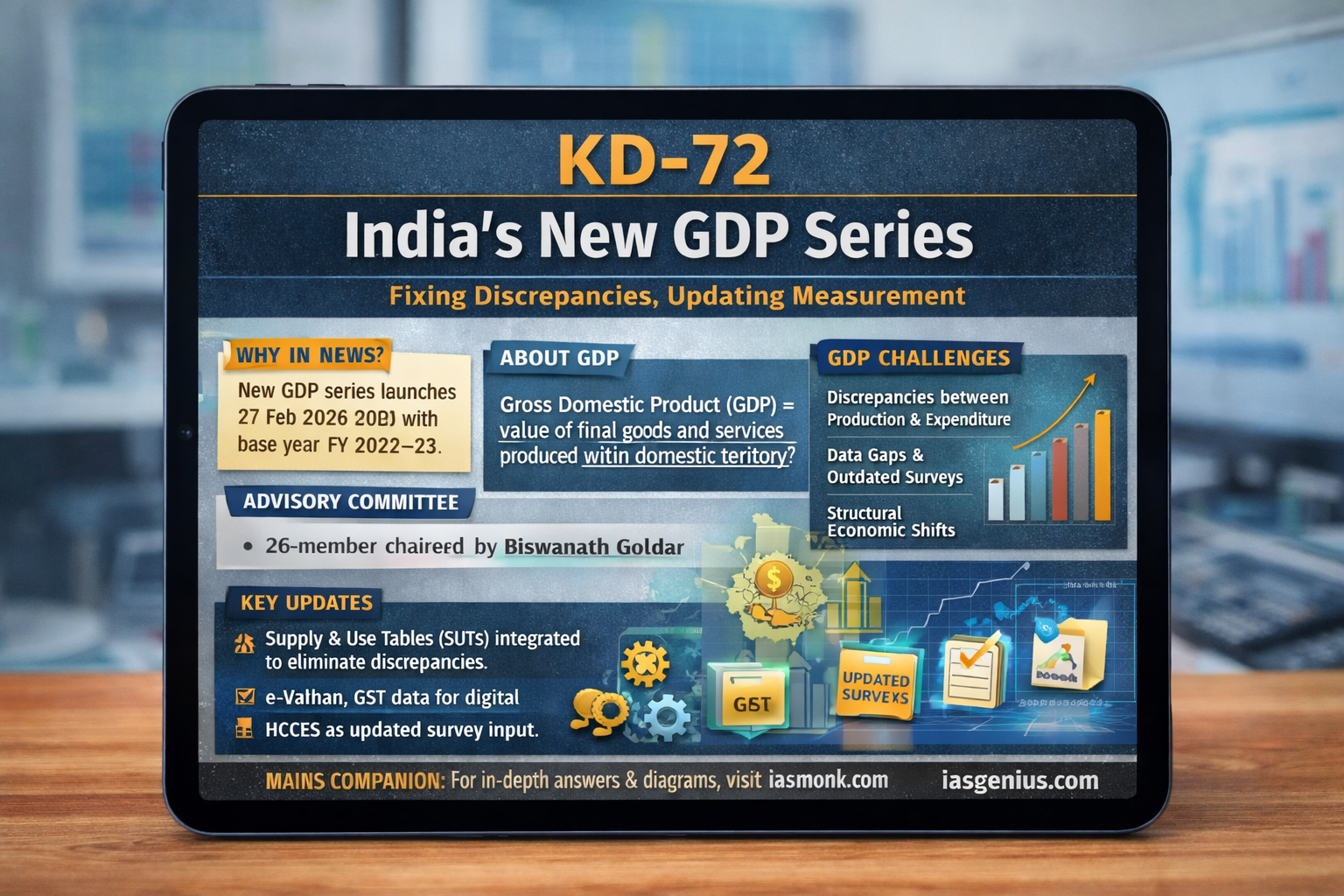
- In 2024, MoSPI constituted a 26-member Advisory Committee on National Accounts Statistics
- Chairman: Biswanath Goldar
- Purpose: Decide the new base year and improve GDP methodology
📅 New GDP series release: 27 February 2026
📌 Base Year: FY 2022–23
📌 Current Base Year: 2011–12
What is GDP? 🧮
Gross Domestic Product (GDP) is the total monetary value of all final goods and services produced within a country’s domestic territory during a given period.
Released By
- National Statistical Office (NSO)
- Under MoSPI
Methods of GDP Calculation ⚙️
GDP is estimated using three approaches:
1️⃣ Expenditure Approach
- Total spending on final goods and services
2️⃣ Income Approach
- Total income earned by factors of production (labour, capital)
3️⃣ Production / Value-Added Approach
- Sum of value added by industries at each stage
What is a Base Year? ⏳
A base year is a reference year used to compare economic indicators such as:
- GDP
- CPI
- IIP
Significance
- Removes impact of inflation
- Reflects current economic structure
- Captures updated consumption patterns and prices
Why Change the GDP Base Year? 🔄
Structural Changes in Economy
- Digitisation
- Formalisation
- GST implementation
- Shift in consumption patterns
Data Limitations
- Reliance on outdated surveys
- Use of static ratios
GDP Discrepancies Problem
- GDP estimated using production + expenditure approaches
- Differences arise due to:
- Data source gaps
- Valuation differences
- Time lags
⚠️ Large discrepancies lead to:
- Major future revisions
- Reduced transparency
- Lower confidence among policymakers and investors
Key Changes in the New GDP Series 🆕
1️⃣ Elimination of ‘Discrepancies’
- Direct integration of Supply and Use Tables (SUTs) into annual GDP compilation
Supply and Use Tables show:
- Supply of goods & services (domestic + imports)
- Their use as:
- Intermediate consumption
- Final consumption
- Exports
🎯 Goal:
- Limit discrepancies in early estimates
- Eliminate them in final estimates
2️⃣ Use of Digital & Administrative Data 📱
Increased reliance on:
- e-Vahan (vehicle registrations)
- GST data
- Other administrative records
3️⃣ Updated Surveys as Data Backbone 📑
Key surveys feeding into the new series:
- Household Consumption Expenditure Survey (HCES)
- 2022–23
- 2023–24
- Updated surveys of:
- Formal enterprises
- Informal enterprises
Challenges Ahead ⚠️
- GDP estimation remains methodologically complex
- Integration of multiple datasets raises:
- Data quality issues
- Consistency concerns
- Ensuring timely survey data is critical
- Transition may create comparability issues for long-term analysis
Conclusion 🧾
The revision of India’s GDP series is a major step toward improving the accuracy, transparency, and credibility of national income statistics.
By updating the base year and integrating Supply and Use Tables, the new framework better reflects the realities of a rapidly formalising and digitising economy.
IASGenius Note 🧠
This topic has high probability for:
Economy-current affairs linkage
Prelims conceptual MCQs
Target IAS-2026+: Highly Expected Prelims MCQs :
📌 Prelims Practice MCQs
Topic:
MCQ 1 | TYPE 1 — How Many Statements Are Correct?
Consider the following statements regarding Gross Domestic Product (GDP):
1)GDP measures the total value of all intermediate goods produced in an economy.
2)GDP includes the value of final goods and services produced within domestic territory.
3)GDP is released in India by the National Statistical Office under MoSPI.
4)GDP is measured only using the production approach.
How many of the above statements are correct?
(a)Only one
(b)Only two
(c)Only three
(d)All four
🌀 Didn’t get it? Click here (▸) for the Correct Answer & Explanation.
🟩 Correct Answer: (b)Only two
🧠 Explanation:
1)❌False – GDP excludes intermediate goods.
2)✅True – Only final goods and services are counted.
3)✅True – NSO under MoSPI releases GDP data.
4)❌False – GDP is measured using three approaches.
MCQ 2 | TYPE 2 — Two-Statement Type
Consider the following statements:
Statement I:A base year helps remove the effect of inflation while measuring real economic growth.
Statement II:A base year remains unchanged irrespective of structural changes in the economy.
Which of the statements given above is/are correct?
(a)Only Statement I
(b)Only Statement II
(c)Both Statement I and II
(d)Neither Statement I nor II
🌀 Didn’t get it? Click here (▸) for the Correct Answer & Explanation.
🟩 Correct Answer: (a)Only Statement I
🧠 Explanation:
Statement I:✅True – Base year allows real growth comparison.
Statement II:❌False – Base years are periodically revised.
MCQ 3 | TYPE 3 — Code-Based Statement Selection
With reference to India’s new GDP series, consider the following statements:
1)The new GDP series will use FY 2022–23 as the base year.
2)Supply and Use Tables will be integrated directly into annual GDP compilation.
3)The new series eliminates the use of the expenditure approach altogether.
Which of the statements given above is/are correct?
(a)1 and 2 only
(b)2 and 3 only
(c)1 only
(d)1,2 and 3
🌀 Didn’t get it? Click here (▸) for the Correct Answer & Explanation.
🟩 Correct Answer: (a)1 and 2 only
🧠 Explanation:
1)✅True – FY 2022–23 is the new base year.
2)✅True – SUTs will be integrated to reduce discrepancies.
3)❌False – Expenditure approach will continue.
MCQ 4 | TYPE 4 — Direct Factual Question
Which one of the following datasets is proposed to be increasingly used in the new GDP series for India?
(a)Socio-Economic Caste Census
(b)e-Vahan vehicle registration data
(c)NSS Employment–Unemployment Survey
(d)Agricultural Census
🌀 Didn’t get it? Click here (▸) for the Correct Answer & Explanation.
🟩 Correct Answer: (b)e-Vahan vehicle registration data
🧠 Explanation:
The new GDP series plans greater use of digital and administrative datasets such as e-Vahan and GST data.
MCQ 5 | TYPE 5 — UPSC 2025 Linkage Reasoning Format (I, II, III)
Consider the following statements:
Statement I:India’s GDP estimates have witnessed persistent discrepancies between production and expenditure approaches.
Statement II:Different data sources, valuation methods and time lags are used across GDP estimation approaches.
Statement III:Integration of Supply and Use Tables into annual GDP compilation can reduce such discrepancies.
Which one of the following is correct?
A)Both Statements II and III are correct and both explain Statement I
B)Both Statements II and III are correct but only one explains Statement I
C)Only one of the Statements II and III is correct and that explains Statement I
D)Neither Statement II nor Statement III is correct
🌀 Didn’t get it? Click here (▸) for the Correct Answer & Explanation.
🟩 Correct Answer: A)Both Statements II and III are correct and both explain Statement I
🧠 Explanation:
Statement I identifies the GDP discrepancy problem.
Statement II explains the methodological causes.
Statement III explains how SUT integration addresses it.
📘 KD-72 | Prelims Booster Notes
Theme: India’s New GDP Series
GS-3 | Indian Economy
Why in News?
The Ministry of Statistics and Programme Implementation (MoSPI) released a discussion paper proposing methodological changes in India’s GDP estimation.
Key Background Facts
- New GDP series release: 27 February 2026
- New Base Year: FY 2022–23
- Current Base Year: 2011–12
- Advisory Committee: 26-member committee on National Accounts Statistics
- Chairman: Biswanath Goldar
What is GDP?
GDP = Total monetary value of all final goods and services produced within domestic territory during a given period.
- Released by National Statistical Office (NSO)
- Under MoSPI
Three Methods of GDP Calculation
1)Expenditure approach → Total final spending
2)Income approach → Total factor incomes
3)Production (Value-added) approach → Value added by industries
What is a Base Year?
- Reference year for comparison of:
- GDP
- CPI
- IIP
Why important?
- Removes inflation effect
- Reflects current economic structure
- Updates consumption & price patterns
Why Change the Base Year?
- Structural transformation due to:
- Digitisation
- Formalisation
- GST
- Outdated surveys & static ratios
- Persistent GDP discrepancies between production and expenditure estimates
- Large revisions later → reduced transparency & confidence
Key Changes in the New GDP Series
1️⃣ Eliminating Discrepancies
- Direct integration of Supply and Use Tables (SUTs) into annual GDP compilation
SUTs show:
- Supply (domestic + imports)
- Use (intermediate, final consumption, exports)
2️⃣ Use of Digital & Administrative Data
- e-Vahan (vehicle registrations)
- GST data
- Other administrative records
3️⃣ Updated Surveys
- Household Consumption Expenditure Survey (HCES)
- 2022–23
- 2023–24
- Updated enterprise surveys (formal & informal)
Challenges Ahead
- Methodological complexity remains
- Data quality & consistency issues
- Timely survey availability
- Comparability issues during transition
Prelims Traps ⚠️
- ❌ GDP includes intermediate goods
- ❌ Base year never changes
- ❌ Discrepancies are errors only
- ❌ GDP uses only one method
One-Line Takeaway
India’s new GDP series aims to improve accuracy, transparency, and credibility by updating the base year and integrating SUTs.
⚡ KD-72 | 20-Word Flash Facts (Prelims)
1)GDP measures value of final goods and services produced within domestic territory.
2)India’s current GDP base year is 2011–12.
3)New GDP series base year will be FY 2022–23.
4)New GDP series release is scheduled for 27 February 2026.
5)GDP in India is released by NSO under MoSPI.
6)GDP is calculated using expenditure, income and production approaches.
7)A base year helps remove inflation effects from growth measurement.
8)Base year revision reflects structural economic changes.
9)GDP discrepancies arise due to data gaps, valuation differences and time lags.
10)Supply and Use Tables link production with expenditure.
11)Integration of SUTs helps reduce GDP discrepancies.
12)e-Vahan data captures vehicle registrations digitally.
13)GST data improves coverage of the formal economy.
14)HCES provides updated household consumption patterns.
15)Large GDP revisions reduce policy predictability.
16)Formalisation and digitisation necessitate new measurement methods.
17)Administrative data complements traditional survey-based estimation.
18)New GDP series aims for greater transparency.
19)Discrepancies are common in early GDP estimates.
20)Better GDP measurement improves investor and policymaker confidence.
🧠 IASGenius Prelims Whisper
Good economics begins with good measurement.