


🌑Knowledge Drop – 70: WTO’s Global Value Chain Development Report 2025| For prelims: Highly expected MCQs | For Mains, All G.S Papers: High Quality Essays on iasmonk.com
WTO’s Global Value Chain Development Report 2025
Post Date: 23-12-2025
Syllabus: GS-3 | 💹 Economy
Context 🌍
The Global Value Chain Development Report 2025 has been released by the World Trade Organization (WTO), analysing recent trends, structural shifts, and future challenges in global value chains.
What is a Global Value Chain (GVC)? 🔗
A Global Value Chain (GVC) refers to the full range of activities involved in producing a good or service when these activities are spread across multiple countries.
Key Stages in a GVC 🏭
- Design and Research & Development
- Sourcing of raw materials
- Production and assembly
- Logistics and distribution
- Marketing, sales and after-sales services
➡️ Each stage adds value, and countries participate in different stages based on their comparative advantage.
Illustrative Example 📱
A smartphone may be:
- Designed in the United States
- Components manufactured in East Asia
- Assembled in Vietnam or India
- Sold across global markets
Major Findings of the Report 📊
Recent Global Trends
- GVCs remain central to world trade
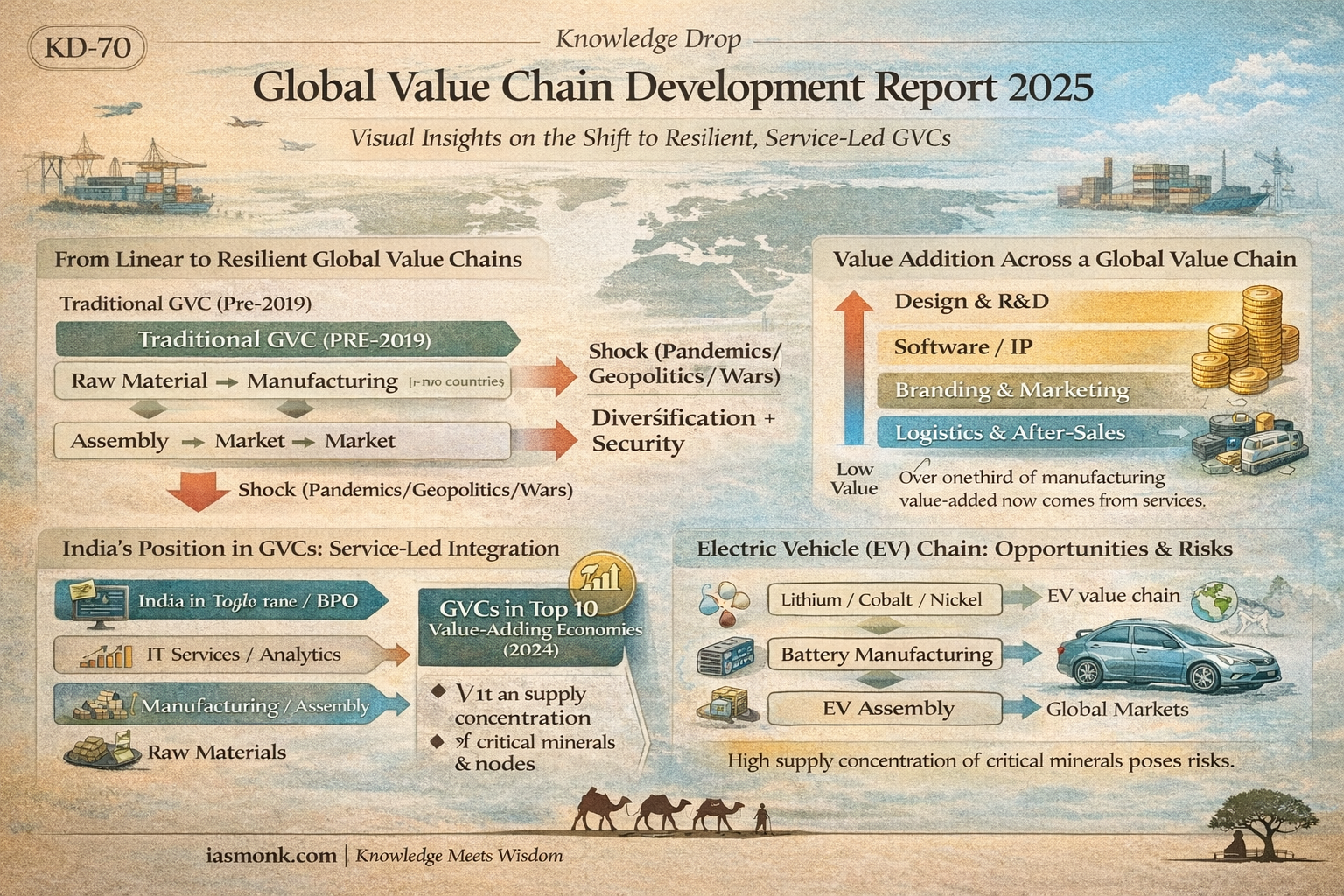
- Account for 46.3% of global trade in value-added terms
- Slightly below the 2022 peak, indicating resilience despite disruptions
- Firms and governments increasingly prioritise resilience and diversification alongside efficiency
India-Specific Findings 🇮🇳
- India, along with the Philippines and several African economies, has strengthened its role in:
- Business-process services
- Digital service exports
- India is now among the top 10 value-adding economies in global trade
- Contributed 2.8% of global Domestic Value Added (DVA) in exports in 2024
- Reflects India’s expanding role in digital trade and services-led GVCs
Structural Shifts in GVCs ⚙️
- Services now outpace goods in GVC participation
- Services contribute more than one-third of value added in manufacturing exports
- Indicates growing importance of design, software, logistics and after-sales services
Regional Reconfiguration 🌏
- Asia, Europe and North America continue to dominate GVC trade
- Increasing emphasis on regional supply chains rather than fully globalised ones
Reshoring and Regionalisation Trends 🧭
- Major economies such as:
- China
- United States
- European Union
are reducing dependence on foreign value-added in domestic consumption.
➡️ Driven by concerns over:
- Supply-chain security
- Strategic autonomy
- Geopolitical risks
Electric Vehicle (EV) Value Chains 🚗⚡
- Rapid expansion of EV production is reshaping automotive GVCs
- China accounted for a major share of global EV output (2023)
- Critical minerals like lithium and cobalt are central to EV supply chains
➡️ Offers opportunities for resource-rich developing countries, but also raises risks due to supply concentration
Technology and GVCs 🤖
- Digitalisation, automation, AI and advanced ICT are enabling:
- Finer fragmentation of production
- Lower coordination costs
- More resilient network-based GVCs
- Economies with strong infrastructure and absorptive capacity benefit most
- Others risk falling behind in high-value segments
Challenges for India in GVC Integration ⚠️
Infrastructure and Logistics
- High logistics costs
- Port inefficiencies and delays
Regulatory and Policy Uncertainty
- Frequent policy changes
- Compliance burden discouraging long-term investment
Limited Trade Agreements
- Fewer Free Trade Agreements reduce preferential market access
Skill and Technology Gaps
- Shortage of skilled labour in advanced manufacturing
Sustainability Barriers
- Carbon border measures
- ESG compliance increasing export costs
Key Recommendations 🧩
For Policymakers 🏛️
- Strengthen digital and logistics infrastructure
- Align climate and trade policies
- Improve access to trade finance for SMEs
- Ensure transparent and coordinated industrial policies
For Firms 🏢
- Invest in digital tools, AI and automation
- Diversify supply networks to balance efficiency and risk
- Leverage regional production networks where advantages exist
IAS Monk Whisper 🌀
In global value chains, strength lies not in isolation, but in intelligent integration.
Prelims Booster Notes
KD-70 | Global Value Chain Development Report 2025
GS-3 | Economy
Why in News?
The Global Value Chain Development Report 2025 was released by the World Trade Organization (WTO), analysing trends, risks and restructuring in global production networks.
Global Value Chain (GVC): Core Concept
- A Global Value Chain refers to production where different stages are spread across countries
- Countries specialise based on comparative advantage
- Value is added at each stage, not just final assembly
Key Stages
- Design & R&D
- Raw material sourcing
- Manufacturing & assembly
- Logistics & distribution
- Marketing & after-sales services
Key Global Findings (Prelims Gold)
- GVCs account for 46.3% of global trade (value-added terms)
- Slightly below 2022 peak → resilient, not collapsing
- Shift from:
- Pure efficiency → efficiency + resilience
- Supplier diversification prioritised
Structural Shifts in GVCs
- Services dominate GVC participation
- Services contribute >1/3rd of value added in manufacturing exports
- Includes:
- Software
- Design
- Logistics
- After-sales services
Regional Patterns
- Dominant regions:
- Asia
- Europe
- North America
- Trend towards regionalisation over hyper-globalisation
Reshoring & Regionalisation
- Major economies:
- USA
- China
- European Union
- Reducing dependence on foreign value-added
- Drivers:
- Supply-chain security
- Geopolitical risks
- Strategic autonomy
Electric Vehicle (EV) Value Chains
- EVs reshaping global automotive GVCs
- China dominates EV production (2023)
- Critical minerals central:
- Lithium
- Cobalt
- Opportunity for resource-rich developing countries
- Risk of supply concentration
Technology & GVCs
- Digitalisation, AI, automation enable:
- Finer fragmentation
- Lower coordination costs
- Network-based resilience
- Winners:
- Economies with strong infrastructure & absorptive capacity
- Losers:
- Economies lacking skills, tech & connectivity
India-Specific Findings
- India among Top 10 value-adding economies
- 2.8% share in global Domestic Value Added (DVA) in exports (2024)
- Strength driven by:
- Digital trade
- Business-process services
- Less driven by heavy manufacturing
Challenges for India
- High logistics costs & port inefficiencies
- Policy & regulatory uncertainty
- Fewer FTAs → limited preferential access
- Skill gaps in advanced manufacturing
- ESG & carbon border compliance costs
Policy Recommendations (Quick Recall)
- Strengthen logistics & digital infrastructure
- Align climate and trade policies
- Improve trade finance access (SMEs)
- Transparent, coordinated industrial policy
Prelims Traps ⚠️
- ❌ GVCs measured only in gross trade
- ❌ GVCs collapsed after COVID
- ❌ Manufacturing alone creates value
- ❌ India’s rise driven mainly by heavy industry
One-Liners for UPSC
- GVC strength lies in value added, not final assembly
- Services are now the backbone of manufacturing exports
- Resilience, not just efficiency, defines modern GVCs
IAS Monk Whisper 🌀
In global trade, power belongs to those who control ideas, logistics and networks — not just factories.
KD-70 Mains Answer (≈250 words):
Global Value Chains in Transition: Key Insights from the GVC Development Report 2025
Global Value Chains (GVCs) have long been central to international trade, enabling countries to participate in global production networks based on comparative advantage. The Global Value Chain Development Report 2025 highlights that despite recent global disruptions, GVCs remain resilient, accounting for about 46.3% of global trade in value-added terms.
A key trend identified in the report is the structural shift from efficiency-driven integration to resilience-oriented reconfiguration. Firms and governments are increasingly prioritising supplier diversification, reshoring and regionalisation to mitigate risks arising from geopolitical tensions, pandemics and supply-chain shocks. This has led major economies such as the United States, China and the European Union to reduce dependence on foreign value-added in domestic consumption.
Another significant transformation is the rising importance of services in GVCs. Services such as design, software, logistics and after-sales support now account for more than one-third of value added in manufacturing exports, underlining that value creation increasingly occurs beyond the factory floor. Technological advances in digitalisation, artificial intelligence and automation have further enabled finer fragmentation of production and reduced coordination costs.
India’s position in GVCs has strengthened, with the country emerging among the top ten value-adding economies and contributing around 2.8% of global Domestic Value Added in exports in 2024. This progress is largely driven by digital trade and business-process services. However, India faces challenges such as high logistics costs, limited trade agreements, skill gaps and emerging sustainability barriers.
Going forward, aligning infrastructure development, trade policy and skill formation will be crucial for India to move into higher-value segments of global value chains while balancing efficiency with resilience.
Target IAS-2026+: Highly Expected Prelims MCQs :
📌 Prelims Practice MCQs
Topic: Global Value Chains
MCQ 1 | TYPE 1 — How Many Statements Are Correct?
Consider the following statements regarding Global Value Chains (GVCs):
1)Global Value Chains involve production activities confined within a single country.
2)Different countries participate in different stages of a GVC based on comparative advantage.
3)Services such as design, logistics and after-sales contribute to value addition in GVCs.
4)GVC participation is measured only in gross trade terms.
How many of the above statements are correct?
(a)Only one
(b)Only two
(c)Only three
(d)All four
🌀 Didn’t get it? Click here (▸) for the Correct Answer & Explanation.
🟩 Correct Answer: (c)Only three
🧠 Explanation:
1)❌False – GVCs span multiple countries.
2)✅True – Participation depends on comparative advantage.
3)✅True – Services add significant value.
4)❌False – GVCs are measured in value-added terms as well.
MCQ 2 | TYPE 2 — Two-Statement Type
Consider the following statements:
Statement I:According to the Global Value Chain Development Report 2025, GVCs account for nearly half of global trade in value-added terms.
Statement II:The share of GVCs in global trade has completely collapsed after the pandemic.
Which of the statements given above is/are correct?
(a)Only Statement I
(b)Only Statement II
(c)Both Statement I and II
(d)Neither Statement I nor II
🌀 Didn’t get it? Click here (▸) for the Correct Answer & Explanation.
🟩 Correct Answer: (a)Only Statement I
🧠 Explanation:
Statement I:✅True – GVCs account for about 46.3% of global trade.
Statement II:❌False – GVCs remain resilient despite disruptions.
MCQ 3 | TYPE 3 — Code-Based Statement Selection
With reference to India’s position in Global Value Chains, consider the following statements:
1)India is among the top ten value-adding economies in global exports.
2)India’s share of global Domestic Value Added in exports stood at about 2.8% in 2024.
3)India’s recent GVC integration is driven primarily by heavy manufacturing exports.
Which of the statements given above is/are correct?
(a)1 and 2 only
(b)2 and 3 only
(c)1 only
(d)1,2 and 3
🌀 Didn’t get it? Click here (▸) for the Correct Answer & Explanation.
🟩 Correct Answer: (a)1 and 2 only
🧠 Explanation:
1)✅True – India is now among the top ten value-adding economies.
2)✅True – India contributed 2.8% of global DVA in exports.
3)❌False – Growth is driven largely by digital and business services.
MCQ 4 | TYPE 4 — Direct Factual Question
According to the Global Value Chain Development Report 2025, which of the following sectors now contributes more than one-third of value added in manufacturing exports?
(a)Agriculture
(b)Mining
(c)Services
(d)Energy
🌀 Didn’t get it? Click here (▸) for the Correct Answer & Explanation.
🟩 Correct Answer: (c)Services
🧠 Explanation:
Services such as R&D, logistics, software and after-sales now account for more than one-third of value added in manufacturing exports.
MCQ 5 | TYPE 5 — UPSC 2025 Linkage Reasoning Format (I, II, III)
Consider the following statements:
Statement I:
The structure of Global Value Chains is undergoing a shift from efficiency-driven integration to resilience-oriented reconfiguration.
Statement II:
Major economies are actively reshoring and regionalising production to reduce dependence on foreign value-added.
Statement III:
Geopolitical risks, supply-chain disruptions and strategic security concerns have altered global trade priorities.
Which one of the following is correct?
A)Both Statements II and III are correct and both explain Statement I
B)Both Statements II and III are correct but only one explains Statement I
C)Only one of the Statements II and III is correct and that explains Statement I
D)Neither Statement II nor Statement III is correct
🌀 Didn’t get it? Click here (▸) for the Correct Answer & Explanation.
🟩 Correct Answer: A)Both Statements II and III are correct and both explain Statement I
🧠 Explanation:
Statement I correctly captures the broader transformation in GVCs from pure cost-efficiency to resilience.
Statement II explains this shift by highlighting reshoring and regionalisation strategies adopted by major economies.
Statement III further explains the shift by identifying geopolitical tensions and supply-chain shocks as underlying drivers.
Hence, both Statements II and III are correct and both logically explain Statement I.