







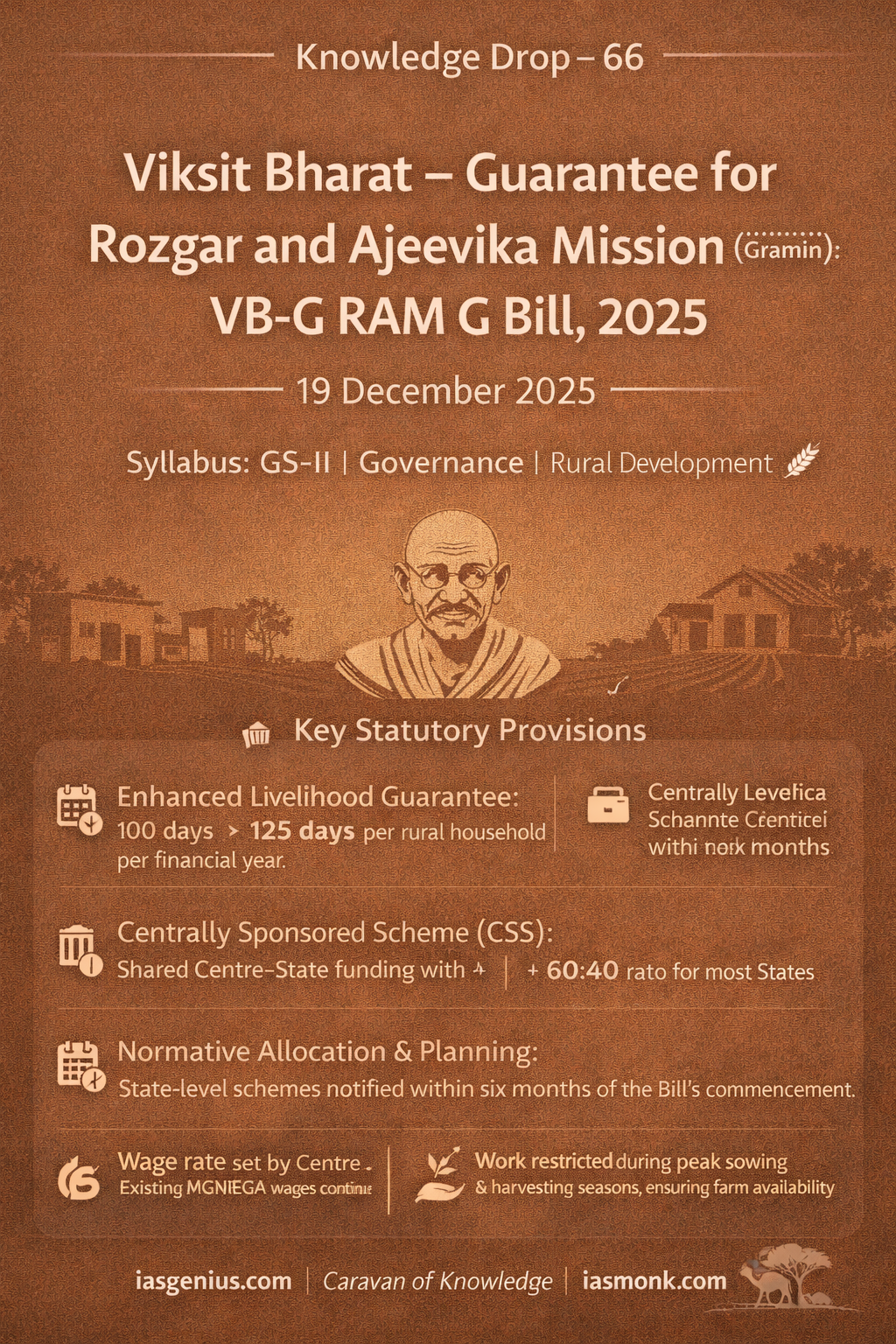
🌑Knowledge Drop – 66: Viksit Bharat – Guarantee for Rozgar and Ajeevika Mission (Gramin): VB-G RAM G Bill, 2025 | For prelims: Highly expected MCQs | For Mains, All G.S Papers: High Quality Essays on iasmonk.com
Viksit Bharat – Guarantee for Rozgar and Ajeevika Mission (Gramin): VB-G RAM G Bill, 2025
Post Date: 19 December 2025
Syllabus: GS-II | Governance | Rural Development 🌾
📍 Context
The Union Minister of Rural Development and Agriculture & Farmers’ Welfare has introduced the Viksit Bharat – Guarantee for Rozgar and Ajeevika Mission (Gramin): VB-G RAM G Bill, 2025 in the Lok Sabha.
The Bill seeks to replace the Mahatma Gandhi National Rural Employment Guarantee Act, 2005 (MGNREGA) and marks a significant shift in India’s rural employment policy.
🔎 About the Bill
- Replaces MGNREGA, 2005
- Shifts the framework from a “demand-driven” to a “supply-driven” employment guarantee model
- Focuses on structured planning, predictable allocation, and integrated rural development
🧩 Key Statutory Provisions
1️⃣ Enhanced Livelihood Guarantee
- Statutory wage employment guarantee increased from 100 days to 125 days
- Applicable per rural household per financial year
- For adults volunteering for unskilled manual work
2️⃣ Centrally Sponsored Scheme (CSS)
- Implemented as a Centrally Sponsored Scheme
- Shared responsibility between Centre and States
Funding Pattern:
- 90:10 for North-Eastern and Himalayan States/UTs
- 60:40 for all other States
3️⃣ Normative Allocation to States
- States to ensure transparent, need-based intra-State distribution
- Allocation across Districts and Gram Panchayats based on:
- Panchayat category
- Local developmental needs
4️⃣ Wage Rate Specification
- Wage rates for unskilled work to be specified by the Central Government
- Until revised rates are notified, existing MGNREGA wages will continue
5️⃣ Protection of Peak Agricultural Seasons
- States empowered to notify up to 60 days in a financial year
- Period to cover peak sowing and harvesting seasons
- No works under the scheme during this period
- Ensures availability of farm labour at critical agricultural stages 🌱
6️⃣ Unemployment Allowance
- If eligible applicants are not provided work within the stipulated time,
- State Governments are legally obliged to pay unemployment allowance
7️⃣ State-level Scheme Notification
- Every State Government must notify its own Scheme
- Must operationalise the guarantee within six months of the Bill’s commencement
8️⃣ VGPP-Based Planning
- Planning through Viksit Gram Panchayat Plans (VGPPs)
- Prepared by Gram Panchayats
- Integrated with national spatial planning systems
9️⃣ Institutional Oversight
- Central Gramin Rozgar Guarantee Council
- State Gramin Rozgar Guarantee Councils
- Responsible for review, monitoring, and effective implementation
⚠️ Key Concerns with the Bill
1️⃣ Increased Fiscal Burden on States
- Under MGNREGA:
- Centre paid 100% wage cost
- 75% of material cost
- Under VB-G RAM G:
- Mandatory 60:40 Centre–State sharing
- Many States may struggle to mobilise their 40% share
- Risk of uneven implementation and regional disparities
2️⃣ Lessons from PMFBY
- Similar cost-sharing under Pradhan Mantri Fasal Bima Yojana (PMFBY)
- Delays due to States’ inability to pay premium subsidies
- Resulted in:
- Poor coverage
- Loss of scheme credibility
3️⃣ Shift from Demand-Driven to Supply-Driven Model
- MGNREGA:
- Bottom-up, demand-based estimation by States
- VB-G RAM G:
- Top-down, normative allocation
- Parameters decided centrally
- Raises concerns over reduced local responsiveness and flexibility
🧭 Conclusion
As India’s development trajectory evolves, rural employment and livelihood programs must also adapt.
To meet changing aspirations, stronger convergence is required to build an integrated, Whole-of-Government rural development framework, linking multiple complementary schemes.
Periodic revision of rural development legislation is essential to ensure relevance, equity, and sustainability in a rapidly transforming economy.
🌀 IAS Monk Whisper
Rural employment is not merely about wages—it is about dignity, predictability, and the quiet assurance that growth will not bypass the village.
Target IAS-2026+: Highly Expected Prelims MCQs :
📌 Prelims Practice MCQs
Topic:
MCQ 1 | TYPE 1 — How Many Statements Are Correct?
Consider the following statements regarding the VB-G RAM G Bill, 2025:
1)The Bill replaces the Mahatma Gandhi National Rural Employment Guarantee Act, 2005.
2)The statutory wage employment guarantee is increased from 100 days to 125 days per rural household.
3)The scheme follows a purely demand-driven framework similar to MGNREGA.
4)The Bill mandates unemployment allowance if work is not provided within the stipulated period.
How many of the above statements are correct?
(a)Only one
(b)Only two
(c)Only three
(d)All four
🌀 Didn’t get it? Click here (▸) for the Correct Answer & Explanation.
🟩 Correct Answer:(c)Only three
🧠 Explanation:
1)✅Correct.The Bill explicitly replaces MGNREGA, 2005.
2)✅Correct.The guarantee is enhanced to 125 days per household.
3)❌Incorrect.The Bill shifts from a demand-driven to a supply-driven framework.
4)✅Correct.States are legally obliged to pay unemployment allowance if work is not provided.
MCQ 2 | TYPE 2 — Two-Statement Type
Consider the following statements:
Statement I:The VB-G RAM G Bill is implemented as a Centrally Sponsored Scheme with shared Centre–State responsibility.
Statement II:Under the Bill, the Centre bears the entire wage cost for all States.
Which of the statements given above is/are correct?
(a)Statement I only
(b)Statement II only
(c)Both Statement I and Statement II
(d)Neither Statement I nor Statement II
🌀 Didn’t get it? Click here (▸) for the Correct Answer & Explanation.
🟩 Correct Answer: (a)Statement I only
🧠 Explanation:
1)✅Correct.The scheme follows a Centrally Sponsored Scheme model.
2)❌Incorrect.The Bill mandates a 60:40 cost-sharing for most States, not full central funding.
MCQ 3 | TYPE 3 — Code-Based Statement Selection
Which of the following are key statutory provisions of the VB-G RAM G Bill, 2025?
1)VGPP-based planning through Gram Panchayats
2)Advance notification of no-work periods during peak agricultural seasons
3)Mandatory implementation of works during sowing and harvesting
4)Constitution of Central and State Gramin Rozgar Guarantee Councils
Select the correct answer using the code given below:
(a)1,2 and 4 only
(b)1 and 3 only
(c)2 and 3 only
(d)1,2,3 and 4
🌀 Didn’t get it? Click here (▸) for the Correct Answer & Explanation.
🟩 Correct Answer: (a)1,2 and 4 only
🧠 Explanation:
1)✅Correct.Planning is undertaken through Viksit Gram Panchayat Plans.
2)✅Correct.States may notify up to 60 no-work days during peak agricultural seasons.
3)❌Incorrect.The Bill explicitly avoids works during peak sowing and harvesting periods.
4)✅Correct.Institutional councils are provided for oversight and monitoring.
MCQ 4 | TYPE 4 — Direct Factual Question
Under the VB-G RAM G Bill, what is the Centre–State funding pattern for most States?
(a)100:0
(b)75:25
(c)60:40
(d)50:50
🌀 Didn’t get it? Click here (▸) for the Correct Answer & Explanation.
🟩 Correct Answer: (c)60:40
🧠 Explanation:
For all States other than North-Eastern and Himalayan States/UTs, the funding pattern is 60:40.
MCQ 5 | TYPE 5 — UPSC 2025 Linkage Reasoning Format (I, II, III)
Consider the following statements:
1)MGNREGA followed a bottom-up, demand-driven allocation of rural employment.
2)The VB-G RAM G Bill introduces a centrally determined, normative allocation system.
3)This shift raises concerns about reduced flexibility and uneven implementation across States.
Which of the above statements best explains the logical linkage?
(a)Statement 1 is the cause, Statements 2 and 3 are the effects
(b)Statements 2 and 3 contradict Statement 1
(c)Statement 3 alone explains Statements 1 and 2
(d)All three statements are unrelated
🌀 Didn’t get it? Click here (▸) for the Correct Answer & Explanation.
🟩 Correct Answer: (a)Statement 1 is the cause, Statements 2 and 3 are the effects
🧠 Explanation:
1)✅Correct.The earlier demand-driven design set the baseline for rural employment policy.
2)✅Correct.The Bill introduces a supply-driven, normative allocation model.
3)✅Correct.This structural shift logically leads to concerns about flexibility and regional disparities.