












High Quality Essay for IAS Mains : On Knowledge Drop-18 : Songs Are Not Mere Melodies — They Are Revolutions Disguised as Prayers
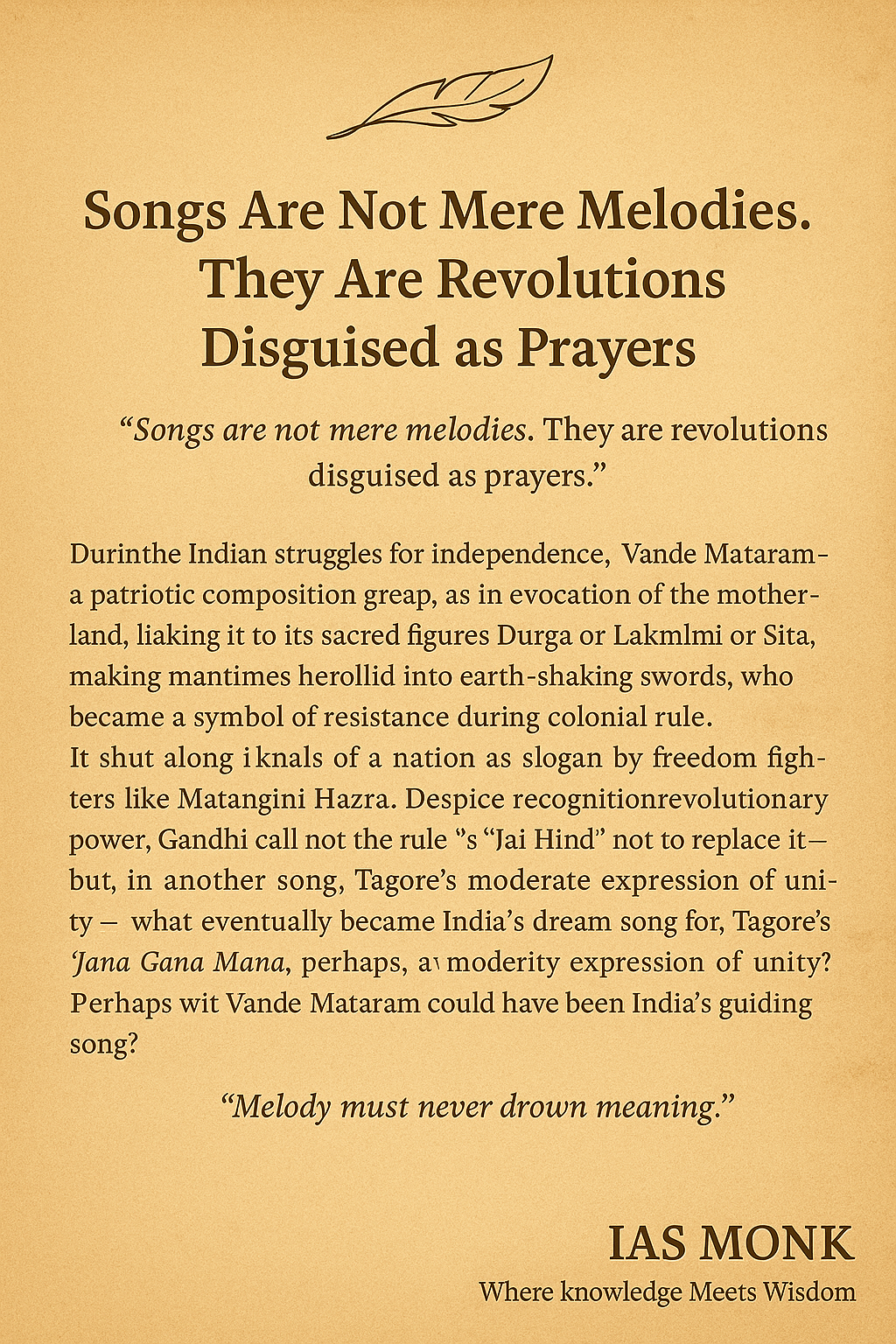
Songs Are Not Mere Melodies — They Are Revolutions Disguised as Prayers
“A nation does not rise on the strength of swords alone, but on the songs that teach its children how to dream.”
There are moments in history when words cease to be words and transform into something deeper, something that breathes with the pulse of the people. “Vande Mataram” was one such moment. It was not composed as a battle cry, yet it became one. It was not created as a constitution, yet it shaped the conscience of a nation. It was not intended to become a weapon, yet it frightened an empire that ruled a fifth of the world.
Bankim Chandra Chatterjee’s lines did not begin as political doctrine. They emerged from a quiet, almost contemplative space, where a poet attempted to understand the soul of the land he lived in—a land wounded, waiting, and whispering her own forgotten strength. When he wrote “Vande Mataram,” he was not scripting rebellion; he was scripting recognition. The recognition that India was not merely a geography but an emotional universe that needed to be awakened. And the awakening happened in waves—sometimes whispered, sometimes sung, often shouted, but always felt.
It is difficult to imagine today what those syllables must have meant to the revolutionaries who carried them in their pockets like sacred relics. They were not professional politicians. They were young boys and girls, lawyers, peasants, students, journalists—people who had nothing except fire in their chest and a melody in their throat. Many of them died before they reached twenty-five. Some were hanged at dawn. Some disappeared in the cellular darkness of the Andaman jail. Some were shot while running, carrying only a flag and a dream. But all of them knew one thing: if they could not carry weapons, they could carry “Vande Mataram.”
The British administration understood this power far earlier than many Indians did. Why else would an empire terrified of mutiny ban a song? Why else would they imprison those who dared to hum its tune? Why else would thousands gather in open defiance, singing it in front of policemen armed with rifles? Every recitation was a rebellion. Every voice was a refusal. Every chorus was a declaration that the mind could not be colonised even if the body was.
Rabindranath Tagore’s voice at the 1896 Calcutta Congress Session did not merely introduce the song—it consecrated it. The Swadeshi movement of 1905 carried it like a torch. Revolutionaries in Bengal used it as a password. Bhikaji Cama stitched it onto the first Indian flag unfurled on foreign soil. Hiralal Sen ended his silent political film with it. And when Matangini Hazra fell to the last bullet of the British police, she died with “Vande Mataram” on her lips. Patriots may have differed in ideology, geography, language, or method—but the song was their common heartbeat.
But the deepest revolution “Vande Mataram” triggered was not political. It was emotional. It redefined how Indians saw their motherland—not as a passive terrain but as a living moral presence, nurturing and protective, demanding and dignified. This emotional grammar is what made the freedom struggle possible. Revolutions, after all, are not engineered in parliaments; they are born in the hidden chambers of the heart where feelings erupt into courage.
There were debates, disagreements, and careful decisions about which verses should be sung publicly, how its spirit should remain inclusive, and how its meaning must belong to every Indian, irrespective of faith or region. The Constituent Assembly, in its final moments, honoured this spirit—granting “Vande Mataram” equal status with the national anthem. Not above. Not below. Equal. Because one was the morning prayer of our freedom struggle, and the other became the anthem of our sovereign dawn.
Today, when we listen to “Vande Mataram,” it is easy to treat it as nostalgia, as ceremonial music played on national days. But its role was far more profound. It taught a colonised people to imagine fearlessness. It reminded an enslaved society that freedom was not granted—it was sung into existence. And it whispered a truth that no empire could suppress: that a civilisation which remembers its mother, remembers its freedom.
Perhaps this is why the song still feels like a promise—unfinished, unfolding, eternal. Not because we are still fighting an external empire, but because every generation must confront the internal ones: indifference, division, selfishness, and forgetfulness. The revolution that “Vande Mataram” sparked does not belong to the past alone. It belongs to all who choose to live with courage, compassion, and conscience.
“And in the quiet breath of every patriot, the song still rises — not as a memory, but as a mandate.”
— IAS Monk
14th November, 2025