









🌑Knowledge Drop – 014: Reimagining Agriculture: Frontier Technologies for India’s Next Green Revolution | Prelims MCQs & High Quality Mains Essay
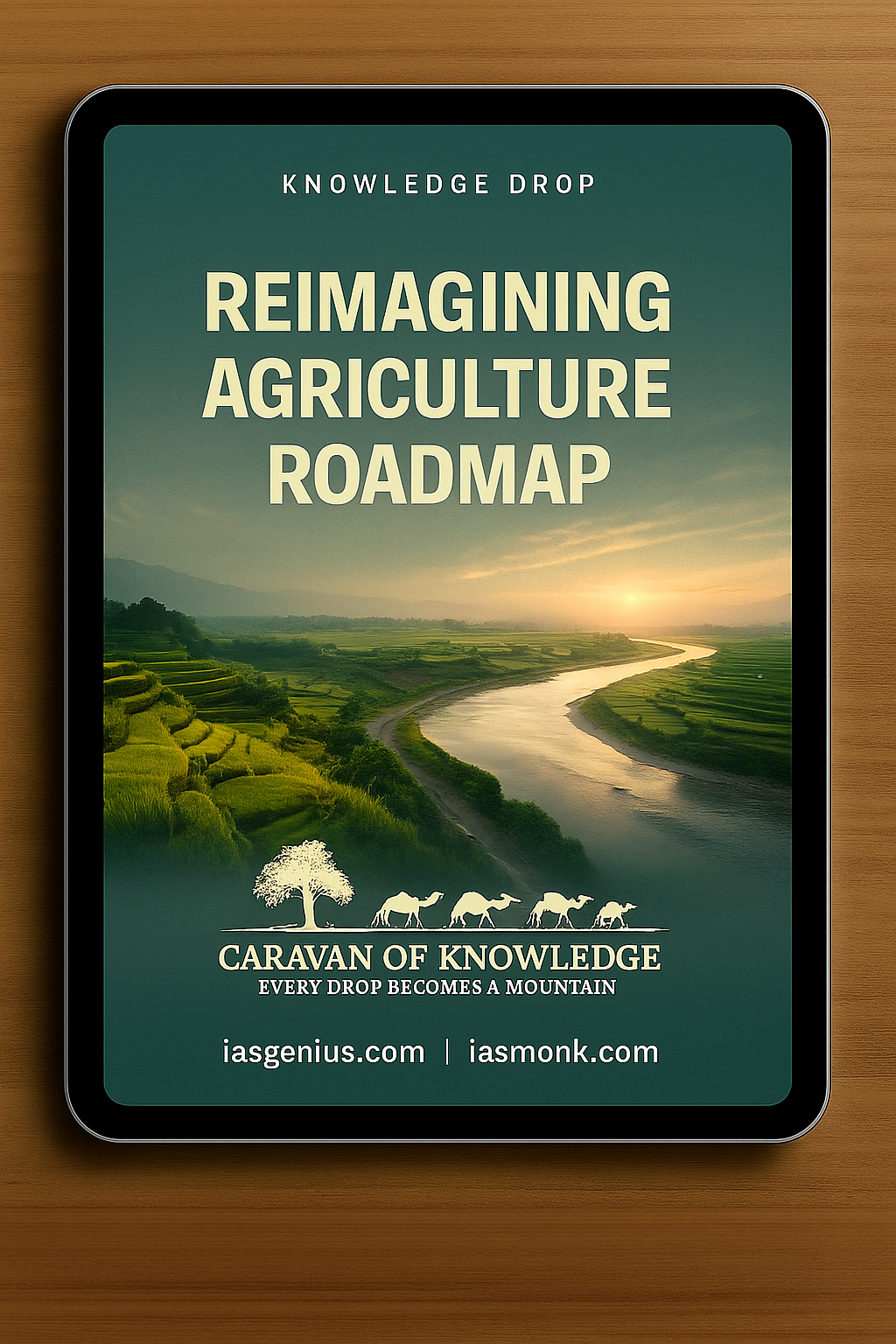
Knowledge Drop – 014: Reimagining Agriculture: Frontier Technologies for India’s Next Green Revolution
NATIONAL HERO — PETAL (Nov 12, 2025)
Syllabus: GS3 / Agriculture, Science & Tech
THEMATIC FOCUS
Frontier Tech in Agriculture • Digital Twins • AI & Precision Farming • Climate Resilience
INTRO WHISPER
🌾 “When the field becomes intelligent and the seed begins to think, a new revolution begins — not in the soil, but in the imagination of a nation.”
KEY HIGHLIGHTS
1. NITI Aayog’s Roadmap Unveiled
The Frontier Tech Hub of NITI Aayog has released a major blueprint:
“Reimagining Agriculture: A Roadmap for Frontier Technology Led Transformation.”
It aims to modernize India’s agriculture landscape through deep-tech, data, and climate-smart systems.
2. Frontier Technologies at the Core
The roadmap envisions integrating advanced technologies such as:
- Digital Twins for real-time crop modelling.
- AI/Agentic AI for predictive agriculture.
- Precision farming tools like variable-rate fertilization.
- Climate-resilient seeds for extreme weather adaptation.
- Advanced mechanisation suited for Indian farm sizes.
This marks a shift from traditional green revolution inputs to New-Age AgTech.
3. Farmer Segmentation — A First for India
Farmers are categorized into three groups:
- Aspiring Farmers – smallholders needing basic digital access, micro-irrigation, and crop advisories.
- Transitioning Farmers – mid-scale farmers who can adopt drones, IoT, soil sensors.
- Advanced Farmers – commercial producers ready for automation, digital twins, and robotics.
This ensures targeted interventions instead of uniform schemes.
4. Pilots to Scale: The Gujarat Model
The roadmap highlights early success cases:
- Gujarat’s Digital Crop Survey
- Farmer Registry systems
- i-Khedut Portal for tech access
- On-ground pilots in disease prediction, micro-irrigation scheduling, and precision spraying
The aim is to scale these models nationwide through PPPs.
5. Challenges in Adopting Frontier Tech
Despite potential, key barriers persist:
- Land fragmentation (86% small & marginal holdings).
- High cost and low RoI for small farmers.
- Data rights, privacy, cybersecurity concerns.
- State-centre coordination issues, as agriculture is a state subject.
India will need policy alignment + financial innovation for adoption.
6. Why Frontier Tech Matters
If implemented well, the roadmap can unlock:
- Higher yields with lower input usage.
- Reduction in post-harvest losses via predictive systems.
- Climate resilience for food system stability.
- Enhanced rural incomes and Agri-export competitiveness.
- Strong role in India’s Bioeconomy and Food Security Vision 2047.
GS PAPER MAPPING
- GS3 – Agriculture: Technology missions, crop productivity, mechanisation
- GS3 – Science & Tech: AI, Digital Twins, IoT, Data governance
- GS3 – Economy: Farmer incomes, agri-value chains, PPPs
- GS2 – Governance: State-centre coordination, data rights, digital governance
🌾IAS MONK WHISPER
“The seed does not ask for applause; it only asks for a chance.
Give the farmer a tool that can think — and he will rewrite the destiny of the land.”
Target IAS-26: Daily MCQs :
📌 Prelims Practice MCQs
Topic: Blue Cities Paradigm. SET-1
MCQ 1 TYPE 1 — How Many Statements Are Correct?
Consider the following statements:
(1) Digital Twins can simulate crop behaviour under different climate scenarios.
(2) Agentic AI enables autonomous decision-making support for farmers.
(3) Precision farming reduces the need for weather forecasts.
(4) Frontier technologies eliminate the need for state-level implementation.
How many of the above statements are correct?
A) Only two
B) Only three
C) All four
D) Only one
🌀 Didn’t get it? Click here (▸) for the Correct Answer & Explanation.
🟩 Correct Answer: A) Only two
🧠 Explanation:
(1) ✅ True – Digital twins are used to simulate crop performance under different conditions.
(2) ✅ True – Agentic AI can autonomously generate and refine advisories for farmers.
(3) ❌ False – Precision farming actually depends heavily on accurate, granular weather forecasts.
(4) ❌ False – State-level implementation is essential because agriculture is a state subject.
MCQ 2 TYPE 2 — Two-Statement Type
Consider the following statements:
(1) Precision agriculture minimizes input waste by applying water and nutrients only where required.
(2) Frontier tech adoption is easier for marginal farmers due to smaller field sizes.
Which of the above statements is/are correct?
A) Only 1 is correct
B) Only 2 is correct
C) Both are correct
D) Neither is correct
🌀 Didn’t get it? Click here (▸) for the Correct Answer & Explanation.
🟩 Correct Answer: A) Only 1 is correct
🧠 Explanation:
(1) ✅ True – Precision systems use sensors and AI to optimise input use.
(2) ❌ False – Adoption is harder for marginal farmers due to cost and scale issues.
MCQ 3 TYPE 3 — Code-Based Statement Selection
With reference to NITI Aayog’s “Frontier Technology” agriculture roadmap, consider the following:
(1) Gujarat’s i-Khedut platform is cited as an example of tech-enabled state service delivery.
(2) The roadmap includes farmer segmentation into Aspiring, Transitioning, and Advanced categories.
(3) Frontier tech aims to replace traditional knowledge systems entirely.
Which of the above statements is/are correct?
A) 1 and 2 only
B) 2 and 3 only
C) 1 and 3 only
D) 1, 2 and 3
🌀 Didn’t get it? Click here (▸) for the Correct Answer & Explanation.
🟩 Correct Answer: A) 1 and 2 only
🧠 Explanation:
(1) ✅ True – Gujarat is highlighted for its digital crop survey and portals.
(2) ✅ True – Segmentation is a core element of the roadmap.
(3) ❌ False – Frontier tech complements, not replaces, traditional knowledge.
MCQ 4 TYPE 4 — Direct Factual Question
Which of the following best describes “Digital Twins” in agriculture?
A) A satellite-based soil moisture measurement device
B) A blockchain-based supply chain authentication tool
C) A virtual replica of a farm used for predictive modelling
D) A sensor that converts analog crop data into digital signals
🌀 Didn’t get it? Click here (▸) for the Correct Answer & Explanation.
🟩 Correct Answer: C) Uranium-233
🧠 Explanation:
🟩 Correct Answer: C) A virtual replica of a farm used for predictive modelling
🧠 Explanation:
Digital twins mirror real farm conditions and simulate outcomes for better decisions.
MCQ 5 TYPE 5 — UPSC 2025 Linkage Reasoning Format (I, II, III)
Consider the following statements:
Statement I:
Frontier technologies help farmers reduce crop losses and adapt better to climate variability.
Statement II:
AI-based systems and digital twins provide predictive insights that improve risk management in agriculture.
Statement III:
Frontier technologies eliminate the need for weather-based advisories for farmers.
Which one of the following is correct in respect of the above statements?
(a) Both Statement II and Statement III are correct and both of them explain Statement I
(b) Both Statement II and Statement III are correct but only one of them explains Statement I
(c) Only one of the Statements II and III is correct and that explains Statement I
(d) Neither Statement II nor Statement III is correct
🌀 Didn’t get it? Click here (▸) for the Correct Answer & Explanation.
🟩 Correct Answer: (c)
🧠 Explanation:
Statement II: ✅ True – Predictive models strengthen climate risk management.
Statement III: ❌ False – Weather advisories remain essential even with frontier tech.
High Quality Mains Essay For Practice :
Word Limit 1000-1200
Reimagining Indian Agriculture: Frontier Technologies and the Next Transformation
Agriculture in India has always been more than an economic activity; it is a civilisation, a culture, a rhythm that has sustained the country for thousands of years. The Green Revolution of the 1960s was a turning point that lifted India out of chronic food shortages. Yet, as the decades rolled on, it became increasingly clear that the gains of that revolution were nearing saturation and that the challenges of the twenty-first century — climate volatility, soil degradation, fragmented landholdings, input inefficiencies, and fluctuating global markets — demanded a new paradigm of transformation. It is against this backdrop that NITI Aayog’s Frontier Tech Hub unveiled the landmark blueprint, “Reimagining Agriculture: A Roadmap for Frontier Technology Led Transformation.” This is not merely a technological document but a vision statement for the future of Indian food systems, structured around the promise and power of frontier technologies.
The central idea of the roadmap is straightforward yet revolutionary: agriculture must evolve from an input-driven system to an intelligence-driven system. This means that decisions about sowing, irrigation, nutrient management, pest control, market timing, insurance payouts, and risk mitigation must be informed by data, algorithms, sensors, and predictive intelligence rather than intuition alone. Frontier technologies such as climate-resilient seeds, digital twins, precision agriculture, satellite analytics, and AI — including the new wave of agentic AI — provide the backbone of this transformation. The roadmap emphasises that without integrating these technologies into the fields of both small and large farmers, India cannot achieve sustainable yields, resilient food systems, or long-term rural prosperity.
One of the most innovative features of the document is the categorisation of farmers into three distinct segments: Aspiring, Transitioning, and Advanced. Aspiring farmers are smallholders who require foundational digital access, affordable advisory systems, and basic mechanisation tools. Transitioning farmers are those with the capacity to use IoT devices, sensors, micro-irrigation controllers, and drones. Advanced farmers, including commercial cultivators, can adopt high-end automation, robotics, digital twin modelling, and agentic AI systems to run farms with industrial precision. This segmentation ensures that technology reaches each farmer in a form suited to their reality, instead of the traditional one-size-fits-all model that often leaves the most vulnerable behind.
The roadmap places strong emphasis on “pilots-to-scale,” highlighting Gujarat as a successful example. Gujarat’s digital crop surveys, farmer authentication systems, and the i-Khedut platform have demonstrated how digital-first state ecosystems can transform agricultural service delivery. High-impact use cases such as variable-rate fertilizer application, crop disease prediction, micro-irrigation scheduling, and drone-based nutrient management, tested in pockets across states, are now positioned for national scaling. The blueprint argues that only through a combination of state-led initiatives, public–private partnerships, and large-scale capacity building can frontier technologies reach India’s millions of farms.
Yet, technology alone cannot solve the structural bottlenecks that have long constrained Indian agriculture. The most significant among them is land fragmentation. With more than eighty-six percent of Indian farmers owning less than two hectares, precision agriculture tools often face limitations of scale. The cost of frontier technologies — from sensors to satellite analytics — poses affordability challenges. Financial innovations in the form of tech-based Kisan Credit Cards, service-based rental models, community technology pools, and subsidised digital infrastructure will be essential. The roadmap also acknowledges a growing concern around data rights and privacy. As agriculture becomes more digital, farmer data becomes the new oil of the rural economy. Clear regulatory frameworks for data governance, cybersecurity, and consent-based data sharing are integral to ensuring that the benefits of technology do not come at the cost of the farmer’s autonomy.
Another challenge lies in the governance architecture. Agriculture remains a state subject, and the adoption of frontier tech requires alignment between the Union government’s vision and the states’ administrative, financial, and technological capacities. Some states have advanced digital ecosystems, while others require foundational digital infrastructure before they can adopt high-impact frontier technologies. Capacity building, skilling, cooperative federalism, and multi-state platforms will therefore be essential components of this transformation.
Despite these hurdles, the potential benefits of frontier technologies are immense. Precision agriculture can reduce input waste dramatically, ensuring that fertilizers, pesticides, and water are used exactly when and where required. AI-based disease prediction systems can prevent crop failures and reduce losses. Satellite-based crop monitoring can streamline insurance payouts and reduce disputes. Climate-resilient seeds combined with real-time weather modelling can help farmers mitigate extreme weather events. Automation and mechanisation can reduce labour shortages, particularly in states witnessing rural–urban migration. Digital twins — virtual replicas of farms — can simulate planting, irrigation, and harvesting scenarios, giving farmers predictive control over their fields. The introduction of frontier tech into livestock, fisheries, and horticulture can also exponentially expand the national agri-value chain.
The roadmap connects directly to India’s larger bioeconomy and export ambitions. Advanced agricultural technologies can unlock value-added agri-products, boost India’s presence in global food markets, and ensure that Indian produce meets international standards consistently. Frontier tech also strengthens India’s climate resilience — a critical requirement in an era where agricultural risk has increased due to erratic monsoons, prolonged droughts, sudden floods, and shifting agro-climatic zones.
As India moves toward Amrit Kaal, the transformation of agriculture will define the stability of the rural economy, the prosperity of farmers, and the resilience of the national food system. Frontier technologies do not replace the farmer; they empower the farmer. They do not diminish the wisdom of traditional practices; they complement them with predictive intelligence. They do not erase age-old knowledge; they elevate it.
The future of Indian agriculture will be built on a fusion of tradition and technology — the instincts of the farmer merged with the insights of algorithms; the memory of the soil joined with the precision of sensors; the power of sunlight captured through photosynthesis enhanced by digital models that guide every decision from seed to harvest.
If implemented with care, inclusiveness, and clarity, the roadmap can unlock the next green revolution — one that is not merely about more production, but smarter, sustainable, climate-secure, and farmer-centric production. It can redefine rural livelihoods, reduce environmental stress, and position India as a global leader in agri-tech innovation.
In this transformation, every farmer becomes a knowledge worker; every field becomes an intelligent ecosystem; and every harvest becomes a triumph of both nature and innovation. The journey ahead is challenging, but the roadmap shows that the nation is ready — ready to reimagine agriculture, ready to adopt frontier technologies, and ready to build a future where the prosperity of the land is matched only by the empowerment of those who cultivate it.