





🧭June 8, 2025 Post 3: 📘 Leadership, Literacy & the Gender Mirror: UNESCO Global Education Monitoring Report 2024–25 | High Quality Mains Essay | Prelims MCQs
📘 Leadership, Literacy & the Gender Mirror: UNESCO Global Education Monitoring Report 2024–25
INTERNATIONAL
🗓️ Post Date: June 8, 2025
📚 Thematic Focus: GS2 / Education | Gender | Governance | International Reports
🪶 Opening Whisper:
When girls rise in reading and fall in math, and women teach without leading — the education mirror reflects our unspoken biases.
🔍 Key Highlights
📚 Global Gender Disparity in Learning Outcomes
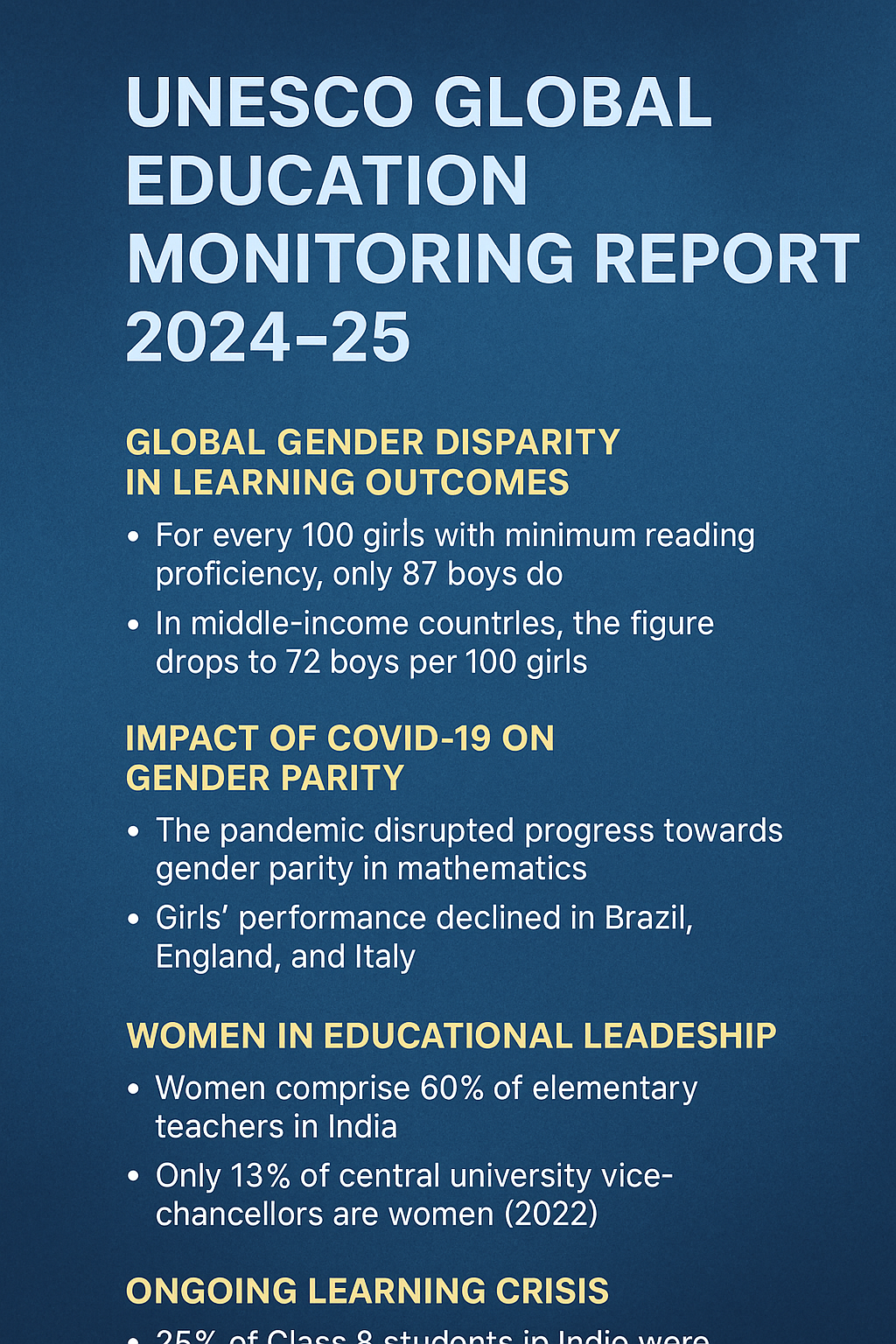
- For every 100 girls who achieve minimum reading proficiency, only 87 boys do.
- In middle-income countries, this drops to just 72 boys per 100 girls.
- This gap reveals a global pattern of gender-based literacy divergence, with boys struggling more in reading across nations.
🦠 Impact of COVID-19 on Learning Equity
- The pandemic reversed progress in mathematics gender parity.
- In Brazil, England, and Italy, girls’ performance in math has declined.
- Indicates a long-term equity crisis aggravated by global disruptions.
👩🏫 Women in Educational Leadership
- In India, women form 60% of elementary teachers, but only 13% of vice-chancellors in central universities (2022).
- Reflects deep-rooted institutional bias in higher education leadership.
- Lack of formal training for school principals in most Indian states further undermines upward mobility for women.
📊 Research Insights
🟢 Female Leadership Correlates with Better Learning
- In some African nations, schools led by women delivered 1 full year of additional learning.
- Research indicates female-led schools may foster more inclusive and result-oriented environments.
🏫 Role of Decentralised Leadership
- The Delhi pilot programme in decentralised leadership showed promise:
• Improved trust among teachers
• Boosted collaboration and performance
• Mentorship-led models created sustained learning improvements
🔺 The Indian Learning Crisis
- Despite rising enrolments, only 25% of Class 8 students in India showed math proficiency in NAS 2021.
- Indicates that access is not translating to achievement.
- Points to the need for pedagogical reform and outcome-based metrics.
🔁 Future Directions from the Report
- Institutionalised leadership training for school heads
- Targeted programmes to increase women in senior education roles
- Strengthening accountability, data collection, and learning assessments
- Implementation of NEP 2020 leadership pipelines
🧭 GS Mains Mapping
Paper: GS Paper 2
Topics Covered:
- Education and Human Resources
- Gender and Social Empowerment
- Government Policies and International Reports
- NEP 2020 Implementation
- Institutional Governance and Leadership
💭 A Thought Spark — by IAS Monk
“When women lead in classrooms but are absent in boardrooms, the lesson remains half-taught.”
True learning is not just about literacy—it is about leadership, voice, and the power to shape futures.
High Quality Mains Essay For Practice :
Word Limit 1000-1200
Leadership, Literacy, and Learning Gaps: A Critical Look at the UNESCO Global Education Monitoring Report 2024–25
Introduction
Education is both a reflection and a driver of social progress. It holds the power to equalize opportunity, foster equity, and catalyze empowerment. Yet, the UNESCO Global Education Monitoring (GEM) Report 2024–25 reveals a sobering reality: while access to schooling has improved globally, learning outcomes remain alarmingly unequal, especially along gender lines. The report highlights paradoxes—boys lagging in literacy, girls declining in numeracy, and women occupying classrooms but not boardrooms.
In this essay, we analyze the key findings of the GEM report, with a focus on gendered disparities in education, the lingering effects of the COVID-19 pandemic, the state of educational leadership, and what these trends imply for India’s educational future and the global sustainable development agenda.
Gender Gaps in Learning: Literacy and Numeracy in Divergence
One of the most striking findings of the report is the global lag in boys’ reading proficiency. For every 100 girls achieving minimum literacy, only 87 boys do so—an imbalance that is more pronounced in middle-income countries, where the ratio plummets to 72 boys per 100 girls.
This reversal of traditional gender patterns in education raises serious concerns:
- The historical underachievement of girls in education has prompted targeted interventions.
- In contrast, boys’ struggles in literacy have received comparatively little policy attention.
- Factors contributing to this include a lack of male role models in early education, gendered expectations around reading, and less engagement with foundational language learning.
On the other hand, the report notes a decline in girls’ performance in mathematics, especially in post-COVID settings. Nations like Brazil, England, and Italy reported significant drops in girls’ math scores. This suggests that gender parity in STEM (Science, Technology, Engineering, and Math) remains fragile and vulnerable to disruption.
Impact of COVID-19: A Hidden Gender Pandemic in Education
The COVID-19 pandemic was not just a public health crisis—it was a global educational shockwave. The GEM report outlines how school closures disproportionately affected girls, particularly in:
- Access to digital learning platforms
- Loss of structured classroom engagement
- Increased domestic responsibilities
Yet, while much attention was paid to girls dropping out of school, the learning loss among boys and girls within schools was under-studied. The reversal in math performance among girls after the pandemic underscores the need for gender-sensitive recovery policies.
In India, these global patterns are mirrored by regional disparities:
- Girls in rural and tribal regions suffered greater digital exclusion.
- Boys faced literacy setbacks due to lack of remedial support in foundational learning.
Women in Education: Teaching Without Leading
A major theme of the report is the glass ceiling in educational leadership. In India:
- Women form 60% of the elementary teaching workforce, yet
- Only 13% of vice-chancellors in central universities were women (2022).
This vast gap reflects entrenched patriarchy and lack of institutional pathways for women to transition from teaching roles to leadership positions. The phenomenon has been called “vertical segregation”, where women are over-represented in base-level positions but excluded from decision-making.
The issue is not one of capacity, but of structural bias:
- Lack of leadership training in many Indian states despite the National Education Policy 2020 (NEP) advocating it
- Limited representation in school management committees, governing boards, and academic councils
- Disproportionate burden of unpaid care work which hinders career progression
Leadership Matters: Women as Catalysts of Learning
The report draws a powerful correlation between female leadership and positive learning outcomes:
- In several African nations, schools headed by women exhibited up to one additional year of learning gain.
- Female leaders tend to adopt inclusive leadership styles, focusing on collaboration, mentoring, and equity-driven reforms.
In India too, anecdotal evidence suggests that:
- Women school principals are more likely to emphasize teacher training, student welfare, and community engagement.
- Leadership models that include mentorship and distributed decision-making improve both teacher morale and student performance.
This makes a strong case for:
- Institutionalizing gender representation in educational governance
- Investing in capacity-building programmes for aspiring female leaders
The Role of Decentralised and Distributed Leadership
The report acknowledges the significance of decentralised leadership models, citing Delhi’s pilot programme as a successful case study. The programme focused on:
- Empowering school heads to lead pedagogical improvements
- Establishing peer mentoring systems among teachers
- Ensuring accountability through data-driven evaluation
This model led to:
- Greater trust between teachers and administration
- Improved student learning metrics, particularly in government schools
It highlights the shift from command-based leadership to collaborative school culture, a direction in line with NEP 2020’s vision of School Complexes and Leadership Training Institutions.
India’s Learning Crisis: Beyond Enrolment
Despite policy reforms and rising enrolments, India continues to face a foundational learning crisis:
- According to the National Achievement Survey (NAS) 2021, only 25% of Class 8 students demonstrated mathematics proficiency.
- While gender enrolment ratios are improving, actual gender-equitable learning outcomes remain elusive.
Key challenges include:
- Outdated rote-based pedagogy
- Poor teacher-student ratio in rural areas
- Inadequate continuous professional development for teachers and principals
The GEM report suggests that without focusing on quality, infrastructure investments alone will not suffice. The future lies in measurable learning improvement and accountable leadership systems.
Recommendations from the Report: Pathways for Reform
The UNESCO GEM Report 2024–25 offers concrete policy prescriptions:
- Institutionalize leadership training as part of teacher career pathways
- Ensure representation of women in all educational governance bodies
- Promote gender-sensitive curricula and assessments
- Invest in data systems to track learning outcomes disaggregated by gender
- Encourage male engagement in early childhood education, addressing gender gaps in foundational literacy
- Integrate NEP 2020 mandates with state-level action plans, particularly in leadership and equity
India’s Policy Response and the NEP 2020 Context
The National Education Policy 2020 lays the groundwork for many of these reforms:
- It calls for establishing National Professional Standards for School Leadership
- Encourages gender parity at all levels of education
- Introduces the idea of School Complexes to strengthen collaboration and resource sharing
The challenge is in translating these frameworks into tangible, budgeted, and state-supported action.
Conclusion
The UNESCO GEM Report 2024–25 serves as a mirror—and a mandate. It shows us not just where we stand, but where we fail to lead. It forces us to ask difficult questions: Why are boys falling behind in literacy? Why are girls losing ground in math? Why do women stop at the classroom door and not enter the conference room?
India’s future depends on its ability to go beyond enrolment, and deliver meaningful, measurable, and inclusive learning—backed by empathetic, empowered leadership, especially from women. Because education without equity is an illusion, and leadership without diversity is a lost opportunity.
Quote to End With:
“We can teach a child to read, but unless we teach a system to listen—true education will remain incomplete.”
Target IAS-26: Daily MCQs :
📌 Prelims Practice MCQs
Topic: UNESCO Global Education Monitoring Report 2024–25
MCQ 1 – Type 1: How many of the above statements are correct?
Consider the following statements regarding the UNESCO Global Education Monitoring Report 2024–25:
1. The report shows that boys outperform girls in reading proficiency across low-income countries.
2. COVID-19 disrupted gender parity in mathematics, especially affecting girls’ performance in multiple countries.
3. Women constitute 60% of elementary teachers in India but hold a small share of top leadership roles.
4. Schools led by female principals have been linked with improved learning outcomes in certain regions.
How many of the above statements are correct?
A) Only two
B) Only three
C) All four
D) Only one
🌀 Didn’t get it? Click here (▸) for the Correct Answer & Explanation
✅ Correct Answer: B) Only three
🧠 Explanation:
1) ❌ False – Girls outperform boys in reading; boys are falling behind.
2) ✅ True – The pandemic worsened gender parity in math for girls.
3) ✅ True – Women make up 60% of teachers but only 13% of vice-chancellors in India.
4) ✅ True – Female-led schools have shown better learning gains in some countries.
MCQ 2 – Type 2: Two Statements Based
Consider the following two statements:
1. India’s National Achievement Survey 2021 revealed that only one-fourth of Class 8 students demonstrated math proficiency.
2. The National Education Policy 2020 explicitly prohibits women from holding university leadership roles.
Which of the above statements is/are correct?
A) Only 1 is correct
B) Only 2 is correct
C) Both are correct
D) Neither is correct
🌀 Didn’t get it? Click here (▸) for the Correct Answer & Explanation
✅ Correct Answer: A) Only 1 is correct
🧠 Explanation:
✅ True – NAS 2021 showed only 25% math proficiency at Class 8 level.
❌ False – NEP 2020 encourages inclusive leadership; it does not prohibit women’s leadership.
MCQ 3 – Type 3: Which of the statements is/are correct?
Which of the following statements are correct regarding leadership in education, as per the UNESCO Report?
1. Formal training for school principals is lacking in many Indian states.
2. Decentralised leadership in Delhi schools improved teacher trust and collaboration.
3. NEP 2020 does not address educational leadership or school complexes.
4. Mentorship-driven leadership models have shown positive results globally.
Select the correct code:
A) 1, 2 and 3 only
B) 1, 2 and 4 only
C) 2, 3 and 4 only
D) 1, 3 and 4 only
🌀 Didn’t get it? Click here (▸) for the Correct Answer & Explanation
✅ Correct Answer: B) 1, 2 and 4 only
🧠 Explanation:
1) ✅ True – Most states lack formal leadership training.
2) ✅ True – Delhi’s decentralised pilot built trust and collaboration.
3) ❌ False – NEP 2020 highlights both leadership and school complexes.
4) ✅ True – Mentorship and distributed leadership improve outcomes.
MCQ 4 – Type 4: Direct Fact
According to the UNESCO GEM Report 2024–25, how many boys per 100 girls achieve minimum reading proficiency in middle-income countries?
A) 87 boys
B) 100 boys
C) 72 boys
D) 60 boys
🌀 Didn’t get it? Click here (▸) for the Correct Answer & Explanation.
✅ Correct Answer: C) 72 boys
🧠 Explanation:
•In middle-income nations, only 72 boys per 100 girls achieve minimum reading proficiency, revealing a growing gender disparity in literacy.