











007. ChaSTE – Probing the Moon’s Thermal Secrets 🧪
Science & Technology, GS3, Space, ISRO, Moon South Pole
By IAS Monk / April 4, 2025
🔍 Mission Highlights
Mission: Chandrayaan-3 — First soft landing on the Moon’s South Pole (23 August 2023)
Instrument: Chandra’s Surface Thermophysical Experiment (ChaSTE)
Purpose: To capture vertical temperature profile of the Moon’s upper regolith and assess thermal conductivity
🔧 ChaSTE’s Tech Design
| Component | Function & Detail |
|---|---|
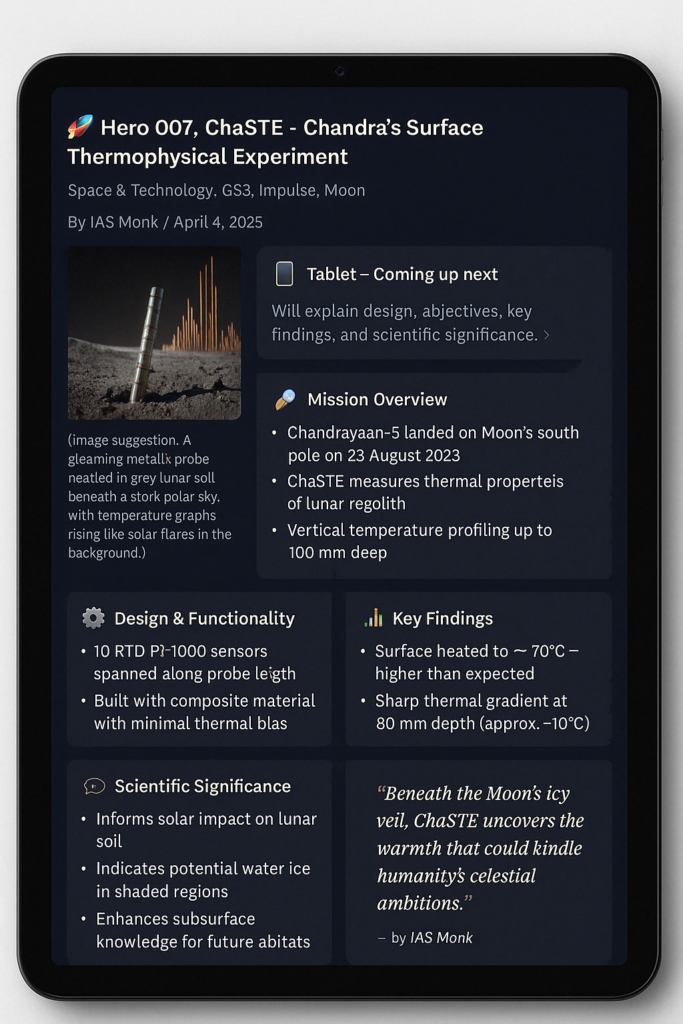
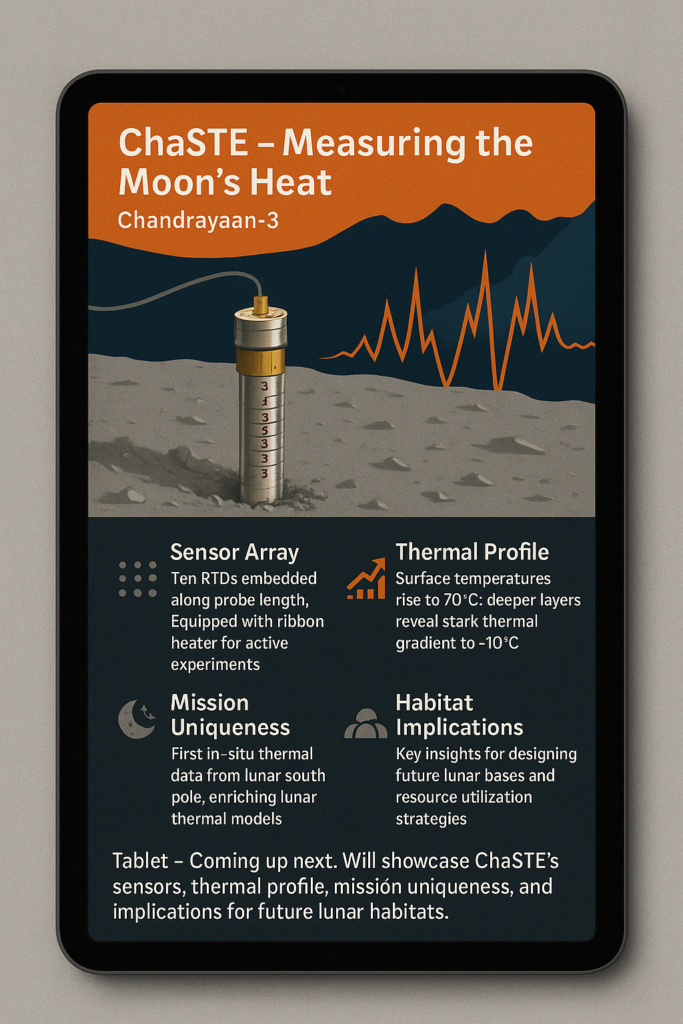
| RTD Pt-1000 Sensors | 10 temperature detectors embedded along a vertical probe |
| Ribbon Heater | Near tip, enables active heat diffusion testing |
| Probe Material | Composite design to reduce self-heating interference |
Deployment: Inserted into lunar regolith by Vikram lander
Depth Achieved: 140 mm
Data Frequency: 1 reading every second for ~14 Earth days
🌡️ Key Findings
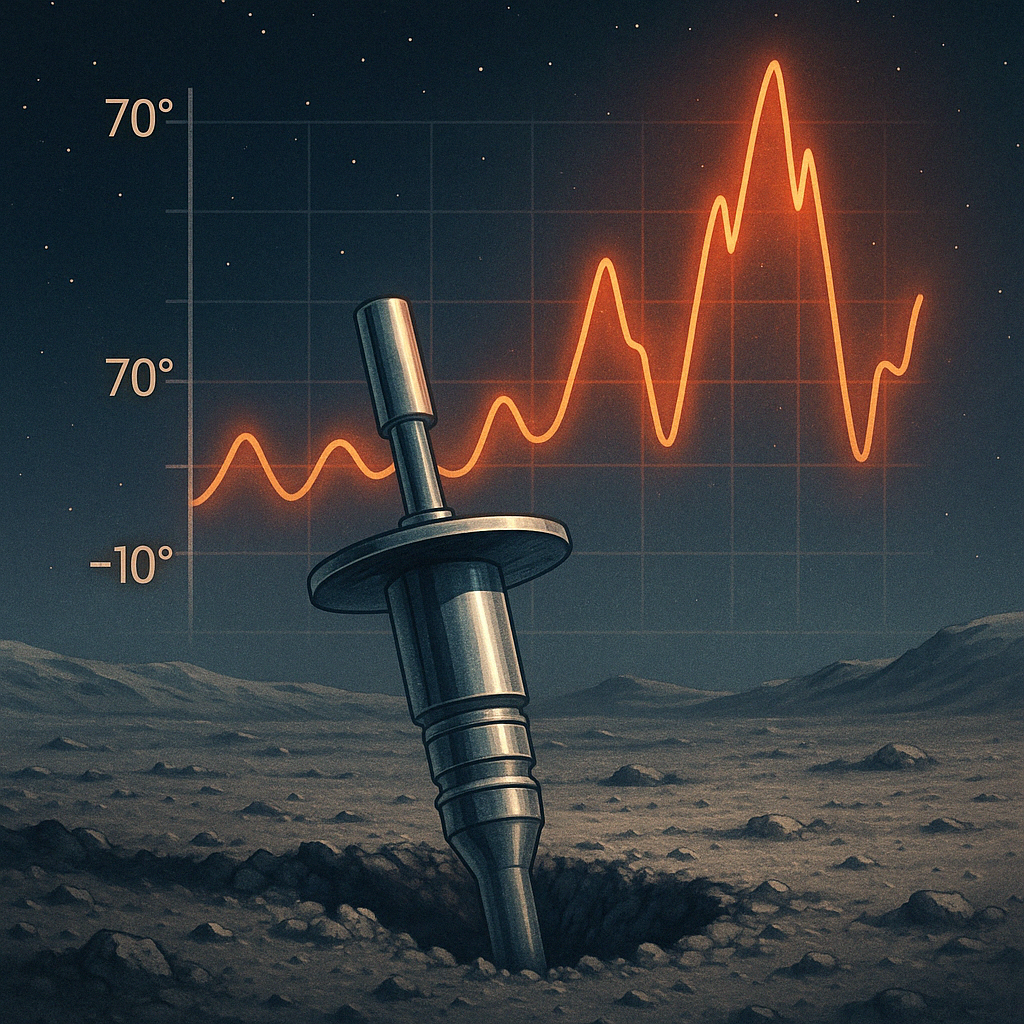
- Surface Temp: Peaked at ~70°C during lunar day
- Subsurface Temp: Dropped to ~–10°C at 80 mm
- Implication: Steep gradient confirms insulating nature of lunar dust and shadowed cold traps
🚀 Why This Matters
- Confirms unique thermal dynamics of the Moon’s polar regions
- Helps plan future lunar infrastructure like human habitats & storage zones
- Critical to locating preserved volatiles like water ice in polar regolith
- ChaSTE succeeded where ESA’s Philae and NASA’s InSight faced mission failures — showcasing Indian engineering ingenuity
🧠 Scientific Firsts
- First in-situ vertical temperature profile from lunar south pole
- Contrasts with equatorial thermal models from previous Apollo & Luna missions
- Lays foundation for long-duration stays and resource extraction models
✨ Closing Whisper
“In the silence of the south pole dust, a metal tongue dipped gently into the Moon’s breath—measuring warmth, secrets, and ancient light.”
🔥 A Thought Spark – by IAS Monk
We touch the Moon not just to conquer it,
but to listen—where the cold is deepest and the silence is kindest.