

🧠 Knowledge Drop-119 | DAY NRLM: Next Phase of Rural Women’s Empowerment | IAS Prelims 2026-27 Highly Expected MCQs | Current Affairs & GS Essays on iasmonk.com
Post Date: 10-Feb-2026
🧭 Knowledge Drop-119
DAY NRLM: Next Phase of Rural Women’s Empowerment
Syllabus: GS2 | Government Policy & Intervention
Context
The Deendayal Antyodaya Yojana–National Rural Livelihoods Mission (DAY NRLM) is entering a new phase, often referred to as NRLM 2.0, as it prepares for the next five-year cycle from 2026–27 to 2030–31. This transition comes after more than a decade of large-scale community mobilisation and financial inclusion led by rural women’s institutions.
What is DAY NRLM?
DAY NRLM is a flagship poverty alleviation and women empowerment programme launched in 2011 by the Ministry of Rural Development. It aims to reduce rural poverty by enabling poor households, especially women, to access sustainable livelihoods through strong, community-based institutions.
Core Objective
The central goal of DAY NRLM is to organise rural poor women into Self-Help Groups (SHGs) and build their capacities so that they can:
- Access affordable credit,
- Start and expand livelihood activities,
- Improve household incomes and social status, and
- Participate actively in local governance and decision-making.
Institutional Architecture
DAY NRLM operates through a three-tier community structure:
- Self-Help Groups (SHGs): Small groups of 10–20 women promoting savings, internal lending, and collective action.
- Village Organisations (VOs): Federations of SHGs at the village level that coordinate activities, resolve issues, and implement programmes.
- Cluster-Level Federations (CLFs): Sub-block level, formally registered bodies that anchor livelihoods, financial services, social action, and convergence with government schemes.
Scale and Reach
DAY NRLM has achieved an unprecedented scale in rural India:
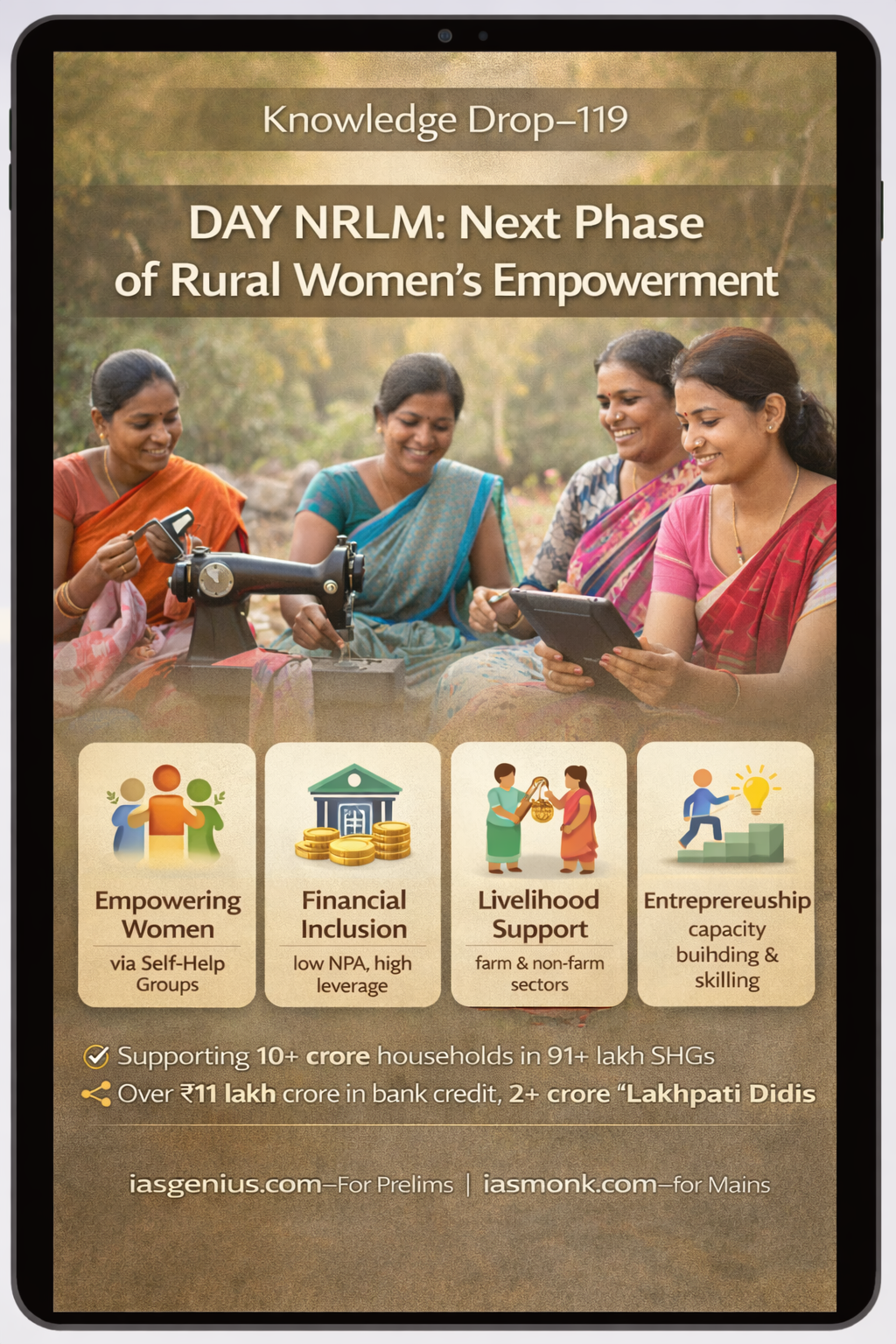
- Nearly 10 crore rural households mobilised into about 91 lakh SHGs.
- These are federated into 5.35 lakh Village Organisations and 33,558 Cluster-Level Federations.
- SHGs have leveraged over ₹11 lakh crore in bank credit, with a low NPA of around 1.7%.
- The number of ‘Lakhpati Didis’ (women earning over ₹1 lakh annually) has crossed two crore, reflecting tangible income gains.
Why DAY NRLM Matters
1. Political and Social Empowerment
Several States now route Direct Benefit Transfers (DBTs) directly to women, such as Ladli Laxmi (Madhya Pradesh), Maiya Samman (Jharkhand), Ladki Bahin (Maharashtra), and the recent ₹10,000 transfer to over one crore women in Bihar. This reflects growing policy trust in women’s collectives.
2. Financial Inclusion
Through SHG–Bank linkage, revolving funds, and community investment funds, DAY NRLM has mainstreamed rural women into formal finance.
3. Livelihood Promotion
The mission supports farm and non-farm enterprises across sectors such as livestock, fisheries, food processing, services, and rural enterprises.
4. Skill Development and Entrepreneurship
Capacity building, entrepreneurship training, and business planning have helped women shift from subsistence activities to income-generating enterprises.
5. Social Empowerment and Convergence
The programme promotes leadership, gender equity, health, nutrition, and education, while converging with schemes in agriculture, animal husbandry, food processing, and social protection. Successful models like Kudumbashree (Kerala) and Jeevika (Bihar) offer replicable lessons nationwide.
Looking Ahead: The Next Phase (2026–31)
DAY NRLM represents a community-led development model that has:
- Shifted rural households from subsistence to entrepreneurship,
- Strengthened grassroots democracy,
- Built financially credible community institutions, and
- Enabled large-scale DBT delivery through women’s collectives.
As the programme enters its next appraisal cycle, the focus is expected to move towards:
- Stronger and more autonomous CLFs,
- Higher-order entrepreneurship and access to scale-up finance,
- Better market access and branding for SHG products, and
- Deeper institutional convergence with professional support systems.
The Road Ahead: Beyond Debt
While credit has been central to NRLM’s success, the next phase must explore equity, venture capital, and blended finance models, potentially through partnerships with SIDBI, NBFCs, neo-banks, and other financial institutions. This shift is essential to support enterprise scaling and long-term sustainability.
Conclusion
DAY NRLM stands as one of the largest women-led development initiatives in the world. Its next phase offers an opportunity to move from financial inclusion to enterprise-driven, market-linked, and institutionally strong rural women’s economies, capable of redefining rural livelihoods in India.
Target IAS-2026+: Highly Expected Prelims MCQs :
📌 Prelims Practice MCQs
Topic: DAY NRLM: Next Phase of Rural Women’s Empowerment
MCQ 1 | TYPE 1 — How Many Statements Are Correct?
Consider the following statements regarding DAY NRLM:
1)It was launched in 2011 by the Ministry of Rural Development.
2)It is a constitutional body established under Article 280.
3)Its primary focus is organising rural poor women into Self-Help Groups.
4)It aims to provide sustainable livelihoods through community institutions.
How many of the above statements are correct?
A)Only two
B)Only three
C)All four
D)Only one
🌀 Didn’t get it? Click here (▸) for the Correct Answer & Explanation.
🟩 Correct Answer: B) Only three
🧠 Explanation:
Correct Answer: B) Only three
1)✅ True – DAY NRLM was launched in 2011 by the Ministry of Rural Development.
2)❌ False – The Finance Commission, not NRLM, is established under Article 280.
3)✅ True – Organising women into SHGs is the core strategy of NRLM.
4)✅ True – The mission focuses on sustainable livelihoods via community institutions.
MCQ 2 | TYPE 2 — Two-Statement Type
Consider the following statements:
Statement 1: DAY NRLM operates through a three-tier institutional structure of SHGs, VOs and CLFs.
Statement 2: Cluster-Level Federations (CLFs) function at the district level and replace Panchayats in governance.
Which one of the following is correct?
A)Only Statement 1 is correct
B)Only Statement 2 is correct
C)Both statements are correct
D)Neither statement is correct
🌀 Didn’t get it? Click here (▸) for the Correct Answer & Explanation.
🟩 Correct Answer: A) Only 1 is correct
🧠 Explanation:
Correct Answer: A) Only Statement 1 is correct
1)✅ True – The three-tier structure consists of SHGs, VOs and CLFs.
2)❌ False – CLFs operate at the sub-block/cluster level and do not replace Panchayats.
MCQ 3 | TYPE 3 — Code-Based Statement Selection
Consider the following statements regarding the scale of DAY NRLM:
1)Nearly 10 crore rural households have been mobilised into SHGs.
2)SHGs under NRLM have leveraged more than ₹11 lakh crore in bank credit.
3)The NPA of SHG bank linkage is around 10%, indicating high financial stress.
4)The number of ‘Lakhpati Didis’ has crossed two crore.
Which of the statements given above are correct?
A)1,2 and 4 only
B)1 and 3 only
C)2 and 3 only
D)1,2,3 and 4
🌀 Didn’t get it? Click here (▸) for the Correct Answer & Explanation.
🟩 Correct Answer: A)1,2 and 4 only
🧠 Explanation:
Correct Answer: A) 1,2 and 4 only
1)✅ True – Nearly 10 crore households have been mobilised.
2)✅ True – Credit leverage has crossed ₹11 lakh crore.
3)❌ False – NPA is low, around 1.7%, not 10%.
4)✅ True – ‘Lakhpati Didis’ have crossed two crore.
MCQ 4 | TYPE 4 — Direct Factual Question
Which of the following best describes the primary objective of DAY NRLM?
A)Providing universal basic income to rural households
B)Organising rural poor women into SHGs for sustainable livelihoods
C)Replacing Panchayati Raj Institutions with community federations
D)Directly funding private rural enterprises
🌀 Didn’t get it? Click here (▸) for the Correct Answer & Explanation.
🟩 Correct Answer: B)
🧠 Explanation:
Correct Answer: B) Organising rural poor women into SHGs for sustainable livelihoods
The core objective of DAY NRLM is to organise rural poor women into SHGs and build their capacities for sustainable livelihoods, financial inclusion and social empowerment.
MCQ 5 | TYPE 5 — UPSC 2025 Linkage Reasoning Format (I, II, III)
Consider the following statements:
Statement I: DAY NRLM is considered a community-led development model transforming rural livelihoods in India.
Statement II: It has built large-scale, financially credible women’s institutions through SHGs, VOs and CLFs.
Statement III: It has shifted rural households from subsistence activities towards entrepreneurship and market linkages.
Which one of the following is correct?
A)Both Statements II and III are correct and both explain Statement I
B)Both Statements II and III are correct but only one explains Statement I
C)Only one of the Statements II and III is correct and that explains Statement I
D)Neither Statement II nor Statement III is correct
🌀 Didn’t get it? Click here (▸) for the Correct Answer & Explanation.
🟩 Correct Answer: A)
🧠 Explanation:
Correct Answer: A) Both Statements II and III are correct and both explain Statement I
Statement II explains the institutional foundation of the community-led model.
Statement III explains the livelihood transformation achieved through this model.
Together, they justify why DAY NRLM is seen as a community-led development framework.