




🧠 Knowledge Drop-117 | Education to Employment and Enterprise: Standing Committee on AI and Jobs | IAS Prelims 2026-27 Highly Expected MCQs | Current Affairs & GS Essays on iasmonk.com
Post Date : 8-Feb-2026
📘 Knowledge Drop-117
Education to Employment and Enterprise: Standing Committee on AI and Jobs
Syllabus: GS3 / Science & Technology / Economy
📌 Context
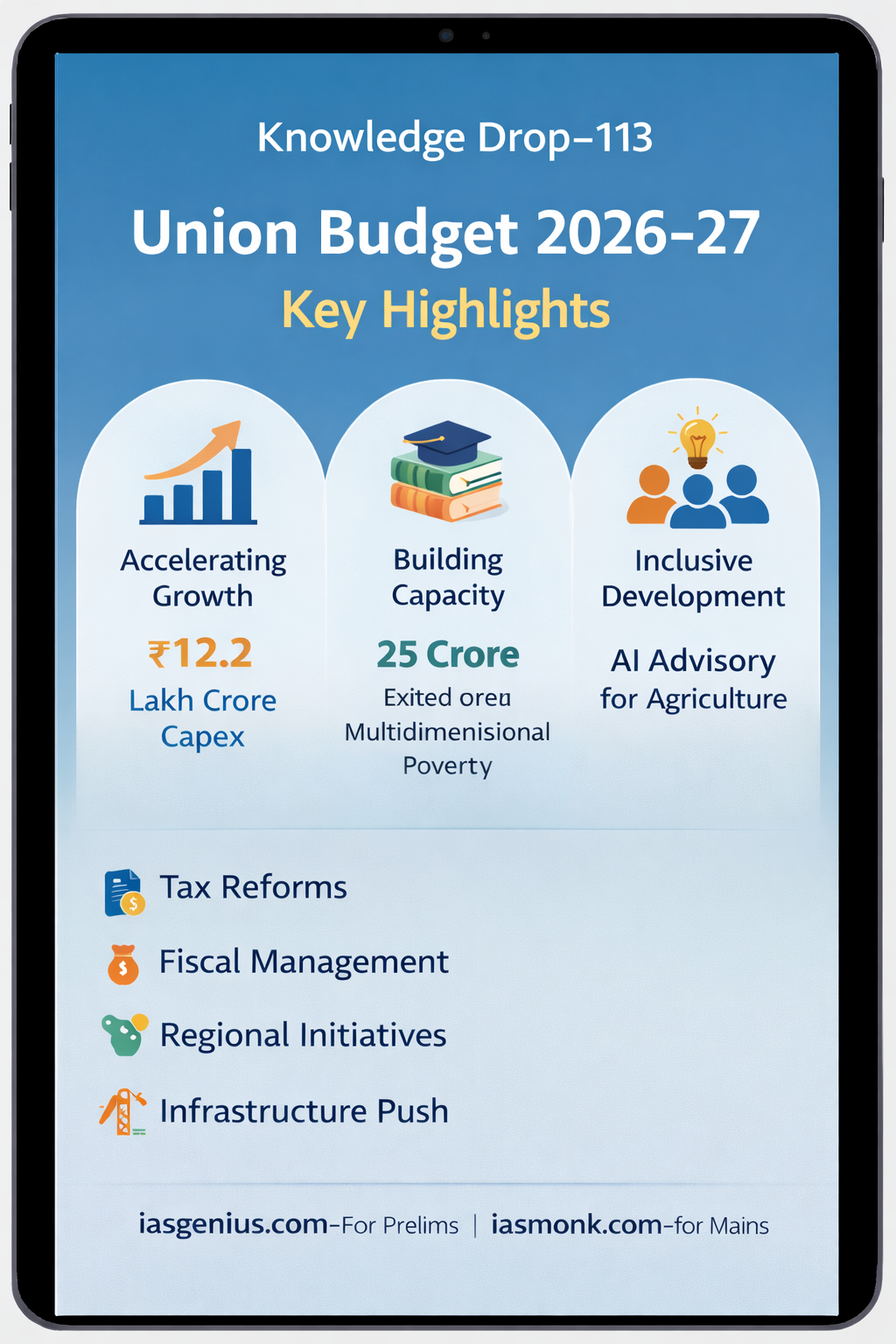
In her Budget Speech, the Union Finance Minister announced the formation of a high-level ‘Education to Employment and Enterprise’ Standing Committee to recommend measures with a special focus on the services sector, particularly in the context of Artificial Intelligence (AI) and emerging technologies.
🏛️ Mandate of the High-Level Standing Committee
As per Budget documents, the Committee will:
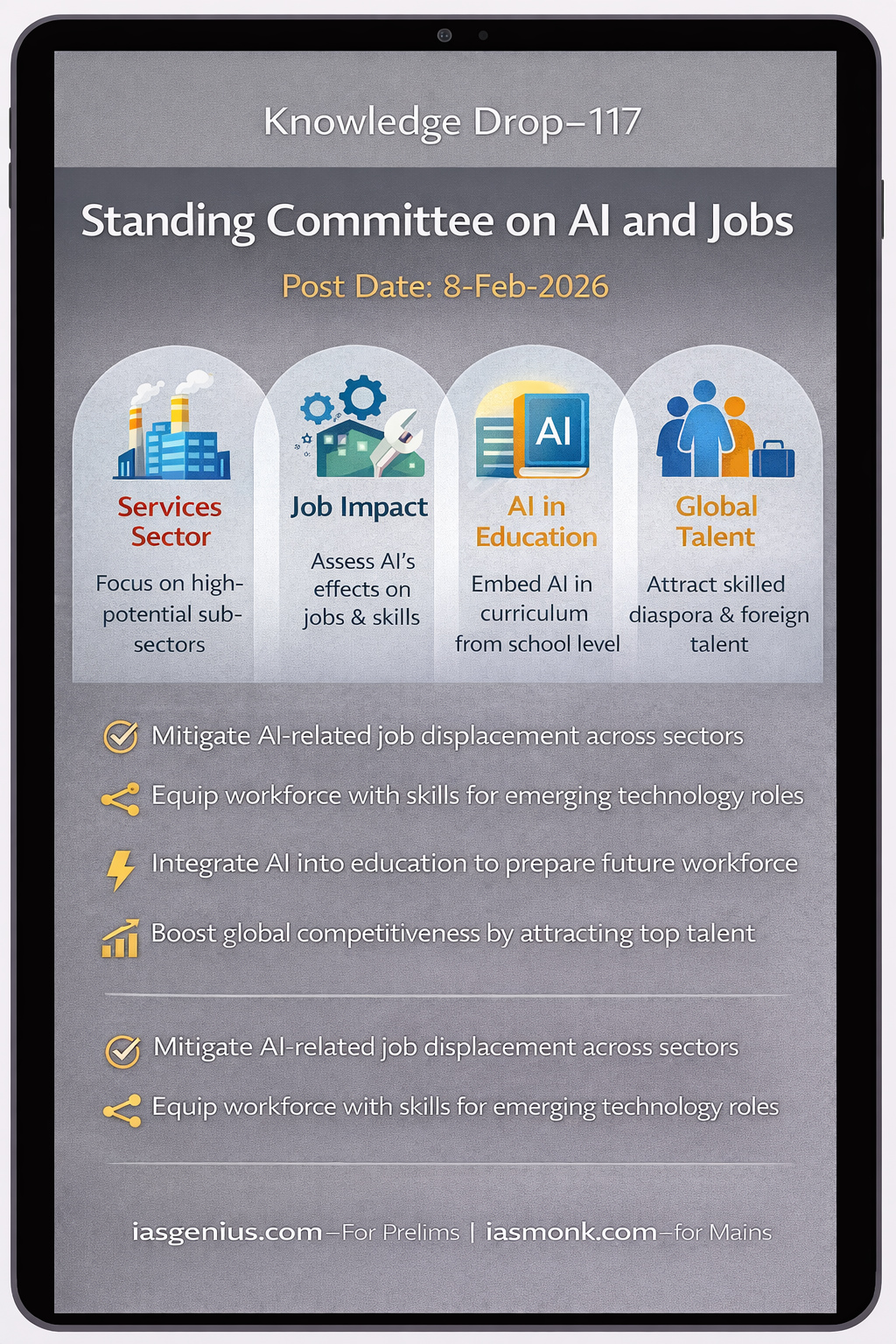
- Identify services sub-sectors with high potential for growth, employment, and exports.
- Assess the impact of emerging technologies, including AI, on jobs and skill requirements.
- Propose measures to embed AI in the education curriculum from school level onwards and upgrade SCERTs for teacher training.
- Recommend steps to make the informal workforce visible, verifiable, and future-ready, improving upward mobility.
- Suggest measures to attract skilled diaspora and foreign talent into India.
The Committee thus seeks to create a systemic bridge between education, employability, and enterprise in the age of AI.
❓ Why is Such a Committee Needed?
- Job Losses due to Automation: AI-driven automation is raising concerns of job displacement across sectors, with enterprises increasingly replacing routine human tasks with machines and algorithms.
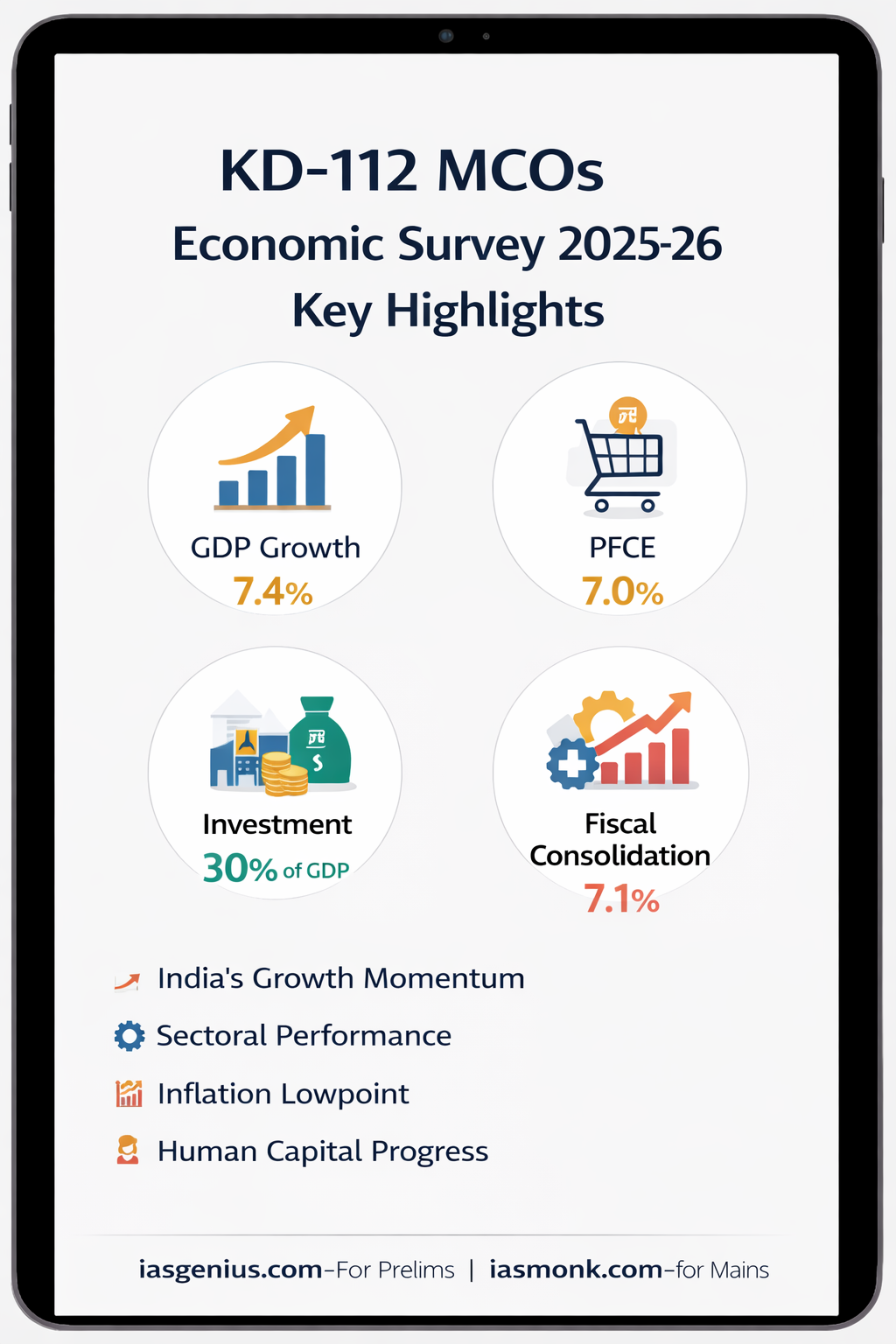
- Need for Sectoral Mapping: The Economic Survey 2025–26 highlighted the need for comprehensive mapping of jobs outside the white-collar workspace, especially in high-skill but understaffed segments that can generate new employment.
- Managing AI-Driven Disruption: Policy reforms are required to mitigate risks of AI on existing jobs while preparing the workforce for new roles.
🤖 Impact of AI on Jobs in India
- Most Vulnerable Roles:
- Routine and repetitive jobs in BPO/customer service, basic clerical work, assembly lines, and logistics are increasingly automated.
- Traditional mid-skill jobs, which once provided stable employment, are being squeezed by automation.
- IT and Outsourcing Sector:
- AI tools are now handling coding, testing, and support functions, contributing to workforce restructuring in major IT and outsourcing firms.
🌱 Emerging Opportunities in the AI Era
- New job categories are expanding rapidly, including:
- AI/ML engineers
- Data scientists and analysts
- Cloud architects
- Cybersecurity specialists
- AI product managers and prompt engineers
- These roles typically offer higher wages and strong demand.
- Forecasts suggest around 4.7 million AI and tech roles could emerge in India by 2027.
- Shift in Skill Demands:
- About 38% of India’s workforce could see changes in skill requirements by 2030, the highest among BRICS countries.
- Employers are increasingly prioritising technology skills, analytical ability, and adaptability over traditional academic credentials.
🧭 Way Ahead
- Upskilling and Reskilling:
- India needs large-scale reskilling; estimates suggest over 16 million workers may need reskilling in AI and automation by 2027.
- Government and Industry Initiatives:
- National strategies and partnerships are focusing on equipping students and workers with AI and digital skills.
- Large-scale corporate skill-building programmes are underway to boost workforce readiness.
🏗️ Key Government Initiatives on AI and Skills
- FutureSkills PRIME: A MeitY–NASSCOM initiative for reskilling/upskilling in 10 emerging technologies including AI.
- Skill India Mission: Now includes AI and tech components, linking vocational pathways with future employability.
- NCVET’s National Programme on Artificial Intelligence (NPAI): Provides a national skilling framework for AI, data science, and emerging technologies.
- SOAR (Skilling for AI Readiness): Launched by MSDE to embed AI awareness among school students (Classes 6–12) and improve AI literacy among teachers.
- DGT Partnerships: Collaborations with IBM, Microsoft, Cisco, Adobe, AWS and others for CSR-based skilling initiatives.
- Sector Skill Councils (SSCs): Co-develop industry-aligned curricula and conduct Training of Trainers, with support for apprenticeships and internships in AI, robotics, and climate tech.
🏁 Conclusion
While several traditional roles will decline or transform, AI is also opening a wide landscape of new, high-value opportunities. The transition demands coordinated action by government, industry, and educational institutions to ensure India’s workforce is future-ready. The proposed Standing Committee represents a crucial step towards aligning education, employment, and enterprise in the era of intelligent technologies.
Target IAS-2026+: Highly Expected Prelims MCQs :
📌 Prelims Practice MCQs
Topic: A high-level ‘Education to Employment and Enterprise’ Standing Committee
MCQ 1 | TYPE 1 — How Many Statements Are Correct?
Consider the following statements regarding the high-level ‘Education to Employment and Enterprise’ Standing Committee:
1)It was announced in the Union Budget with a focus on the services sector.
2)It will assess the impact of emerging technologies including AI on jobs and skills.
3)It will recommend embedding AI in the curriculum from school level onwards.
4)It will function as a statutory body under an Act of Parliament.
How many of the above statements are correct?
A)Only two
B)Only three
C)All four
D)Only one
🌀 Didn’t get it? Click here (▸) for the Correct Answer & Explanation.
🟩 Correct Answer: B) Only three
🧠 Explanation:
Correct Answer: B)
1)✅ True – The Committee was announced in the Budget with focus on services.
2)✅ True – Assessing AI’s impact on jobs and skills is a core mandate.
3)✅ True – It will propose embedding AI from school level onwards.
4)❌ False – It is not a statutory body created by an Act of Parliament.
MCQ 2 | TYPE 2 — Two-Statement Type
Consider the following statements:
Statement 1: The Committee will propose measures to make the informal workforce visible, verifiable and future-ready.
Statement 2: The Committee’s mandate is limited only to the IT and software sector.
Which of the above statements is/are correct?
A)Only 1 is correct
B)Only 2 is correct
C)Both 1 and 2 are correct
D)Neither 1 nor 2 is correct
🌀 Didn’t get it? Click here (▸) for the Correct Answer & Explanation.
🟩 Correct Answer: A) Only 1 is correct
🧠 Explanation:
Correct Answer: A)
Statement 1:✅ True – Making the informal workforce visible and future-ready is part of the mandate.
Statement 2:❌ False – The focus is on the broader services sector, not only IT.
MCQ 3 | TYPE 3 — Code-Based Statement Selection
Consider the following statements regarding the impact of AI on jobs in India:
1)Routine and repetitive jobs in BPO, clerical work and logistics are most vulnerable to automation.
2)Traditional mid-skill jobs are being squeezed due to automation.
3)AI tools are increasingly handling coding, testing and support work in IT firms.
4)AI has had no significant impact on workforce restructuring in the IT and outsourcing sector.
Which of the statements given above are correct?
A)1,2 and 3 only
B)1 and 4 only
C)2 and 3 only
D)1,2,3 and 4
🌀 Didn’t get it? Click here (▸) for the Correct Answer & Explanation.
🟩 Correct Answer: A)1,2 and 3 only
🧠 Explanation:
Correct Answer: A)
1)✅ True – These routine roles are highly vulnerable to automation.
2)✅ True – Mid-skill jobs are increasingly being squeezed.
3)✅ True – AI is taking over coding, testing and support functions.
4)❌ False – AI has already contributed to workforce restructuring.
MCQ 4 | TYPE 4 — Direct Factual Question
According to estimates mentioned, approximately how many AI and tech roles could emerge in India by 2027?
A)About 1.5 million
B)About 3 million
C)About 4.7 million
D)About 10 million
🌀 Didn’t get it? Click here (▸) for the Correct Answer & Explanation.
🟩 Correct Answer: C)About 4.7 million
🧠 Explanation:
Correct Answer: C)
A)❌ Incorrect – Lower than the estimate.
B)❌ Incorrect – Still below the projection.
C)✅ Correct – Around 4.7 million roles are projected by 2027.
D)❌ Incorrect – Much higher than the stated estimate.
MCQ 5 | TYPE 5 — UPSC 2025 Linkage Reasoning Format (I, II, III)
Consider the following statements:
Statement I: The formation of the Standing Committee reflects the need to align education, skills and employment in the age of AI.
Statement II: AI-driven automation is displacing routine and mid-skill jobs while simultaneously creating demand for advanced technology roles.
Statement III: Large-scale upskilling and reskilling are necessary because a significant share of India’s workforce will see changes in skill requirements due to AI.
Which one of the following is correct?
A)Both Statements II and III are correct and both explain Statement I
B)Both Statements II and III are correct but only one explains Statement I
C)Only one of the Statements II and III is correct and that explains Statement I
D)Neither Statement II nor Statement III is correct
🌀 Didn’t get it? Click here (▸) for the Correct Answer & Explanation.
🟩 Correct Answer: A)
🧠 Explanation:
Correct Answer: A)
✅Statement I is correct.
✅Statement II is correct and explains the disruption and opportunity created by AI.
✅Statement III is correct and explains the need for systematic skill alignment and reform.