








🧠 Knowledge Drop-111 | Who Owns Innovation in Space? The Intellectual Property Dilemma Beyond Earth | IAS Prelims 2026-27 Highly Expected MCQs | Current Affairs & GS Essays on iasmonk.com
🧠 Knowledge Drop-111 | Who Owns Innovation in Space? The Intellectual Property Dilemma Beyond Earth
GS-3 | Space
Post Date: 2 February 2026
📌 In News
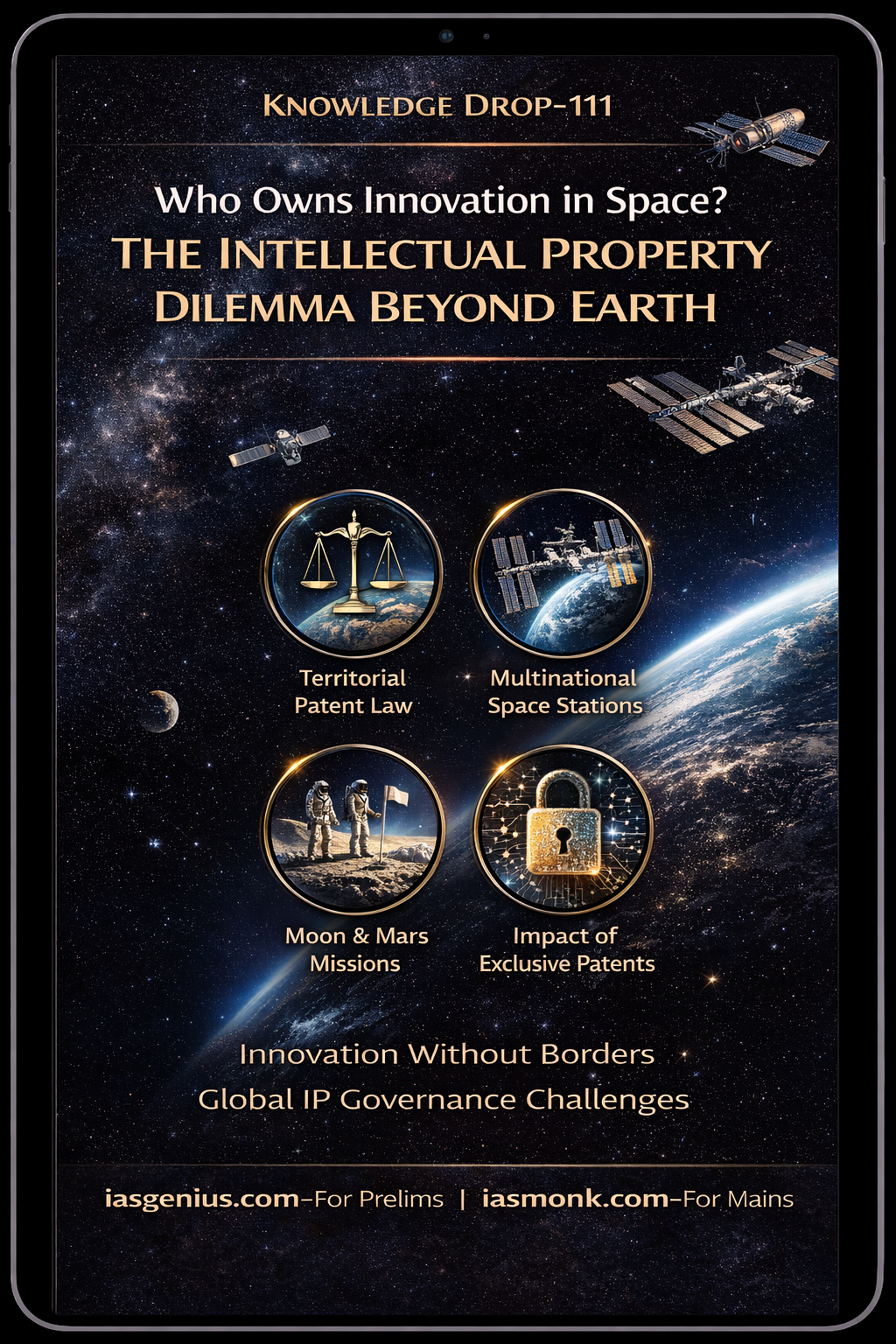
As human space activity expands, a growing tension is emerging between territorial patent law and multinational, collaborative innovation in a domain that lies beyond any nation’s sovereignty.
🚀 Innovation in Space
• Human space habitation is becoming a practical reality, dependent on continuous, collaborative technological innovation for survival.
• This raises a fundamental question: Who owns inventions created in space, where no state can claim sovereignty?
• The current legal framework struggles to align with the shared, multinational nature of space innovation.
⚖️ Territorial Foundations of Patent Law
• Patent law is territorial in nature.
• Patent systems grant exclusive rights within national jurisdictions.
• Infringement is assessed by identifying where acts like making or using an invention occur.
• On Earth, this works because innovation usually happens within clearly defined territorial boundaries.
🌌 Applicability in Space
• Outer space disrupts territorial logic.
• International space law prohibits national sovereignty over celestial bodies.
• However, states retain jurisdiction over space objects they register.
• Under Article VIII of the Outer Space Treaty, legal jurisdiction follows registration, not physical location.
🛰️ Present Status of IP Governance in Space
• An invention made aboard a registered space object is treated as if it occurred within the registering state.
• This extends domestic patent law into space through a legal fiction.
• This has become the default method for governing intellectual property in space.
• The International Space Station (ISS) assigns jurisdiction module by module based on contributing states.
• Each module is treated as national territory for IP purposes.
• Future lunar and Martian bases will likely lack clear national zones, with multinational teams jointly improving shared systems, making jurisdiction over innovation increasingly uncertain.
📜 Do You Know? Key Legal Anchors
• Article I, Outer Space Treaty: Outer space shall be explored and used for the benefit of all humankind.
• Article II, Outer Space Treaty: Prohibits national appropriation of celestial bodies, including the Moon.
• Article VIII, Outer Space Treaty + Registration Convention: Legal jurisdiction attaches to the state of registry of a space object, not to physical location.
• Article 5, Paris Convention (Temporary Presence Doctrine):
– Limits patent enforcement in the public interest.
– Ensures patented articles in transit are not treated as infringing.
– On Earth, this preserves freedom of transport across borders.
⚠️ Challenges and Issues
• Space innovation is highly collaborative and multinational, but patent jurisdiction is determined by registration, not actual contribution, creating a mismatch.
• The Outer Space Treaty forbids national claims and mandates benefit to all humanity, yet patents can grant exclusive control over essential technologies, risking de facto exclusion in permanently inhabited space.
• Patent enforcement in space is fragmented and unclear, and doctrines like temporary presence may not apply.
• Registration-based jurisdiction encourages strategic exploitation, similar to maritime “flags of convenience”, potentially weakening protection and fairness.
• A few states dominate rule-making, coordination mechanisms lack binding legal authority, and most countries remain rule-takers in a system poorly suited to shared space environments.
🛤️ Suggestions and Way Forward
• Patent law, rooted in territorial boundaries, struggles to govern innovation in a domain defined by collaboration, shared infrastructure, and non-appropriation.
• There is a growing case for a specialised international IP framework for space.
• Such a framework should:
– Prevent exclusion from essential survival technologies
– Ensure equitable access
– Reflect the collective and cooperative nature of space exploration
🧭 IAS Monk Whisper
When humanity leaves Earth, its laws must also learn to leave their borders behind. Otherwise, the stars will be shared in name, but owned in practice.
Target IAS-2026+: Highly Expected Prelims MCQs :
📌 Prelims Practice MCQs
Topic: 🧠 Knowledge Drop-111 | Who Owns Innovation in Space? The Intellectual Property Dilemma Beyond Earth
MCQ 1 | TYPE 1 — How Many Statements Are Correct?
Consider the following statements regarding patent law and outer space:
1)Patent law is territorially based and grants exclusive rights within national jurisdictions.
2)Under international space law, states can claim sovereignty over celestial bodies they explore.
3)Article VIII of the Outer Space Treaty links legal jurisdiction to the state of registry of a space object.
4)An invention made aboard a registered space object is treated as if it occurred within the registering state.
How many of the above statements are correct?
A)Only one
B)Only two
C)Only three
D)All four
🌀 Didn’t get it? Click here (▸) for the Correct Answer & Explanation.
🟩 Correct Answer: C) Only three
🧠 Explanation:
Correct Answer: C) Only three
1)✅ True – Patent law is territorial and operates within national jurisdictions.
2)❌ False – International space law prohibits national sovereignty over celestial bodies.
3)✅ True – Article VIII attaches jurisdiction to the state of registry.
4)✅ True – Inventions aboard registered space objects are treated as occurring within the registering state.
MCQ 2 | TYPE 2 — Two-Statement Type
Consider the following statements:
Statement 1: The International Space Station assigns legal jurisdiction module by module based on contributing states.
Statement 2: Each ISS module is treated as national territory for intellectual property purposes.
Which of the statements given above is/are correct?
A)Only 1 is correct
B)Only 2 is correct
C)Both are correct
D)Neither is correct
🌀 Didn’t get it? Click here (▸) for the Correct Answer & Explanation.
🟩 Correct Answer: C) Both are correct
🧠 Explanation:
Correct Answer: C) Both are correct
Statement 1:✅ True – Jurisdiction on the ISS is assigned module by module.
Statement 2:✅ True – Each module is treated as national territory for IP purposes.
MCQ 3 | TYPE 3 — Code-Based Statement Selection
Consider the following statements regarding space law and intellectual property:
1)Article I of the Outer Space Treaty states that outer space shall be explored for the benefit of all humankind.
2)Article II of the Outer Space Treaty prohibits national appropriation of celestial bodies.
3)Article VIII of the Outer Space Treaty provides that jurisdiction follows physical location in space.
4)The Registration Convention supports the principle that jurisdiction attaches to the state of registry of a space object.
Which of the statements given above are correct?
A)1, 2 and 4 only
B)1 and 3 only
C)2 and 3 only
D)1, 2, 3 and 4
🌀 Didn’t get it? Click here (▸) for the Correct Answer & Explanation.
🟩 Correct Answer: A) 1, 2 and 4 only
🧠 Explanation:
Correct Answer: A) 1, 2 and 4 only
1)✅ True – Article I frames space as a domain for the benefit of all humankind.
2)✅ True – Article II prohibits national appropriation of celestial bodies.
3)❌ False – Article VIII links jurisdiction to registration, not physical location.
4)✅ True – The Registration Convention reinforces registry-based jurisdiction.
MCQ 4 | TYPE 4 — Direct Factual Question
Which one of the following doctrines under the Paris Convention limits patent enforcement to ensure freedom of transport across borders?
A)Doctrine of exhaustion
B)Doctrine of compulsory licensing
C)Doctrine of temporary presence
D)Doctrine of fair use
🌀 Didn’t get it? Click here (▸) for the Correct Answer & Explanation.
🟩 Correct Answer: C) Doctrine of temporary presence
🧠 Explanation:
Correct Answer: C) Doctrine of temporary presence
A)❌ Incorrect – Exhaustion deals with post-sale rights.
B)❌ Incorrect – Compulsory licensing is about public interest use of patents.
C)✅ Correct – Temporary presence limits enforcement for patented articles in transit.
D)❌ Incorrect – Fair use is not the relevant doctrine here.
MCQ 5 | TYPE 5 — UPSC 2025 Linkage Reasoning Format (I, II, III)
Consider the following statements:
Statement I:
The existing patent framework faces serious difficulties in governing innovation in outer space.
Statement II:
Space innovation is increasingly collaborative and multinational, while patent jurisdiction is still based on registration and territorial logic.
Statement III:
The Outer Space Treaty’s non-appropriation principle and the risk of patents creating de facto exclusion highlight the need for a specialised international space IP framework.
Which one of the following is correct?
A) Both Statements II and III are correct and both explain Statement I
B) Both Statements II and III are correct but only one explains Statement I
C) Only one of the Statements II and III is correct and that explains Statement I
D) Neither Statement II nor Statement III is correct
🌀 Didn’t get it? Click here (▸) for the Correct Answer & Explanation.
🟩 Correct Answer: A)
🧠 Explanation:
Correct Answer: A) Both Statements II and III are correct and both explain Statement I
Statement II:✅ True – The mismatch between collaborative innovation and territorial jurisdiction explains the difficulty.
Statement III:✅ True – The tension between non-appropriation and exclusive patent control reinforces the need for a new framework.