



🧠 Knowledge Drop-110 | Solid Waste Management (SWM) Rules, 2026 | IAS Prelims 2026-27 Highly Expected MCQs | Current Affairs & GS Essays on iasmonk.com
🧠 Knowledge Drop-110 | Solid Waste Management (SWM) Rules, 2026
GS-3 | Environment
Post Date: 1 February 2026
📌 In News
India has notified the Solid Waste Management (SWM) Rules, 2026, replacing the 2016 framework. The new rules will come into force on 1 April 2026 and aim to embed circular economy principles and Extended Producer Responsibility (EPR) into urban waste governance.
🌱 About the SWM Rules, 2026
• The rules prioritise waste reduction, reuse, recycling, and recovery over disposal.
• They integrate circular economy and EPR to shift the system from “collect–dump” to “recover–reuse”.
• The focus is on India’s growing urban waste crisis: over 62 million tonnes annually, with bulk waste generators (BWGs) contributing about 30%.
• The framework emphasises technology, transparency, and accountability across the waste value chain.
🧱 Key Provisions of SWM Rules, 2026
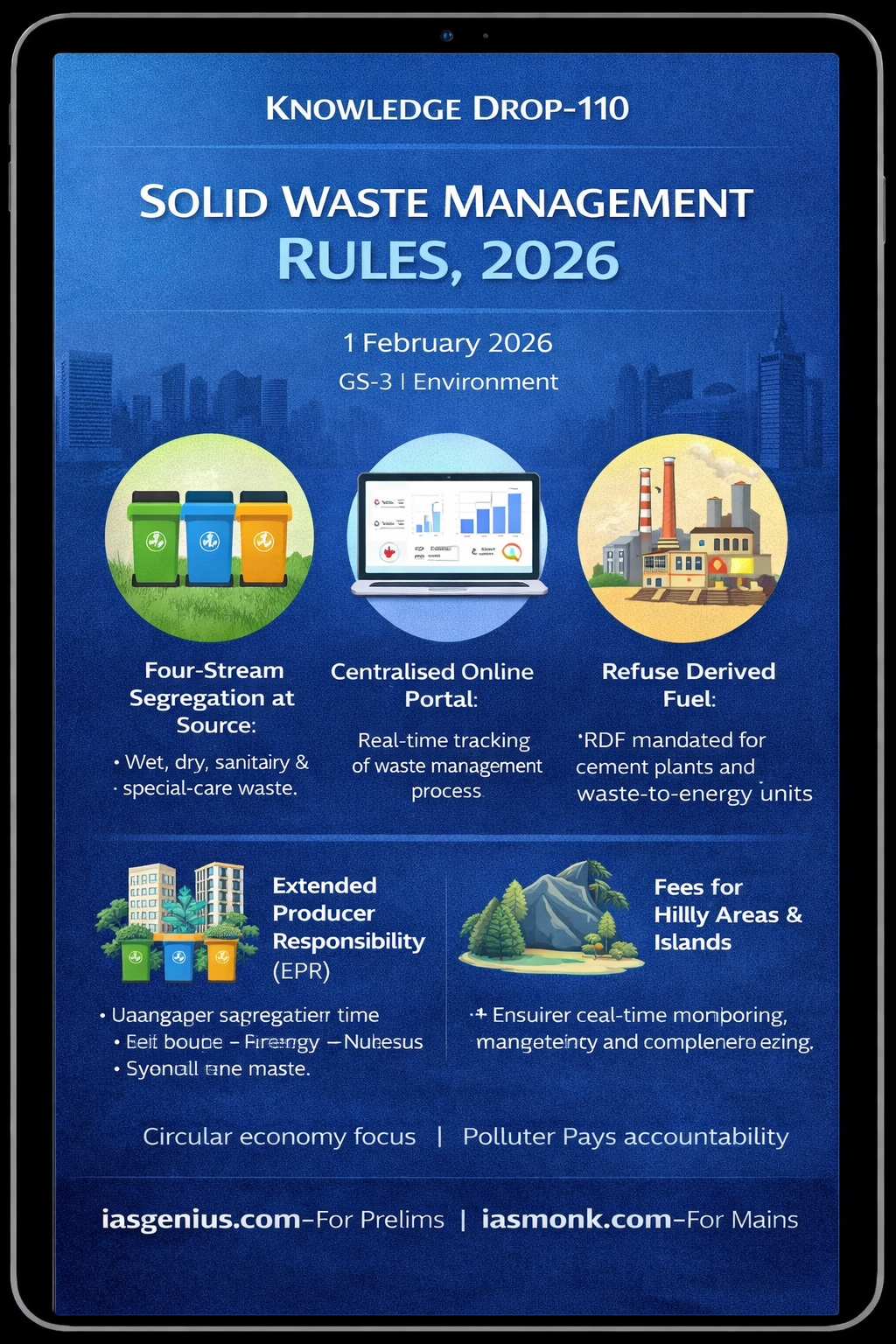
1) Four-Stream Segregation at Source
• Mandatory segregation into:
– Wet waste
– Dry waste
– Sanitary waste
– Special-care waste
• Objective: Improve recycling efficiency, worker safety, and resource recovery.
2) Clear Definition of Bulk Waste Generators (BWGs)
BWGs identified based on any one of the following:
• Built-up area ≥ 20,000 sq m, or
• Water consumption ≥ 40,000 litres/day, or
• Waste generation ≥ 100 kg/day.
3) Extended Bulk Waste Generator Responsibility (EBWGR)
• BWGs made responsible for:
– Segregation
– Processing
– Safe disposal
of the waste generated by them.
4) Centralised Online Portal for Solid Waste Management
• A digital platform to track:
– Waste generation
– Collection
– Transportation
– Processing
– Disposal
• Enables real-time monitoring, transparency, and compliance tracking.
5) Promotion and Mandatory Use of Refuse Derived Fuel (RDF)
• Industries such as cement plants and waste-to-energy units are mandated to use RDF produced from high-calorific municipal waste.
• Aims to reduce landfill burden and substitute fossil fuels in industry.
6) Restrictions on Landfilling
• Landfilling permitted only for:
– Non-recyclable waste
– Non-energy-recoverable waste
– Inert materials
• Objective: Minimise dumping and promote recovery-based waste management.
7) Solid Waste Management in Hilly Areas and Islands
• Local bodies empowered to:
– Levy user fees on tourists
– Regulate tourist inflow based on waste-handling capacity
• Recognises ecological fragility and limited carrying capacity of such regions.
8) Environmental Compensation for Non-Compliance
• Provision to impose environmental compensation based on the Polluter Pays Principle.
• Strengthens enforcement and accountability.
🔥 Note on Refuse Derived Fuel (RDF)
• RDF is fuel produced from high-calorific fractions of municipal solid waste such as plastics, paper, textiles, and packaging waste.
• It is processed through segregation, shredding, drying, and pelletisation.
• Uses:
– Cement kilns
– Waste-to-energy plants
• Benefits:
– Reduces landfill volume
– Substitutes coal and fossil fuels
– Lowers greenhouse gas emissions
– Promotes circular use of waste as a resource
🌍 Significance of the 2026 Rules
• Shifts India from a dumping-oriented to a resource-recovery-oriented waste regime.
• Strengthens urban governance, digital monitoring, and polluter accountability.
• Aligns India’s waste policy with circular economy and climate goals.
• Makes bulk generators and industries active stakeholders in waste management.
🧭 IAS Monk Whisper
Civilisations are not judged by what they consume, but by what they choose to return to the earth. Waste, when governed wisely, becomes a second beginning.
Target IAS-2026+: Highly Expected Prelims MCQs :
📌 Prelims Practice MCQs
Topic: 🧠 Knowledge Drop-110 | Solid Waste Management (SWM) Rules, 2026
MCQ 1 | TYPE 1 — How Many Statements Are Correct?
Consider the following statements regarding the SWM Rules, 2026:
1)The SWM Rules, 2026 replace the 2016 rules and come into force from 1 April 2026.
2)The rules embed circular economy principles and Extended Producer Responsibility.
3)They mandate three-stream segregation of waste at source.
4)They aim to prioritise waste reduction, reuse, recycling, and recovery over disposal.
How many of the above statements are correct?
A)Only one
B)Only two
C)Only three
D)All four
🌀 Didn’t get it? Click here (▸) for the Correct Answer & Explanation.
🟩 Correct Answer: C) Only three
🧠 Explanation:
Correct Answer: C) Only three
1)✅ True – The new rules replace the 2016 version and are effective from 1 April 2026.
2)✅ True – Circular economy and EPR are core pillars of the 2026 rules.
3)❌ False – The rules mandate four-stream segregation, not three.
4)✅ True – The priority is reduction, reuse, recycling, and recovery over disposal.
MCQ 2 | TYPE 2 — Two-Statement Type
Consider the following statements:
Statement 1: Under the SWM Rules, 2026, Bulk Waste Generators are identified based on built-up area, water consumption, or waste generation thresholds.
Statement 2: Extended Bulk Waste Generator Responsibility makes BWGs accountable for segregation, processing, and safe disposal of their waste.
Which of the statements given above is/are correct?
A)Only 1 is correct
B)Only 2 is correct
C)Both are correct
D)Neither is correct
🌀 Didn’t get it? Click here (▸) for the Correct Answer & Explanation.
🟩 Correct Answer: C) Both are correct
🧠 Explanation:
Correct Answer: C) Both are correct
Statement 1:✅ True – BWGs are defined using area, water use, or waste generation criteria.
Statement 2:✅ True – EBWGR places responsibility on BWGs for end-to-end waste handling.
MCQ 3 | TYPE 3 — Code-Based Statement Selection
Consider the following statements regarding key provisions of the SWM Rules, 2026:
1)Four-stream segregation includes wet, dry, sanitary, and special-care waste.
2)A centralised online portal will track waste generation, collection, transportation, processing, and disposal.
3)Landfilling is permitted for all types of municipal waste provided it is scientifically managed.
4)Industries such as cement plants are mandated to use Refuse Derived Fuel produced from high-calorific municipal waste.
Which of the statements given above are correct?
A)1, 2 and 4 only
B)1 and 3 only
C)2 and 3 only
D)1, 2, 3 and 4
🌀 Didn’t get it? Click here (▸) for the Correct Answer & Explanation.
🟩 Correct Answer: A) 1, 2 and 4 only
🧠 Explanation:
Correct Answer: A) 1, 2 and 4 only
1)✅ True – The four streams are wet, dry, sanitary, and special-care waste.
2)✅ True – The portal enables real-time tracking across the waste chain.
3)❌ False – Landfilling is restricted only to non-recyclable, non-energy-recoverable, and inert waste.
4)✅ True – Cement plants and waste-to-energy units are mandated to use RDF.
MCQ 4 | TYPE 4 — Direct Factual Question
Which one of the following best describes Refuse Derived Fuel (RDF) under the SWM Rules, 2026?
A)Fuel produced exclusively from agricultural residues
B)Fuel produced from high-calorific fractions of municipal solid waste
C)Fuel derived from hazardous industrial waste
D)Fuel produced only from biodegradable kitchen waste
🌀 Didn’t get it? Click here (▸) for the Correct Answer & Explanation.
🟩 Correct Answer: B) Fuel produced from high-calorific fractions of municipal solid waste
🧠 Explanation:
Correct Answer: B) Fuel produced from high-calorific fractions of municipal solid waste
A)❌ Incorrect – RDF is not limited to agricultural residues.
B)✅ Correct – RDF is made from high-calorific municipal waste like plastics, paper, and textiles.
C)❌ Incorrect – Hazardous waste is not used for RDF.
D)❌ Incorrect – RDF is not produced only from biodegradable waste.
MCQ 5 | TYPE 5 — UPSC 2025 Linkage Reasoning Format (I, II, III)
Consider the following statements:
Statement I:
The SWM Rules, 2026 aim to transform India’s urban waste management from a disposal-centric system to a resource-recovery-oriented system.
Statement II:
The rules mandate segregation at source, promote the use of RDF, and restrict landfilling to non-recoverable waste.
Statement III:
They introduce digital monitoring and impose environmental compensation based on the Polluter Pays Principle to strengthen compliance.
Which one of the following is correct?
A) Both Statements II and III are correct and both explain Statement I
B) Both Statements II and III are correct but only one explains Statement I
C) Only one of the Statements II and III is correct and that explains Statement I
D) Neither Statement II nor Statement III is correct
🌀 Didn’t get it? Click here (▸) for the Correct Answer & Explanation.
🟩 Correct Answer: A)
🧠 Explanation:
Correct Answer: A) Both Statements II and III are correct and both explain Statement I
Statement II:✅ True – These measures directly support the shift to recovery and resource use.
Statement III:✅ True – Digital tracking and polluter-pays enforcement explain how the transformation is institutionalised.