











🧠 Knowledge Drop-109 | To UNESCO Tentative List : Diamond Triangle of Buddhist Sites in Odisha | IAS Prelims 2026-27 Highly Expected MCQs | Current Affairs & GS Essays on iasmonk.com
🧠 Knowledge Drop-109 | To UNESCO Tentative List: Diamond Triangle of Buddhist Sites in Odisha
GS-1 | Culture
Post Date: 31 January 2026
📌 Context
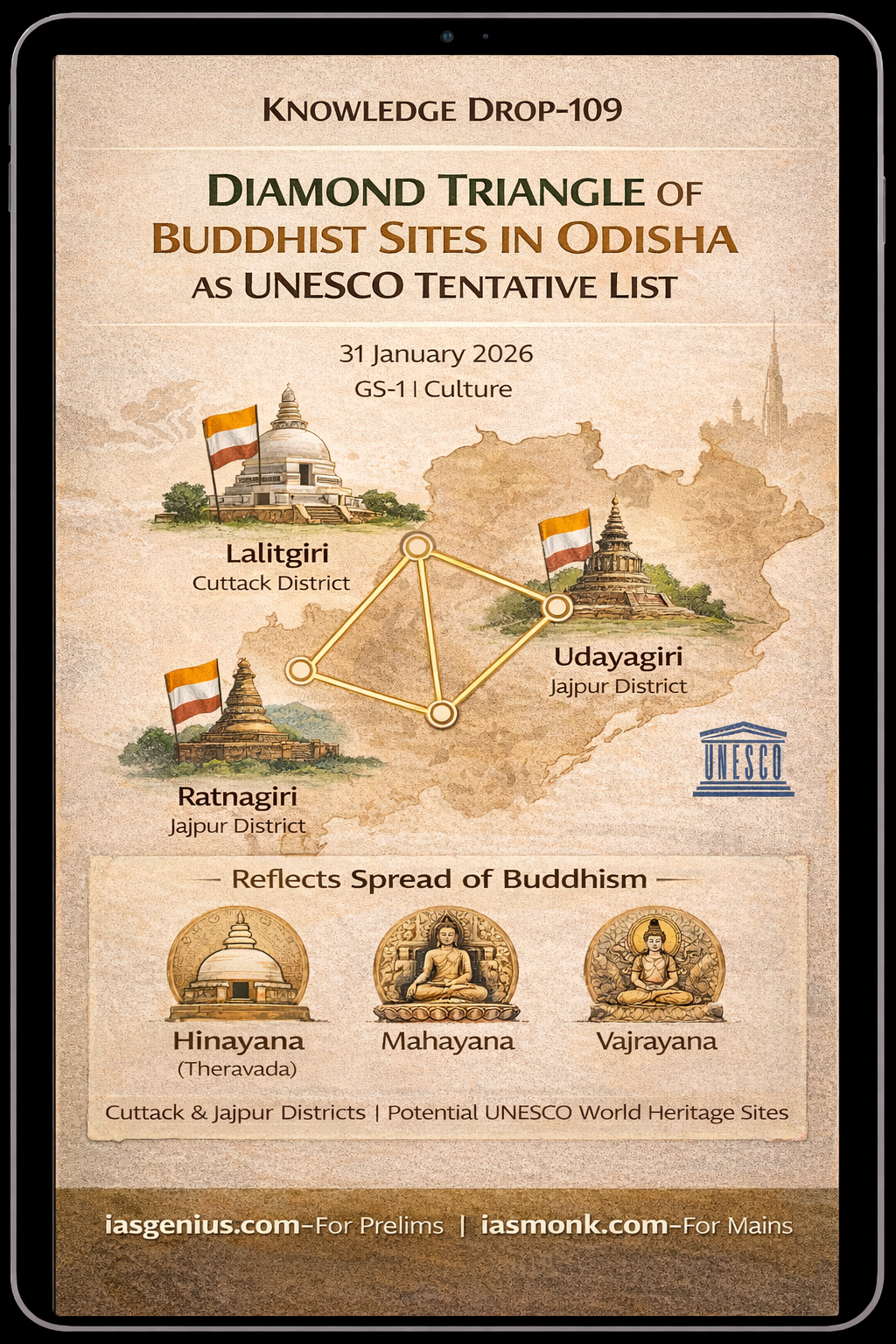
UNESCO has reportedly included three Buddhist heritage sites from Odisha — Ratnagiri, Udayagiri, and Lalitgiri — in India’s tentative list for potential recognition as UNESCO World Heritage Sites.
🏛️ About the Tentative List
• The tentative list identifies sites of outstanding universal value, cultural or natural, that are considered suitable for future inscription on the World Heritage List.
• These three sites are collectively known as the “Diamond Triangle” of Buddhism in Odisha.
• They are believed to reflect the spread and evolution of all three major schools of Buddhism:
– Hinayana (Theravada)
– Mahayana
– Vajrayana
📍 Buddhist Site of Lalitgiri (Cuttack District)
Location:
• Situated on Nandapahad hillock in the Assia hill range, within the Birupa river valley
Historical Significance:
• Shows uninterrupted cultural continuity from the 2nd–3rd century BCE to the 13th century CE
Archaeological Findings:
• Discovery of an inscribed terracotta sealing reading:
“Sri Chandraditya Vihara Samagra Arya Bhikshu Sanghasa” (9th–10th century CE)
• A massive stupa of the Theravada phase containing relic caskets of:
– Khondalite stone (outer)
– Steatite, silver, and gold (inner caskets)
• Images from Mahayana and Vajrayana pantheon such as:
– Vajrapani, Manjusri, Tara, Jambhala, Hariti, Aparajita
📍 Buddhist Site of Udayagiri (Jajpur District)
Location:
• Situated in the Assia hill range on the right bank of the Birupa River
• Also known as “Sunrise Hill” due to its east-facing crescent-shaped hill
Architectural Importance:
• Discovery of a massive Chaityagriha showing architectural evolution:
– Circular → Apsidal → Rectangular forms
Art and Inscriptions:
• Sculptures of: Avalokiteswara (colossal), Tara, Manjusri, Bhrikuti, Hariti, Chunda, Maitreya, Vairochana, Vasudhara, and others
• Inscriptions with Buddhist Dharanis on terracotta plaques and stone tablets
📍 Buddhist Site of Ratnagiri (Jajpur District)
Location:
• Located in the Assia hill range on the left bank of the Kelua River, a distributary of the Brahmani River
• Also known as the “Hill of Jewels”
Patronage and Historical Importance:
• Received major patronage from the Bhaumakara dynasty (8th–10th century CE)
• A copperplate inscription records the residence of Queen Karpurashri, indicating female royal patronage of Buddhism
🌏 Cultural Significance of the Diamond Triangle
• Represents the full spectrum of Buddhist evolution: Hinayana, Mahayana, and Vajrayana
• Demonstrates Odisha’s role as a major centre of Buddhist learning, art, and monastic culture
• Strengthens India’s case for global recognition of its ancient Buddhist heritage through UNESCO
🧭 IAS Monk Whisper
When stones remember silence, and stupas remember prayer, history stops being dead — it becomes a living pilgrimage.
Target IAS-2026+: Highly Expected Prelims MCQs :
📌 Prelims Practice MCQs
Topic: Knowledge Drop-109 | To UNESCO Tentative List: Diamond Triangle of Buddhist Sites in Odisha
MCQ 1 | TYPE 1 — How Many Statements Are Correct?
Consider the following statements regarding the “Diamond Triangle” of Buddhist sites in Odisha:
1)It comprises Ratnagiri, Udayagiri and Lalitgiri.
2)These sites reflect the evolution of Hinayana, Mahayana and Vajrayana Buddhism.
3)All three sites are located on the banks of the Brahmani River.
4)They are included in India’s tentative list for UNESCO World Heritage recognition.
How many of the above statements are correct?
A)Only one
B)Only two
C)Only three
D)All four
🌀 Didn’t get it? Click here (▸) for the Correct Answer & Explanation.
🟩 Correct Answer: C) Only three
🧠 Explanation:
Correct Answer: C) Only three
1)✅ True – The Diamond Triangle consists of Ratnagiri, Udayagiri and Lalitgiri.
2)✅ True – The sites represent Hinayana, Mahayana and Vajrayana traditions.
3)❌ False – They are located in different river valleys, not all on the Brahmani.
4)✅ True – They are included in India’s tentative list for UNESCO recognition.
MCQ 2 | TYPE 2 — Two-Statement Type
Consider the following statements:
Statement 1: Lalitgiri shows uninterrupted cultural continuity from the 2nd–3rd century BCE to the 13th century CE.
Statement 2: A massive stupa of the Theravada phase at Lalitgiri contained relic caskets made of stone, steatite, silver and gold.
Which of the statements given above is/are correct?
A)Only 1 is correct
B)Only 2 is correct
C)Both are correct
D)Neither is correct
🌀 Didn’t get it? Click here (▸) for the Correct Answer & Explanation.
🟩 Correct Answer: C) Both are correct
🧠 Explanation:
Correct Answer: C) Both are correct
Statement 1:✅ True – Lalitgiri shows long cultural continuity from early BCE to medieval times.
Statement 2:✅ True – The stupa contained nested relic caskets of stone, steatite, silver and gold.
MCQ 3 | TYPE 3 — Code-Based Statement Selection
Consider the following statements regarding Udayagiri and Ratnagiri:
1)Udayagiri is also known as “Sunrise Hill” because of its east-facing crescent-shaped hill.
2)Udayagiri has yielded evidence of a Chaityagriha showing evolution from circular to apsidal to rectangular forms.
3)Ratnagiri received major patronage from the Bhaumakara dynasty.
4)Ratnagiri is located on the right bank of the Birupa River.
Which of the statements given above are correct?
A)1, 2 and 3 only
B)1 and 4 only
C)2 and 3 only
D)1, 2, 3 and 4
🌀 Didn’t get it? Click here (▸) for the Correct Answer & Explanation.
🟩 Correct Answer: A) 1, 2 and 3 only
🧠 Explanation:
Correct Answer: A) 1, 2 and 3 only
1)✅ True – Udayagiri is called Sunrise Hill due to its east-facing crescent shape.
2)✅ True – The Chaityagriha shows architectural evolution from circular to apsidal to rectangular.
3)✅ True – Ratnagiri received major patronage from the Bhaumakara dynasty.
4)❌ False – Ratnagiri is located on the left bank of the Kelua River, not the Birupa.
MCQ 4 | TYPE 4 — Direct Factual Question
Which one of the following inscriptions indicates female patronage at one of the Diamond Triangle sites?
A)An Ashokan rock edict at Udayagiri
B)A copperplate inscription mentioning Queen Karpurashri at Ratnagiri
C)A Gupta pillar inscription at Lalitgiri
D)A Hiuen Tsang travel account at Udayagiri
🌀 Didn’t get it? Click here (▸) for the Correct Answer & Explanation.
🟩 Correct Answer: B) A copperplate inscription mentioning Queen Karpurashri at Ratnagiri
🧠 Explanation:
Correct Answer: B) A copperplate inscription mentioning Queen Karpurashri at Ratnagiri
A)❌ Incorrect – No Ashokan rock edict is mentioned here.
B)✅ Correct – The copperplate inscription at Ratnagiri records the residence of Queen Karpurashri.
C)❌ Incorrect – There is no such Gupta pillar inscription cited at Lalitgiri.
D)❌ Incorrect – This is not the evidence referred to for female patronage.
MCQ 5 | TYPE 5 — UPSC 2025 Linkage Reasoning Format (I, II, III)
Consider the following statements:
Statement I:
The Diamond Triangle sites of Odisha are considered crucial for understanding the evolution of Buddhism in eastern India.
Statement II:
These sites preserve evidence of Hinayana, Mahayana and Vajrayana traditions in the form of stupas, monasteries, sculptures and inscriptions.
Statement III:
Their inclusion in India’s tentative list reflects their outstanding universal cultural value and suitability for UNESCO World Heritage status.
Which one of the following is correct?
A) Both Statements II and III are correct and both explain Statement I
B) Both Statements II and III are correct but only one explains Statement I
C) Only one of the Statements II and III is correct and that explains Statement I
D) Neither Statement II nor Statement III is correct
🌀 Didn’t get it? Click here (▸) for the Correct Answer & Explanation.
🟩 Correct Answer: A)
🧠 Explanation:
Correct Answer: A) Both Statements II and III are correct and both explain Statement I
Statement II:✅ True – The presence of all three Buddhist traditions explains the historical importance of the sites.
Statement III:✅ True – Their tentative list inclusion supports their global cultural significance and relevance.