
🧠 Knowledge Drop-103 | The ‘Pax Silica’ and its Importance for India | IAS Prelims 2026-27 Highly Expected MCQs | Current Affairs & GS Essays on iasmonk.com
🧠 Knowledge Drop-103 | The ‘Pax Silica’ and its Importance for India
GS-3 | Economy | Science & Technology
Post Date: 25 January 2026
📌 Context
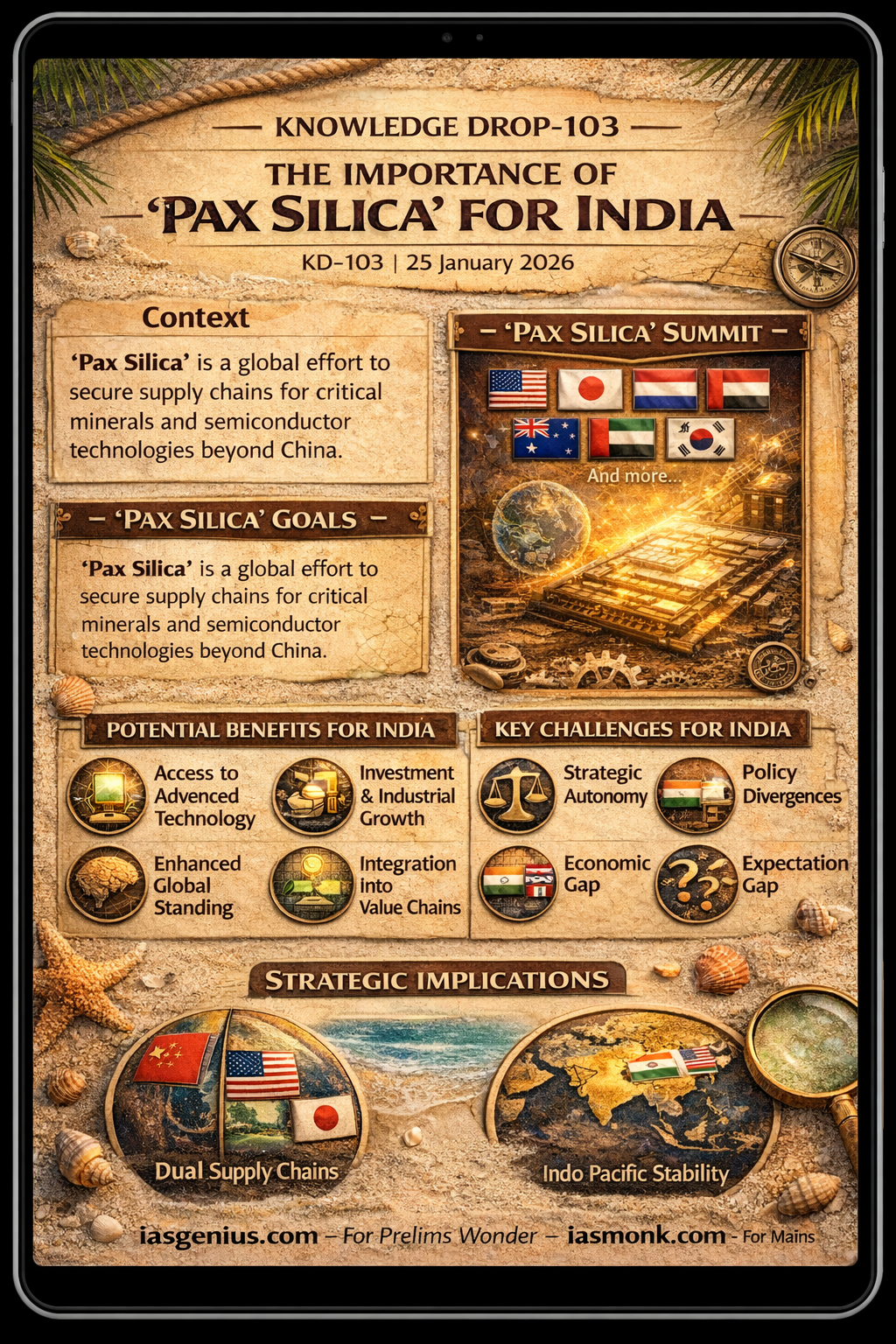
Recently, the United States convened the inaugural Pax Silica Summit, highlighting the need to reduce coercive dependencies, secure the flow of critical minerals, and promote trusted digital ecosystems. This marks a new phase in global efforts to stabilise semiconductor, AI, and critical mineral supply chains.
📘 About ‘Pax Silica’
The term ‘Pax Silica’ is derived from Latin:
• Pax meaning peace
• Silica referring to a core compound used in semiconductors
It symbolises the pursuit of technological peace and prosperity through resilient, transparent, and cooperative supply chains, especially in semiconductors, AI, and critical minerals.
🧭 Why ‘Pax Silica’ is Needed
• Supply Chain Security: To ensure reliable and diversified access to Rare Earth Elements (REEs) and other critical minerals essential for semiconductors and AI technologies.
• Reducing Dependence on China: To counter China’s dominance and coercive leverage over global REE supply chains and technology exports.
• Resilient Technology Ecosystem: To build trusted, transparent, and shock-resistant global supply chains for frontier technologies.
• Economic Stability and Strategic Balance: To protect the global economy from disruptions caused by monopolised production or geopolitical tensions.
• Allied Technological Collaboration: To bring together technology leaders (US, Japan, South Korea, Netherlands, Israel) and resource-rich nations (Australia, UAE, Qatar) for joint innovation.
• Trusted Digital Infrastructure: To establish common standards for ethical AI, cybersecurity, and secure semiconductor ecosystems among like-minded nations.
• Sustainable Mining and Innovation: To promote responsible extraction, recycling, and green manufacturing of critical minerals.
• Maintaining U.S. Technological Leadership: To reaffirm US leadership in global innovation governance in the AI–semiconductor era.
🌐 Composition of Pax Silica
• United States and Japan: Innovation and R&D leaders in semiconductors and AI.
• Australia: Leading exporter of lithium and a key REE mining player.
• Netherlands: Home to ASML, the global leader in advanced lithography systems.
• South Korea: Dominant in memory chip manufacturing.
• Singapore: Longstanding semiconductor manufacturing base linked with US firms.
• Israel: Specialises in AI software, cybersecurity, and defence technologies.
• United Kingdom: The world’s third-largest AI market with a strong innovation ecosystem.
• Qatar and UAE: Financial powerhouses investing heavily in AI and advanced technologies.
Observers at the inaugural summit included Canada, the European Union, OECD, and Taiwan, all of whom may join as the initiative evolves.
🇮🇳 India’s Prospective Role in Pax Silica
• Expanding Digital Infrastructure: India’s fast-growing digital economy and AI adoption align with Pax Silica’s goals.
• Semiconductor Ambitions: Through India’s Semiconductor Mission and AI Mission, the country is investing in chip design and fabrication.
• Strategic Partnerships: Collaboration with Japan, Israel, Singapore, and the US in chip manufacturing and R&D.
• Human Capital Advantage: A large pool of STEM graduates and returning AI engineers strengthens India’s innovation capacity.
• Resilient Supply Chains: India’s experience with the Quad Critical Minerals Initiative makes it a natural partner for Pax Silica.
✅ Benefits for India
• Access to Advanced Technology: Greater scope for technology transfer and joint R&D.
• Investment and Industrial Growth: Attraction of global investments in AI and semiconductor sectors.
• Enhanced Global Standing: A role in shaping global technology governance.
• Supply Chain Security: Reduced vulnerability to REE export disruptions from China.
• Integration into Global Value Chains: Entry into advanced semiconductor and AI production networks.
⚠️ Challenges for India
• Strategic Autonomy: Balancing non-aligned foreign policy with participation in a US-led framework.
• Economic Gap: India’s tech ecosystem still lags behind established Pax Silica members.
• Policy Divergences: India’s subsidy- and protection-oriented industrial policy may clash with market-driven approaches of high-income members.
• Expectation Gap: As a developing and non-US-ally partner, India must manage differing expectations within the group.
🌏 Strategic Implications
• Dual Supply Chain Order: The world may move towards two parallel REE and technology ecosystems, one led by China and the other by Pax Silica.
• India’s Alignment Choice: India is likely to align with Pax Silica’s democratic and transparent framework while retaining strategic flexibility.
• Regional Stability: Pax Silica could promote technological cooperation and economic stability across the Indo-Pacific.
🧭 IAS Monk Whisper
In the age of algorithms and atoms, peace will not be signed on paper alone. It will be engineered in supply chains, coded in trust, and secured in silicon.
Target IAS-2026+: Highly Expected Prelims MCQs :
📌 Prelims Practice MCQs
Topic: The ‘Pax Silica’ and its Importance for India
MCQ 1 | TYPE 1 — How Many Statements Are Correct?
Consider the following statements regarding ‘Pax Silica’:
1)The term ‘Pax Silica’ combines the ideas of peace and semiconductor-based technology.
2)It focuses on building resilient and transparent supply chains for semiconductors and AI.
3)It aims to promote exclusive national control over critical minerals.
4)It seeks to reduce coercive dependencies in global technology ecosystems.
How many of the above statements are correct?
A)Only one
B)Only two
C)Only three
D)All four
🌀 Didn’t get it? Click here (▸) for the Correct Answer & Explanation.
🟩 Correct Answer: C)Only three
🧠 Explanation:
1)✅ True – ‘Pax’ means peace and ‘Silica’ refers to the semiconductor base.
2)✅ True – Resilient and transparent supply chains are a core objective.
3)❌ False – The aim is cooperation and diversification, not exclusive national control.
4)✅ True – Reducing coercive dependencies is a key goal.
MCQ 2 | TYPE 2 — Two-Statement Type
Consider the following statements:
Statement 1: Pax Silica seeks to reduce dependence on China in critical minerals and technology supply chains.
Statement 2: Pax Silica promotes monopolisation of semiconductor production within a single country.
Which of the statements given above is/are correct?
A)Only 1 is correct
B)Only 2 is correct
C)Both are correct
D)Neither is correct
🌀 Didn’t get it? Click here (▸) for the Correct Answer & Explanation.
🟩 Correct Answer: A) Only 1 is correct
🧠 Explanation:
Statement 1:✅ True – Reducing overdependence on China is a central motivation.
Statement 2:❌ False – The aim is diversification and allied collaboration, not monopolisation.
MCQ 3 | TYPE 3 — Code-Based Statement Selection
Consider the following statements regarding the composition of Pax Silica:
1)Netherlands is important due to ASML’s leadership in advanced lithography systems.
2)South Korea plays a major role in memory chip manufacturing.
3)Australia is significant mainly for its role in lithium and REE mining.
4)Qatar and UAE participate primarily because of their dominance in semiconductor fabrication.
Which of the statements given above are correct?
A)1, 2 and 3 only
B)1 and 2 only
C)2, 3 and 4 only
D)1, 2, 3 and 4
🌀 Didn’t get it? Click here (▸) for the Correct Answer & Explanation.
🟩 Correct Answer: A) 1, 2 and 3 only
🧠 Explanation:
Correct Answer: A) 1, 2 and 3 only
1)✅ True – ASML makes the Netherlands critical in advanced chip equipment.
2)✅ True – South Korea dominates memory chip manufacturing.
3)✅ True – Australia is key for lithium and REE resources.
4)❌ False – Qatar and UAE are mainly financial and investment powerhouses, not chip fabricators.
MCQ 4 | TYPE 4 — Direct Factual Question
Which one of the following best explains India’s relevance to the Pax Silica framework?
A)India’s monopoly over global REE production
B)India’s large pool of STEM talent and growing digital and semiconductor ambitions
C)India’s status as the world’s largest chip equipment manufacturer
D)India’s complete self-sufficiency in advanced semiconductor fabrication
🌀 Didn’t get it? Click here (▸) for the Correct Answer & Explanation.
🟩 Correct Answer: B)
🧠 Explanation:
Correct Answer: B) India’s large pool of STEM talent and growing digital and semiconductor ambitions
A)❌ Incorrect – India does not have a monopoly over REE production.
B)✅ Correct – Human capital and policy missions make India relevant.
C)❌ Incorrect – That role belongs mainly to countries like the Netherlands and the US.
D)❌ Incorrect – India is not yet self-sufficient in advanced semiconductor fabrication.
MCQ 5 | TYPE 5 — UPSC 2025 Linkage Reasoning Format (I, II, III)
Consider the following statements:
Statement I:
Pax Silica is likely to reshape global technology supply chains and reduce vulnerability to geopolitical disruptions.
Statement II:
The initiative promotes diversification of critical mineral sources and cooperation among technologically advanced and resource-rich countries.
Statement III:
China’s dominance in REE supply chains and technology exports has created strategic and economic risks for many countries.
Which one of the following is correct?
A) Both Statements II and III are correct and both explain Statement I
B) Both Statements II and III are correct but only one explains Statement I
C) Only one of the Statements II and III is correct and that explains Statement I
D) Neither Statement II nor Statement III is correct
🌀 Didn’t get it? Click here (▸) for the Correct Answer & Explanation.
🟩 Correct Answer: A)
🧠 Explanation:
Correct Answer: A) Both Statements II and III are correct and both explain Statement I
Statement II:✅ True – Diversification and cooperation directly reduce supply chain vulnerabilities.
Statement III:✅ True – China’s dominance explains why such a restructuring is strategically necessary.