

📅 May 12, 2025, Post 3: 🪖 BrahMos Missile: The Sonic Spear of Indian Precision |High Quality Mains Essay | Prelims MCQs
🪖 BrahMos Missile: The Sonic Spear of Indian Precision
NATIONAL HERO — PETAL 003
🗓️ May 12, 2025
📚 GS Paper 3 – Defence Technology / Strategic Security
🌠 Intro Whisper
In a world of shadows and stealth,
A missile roars — a pact of precision and power.
🔹 Key Highlights
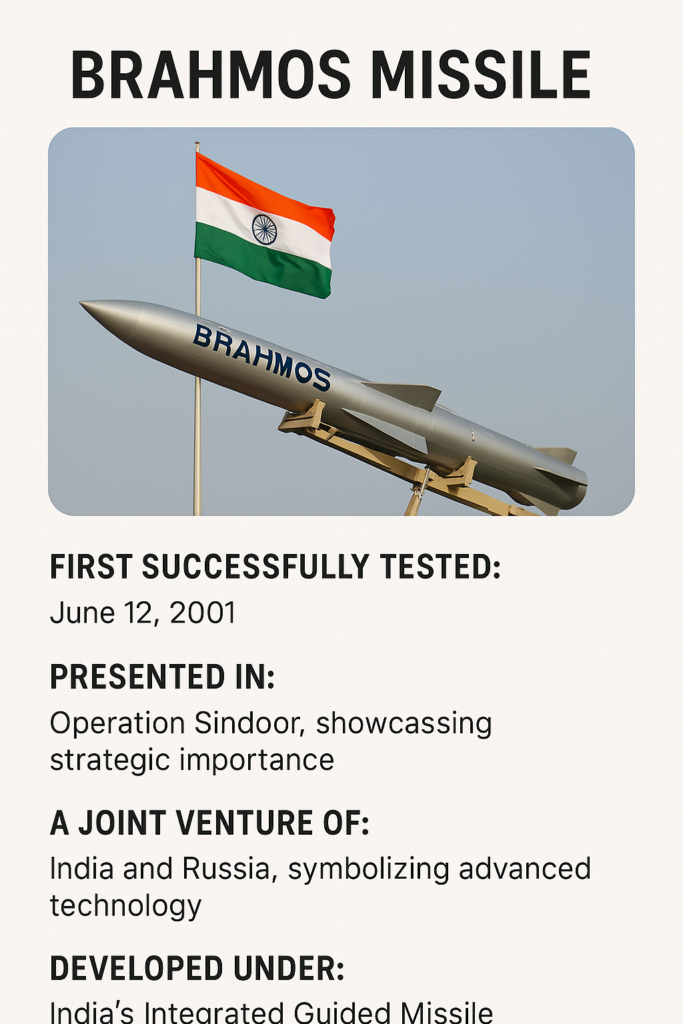
- First Combat Use: BrahMos was reportedly used for the first time in live conflict during Operation Sindoor, marking a major leap in India’s operational capability.
- Joint Indo-Russian Venture: Born from a 1998 agreement, BrahMos Aerospace merges India’s vision with Russia’s technological might.
- Named After Rivers: The missile’s name symbolizes strategic partnership — Brahmaputra (India) + Moskva (Russia).
- Versatile Platform Integration: Deployed on land, air, sea, and submarine platforms.
- Supersonic Speed: Travels at Mach 2.8 to 3.0, making it one of the fastest cruise missiles in the world.
- Stealth & Maneuverability: Low radar signature, high accuracy, and pinpoint maneuvering allow penetration into well-defended targets.
- BrahMos-NG: The Next Generation version will be lighter, stealthier, and capable of underwater combat — currently under development.
📘 Concept Explainer: Anatomy & Evolution of BrahMos
The BrahMos missile is a two-stage system:
- The first stage uses a solid propellant booster to gain initial thrust.
- The second stage, powered by a liquid-fuelled ramjet engine, pushes it beyond Mach 2.8.
It is capable of:
- Low-altitude flight (as low as 10m) for radar evasion.
- High-precision targeting with minimal collateral damage.
Variants:
- Ship-Based: Deployed on frontline naval destroyers and frigates for land-sea precision strikes.
- Land-Based: Mobile launchers operational in the Indian Army since 2007.
- Air-Launched: Integrated with Su-30 MKI, extending strategic air reach.
- Submarine-Launched: Enhances second-strike capability, tested in 2013.
- BrahMos-NG: Smaller, faster, and designed for multi-platform flexibility in future warfare scenarios.
🗺️ GS Paper Mapping
| Paper | Theme | Relevance |
|---|---|---|
| GS-3 | Science & Tech | Cruise Missile Technology, Ramjet Propulsion |
| GS-3 | Defence | Strategic deterrence, Make-in-India |
| GS-2 | International Relations | Indo-Russian Collaboration |
✨ A Thought Spark — by IAS Monk
When rivers meet and engineers dream,
A weapon of speed is born from the whisper of war.
Not just a missile, but a mark of mutual resolve —
Where science becomes sovereignty.
High Quality Mains Essay For Practice :
Word Limit 1000-1200
India’s Missile Capability: Past, Present and Future in the Fast-Changing Geopolitics
🪖 Introduction: The Arc of Strategic Sovereignty
In the theatre of 21st-century geopolitics, where diplomacy walks hand in hand with deterrence, a nation’s missile capability is more than just a symbol of military might — it is the architecture of its strategic autonomy. India’s missile journey, born from insecurity and built through innovation, now stands at a transformative threshold. From the ashes of 1962 to the era of Agni-V, and now BrahMos-NG and space-based platforms, India’s missile programme reflects both technological resilience and strategic foresight.
🔹 A Glimpse into the Past: From Vulnerability to Vision
India’s missile capability has roots in a difficult past. The 1962 war with China and the nuclear test by China in 1964 exposed India’s strategic vulnerability. The need for deterrence was no longer optional — it became existential.
India’s early efforts were driven by scientific visionaries like Dr. Vikram Sarabhai and Dr. APJ Abdul Kalam, and culminated in the launch of the Integrated Guided Missile Development Programme (IGMDP) in 1983. Under IGMDP, India developed five key missile systems:
- Prithvi (surface-to-surface)
- Agni (ballistic missile)
- Akash (surface-to-air)
- Trishul (short-range SAM)
- Nag (anti-tank)
The Agni series, particularly, marked India’s entry into the league of long-range missile powers. These developments were not just technological feats but strategic messages, asserting India’s resolve for credible minimum deterrence.
🔹 Present Arsenal: A Multifaceted Force
Today, India possesses a diverse and credible missile arsenal, spanning tactical, strategic, and cruise missile categories. Some key developments include:
🛰️ Agni Series
- Agni-I to Agni-V form the backbone of India’s nuclear delivery capability.
- Agni-V, with a range exceeding 5,000 km, brings almost all of Asia and parts of Europe within range.
🛡️ BrahMos Supersonic Cruise Missile
- A joint venture with Russia, BrahMos has been deployed in all three domains — land, sea, and air.
- Its speed (Mach 2.8–3.0), accuracy, and versatility make it a force multiplier in short-duration conflicts.
🚀 Submarine-Launched Ballistic Missiles (SLBMs)
- The K-series missiles (K-15, K-4) are developed for India’s nuclear submarines like INS Arihant.
- These offer a second-strike capability crucial for credible nuclear deterrence under India’s No First Use policy.
✈️ Air-Launched Weapons
- Integration of BrahMos on Su-30 MKI and development of ASTRA beyond-visual-range missiles boost air dominance.
🛰️ Hypersonic & Anti-Satellite (ASAT) Capability
- India is developing Hypersonic Technology Demonstrator Vehicles (HSTDV) and has tested ASAT weapons under Mission Shakti (2019), entering the elite club of space warfare nations.
🔹 Geopolitics of Missile Power: Why it Matters More Today
In an era where China is increasing its ballistic missile arsenal and Pakistan pursues tactical nuclear weapons, missile parity becomes essential for deterrence credibility.
- China’s DF-26 and DF-41 missiles, coupled with growing naval assertiveness, demand that India strengthen both land-based and maritime missile networks.
- Pakistan’s Nasr (short-range missile) raises the risk of nuclear escalation in the subcontinent, and India must maintain readiness across the escalation ladder.
Moreover, the global withdrawal from arms control treaties — such as the INF Treaty (by the U.S. and Russia) — hints at a future missile race where even space and cyber will become contested domains. India cannot afford to be passive.
🔹 Future Frontiers: Where India Must Accelerate
India’s strategic environment is not just changing — it is transforming rapidly. The future of Indian missile capability must address:
1. Hypersonic Glide Vehicles
- China and Russia have tested hypersonic weapons. India must fast-track the HSTDV program and associated scramjet technologies.
2. Multiple Independently Targetable Reentry Vehicles (MIRVs)
- These allow a single missile to deliver multiple warheads. India is reportedly testing MIRV-capable Agni-VI.
3. Advanced Ballistic Missile Defence (BMD)
- India’s two-tiered BMD (exo and endo-atmospheric interceptors) needs upgradation to deal with hypersonic and decoy-equipped missiles.
4. Artificial Intelligence in Missile Targeting
- Integrating AI and satellite-based surveillance for precision targeting and real-time tracking is the next leap forward.
5. Export Capability under Make-in-India
- With the success of BrahMos, India can become a key arms exporter to Southeast Asia, Latin America, and Africa.
🌐 Diplomatic & Ethical Dimensions
While technological advances are essential, India must continue to champion responsible missile behavior:
- Adhering to No First Use (NFU)
- Avoiding arms race in South Asia
- Maintaining transparency in testing
- Engaging in missile non-proliferation dialogues, even outside the Missile Technology Control Regime (MTCR)
Missile diplomacy can act as a balancing force, enabling India to counterbalance China and project responsible power.
🧭 Conclusion: The Missile is Might, but Vision is Vital
India’s missile capability is not just a product of engineering brilliance but a manifestation of civilizational confidence — that peace is preserved through preparedness, and sovereignty is safeguarded through strength.
As the geopolitical winds shift unpredictably, India’s missile development must embrace speed, scale, and sophistication — guided not by fear, but by foresight.
In this journey, every BrahMos roar, every Agni lift-off, and every Arihant silence at sea is a whisper of power, echoing the soul of a nation that chooses wisdom over war — but never without the will to win it.
🧠 Closing Quote
“Missiles can defend a nation, but only vision can define it.” — IAS Monk
Target IAS-26: Daily MCQs :
📌 Prelims Practice MCQs
Topic:
MCQ 1: Type – “How many of the above statements are correct?”
Consider the following statements regarding the BrahMos Missile:
1.BrahMos is a supersonic cruise missile jointly developed by India and Russia.
2.It can be launched from land, sea, air, and submarine platforms.
3.BrahMos uses a single-stage solid fuel propulsion system.
4.The name ‘BrahMos’ is derived from the Brahmaputra and Moskva rivers.
Which of the above statements are correct?
A) Only two
B) Only three
C) All four
D) Only one
🌀 Didn’t get it? Click here (▸) for the Correct Answer & Explanation
✅ Correct Answer: B) Only three
🧠 Explanation:
•1) Correct – BrahMos is a joint Indo-Russian venture.
•2) Correct – It has land, air, sea, and submarine-launched versions.
•3) Incorrect – It has two stages: a solid booster and a liquid ramjet engine.
•4) Correct – ‘BrahMos’ comes from Brahmaputra (India) and Moskva (Russia).
MCQ 2: Type – Two Statements
Consider the following two statements:
1.BrahMos is capable of hypersonic speeds exceeding Mach 5.
2.Agni-V is a ballistic missile capable of striking targets over 5,000 km away.
Which of the above statements is/are correct?
A) Only 1 is correct
B) Only 2 is correct
C) Both are correct
D) Neither is correct
🌀 Didn’t get it? Click here (▸) for the Correct Answer & Explanation
✅ Correct Answer: B) Only 2 is correct
🧠 Explanation:
•1) Incorrect – BrahMos is a supersonic missile (Mach 2.8–3.0), not hypersonic.
•2) Correct – Agni-V has a range over 5,000 km and forms part of India’s strategic arsenal.
MCQ 3: Type – “Which of the above statements is/are correct?”
Consider the following statements about India’s missile development:
1.The Integrated Guided Missile Development Programme (IGMDP) was launched in 2001.
2.ASTRA is India’s beyond-visual-range air-to-air missile.
3.The K-series missiles are designed for deployment from submarines.
Which of the above statements is/are correct?
A) 1 and 2 only
B) 2 and 3 only
C) 1 and 3 only
D) All of the above
🌀 Didn’t get it? Click here (▸) for the Correct Answer & Explanation
✅ Correct Answer: B) 2 and 3 only
🧠 Explanation:
•1) Incorrect – IGMDP was launched in 1983, not 2001.
•2) Correct – ASTRA is India’s BVR air-to-air missile.
•3) Correct – K-series (K-15, K-4) are submarine-launched ballistic missiles.
MCQ 4: Type – Direct Fact-Based
Which of the following best describes the purpose of Mission Shakti?
A) Launch of India’s first interplanetary probe
B) Deployment of a hypersonic glide vehicle
C) Testing of a submarine-launched missile system
D) Demonstration of India’s anti-satellite (ASAT) capability
🌀 Didn’t get it? Click here (▸) for the Correct Answer & Explanation.
✅ Correct Answer: D) Demonstration of India’s anti-satellite (ASAT) capability
🧠 Explanation:
•Mission Shakti, conducted in 2019, was India’s first successful test of an anti-satellite weapon, targeting a live satellite in low-Earth orbit.