













🌾 Knowledge Drop-101 | Seed Act 2026 and Its Impact on Farmers: Reforming India’s Seed Governance | IAS Prelims 2026-27 Highly Expected MCQs | Current Affairs & GS Essays on iasmonk.com
🌾 KD-101 | Seed Act 2026 and Its Impact on Farmers: Reforming India’s Seed Governance
Post Date: 23 January 2026
Syllabus: GS3 | Agriculture
📌 Context
Recently, the Union Minister for Agriculture and Farmers’ Welfare (MoA&FW) briefed Parliament on the features of the Seed Act 2026 and its expected impact on farmers.
The new law is proposed to be introduced in the upcoming Budget Session of Parliament, replacing the long-standing Seed Act, 1966.
The reform aims to modernise India’s seed regulatory framework in response to technological change, market expansion, farmer grievances, and food security needs.
🌱 Why a New Seed Act Was Needed
1) Outdated Nature of the Seed Act, 1966
- The 1966 Act was framed when:
- The seed market was largely public-sector driven
- Hybrid and improved varieties were limited
- Digital systems and traceability did not exist
- Today, the seed sector is private-sector dominated, technologically advanced, and market-driven.
- The old law lacks provisions for:
- Digital monitoring
- Modern certification standards
- Effective enforcement mechanisms
2) Lack of Seed Traceability
- Farmers often do not know:
- Who produced the seed
- Whether it was certified
- Who is responsible if crops fail
- This makes grievance redressal extremely difficult and encourages anonymity in the seed market.
3) Rising Menace of Fake and Substandard Seeds
- Farmers frequently report losses due to:
- Spurious or adulterated seeds
- Mislabelled varieties
- Poor germination and low yields
- Under the old Act:
- Penalties were minimal
- Prosecution was slow and ineffective
4) Protection of Farmers’ Rights
- While regulating commercial seed sales, it is crucial to protect farmers’ traditional rights:
- To save, use, exchange, and share seeds
- The reform seeks to ensure farmers are not criminalised for age-old practices.
5) Growth of the Private Seed Market
- Rapid expansion of private seed companies has led to:
- Uneven quality control
- Aggressive marketing to small farmers
- The old law does not adequately regulate:
- Registration of seed companies and dealers
- Accountability of private players
6) Food Security and Productivity Concerns
- Low-quality seeds directly affect:
- Crop output
- Food availability
- Price stability
- With climate change increasing agricultural risks, seed quality becomes even more critical.
7) Regulation of Imported Seeds
- India imports several seed varieties.
- Weak regulation can lead to:
- Entry of unsuitable or low-quality seeds
- Ecological and agronomic risks
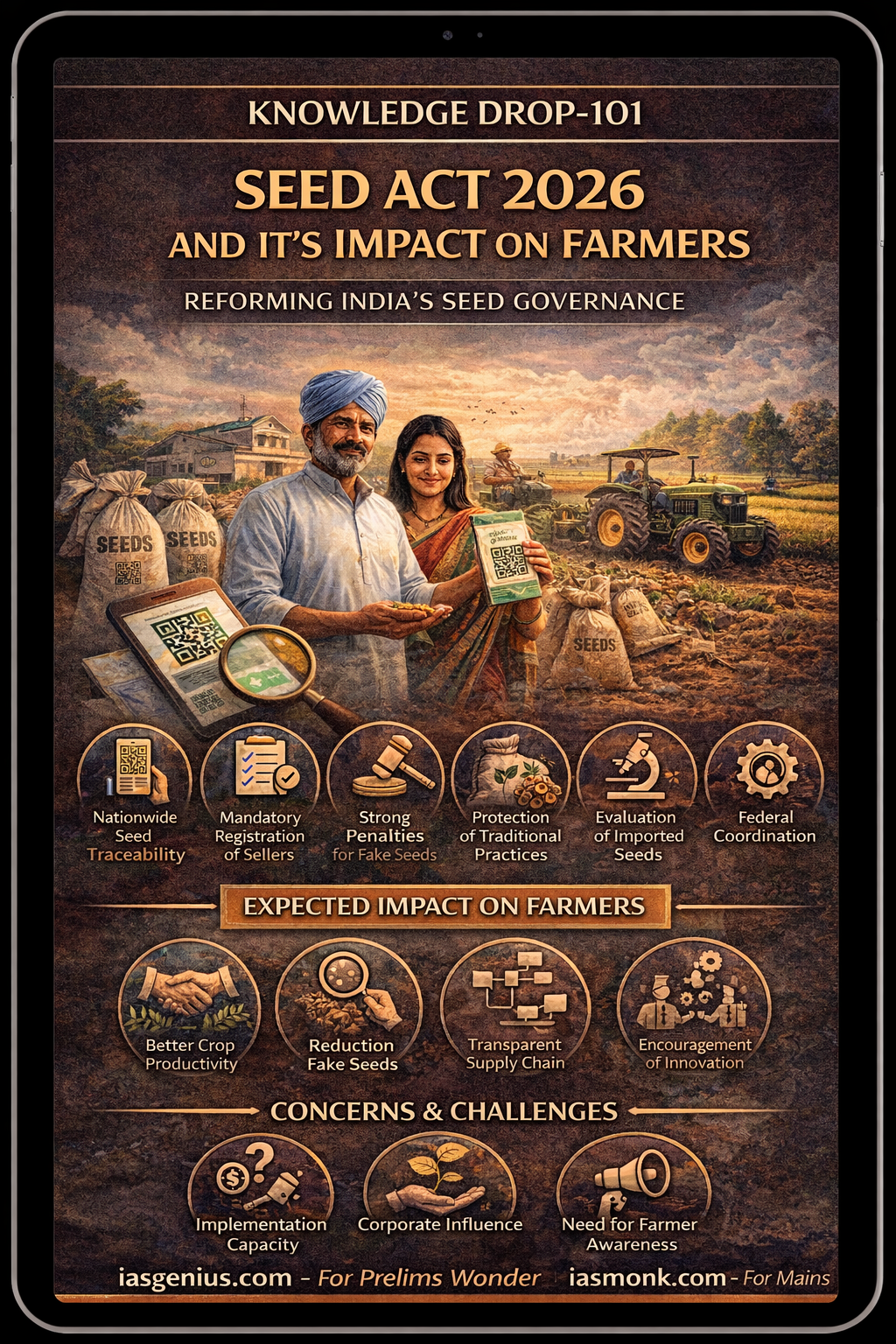
🧾 Key Features of the Seed Act 2026
1) Nationwide Seed Traceability
- Every commercial seed packet will carry a QR code.
- Scanning reveals:
- Who produced the seed
- Where it was sourced
- Which dealer sold it
- Objective:
- Eliminate anonymous seed sales
- Detect fake or substandard seeds quickly
- Enable faster remedies for farmers
2) Mandatory Registration of Seed Companies and Dealers
- Compulsory registration for:
- Seed producers
- Traders
- Dealers
- Unregistered vendors will not be allowed to sell seeds.
- Ensures only authorised players operate in the market.
3) Strong Penalties for Fake and Substandard Seeds
- Proposes:
- Fines up to ₹30 lakh
- Possible imprisonment for deliberate violations
- Aims to deter routine exploitation of farmers.
4) Protection of Traditional Seed Practices
- The government has clarified:
- Farmers can continue saving, sharing, and exchanging seeds within communities
- The law targets commercial seed quality, not traditional non-branded systems.
5) Scientific Evaluation of Imported Seeds
- Imported seeds will undergo rigorous scientific assessment before approval.
- Ensures they meet:
- Ecological
- Agronomic
- Quality criteria
- Protects Indian farmers from unsuitable foreign varieties.
6) Institutional Mechanisms and Federal Cooperation
- Likely creation of:
- Oversight committees at Central and State levels
- Improves coordination in:
- Seed testing
- Registration
- Enforcement
- Since Agriculture is a State Subject (Schedule VII), states will play a key role alongside the Centre.
🌾 Expected Impact on Farmers
1) Boost in Confidence and Crop Productivity
- Certified, traceable seeds improve:
- Germination rates
- Yield stability
- Risk management
- Farmers benefit from better production outcomes and reduced uncertainty.
2) Reduction of Fake and Substandard Seeds
- Traceability + registration + penalties will:
- Clean up the market
- Protect especially smallholder farmers, who are most vulnerable to poor-quality inputs.
3) Transparent Supply Chain
- Digital records allow:
- Informed purchase decisions
- Easier grievance redressal
- Over time:
- Trusted brands and reliable dealers gain prominence
- Market discipline improves
4) Encouragement of Domestic Seed Innovation
- Strengthens the role of:
- ICAR
- Agricultural universities
- Promotes:
- Locally adapted varieties
- Reduced dependence on imports
- Stronger public and domestic R&D ecosystem
⚠️ Concerns and Challenges
1) Implementation Capacity
- Effective enforcement needs:
- Well-equipped seed testing labs
- Trained personnel
- Digital infrastructure
- State capacities vary widely, risking uneven implementation.
2) Concerns Over Corporate Influence
- Stringent registration and compliance costs could:
- Concentrate market power among large corporations
- Marginalise small seed producers
3) Need for Farmer Awareness
- Digital traceability and complaint systems require:
- Training
- Outreach
- Awareness campaigns
- Without this, benefits may remain underutilised.
🏁 Conclusion
The Seed Act 2026 represents a decisive shift from a paper-era regulatory mindset to a digital, accountability-driven seed governance system. If implemented with sensitivity to federal realities and small farmer concerns, it can restore trust in seed markets, boost productivity, and strengthen India’s food security in an era of climate uncertainty.
🪔 IAS Monk Whisper
A seed is small, but the law that guards it decides whether a farmer harvests hope or loss.
Target IAS-2026+: Highly Expected Prelims MCQs :
📌 Prelims Practice MCQs
Topic: KD-101 | Seed Act 2026 and Its Impact on Farmers: Reforming India’s Seed Governance
MCQ 1 | TYPE 1 — How Many Statements Are Correct?
Consider the following statements regarding the Seed Act 2026:
1)The Seed Act 2026 is proposed to replace the Seed Act, 1966.
2)The 1966 Act was enacted when the seed market was largely private-sector dominated and digitally monitored.
3)The new Act proposes nationwide seed traceability using QR codes.
4)India’s agriculture being a State Subject implies states will have a role in implementing the Act.
How many of the above statements are correct?
A)Only one
B)Only two
C)Only three
D)All four
🌀 Didn’t get it? Click here (▸) for the Correct Answer & Explanation.
🟩 Correct Answer: C) Only three
🧠 Explanation:
1)✅ True – The Seed Act 2026 is meant to replace the Seed Act, 1966.
2)❌ False – In 1966, the seed market was largely public-sector driven and lacked digital systems.
3)✅ True – The Act proposes QR-code based nationwide traceability.
4)✅ True – Agriculture is a State Subject; states will play a key role in implementation.
MCQ 2 | TYPE 2 — Two-Statement Type
Consider the following statements:
Statement 1: The Seed Act 2026 focuses on regulating commercial seed quality while protecting farmers’ traditional rights to save and share seeds.
Statement 2: The Seed Act 2026 criminalises traditional non-branded seed practices to improve market discipline.
Which of the following is correct?
A)Only Statement 1 is correct
B)Only Statement 2 is correct
C)Both statements are correct
D)Neither statement is correct
🌀 Didn’t get it? Click here (▸) for the Correct Answer & Explanation.
🟩 Correct Answer: A) Only 1 is correct
🧠 Explanation:
Statement 1)✅ True – The Act targets commercial seed quality and protects traditional practices.
Statement 2)❌ False – The government has clarified that traditional practices will not be criminalised.
MCQ 3 | TYPE 3 — Code-Based Statement Selection
Consider the following statements regarding key features of the Seed Act 2026:
1)It proposes mandatory registration of seed companies, traders, and dealers.
2)It introduces strong penalties, including fines up to ₹30 lakh and possible imprisonment for deliberate violations.
3)It mandates that all seeds, including non-branded traditional seeds exchanged within communities, must be registered.
4)It provides for scientific evaluation of imported seeds before they enter the Indian market.
Which of the above statements are correct?
A)1, 2 and 3 only
B)1, 2 and 4 only
C)2 and 3 only
D)1, 2, 3 and 4
🌀 Didn’t get it? Click here (▸) for the Correct Answer & Explanation.
🟩 Correct Answer: B)1, 2 and 4 only
🧠 Explanation:
1)✅ True – Mandatory registration of commercial players is proposed.
2)✅ True – Fines up to ₹30 lakh and imprisonment are proposed for deliberate violations.
3)❌ False – Traditional non-branded seed practices are explicitly protected.
4)✅ True – Imported seeds will undergo rigorous scientific evaluation.
MCQ 4 | TYPE 4 — Direct Factual Question
Under the proposed Seed Act 2026, which of the following mechanisms is introduced to ensure nationwide seed traceability?
A)Blockchain-based farmer registry
B)Unique farmer identity numbers
C)QR code on every commercial seed packet
D)RFID tagging of seed warehouses
🌀 Didn’t get it? Click here (▸) for the Correct Answer & Explanation.
🟩 Correct Answer: C)QR code on every commercial seed packet
🧠 Explanation:
The Act proposes QR codes on seed packets so farmers can trace the producer, source, and seller.
MCQ 5 | TYPE 5 — UPSC 2025 Linkage Reasoning Format (I, II, III)
Consider the following statements:
Statement I:
The Seed Act 2026 aims to restore farmer confidence and improve crop productivity in India.
Statement II:
The Act introduces digital traceability, mandatory registration of sellers, and strong penalties against fake and substandard seeds.
Statement III:
The Act protects traditional seed-saving practices while strengthening scientific evaluation of imported seeds and domestic innovation.
Which one of the following is correct?
A)Both Statements II and III are correct and both explain Statement I
B)Both Statements II and III are correct but only one explains Statement I
C)Only one of the Statements II and III is correct and that explains Statement I
D)Neither Statement II nor Statement III is correct
🌀 Didn’t get it? Click here (▸) for the Correct Answer & Explanation.
🟩 Correct Answer: A)
🧠 Explanation:
Statement II)✅ True – Traceability, registration, and penalties improve seed quality and market trust, boosting productivity and confidence.
Statement III)✅ True – Protecting traditional practices while strengthening import checks and domestic innovation supports sustainable, reliable agriculture.
Together, both statements explain why the Seed Act 2026 aims to restore farmer confidence and improve crop productivity.