


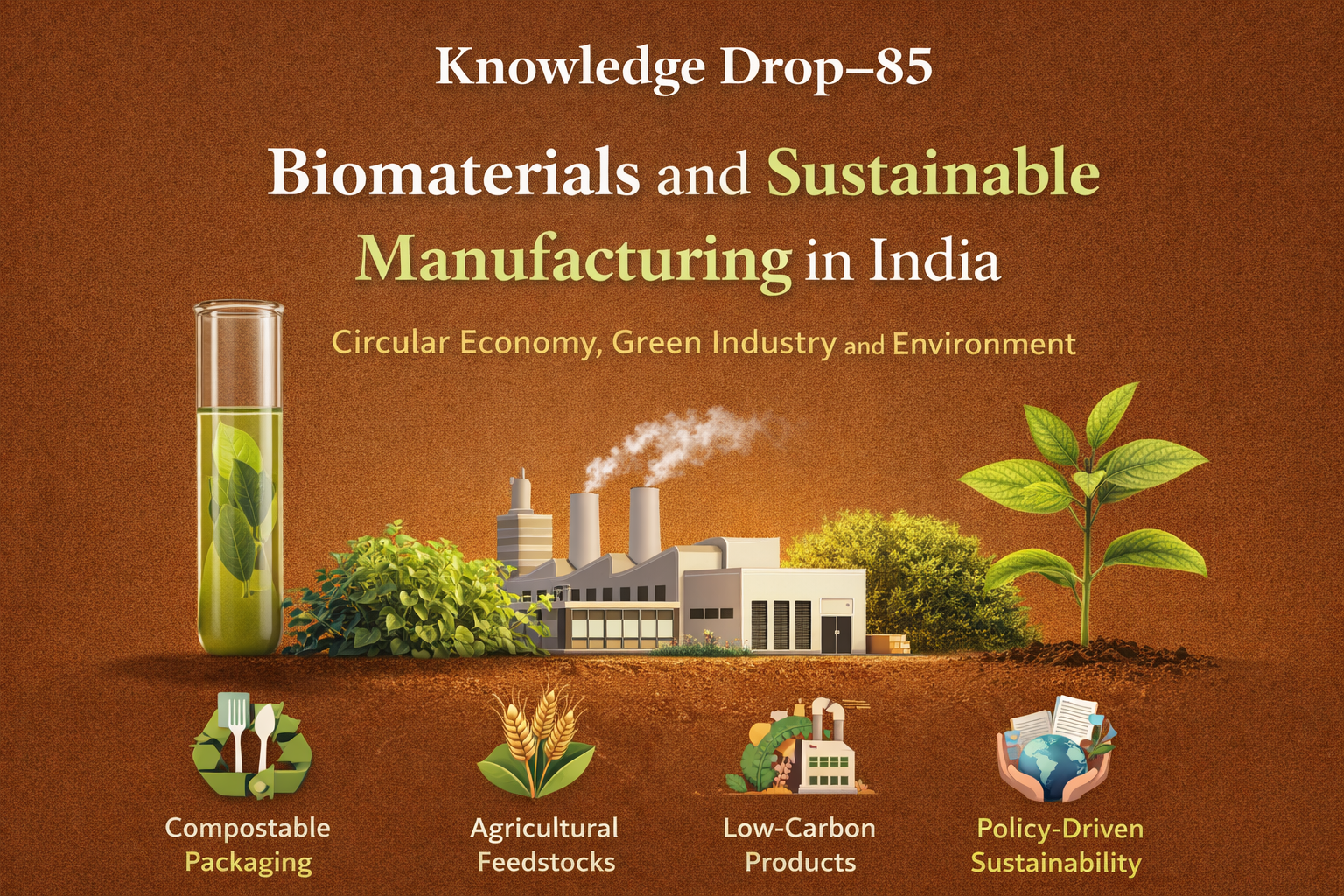
🌑Knowledge Drop – 85: Biomaterials and Sustainable Manufacturing in India
🔗 This Knowledge Drop has a Mains-focused companion on iasmonk.com
“For answer-writing enrichment beyond Prelims, visit iasmonk.com.”
For prelims: In-depth UPSC Level MCQs; Booster Notes; 20 Word-Flash Facts | You are very much here! For Mains: All G.S Papers: High Quality Essays ; Model Answers; Case Studies and beyond … Visit: iasmonk.com
Biomaterials and Sustainable Manufacturing in India
Post Date: 7 January 2026
Syllabus: GS Paper III | Economy & Environment
Theme: Sustainable Manufacturing × Circular Economy × Climate Action 🌱🏭
📍 In News
Biomaterials are emerging as a central pillar in the global shift toward sustainable manufacturing, as countries seek to reduce fossil-fuel dependence, lower carbon footprints, and build circular industrial systems.
🌿 What are Biomaterials?
Biomaterials are materials derived wholly or partly from biological sources, or engineered using biological processes, designed to replace or interact with conventional fossil-based materials.
They are increasingly used in:
1)Packaging
2)Textiles
3)Construction
4)Healthcare
Common examples
1)Bioplastics made from plant sugars or starch
2)Bio-based fibres used in textiles
3)Medical biomaterials such as biodegradable sutures and tissue scaffolds
🧪 Categories of Biomaterials
Biomaterials fall into three broad categories:
1)Drop-in biomaterials
These directly substitute petroleum-based materials and work in existing industrial systems.
2)Drop-out biomaterials
These require new processing, handling, or disposal systems.
3)Novel biomaterials
These offer entirely new properties and functions, enabling advanced applications.
🌍 Why Biomaterials Matter for India
Biomaterials help India achieve multiple objectives simultaneously.
1)Environmental sustainability through reduced plastic and carbon footprint
2)Industrial growth via new green manufacturing sectors
3)Revenue generation from value-added bio-products
4)Improved farmer incomes through use of agricultural residues
5)Reduced dependence on imported fossil-based plastics and chemicals
6)Alignment with bans on single-use plastics and climate action goals
They strengthen India’s competitiveness as global markets move toward low-carbon and circular products.
🌐 Global Scenario
European Union 🇪🇺
- The EU has adopted Packaging and Packaging Waste Regulation (EU) 2025/40 (PPWR).
- It recognises compostable packaging as environmentally beneficial for specific applications.
United States 🇺🇸
- The US leads in multiple biomaterial technologies.
- Federal procurement drives demand through the USDA BioPreferred Program.
United Arab Emirates 🇦🇪
- UAE is emerging as a major bioplastics manufacturing hub.
- Emirates Biotech is setting up a large PLA facility using Sulzer technology.
- Planned capacity: two phases of 80,000 tonnes per year each, operational from 2028.
- Once completed, it will be the world’s largest PLA plant.
🇮🇳 Present Status in India
India’s biomaterials sector is rapidly emerging as a strategic industrial opportunity.
1)Bioplastics market valued at about $500 million in 2024.
2)Strong growth forecast through the decade.
3)Major investment by Balrampur Chini Mills in a PLA plant in Uttar Pradesh.
4)Startups such as Phool.co converting temple flower waste into biomaterials.
5)Praj Industries developing a demonstration-scale bioplastics plant.
⚠️ Issues and Concerns
Despite strong potential, challenges remain.
1)Scaling feedstocks may compete with food crops.
2)Intensive agriculture could increase water stress and soil degradation.
3)Weak waste management and composting infrastructure.
4)Fragmented policies across agriculture, environment, and industry.
5)Risk of long-term import dependence if action is delayed.
🧭 Way Forward
To fully capitalise on biomaterials, India should:
1)Expand biomanufacturing infrastructure.
2)Improve feedstock productivity using advanced agricultural technologies.
3)Invest in R&D for drop-in and novel biomaterials.
4)Create clear regulations, labelling norms, and end-of-life pathways.
5)Use government procurement and targeted incentives to de-risk early investments.
6)Support pilot plants and shared testing facilities.
🪔 IAS Monk Whisper
“When industry learns to grow from fields instead of wells,
manufacturing becomes a partner of nature, not its rival.”
Target IAS-2026+: Highly Expected Prelims MCQs :
📌 Prelims Practice MCQs
Topic:
MCQ 1 | TYPE 1 — How Many Statements Are Correct?
Consider the following statements regarding biomaterials:
1)Biomaterials are derived wholly or partly from biological sources or biological processes.
2)Biomaterials are used only in the healthcare sector.
3)Bioplastics made from plant sugars are examples of biomaterials.
How many of the above statements are correct?
A)Only one
B)Only two
C)All three
D)None
🌀 Didn’t get it? Click here (▸) for the Correct Answer & Explanation.
🟩 Correct Answer: B)Only two
🧠 Explanation:
1)✅ True – Biomaterials originate from biological sources or processes.
2)❌ False – They are used in packaging, textiles, construction, and healthcare.
3)✅ True – Bioplastics from plant sugars or starch are biomaterials.
MCQ 2 | TYPE 2 — Two-Statement Type
Consider the following statements:
Statement I: Drop-in biomaterials can directly replace petroleum-based materials in existing systems.
Statement II: Drop-out biomaterials require new processing or disposal methods.
Which of the statements given above is/are correct?
A)Only Statement I is correct
B)Only Statement II is correct
C)Both Statement I and Statement II are correct
D)Neither Statement I nor Statement II are correct
🌀 Didn’t get it? Click here (▸) for the Correct Answer & Explanation.
🟩 Correct Answer: C)Both Statement I and Statement II are correct
🧠 Explanation:
Statement I ✅ True – Drop-in biomaterials are compatible with existing infrastructure.
Statement II ✅ True – Drop-out biomaterials need new systems.
MCQ 3 | TYPE 3 — Code-Based Statement Selection
Which of the following are advantages of promoting biomaterials in India?
1)Reduction in dependence on fossil-based imports
2)Additional income opportunities for farmers
3)Increase in single-use plastic consumption
Select the correct answer using the code given below:
A)1 and 2 only
B)2 and 3 only
C)1 and 3 only
D)1, 2 and 3
🌀 Didn’t get it? Click here (▸) for the Correct Answer & Explanation.
🟩 Correct Answer: A) 1 and 2 only
🧠 Explanation:
1)✅ True – Indigenous biomaterials reduce fossil import dependence.
2)✅ True – Agricultural residues create new revenue streams.
3)❌ False – Biomaterials aim to reduce plastic waste, not increase it.
MCQ 4 | TYPE 4 — Direct Factual Question
Which one of the following policies or programmes in the United States promotes the use of biomaterials through federal procurement?
A)Green Deal Programme
B)BioPreferred Program
C)Clean Energy Act
D)Farm to Factory Initiative
🌀 Didn’t get it? Click here (▸) for the Correct Answer & Explanation.
🟩 Correct Answer: B)BioPreferred Program
🧠 Explanation:
he USDA BioPreferred Program uses federal purchasing power to promote bio-based products.
MCQ 5 | TYPE 5 — UPSC 2025 Linkage Reasoning Format (I, II, III)
Consider the following statements:
Statement I:
Biomaterials are increasingly viewed as a critical pillar of sustainable manufacturing in India.
Statement II:
Biomaterials can reduce dependence on fossil-based materials while adding value to agricultural residues and bio-based feedstocks.
Statement III:
Global markets and regulatory regimes are shifting towards low-carbon and circular economy–based products.
Which one of the following is correct?
A)Both Statements II and III are correct and both explain Statement I
B)Both Statements II and III are correct but only one explains Statement I
C)Only one of the Statements II and III is correct and that explains Statement I
D)Neither Statement II nor Statement III is correct
🌀 Didn’t get it? Click here (▸) for the Correct Answer & Explanation.
🟩 Correct Answer: A)Both Statements II and III are correct and both explain Statement I
🧠 Explanation:
✅ Statement I correctly highlights the growing importance of biomaterials in sustainable manufacturing.
✅Statement II explains this importance by linking biomaterials to reduced fossil dependence and enhanced farmer incomes.
✅Statement III further explains the relevance by pointing to global shifts toward low-carbon and circular economy products, which strengthen the case for biomaterials.
📘 Knowledge Drop–85
Prelims Booster Notes (1-Page | Copy-Safe)
Topic: Biomaterials and Sustainable Manufacturing in India
GS: Paper III | Economy & Environment 🌱🏭
1) What are Biomaterials 🌿
1)Biomaterials are materials derived wholly or partly from biological sources or engineered using biological processes.
2)They are designed to replace or interact with conventional fossil-based materials.
3)They are increasingly used in packaging, textiles, construction, and healthcare.
2) Common Examples 🧪
1)Bioplastics produced from plant sugars or starch.
2)Bio-based fibres used in textiles.
3)Medical biomaterials such as biodegradable sutures and tissue scaffolds.
3) Categories of Biomaterials 🔬
1)Drop-in biomaterials directly substitute petroleum-based materials and work in existing systems.
2)Drop-out biomaterials require new processing, handling, or disposal systems.
3)Novel biomaterials offer entirely new functions and properties beyond conventional materials.
4) Importance for India 🇮🇳
1)Biomaterials support environmental sustainability by lowering carbon and plastic footprints.
2)They reduce dependence on imported fossil-based plastics and chemicals.
3)Agricultural feedstocks and residues gain value, creating new income streams for farmers 🌾.
4)They strengthen India’s competitiveness as global markets move toward low-carbon and circular products.
5)They align with domestic goals such as waste reduction and bans on single-use plastics.
5) Global Scenario 🌍
1)The European Union has adopted a binding Packaging and Packaging Waste Regulation recognising benefits of compostable packaging.
2)The United States promotes biomaterials through federal procurement policies such as the BioPreferred program.
3)The UAE is investing in large-scale PLA manufacturing, positioning itself as a global biomaterials hub.
6) Present Status in India 📈
1)India’s bioplastics market was valued at around $500 million in 2024.
2)Strong growth is expected through the decade.
3)Major investments include large PLA plants planned in Uttar Pradesh.
4)Startups are innovating by converting waste streams into biomaterials.
7) Issues and Concerns ⚠️
1)Scaling feedstocks may compete with food crops.
2)Intensive agriculture could increase water stress and soil degradation.
3)Weak waste management and composting infrastructure may limit environmental benefits.
4)Fragmented policies across agriculture, environment, and industry slow adoption.
5)Delayed action risks long-term dependence on imports.
8) Way Forward 🧭
1)Expand biomanufacturing infrastructure and shared facilities.
2)Improve feedstock productivity using advanced agricultural technologies.
3)Invest in R&D for drop-in and novel biomaterials.
4)Establish clear regulations, labelling norms, and end-of-life pathways ♻️.
5)Use government procurement and targeted incentives to reduce early investment risks.
🔑 High-Value Prelims Takeaways 🧠
1)Biomaterials link environment protection with industrial growth.
2)Drop-in biomaterials enable faster adoption through existing systems.
3)Farmer livelihoods can improve via value-added residues.
4)Global regulations are accelerating biomaterials demand.
5)Policy coherence and infrastructure are critical for scale-up.
⚡ Knowledge Drop–85
20 Flash Words (Prelims)
1)Biomaterials 🌿
2)Bio-based materials
3)Sustainable manufacturing 🏭
4)Circular economy
5)Bioplastics
6)Plant sugars and starch
7)Bio-based fibres
8)Drop-in biomaterials
9)Drop-out biomaterials
10)Novel biomaterials
11)Fossil fuel substitution
12)Farmer income linkage 🌾
13)Agricultural residues
14)Low-carbon products
15)Single-use plastic bans
16)Compostable packaging ♻️
17)PLA bioplastics
18)Green industrial growth
19)Waste-to-value approach
20)Policy-driven sustainability 🌍