




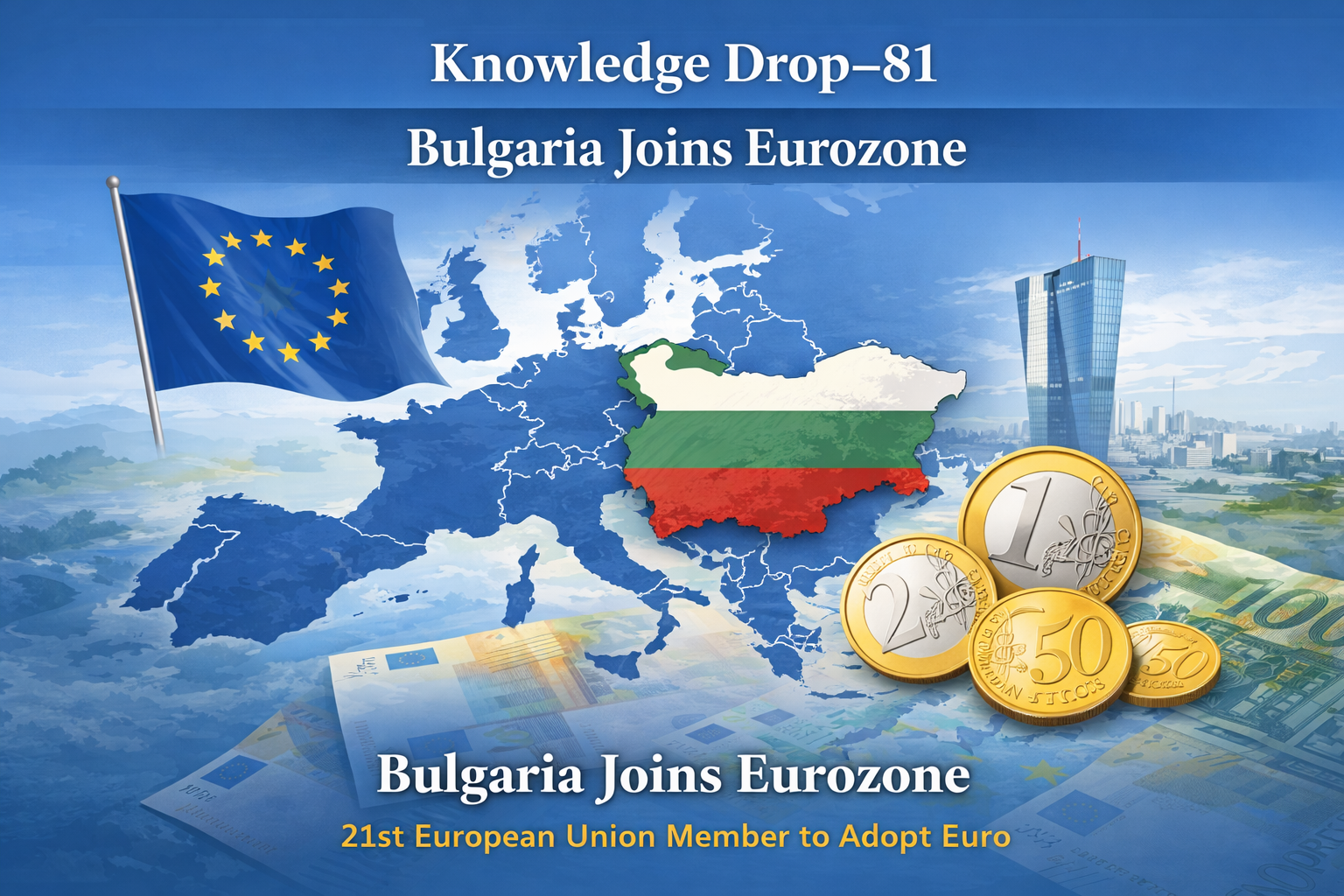
🌑Knowledge Drop – 81: Bulgaria Adopts Euro | Expansion of the Eurozone
🔗 This Knowledge Drop has a Mains-focused companion on iasmonk.com
“For answer-writing enrichment beyond Prelims, visit iasmonk.com.”
For prelims: In-depth UPSC Level MCQs; Booster Notes; 20 Word-Flash Facts | You are very much here! For Mains: All G.S Papers: High Quality Essays ; Model Answers; Case Studies and beyond … Visit: iasmonk.com
Bulgaria Adopts Euro | Expansion of the Eurozone
Post Date: 3 January 2026
Syllabus: GS Paper II | International Relations
Theme: European Union × Eurozone × Monetary Integration
📍 In News
Bulgaria has become the 21st country to adopt the euro, nearly two decades after joining the European Union, marking a significant milestone in the deepening of European economic and monetary integration.
🌍 About Bulgaria (Quick Geography Refresh)
- Located in southeastern Europe, in the eastern Balkan Peninsula
- Borders:
- Romania (north, Danube River)
- Black Sea (east)
- Turkey & Greece (south)
- North Macedonia (southwest)
- Serbia (west)
- Capital: Sofia, situated in a mountainous basin in western Bulgaria
🏛️ Background: European Union & Monetary Union
- The Maastricht Treaty (1992) laid the foundation of the European Union.
- It created the European Economic and Monetary Union (EMU), enabling:
- A common currency (euro)
- A unified central banking system
- A single economic region
- The euro was first introduced in 12 countries on 1 January 2002.
- Croatia was the most recent entrant before Bulgaria, joining in 2023.
- The European Central Bank (ECB) manages eurozone monetary policy.
💶 What is the Eurozone?
- The eurozone (euro area) consists of EU member states that have:
- Fully adopted the euro as legal tender
- Transferred monetary policy authority to the ECB
- With Bulgaria’s entry:
- 21 of 27 EU members are now part of the eurozone
- 6 EU members continue using national currencies
Special Cases
- Microstates using euro by agreement:
Andorra, Monaco, Vatican City, San Marino - Euro users without agreement:
Kosovo and Montenegro - These are not considered eurozone members.
✅ Eligibility for Eurozone Membership
- EU countries (except Denmark, which has an opt-out) must meet convergence criteria, including:
- Price stability
- Sound public finances
- Exchange rate stability
- Interest rate convergence
- Requires:
- Legal alignment with EU treaties
- Integration into the single market
- Adjustment of national monetary and fiscal frameworks
- Objective: ensure smooth entry without destabilising the eurozone.
📈 Benefits of Joining the Eurozone
- Price stability and lower interest rates
- Elimination of currency exchange costs
- Easier trade, labour, and capital mobility
- Greater price transparency for consumers
- Seat on the ECB’s Governing Council
- Enhanced protection from external economic shocks
- Strengthens:
- European integration
- Tourism
- Investment confidence
- The euro is the world’s second-largest reserve currency, after the US dollar.
🧭 Big Picture (GS-2 Perspective)
Bulgaria’s euro adoption reflects the EU’s continued push toward deeper economic integration, even amid global economic uncertainty and geopolitical fragmentation.
🪔 IAS Monk Whisper
“A common currency is not merely an economic tool;
it is a shared promise of trust, discipline, and destiny.”
Target IAS-2026+: Highly Expected Prelims MCQs :
📌 Prelims Practice MCQs
Topic:
MCQ 1 | TYPE 1 — How Many Statements Are Correct?
Consider the following statements regarding Bulgaria and the eurozone:
1)Bulgaria adopted the euro nearly two decades after joining the European Union.
2)With Bulgaria’s entry, the eurozone now consists of 21 EU member states.
3)All European countries using the euro are considered eurozone members.
How many of the above statements are correct?
A)Only one
B)Only two
C)All three
D)None
🌀 Didn’t get it? Click here (▸) for the Correct Answer & Explanation.
🟩 Correct Answer: B) Only two
🧠 Explanation:
1)✅ True – Bulgaria joined the EU earlier and adopted the euro almost 20 years later.
2)✅ True – Bulgaria became the 21st eurozone member.
3)❌ False – Kosovo and Montenegro use the euro but are not eurozone members.
MCQ 2 | TYPE 2 — Two-Statement Type
Consider the following statements:
Statement I: The Maastricht Treaty laid the foundation for the European Economic and Monetary Union.
Statement II: The Maastricht Treaty directly introduced the euro as legal tender in all EU member states.
Which of the statements given above is/are correct?
A)Only Statement I is correct
B)Only Statement II is correct
C)Both Statement I and Statement II are correct
D)Neither Statement I nor Statement II is correct
🌀 Didn’t get it? Click here (▸) for the Correct Answer & Explanation.
🟩 Correct Answer: A)Only Statement I is correct
🧠 Explanation:
tatement I ✅ True – Maastricht Treaty (1992) created the EMU framework.
Statement II ❌ False – The euro was introduced later in phases and not by automatic adoption.
MCQ 3 | TYPE 3 — Code-Based Statement Selection
Which of the following are benefits of joining the eurozone?
1)Reduction in currency exchange costs
2)Greater price transparency across member states
3)Automatic fiscal transfers from the EU budget
Select the correct answer using the code given below:
A)1 and 2 only
B)2 and 3 only
C)1 and 3 only
D)1, 2 and 3
🌀 Didn’t get it? Click here (▸) for the Correct Answer & Explanation.
🟩 Correct Answer: A) 1 and 2 only
🧠 Explanation:
1)✅ True – Common currency removes exchange costs.
2)✅ True – Prices become comparable across countries.
3)❌ False – Fiscal policy remains largely national; no automatic transfers.
MCQ 4 | TYPE 4 — Direct Factual Question
Which one of the following institutions manages monetary policy for the eurozone?
A)European Commission
B)European Central Bank
C)European Council
D)International Monetary Fund
🌀 Didn’t get it? Click here (▸) for the Correct Answer & Explanation.
🟩 Correct Answer: B)
🧠 Explanation:
The ECB is responsible for eurozone monetary policy.
Other bodies handle political or advisory roles.
MCQ 5 | TYPE 5 — UPSC 2025 Linkage Reasoning Format (I, II, III)
With reference to the eurozone, consider the following pairs:
1)Andorra – Uses euro by agreement with the EU
2)Kosovo – Uses euro without formal EU agreement
3)Denmark – Mandatory adopter of the euro
Which of the pairs given above is/are correctly matched?
A)1 and 2 only
B)2 and 3 only
C)1 and 3 only
D)1, 2 and 3
🌀 Didn’t get it? Click here (▸) for the Correct Answer & Explanation.
🟩 Correct Answer: A)
🧠 Explanation:
1)✅ True – Andorra uses the euro through an agreement.
2)✅ True – Kosovo uses the euro unilaterally.
3)❌ False – Denmark has an opt-out from adopting the euro.
📘 Knowledge Drop–81
Prelims Booster Notes (1-Page | Ultra-Crisp)
Topic: Bulgaria Joins Eurozone
GS: Paper II | International Relations
Keywords: European Union, Eurozone, EMU, ECB, Maastricht Treaty
1️⃣ Bulgaria: Key Facts
- Located in southeastern Europe, eastern Balkan Peninsula
- Borders:
- Romania (north, Danube River)
- Black Sea (east)
- Turkey & Greece (south)
- North Macedonia (southwest)
- Serbia (west)
- Capital: Sofia (mountain basin location)
2️⃣ European Union & Monetary Integration
- Maastricht Treaty (1992):
- Established the European Union
- Created the European Economic and Monetary Union (EMU)
- EMU features:
- Common market
- Common currency (euro)
- Unified monetary policy
- European Central Bank (ECB):
- Conducts monetary policy for eurozone
- Manages price stability
3️⃣ Eurozone Overview
- Eurozone = EU members that:
- Use the euro as sole legal tender
- Transfer monetary sovereignty to ECB
- With Bulgaria:
- 21 out of 27 EU members in eurozone
- 6 EU members retain national currencies
4️⃣ Euro Adoption Timeline
- Euro introduced in 2002 in 12 countries
- Croatia joined in 2023
- Bulgaria joined in 2026
- Denmark:
- EU member
- Permanent opt-out from euro adoption
5️⃣ Special Euro Users
- By agreement with EU:
Andorra, Monaco, Vatican City, San Marino - Without agreement:
Kosovo, Montenegro - These are not eurozone members
6️⃣ Eligibility for Eurozone Membership
- Must meet convergence (Maastricht) criteria:
- Price stability
- Sound public finances
- Stable exchange rates
- Interest rate convergence
- Requires:
- Legal alignment with EU treaties
- Integration into single market
- Monetary policy adjustment
7️⃣ Benefits of Joining the Eurozone
- Lower transaction and exchange costs
- Price transparency across countries
- Easier trade, labour & capital mobility
- Lower interest rates
- Protection from external shocks
- Seat in ECB Governing Council
- Euro is second-largest global reserve currency
8 High-Value Prelims Takeaways 🔑
1)Eurozone and EU are not the same
2)Not all euro users are eurozone members
3)Maastricht Treaty enabled the euro, not imposed it
4)ECB controls monetary policy, not fiscal policy
5)Bulgaria is the 21st eurozone member
⚡ Knowledge Drop–81
20 Flash Words (Prelims)
1)Bulgaria joins eurozone
2)21st eurozone member
3)European Union integration
4)Maastricht Treaty 1992
5)European Economic and Monetary Union
6)Euro introduced in 2002
7)Croatia joined eurozone 2023
8)European Central Bank
9)Common currency euro
10)Eurozone monetary policy
11)Convergence criteria
12)Price stability requirement
13)Exchange rate stability
14)Interest rate convergence
15)Denmark opt-out
16)Andorra euro agreement
17)Kosovo unilateral euro use
18)Second-largest reserve currency
19)Lower transaction costs
20)Price transparency