
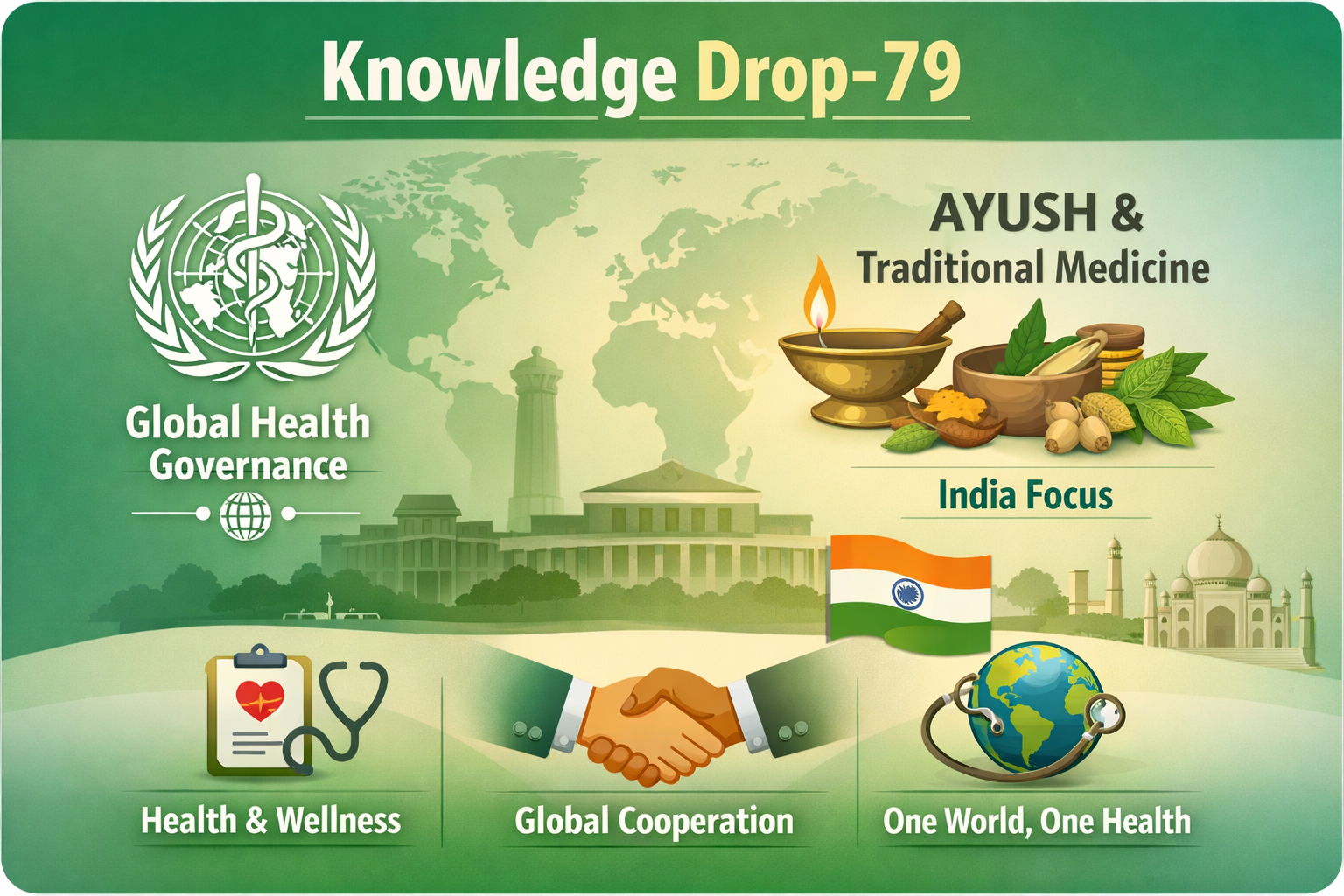
🌑Knowledge Drop – 79: Second WHO Global Summit on Traditional Medicine
🔗 This Knowledge Drop has a Mains-focused companion on iasmonk.com
“For answer-writing enrichment beyond Prelims, visit iasmonk.com.”
For prelims: In-depth UPSC Level MCQs; Booster Notes; 20 Word-Flash Facts | You are very much here! For Mains: All G.S Papers: High Quality Essays ; Model Answers; Case Studies and beyond … Visit: iasmonk.com
Second WHO Global Summit on Traditional Medicine
post Date: 01-01-2026
GS-2 | Health | Global Governance
🧭 Context
India hosted the Second WHO Global Summit on Traditional Medicine in New Delhi, reaffirming its leadership in shaping the global agenda on traditional, complementary and integrative medicine (TCIM).
🎯 Theme
“Restoring Balance for People and Planet:
The Science and Practice of Well-Being.”
🧠 What Is Traditional Medicine?
Traditional medicine refers to codified and non-codified health systems rooted in cultural practices, knowledge, and philosophies that pre-date biomedicine, and evolve with scientific validation.
It emphasizes nature-based remedies, holistic care, and personalised healing, aiming to restore balance between mind, body, and environment.
🏛️ Key Outcomes of the Summit
🔹 Major Initiatives Launched
• My Ayush Integrated Services Portal (MAISP):
A unified digital platform integrating services, research, and governance across the Ayush ecosystem.
• Ayush Mark:
Envisioned as a global quality benchmark for Ayush products and services.
• Traditional Medicine Global Library (TMGL):
The world’s largest digital repository of traditional, complementary and integrative medicine knowledge.
🌐 Global & Institutional Significance
• The summit is grounded in the Gujarat Declaration (2023)
• Aligned with WHO’s Global Traditional Medicine Strategy 2025–2034
• Strengthens India’s role as a knowledge hub and norm-setter in traditional medicine governance
🤝 International Collaboration
• Centre of Excellence for BIMSTEC countries
• India–Japan partnership in traditional medicine research
• Reinforced the role of the WHO Global Traditional Medicine Centre (GTMC) in Jamnagar, Gujarat
💻 Technology & Innovation Focus
The summit stressed the use of digital health platforms and AI tools for:
• Research and evidence generation
• Data standardisation
• Wider global access to traditional medicine
🌱 Why It Matters for Prelims
• India hosted both the 1st (2023) and 2nd (2026) WHO Global Summits
• Institutionalisation of Ayush at global governance level
• Clear linkage with WHO strategy cycles
• Expansion of digital public infrastructure into health governance
🧠 IASGenius Prelims Whisper
India is not exporting medicines alone — it is exporting health systems.
Target IAS-2026+: Highly Expected Prelims MCQs :
📌 Prelims Practice MCQs
Topic:
MCQ 1 | TYPE 1 — How Many Statements Are Correct?
Consider the following statements regarding the Second WHO Global Summit on Traditional Medicine:
1)India hosted the second WHO Global Summit on Traditional Medicine in New Delhi.
2)The theme focused on integrating traditional medicine exclusively into emergency healthcare.
3)The summit aligned with WHO’s Global Traditional Medicine Strategy 2025–2034.
Which of the above statements is/are correct?
A)1 and 3 only
B)2 and 3 only
C)1 and 2 only
D)1, 2 and 3
🌀 Didn’t get it? Click here (▸) for the Correct Answer & Explanation.
🟩 Correct Answer: A)1 and 3 only
🧠 Explanation:
1)✅True – KD states India hosted the 2nd summit in New Delhi.
2)❌False – Theme is “Restoring Balance for People and Planet…” not emergency-only integration.
3)✅True – KD states alignment with WHO Global Traditional Medicine Strategy 2025–2034.
MCQ 2 | TYPE 2 — Two-Statement Type
Statement I:
The My Ayush Integrated Services Portal aims to digitally integrate services, research and governance in the Ayush sector.
Statement II:
Ayush Mark is envisaged as a global quality benchmark for Ayush products and services.
Which of the statements given above is/are correct?
A)Only Statement I
B)Only Statement II
C)Both Statement I and Statement II
D)Neither Statement I nor Statement II
🌀 Didn’t get it? Click here (▸) for the Correct Answer & Explanation.
🟩 Correct Answer: C)Both Statement I and Statement II
🧠 Explanation:
Statement I:✅True – MAISP is described as a master digital portal for services, research and governance.
Statement II:✅True – Ayush Mark is described as a global quality benchmark for products/services.
MCQ 3 | TYPE 3 — Code-Based Statement Selection/ Conceptual
raditional medicine, as defined by WHO, primarily emphasizes:
A)Standardised pharmaceutical formulations only
B)Nature-based, holistic and experience-derived healthcare systems
C)Emergency and trauma-focused medical practices
D)Exclusive reliance on non-scientific belief systems
🌀 Didn’t get it? Click here (▸) for the Correct Answer & Explanation.
🟩 Correct Answer: B)Nature-based, holistic and experience-derived healthcare systems
🧠 Explanation:
WHO’s framing includes practices/skills/knowledge rooted in cultural contexts, emphasizing nature-based remedies, holistic and personalized balance-oriented care. It is not limited to pharma-only, not emergency-only, and not anti-science.
MCQ 4 | TYPE 4 — Direct Factual Question/ Match the following
Match the following initiatives with their purpose:
A)Traditional Medicine Global Library
B)Ayush Mark
C)MAISP
1)Digital governance and service integration
2)Global digital repository of traditional medicine
3)Quality certification benchmark
Which of the following is correct?
A)A-2, B-3, C-1
B)A-1, B-2, C-3
C)A-3, B-1, C-2
D)A-2, B-1, C-3
🌀 Didn’t get it? Click here (▸) for the Correct Answer & Explanation.
🟩 Correct Answer: A)A-2, B-3, C-1
🧠 Explanation:
A)TMGL – ✅2 (largest digital repository of traditional medicine).
B)Ayush Mark – ✅3 (global quality benchmark).
C)MAISP – ✅1 (integrated digital portal for services/research/governance).
MCQ 5 | TYPE 5 — UPSC 2025 Linkage Reasoning Format (I, II, III)
Consider the following statements:
Statement I:
Traditional medicine is gaining renewed global policy relevance.
Statement II:
WHO is promoting evidence-based integration of traditional, complementary and integrative medicine.
Statement III:
Digital platforms and AI are being leveraged to standardise research and access in traditional medicine.
Which one of the following is correct?
A)Both Statements II and III are correct and both explain Statement I
B)Both Statements II and III are correct but only one explains Statement I
C)Only one of the Statements II and III is correct and that explains Statement I
D)Neither Statement II nor Statement III is correct
🌀 Didn’t get it? Click here (▸) for the Correct Answer & Explanation.
🟩 Correct Answer: A)
🧠 Explanation:
Statement II explains renewed relevance because WHO’s strategy and summit stress evidence-based integration and governance.
Statement III explains renewed relevance because digital tools and AI improve access, research, data generation and standardisation, scaling global adoption.
Both together support and explain Statement I.
📗 KD-79 Prelims Booster Notes (1-Page)
Why in News?
India hosted the 2nd WHO Global Summit on Traditional Medicine (2026) in New Delhi.
Theme
“Restoring Balance for People and Planet: The Science and Practice of Well-Being”
Key Initiatives Launched
• MAISP – My Ayush Integrated Services Portal
• Ayush Mark – Global quality benchmark
• Traditional Medicine Global Library (TMGL) – World’s largest digital repository
Policy Alignment
• Gujarat Declaration (2023)
• WHO Global Traditional Medicine Strategy 2025–2034
International Collaboration
• BIMSTEC Centre of Excellence
• India–Japan partnership
• WHO Global Traditional Medicine Centre (GTMC), Jamnagar
Traditional Medicine (WHO Definition)
• Codified & non-codified systems
• Nature-based, holistic, personalised
• Pre-dates biomedicine; evolves with science
India’s Leadership
• Host of 1st (2023) & 2nd (2026) summits
• Global agenda-setter for TCIM integration
⚡ KD-79 | 20-Word Flash Facts (Prelims)
1)India hosted the 2nd WHO Global Summit on Traditional Medicine in 2026.
2)Theme emphasised balance between people, planet and well-being.
3)MAISP integrates Ayush services, research and governance digitally.
4)Ayush Mark aims global quality certification.
5)TMGL is the world’s largest digital traditional medicine repository.
6)Summit aligned with WHO strategy 2025–2034.
7)Gujarat Declaration adopted in 2023.
8)WHO GTMC is located in Jamnagar, Gujarat.
9)Traditional medicine predates biomedicine.
10)WHO promotes evidence-based TCIM integration.
11)AI tools are being applied in traditional medicine research.
12)India hosted first summit in Gandhinagar, 2023.
13)Traditional medicine is holistic and nature-based.
14)BIMSTEC Centre of Excellence announced.
15)India–Japan collaboration launched.
16)TCIM includes codified and non-codified systems.
17)Summit stressed data generation and regulation.
18)Digital libraries support global standardisation.
19)Traditional medicine contributes to preventive healthcare.
20)India leads global traditional medicine diplomacy.