






🌑Knowledge Drop – 78: CSR Inherently Includes Environmental Responsibility: Supreme Court (2025)
🔗 This Knowledge Drop has a Mains-focused companion on iasmonk.com
“For answer-writing enrichment beyond Prelims, visit iasmonk.com.”
For prelims: In-depth UPSC Level MCQs; Booster Notes; 20 Word-Flash Facts | You are very much here! For Mains: All G.S Papers: High Quality Essays ; Model Answers; Case Studies and beyond … Visit: iasmonk.com
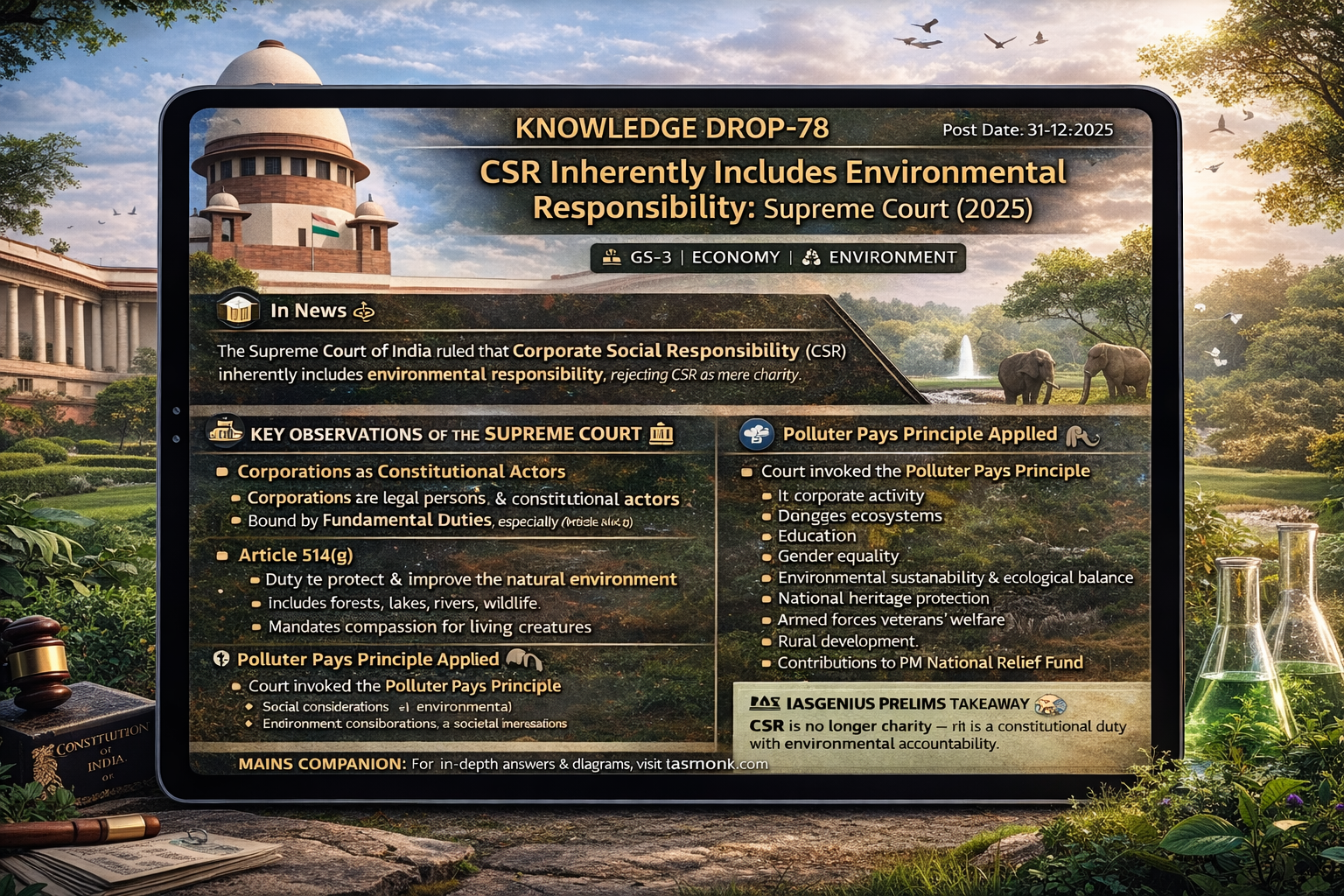
CSR Inherently Includes Environmental Responsibility: Supreme Court (2025)
Post Date: 31-12-2025
Syllabus: GS-3 | Economy • Environment
In News ⚖️
The Supreme Court of India ruled that Corporate Social Responsibility (CSR) inherently includes environmental responsibility, rejecting the view that CSR is merely voluntary philanthropy.
Key Observations of the Supreme Court 🏛️
1. Corporations as Constitutional Actors
- Corporations are not merely profit-making entities
- As legal persons, they are constitutional actors within society
- Hence, corporations are bound by Fundamental Duties
📜 Relevant Constitutional Provision
- Article 51A(g) of the Constitution:
- Duty to protect and improve the natural environment
- Includes forests, lakes, rivers, wildlife
- Mandates compassion for living creatures
2. CSR Is a Constitutional Obligation, Not Charity
- CSR, especially in environmental matters, is:
- Not voluntary philanthropy
- Not discretionary benevolence
- CSR flows from:
- Constitutional duties
- Statutory mandate under company law
3. Polluter Pays Principle Applied 🐘
- Court invoked the Polluter Pays Principle
- If corporate activity:
- Damages ecosystems
- Threatens endangered species or habitats
- Then corporations must:
- Bear full cost of restoration
- Fund wildlife and habitat conservation
What is Corporate Social Responsibility (CSR)? 🏭
- A management framework integrating:
- Social considerations
- Environmental considerations
- Reflects long-term commitment to societal welfare
Evolution of CSR in India 🇮🇳
- 2009: Voluntary Guidelines (Ministry of Corporate Affairs)
- 2011: National Voluntary Guidelines on Social, Environmental & Economic Responsibilities
- Parliamentary Standing Committee (21st Report):
- Recommended statutory CSR
- Emphasised disclosure for compliance
- Companies Act, 2013:
- Made CSR mandatory for eligible companies
CSR Eligibility Criteria 📊
Under Section 135(1) of the Companies Act, 2013:
Companies must spend 2% of average net profits of last three years if they have:
- Net worth ≥ ₹500 crore, or
- Turnover ≥ ₹1,000 crore, or
- Net profit ≥ ₹5 crore
⚠️ Important Clarification
- Holding or subsidiary companies:
- Must comply only if they independently meet eligibility criteria
Permitted CSR Activities (Schedule VII) 📋
Includes:
- Eradicating hunger, poverty, malnutrition
- Promoting health care & sanitation
- Promoting education
- Gender equality & women empowerment
- Environmental sustainability & ecological balance
- Protection of national heritage, art & culture
- Welfare of armed forces veterans
- Rural development projects
- Contributions to PM National Relief Fund
Importance of CSR 🌱
- Promotes equitable development
- Encourages environmentally responsible practices
- Mandates disclosure of CSR spending
- Supports:
- Education
- Healthcare
- Sanitation
- Livelihoods
- Aligns with government initiatives:
- Swachh Bharat
- Skill India
- Digital India
Emerging Issues & Challenges ⚠️
- Impact deficit: High spending, low measurable outcomes
- Greenwashing risks: Cosmetic compliance over real impact
- Spatial imbalance: CSR clustered near urban/industrial zones
- Compliance burden: Smaller firms face reporting challenges
Conclusion 🧭
CSR in India has evolved from voluntary charity to a constitutional, statutory, and ethical obligation.
The Supreme Court’s ruling firmly integrates environmental protection into CSR, aligning corporate profits with sustainable and inclusive national development.
IASGenius Prelims Takeaway 🧠
CSR is no longer charity — it is a constitutional duty with environmental accountability.
Target IAS-2026+: Highly Expected Prelims MCQs :
📌 Prelims Practice MCQs
Topic:
MCQ 1 | TYPE 1 — How Many Statements Are Correct?
Consider the following statements regarding the Supreme Court’s ruling on Corporate Social Responsibility (CSR):
1)The Court held that corporations are constitutional actors within society.
2)The Court ruled that CSR obligations arise only from statutory law.
3)Corporations are bound by Fundamental Duties under Article 51A.
4)Environmental responsibility is inherent within CSR.
How many of the above statements are correct?
(a)Only one
(b)Only two
(c)Only three
(d)All four
🌀 Didn’t get it? Click here (▸) for the Correct Answer & Explanation.
🟩 Correct Answer:(c)Only three
🧠 Explanation:
1)✅True – Corporations were recognised as constitutional actors.
2)❌False – CSR flows from constitutional duties as well, not only statutes.
3)✅True – Article 51A duties apply to corporations as legal persons.
4)✅True – Environmental responsibility is integral to CSR.
MCQ 2 | TYPE 2 — Two-Statement Type
Consider the following statements:
Statement I:Article 51A(g) mandates protection and improvement of the natural environment.
Statement II:Article 51A(g) applies only to individual citizens and not to corporate entities.
Which of the statements given above is/are correct?
(a)Only Statement I
(b)Only Statement II
(c)Both Statement I and II
(d)Neither Statement I nor Statement II
🌀 Didn’t get it? Click here (▸) for the Correct Answer & Explanation.
🟩 Correct Answer: (a)Only Statement I
🧠 Explanation:
Statement I:✅True – Environmental protection is mandated.
Statement II:❌False – The Court extended this duty to corporations as legal persons.
MCQ 3 | TYPE 3 — Code-Based Statement Selection
With reference to Corporate Social Responsibility (CSR) in India, consider the following statements:
1)CSR was made mandatory under the Companies Act, 2013.
2)Companies with net profit of ₹5 crore or more must spend on CSR.
3)Holding companies must comply with CSR even if they do not meet eligibility criteria.
Which of the statements given above is/are correct?
(a)1 and 2 only
(b)2 and 3 only
(c)1 only
(d)1,2 and 3
🌀 Didn’t get it? Click here (▸) for the Correct Answer & Explanation.
🟩 Correct Answer: (a)1 and 2 only
🧠 Explanation:
1)✅True – CSR became statutory in 2013.
2)✅True – ₹5 crore net profit threshold applies.
3)❌False – Holding/subsidiary must independently meet criteria.
MCQ 4 | TYPE 4 — Direct Factual Question
Which one of the following principles was explicitly applied by the Supreme Court to corporate activities affecting wildlife and habitats?
(a)Precautionary Principle
(b)Public Trust Doctrine
(c)Polluter Pays Principle
(d)Intergenerational Equity
🌀 Didn’t get it? Click here (▸) for the Correct Answer & Explanation.
🟩 Correct Answer: (c)Polluter Pays Principle
🧠 Explanation:
The Court held corporations financially liable for ecological damage caused by their activities.
MCQ 5 | TYPE 5 — UPSC 2025 Linkage Reasoning Format (I, II, III)
Consider the following statements:
Statement I:Corporate environmental responsibility in India is no longer voluntary in nature.
Statement II:The Supreme Court linked CSR obligations with Fundamental Duties under Article 51A(g).
Statement III:Statutory CSR provisions under the Companies Act reinforce constitutional environmental obligations.
Which one of the following is correct?
A)Both Statements II and III are correct and both explain Statement I
B)Both Statements II and III are correct but only one explains Statement I
C)Only one of the Statements II and III is correct and that explains Statement I
D)Neither Statement II nor Statement III is correct
🌀 Didn’t get it? Click here (▸) for the Correct Answer & Explanation.
🟩 Correct Answer:A)Both Statements II and III are correct and both explain Statement I
🧠 Explanation:
Statement I reflects the non-voluntary nature of CSR.
Statement II explains the constitutional basis.
Statement III explains statutory reinforcement.
Both statements logically explain Statement I.
🧠 IASGenius Prelims Whisper
When courts constitutionalise CSR, sustainability becomes enforceable.
📘 Knowledge Drop-78 | Prelims Booster Notes (1-Page)
Theme: CSR Inherently Includes Environmental Responsibility (2025)
GS-3 | Economy • Environment
Why in News?
The Supreme Court of India ruled that Corporate Social Responsibility (CSR) inherently includes environmental responsibility, rejecting CSR as mere charity.
Key Judicial Observations 🏛️
Corporations as Constitutional Actors
- Corporations are legal persons and constitutional actors
- Bound by Fundamental Duties, especially Article 51A(g)
Article 51A(g)
- Duty to protect and improve the natural environment
- Includes forests, lakes, rivers, wildlife
- Mandates compassion for living creatures
CSR Is Not Charity
- CSR, particularly environmental CSR, is a constitutional obligation
- Not voluntary philanthropy or discretionary spending
Polluter Pays Principle
- Applied to corporate activities harming:
- Ecosystems
- Endangered species
- Habitats
- Corporations must bear restoration costs
What is CSR? 🏭
- A management framework integrating:
- Social responsibility
- Environmental responsibility
- Reflects long-term societal commitment
Evolution of CSR in India 🇮🇳
- 2009: Voluntary Guidelines (MCA)
- 2011: National Voluntary Guidelines
- Parliamentary Standing Committee (21st Report):
- Pushed for statutory CSR
- Companies Act, 2013: CSR made mandatory
CSR Eligibility (Section 135, Companies Act, 2013) 📊
CSR applies if a company has:
- Net worth ≥ ₹500 crore, or
- Turnover ≥ ₹1,000 crore, or
- Net profit ≥ ₹5 crore
➡️ Must spend 2% of average net profits (last 3 years)
Important Clarification
- Holding/subsidiary must comply only if it independently meets criteria
Permitted CSR Activities (Schedule VII) 📋
Includes:
- Poverty, hunger, malnutrition eradication
- Health care, sanitation
- Education
- Gender equality
- Environmental sustainability & ecological balance
- National heritage protection
- Armed forces veterans’ welfare
- Rural development
- Contributions to PM National Relief Fund
Why CSR Matters 🌱
- Promotes equitable development
- Encourages environmental stewardship
- Ensures mandatory disclosure
- Aligns corporate action with national missions:
- Swachh Bharat
- Skill India
- Digital India
Emerging Issues ⚠️
- Impact gap despite higher spending
- Greenwashing risks
- Urban–industrial clustering of CSR projects
- Compliance burden on smaller firms
One-Line Takeaway
CSR in India is a constitutional, statutory, and environmental obligation, not a charitable choice.
⚡ Knowledge Drop-78 | 20-Word Flash Facts (Prelims)
1)Supreme Court ruled CSR inherently includes environmental responsibility.
2)Corporations are constitutional actors, not mere profit entities.
3)Article 51A(g) mandates environmental protection.
4)Fundamental Duties apply to corporate legal persons.
5)CSR is not voluntary philanthropy.
6)Polluter Pays Principle applies to corporate environmental harm.
7)CSR integrates social and environmental considerations.
8)CSR began with 2009 Voluntary Guidelines.
9)National Voluntary Guidelines issued in 2011.
10)CSR became mandatory under Companies Act, 2013.
11)CSR threshold includes ₹5 crore net profit.
12)CSR spending is 2% of average net profits.
13)Holding/subsidiary must meet independent eligibility.
14)Schedule VII permits environmental sustainability projects.
15)CSR spending requires annual disclosure.
16)CSR supports health, education, sanitation.
17)Greenwashing remains a key CSR risk.
18)CSR projects cluster near urban–industrial areas.
19)Smaller firms face reporting challenges.
20)CSR links profits with public welfare.
🧠 IASGenius Prelims Whisper
When CSR is constitutionalised, sustainability becomes enforceable.