












🌑Knowledge Drop – 69: How Mangroves’ Cells Help Plants Survive in Saltwater| For prelims: Highly expected MCQs | For Mains, All G.S Papers: High Quality Essays on iasmonk.com
How Mangroves’ Cells Help Plants Survive in Saltwater
Post Date: 22-12-2025
Syllabus: GS-3 | 🌱 Environment & Ecology
Context 🔬
A new study published in Current Biology explains the cellular adaptations that enable mangrove species to survive extreme salt stress, opening new possibilities for developing salt-tolerant crops in the future.
Key Highlights of the Study 🧬
Cellular Traits (Not Stomata-Based)
Unlike many plants, mangroves do not rely on:
- Smaller stomata
- Higher stomatal density
Instead, they show:
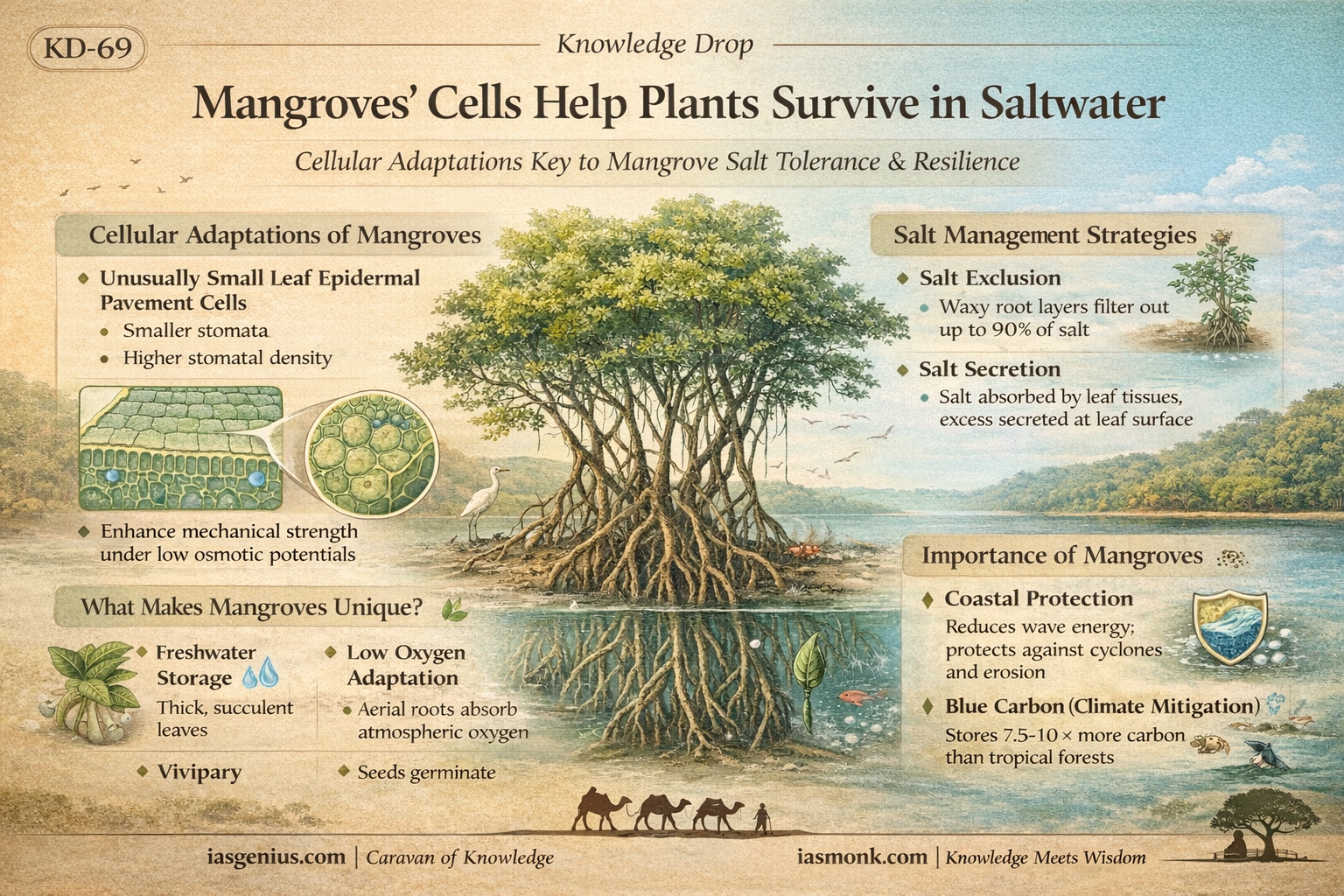
- Unusually small leaf epidermal pavement cells
- Thicker cell walls
➡️ These features provide mechanical strength, enabling mangroves to tolerate low osmotic potentials caused by saline environments.
Salt Management Strategies 🧂
Mangroves adopt two major strategies:
1. Salt Exclusion 🚫
- Some mangroves possess waxy root layers
- These roots filter out salt before water enters the plant
2. Salt Secretion 💦
- Other species allow salt to enter
- Excess salt is secreted through specialised leaf tissues
What are Mangroves? 🌿
Mangroves are small trees or shrubs that grow along coastlines, rooting themselves in salty, waterlogged sediments.
They are flowering plants belonging to families such as:
- Rhizophoraceae
- Acanthaceae
- Lythraceae
- Combretaceae
- Arecaceae
Key Features of Mangroves ⚙️
Saline Tolerance 🌊
- Can survive in high salt and low oxygen conditions
- Roots can filter out up to 90% of salt from saline or brackish water
Low Oxygen Adaptation 🌬️
- Underground tissues require oxygen for respiration
- Mangroves absorb oxygen directly from the atmosphere using specialised root systems
Freshwater Storage 💧
- Like desert plants, mangroves store freshwater in thick, succulent leaves
Vivipary 🌱
- Mangroves are viviparous
- Seeds germinate while still attached to the parent tree
- The germinated seed develops into a propagule
Major Mangrove Regions in India 🗺️
- Sundarbans (West Bengal)
- Largest mangrove region in the world
- UNESCO World Heritage Site
- Bhitarkanika (Odisha)
- Second-largest mangrove forest in India
- Also a Ramsar Site
- Formed by the deltas of Brahmani River and Baitarani River
Importance of Mangroves 🌍
Natural Coastal Defence 🌊
- A mature mangrove belt (50 years old, 100–1,000 m wide) can reduce wave energy by 7–55%
- Significantly lowers damage from cyclones, storm surges and coastal flooding
Biodiversity Hotspots 🐟
- India’s mangroves support 4,011 species:
- 920 plant species
- 3,091 animal species
Climate Change Mitigation (Blue Carbon) 🌎
- Mangroves store 7.5–10 times more carbon per acre than tropical forests
Livelihood & Economic Security 🎣
- Support millions of livelihoods globally through:
- Fisheries
- Aquaculture
- Eco-tourism
- Mangrove restoration activities
Cost-Effective Nature-Based Solutions 🌱
- Combine:
- Disaster risk reduction
- Biodiversity conservation
- Carbon sequestration
- Offer low-cost, high-impact alternatives to engineered coastal defences
IAS Monk Whisper 🌀
In the quiet resilience of mangroves lies a blueprint for future agriculture — strength built at the cellular level.
KD-69 Prelims Booster Notes:
| Mangroves’ Cells Help Plants Survive in Saltwater
GS-3 | Environment & Ecology
Why in News?
A study in Current Biology explains cell-level adaptations that allow mangroves to tolerate extreme salinity, offering lessons for salt-tolerant crop development.
Core Scientific Insight (Very Important) 🔬
- Mangrove salt tolerance is NOT stomata-based
- It is driven by cellular architecture
Key Cellular Adaptations
- Unusually small leaf epidermal pavement cells
- Thicker cell walls
➡️ Provide mechanical strength under low osmotic potential conditions
Salt Management Strategies 🧂
1. Salt Exclusion
- Waxy root layers
- Prevent salt from entering plant tissues
- Roots filter out up to 90% salt
2. Salt Secretion
- Salt absorbed → secreted through specialised leaf tissues
- Seen in some mangrove species
Mangroves: Key Facts 🌿
- Coastal trees/shrubs growing in saline, waterlogged sediments
- Flowering plants
- Major families:
- Rhizophoraceae
- Acanthaceae
- Lythraceae
- Combretaceae
- Arecaceae
Physiological Adaptations ⚙️
Salinity Tolerance
- Survive high salt + low oxygen
- Roots filter saline water
Low Oxygen Adaptation
- Underground tissues need oxygen
- Roots absorb atmospheric oxygen (aerial roots)
Freshwater Storage
- Thick, succulent leaves
- Similar to desert plants
Vivipary
- Seeds germinate on parent tree
- Develop into propagules
Major Mangrove Regions (Prelims Gold) 🗺️
- Sundarbans (West Bengal)
- Largest mangrove forest in the world
- UNESCO World Heritage Site
- Bhitarkanika (Odisha)
- Second largest in India
- Ramsar Site
- Formed by Brahmani + Baitarani rivers
Ecological & Economic Importance 🌍
Coastal Defence
- 50-year mangrove belt (100–1000 m wide)
- Reduces wave energy by 7–55%
Biodiversity
- India’s mangroves support 4,011 species
- 920 plants
- 3,091 animals
Climate Change (Blue Carbon)
- Store 7.5–10× more carbon per acre than tropical forests
Livelihood Support
- Fisheries
- Aquaculture
- Eco-tourism
- Coastal community income security
Prelims Traps to Avoid ⚠️
- ❌ Mangroves depend on stomatal density
- ❌ Mangroves cannot survive low oxygen
- ❌ All mangroves follow only salt exclusion
UPSC One-Liners ✍️
- Mangrove salt tolerance is cell-wall driven, not stomata driven
- Vivipary is a reproductive adaptation to tidal environments
- Mangroves are high-impact, low-cost nature-based solutions
IAS Monk Whisper 🌀
When roots learn to reject salt and cells learn to endure stress, survival becomes science.
KD-69 Mains Answer (250 words):
Mangroves’ Cellular Adaptations and Their Significance for Climate Resilience
Mangroves are unique coastal ecosystems that survive under extreme environmental stress, particularly high salinity and low oxygen conditions. A recent study published in Current Biology highlights that mangroves’ salt tolerance is driven not by stomatal modifications, but by specialised cellular adaptations, offering important lessons for climate resilience and agriculture.
Unlike conventional plants, mangroves do not rely on increased stomatal density or reduced stomatal size to sustain photosynthesis. Instead, they exhibit unusually small leaf epidermal pavement cells combined with thicker cell walls. These structural traits provide enhanced mechanical strength, enabling mangrove tissues to tolerate low osmotic potentials created by saline environments. Such adaptations prevent cellular collapse under salt-induced water stress.
Mangroves also employ distinct salt management strategies. Some species practise salt exclusion, using waxy root layers that filter out up to 90% of salt before water enters the plant system. Others adopt salt secretion, absorbing salt but excreting excess amounts through specialised leaf tissues. In addition, mangroves store freshwater in thick succulent leaves, absorb atmospheric oxygen through aerial roots, and reproduce via vivipary, ensuring seedling survival in tidal zones.
These adaptations make mangroves powerful nature-based solutions. They protect coastlines by reducing wave energy, support rich biodiversity, and act as significant blue carbon sinks, storing several times more carbon than tropical forests. Importantly, insights from mangrove cellular biology can guide the development of salt-tolerant crops, crucial for sustaining agriculture amid rising soil salinisation due to climate change and sea-level rise.
Thus, mangroves represent not only ecological guardians of coasts but also living laboratories for future climate-resilient food systems.
Target IAS-2026+: Highly Expected Prelims MCQs :
📌 Prelims Practice MCQs
Topic:
MCQ 1 | TYPE 1 — How Many Statements Are Correct?
Consider the following statements regarding mangrove adaptations to saline environments:
1)Mangroves rely primarily on higher stomatal density to maintain photosynthesis under salt stress.
2)Mangroves possess unusually small leaf epidermal pavement cells.
3)Thicker cell walls in mangroves provide mechanical strength under low osmotic potential.
4)Cellular adaptations play a greater role than stomatal modifications in salt tolerance.
How many of the above statements are correct?
(a)Only one
(b)Only two
(c)Only three
(d)All four
🌀 Didn’t get it? Click here (▸) for the Correct Answer & Explanation.
🟩 Correct Answer: (c)Only three
🧠 Explanation:
1)❌False – Mangroves do not rely on stomatal modifications.
2)✅True – Small pavement cells are a key adaptation.
3)✅True – Thicker cell walls improve mechanical strength.
4)✅True – Cellular traits are central to salt tolerance.
MCQ 2 | TYPE 2 — Two-Statement Type
Consider the following statements:
Statement I:Mangroves adopt salt exclusion by filtering salt at the root level before water uptake.
Statement II:All mangrove species exclusively follow salt exclusion as their only salt management strategy.
Which of the statements given above is/are correct?
(a)Only Statement I
(b)Only Statement II
(c)Both Statement I and II
(d)Neither Statement I nor II
🌀 Didn’t get it? Click here (▸) for the Correct Answer & Explanation.
🟩 Correct Answer: (a)Only Statement I
🧠 Explanation:
Statement I:✅True – Waxy root layers filter salt.
Statement II:❌False – Some species use salt secretion instead.
MCQ 3 | TYPE 3 — Code-Based Statement Selection
With reference to mangroves, consider the following statements:
1)Mangroves store freshwater in thick succulent leaves.
2)Mangrove roots can absorb oxygen directly from the atmosphere.
3)Mangroves cannot survive in low oxygen conditions.
Which of the statements given above is/are correct?
(a)1 and 2 only
(b)2 and 3 only
(c)1 only
(d)1,2 and 3
🌀 Didn’t get it? Click here (▸) for the Correct Answer & Explanation.
🟩 Correct Answer: (a)1 and 2 only
🧠 Explanation:
1)✅True – Freshwater storage is a key adaptation.
2)✅True – Aerial roots absorb atmospheric oxygen.
3)❌False – Mangroves are adapted to low oxygen conditions.
MCQ 4 | TYPE 4 — Direct Factual Question
Which one of the following correctly describes vivipary in mangroves?
(a)Seeds remain dormant until favourable salinity conditions arise
(b)Seeds germinate after dispersal in freshwater zones
(c)Seeds germinate while still attached to the parent plant
(d)Seeds develop underground before detachment
🌀 Didn’t get it? Click here (▸) for the Correct Answer & Explanation.
🟩 Correct Answer: (c)Seeds germinate while still attached to the parent plant
🧠 Explanation:
Mangroves exhibit vivipary, where seeds germinate on the parent plant and develop into propagules before dispersal.
MCQ 5 | TYPE 5 — UPSC 2025 Linkage Reasoning Format (I, II, III)
Why are mangroves considered highly effective nature-based solutions for climate resilience?
(a)They replace engineered coastal infrastructure
(b)They combine coastal protection, biodiversity support and high carbon sequestration
(c)They function only as fisheries breeding grounds
(d)They reduce rainfall variability in coastal regions
🌀 Didn’t get it? Click here (▸) for the Correct Answer & Explanation.
🟩 Correct Answer:(b)They combine coastal protection, biodiversity support and high carbon sequestration
🧠 Explanation:
Mangroves reduce wave energy, support rich biodiversity and store 7.5–10 times more carbon than tropical forests, making them cost-effective climate solutions.